Ying Jiang (2022). A Care-oriented Design Process Model for Sustainable Design Education. In: Training, Education, and Learning Sciences. AHFE Open Access, vol. 59, pp. 353–359. https://doi.org/10.54941/ahfe1002421
In the unsustainable development of commodity production and resource consumption, designers are both part of the root of the problem and the agents of its solution. Education institutions and teaching plans bear a profound moral responsibility to improve designers’ ability to create a sustainable future. This chapter goes deep into the design education curriculum to explore a design process model that can be specifically applied to the field of care design.Education for sustainable development has become the main concern of environmental education since the 1990s (United Nations 1992). David W. Orr calls for an education system shift: ‘This crisis cannot be solved by the same kind of education that helped create the problems. Against the test of sustainability, our ideas, theories, sciences, humanities, social sciences, pedagogy, and educational institutions have not measured up’ (1992, p. 83). The UN Decade of Education for Sustainable Development (2005–2014) highlighted the key role of Education for Sustainable Development (ESD), aiming at ‘integrating the principles and practices of sustainable development into all aspects of education and learning, to encourage changes in knowledge, values and attitudes with the vision of enabling a more sustainable and just society for all’ (UNESCO, 2005, p.9). It fundamentally mobilized education to create relevant teaching rationales, teaching methods and learning content.The evolution of design for sustainability has been advanced ESD in higher education institutions and has created a wide array of teaching methods and tools, such as Service Design (Miso, 2020), Design Futuring (Fry, 2009), Transition Design (Jones, 2014), Systemic Design (Irwin, 2015), Design for Behaviour Change (Bhamra & Dewberry, 2007) and Ecology of Care (Coxon, 2017). The continuous improvement of sustainable design education helps designers to conceive a number of different conceptual solutions as a whole, and to take into consideration the wide array of impacts that their decisions have on people, the environment and the economy. However, the problem in curriculum education is that its focus is more on the designer’s sustainable achievements, rather than the designer's sustainable awareness and behavior changes. Strengthen the correlation between designers’sustainability awareness and design results would be appreciated.East China University of Science and Technology (ECUST) is a comprehensive university with a strong background in science and engineering. The fundamental design course teaching at the School of Art Design and Media has provided me with excellent research opportunities. In this context, I could integrate the care-oriented sustainable design course into the curriculum system and conduct research directly. I noticed that sustainable design is a special and independent concept rarely mentioned in existing design courses. As expected from traditional courses, design courses focus on creating visually compelling and fully functional works. Although some ‘green’ design projects are sometimes carried out, in most cases green design courseworks focus on finding solutions in terms of principles, technology, materials, etc., and finally propose a small product design concept without considering the whole systemof thought at the basis of design. Also, most part of the courses are devoted to the introduction of the double diamond model that guides the design process, even though it does not make full use of the scientific nature of the design process itself. Sometimes, design research is separated from design results. I am interested in reshaping the way designers think about sustainability in the field of traditional design education, by considering all the different impacts of design decisions on people, the environment and the economy.By understanding the nature of care, I intend to develop a design process model and teaching tools from the perspective of care, which can be extrapolated as a care-oriented, sustainable design education course. The design process can be seen as a learning process which provides deeper information about sustainability challenges and opportunities by influencing students’ design thinking and design activity. On the one hand, the design process model could build a clear teaching idea for teachers. On the other hand, it could raise students’ awareness of caring, and transform this consciousness into specific design schemes, which can provide insight into problems and propose solutions from larger and more complex perspectives, thereby generating new sustainable design ideas. This newly developed design process emphasizes the role of the immediate-environment in promoting clients and products care.
Education for sustainable development (ESD) has become the main concern of environmental education since the 1990s (United Nations 1992). David W. Orr calls for an education system shift: ‘Against the test of sustainability, our ideas, theories, sciences, humanities, social sciences, pedagogy, and edu- cational institutions have not measured up’ (1992, p. 83). The UN Decade of ESD (2005–2014) highlighted ‘integrating the principles and practices of sustainable development into all aspects of education and learning, to encou- rage changes in knowledge, values and attitudes with the vision of enabling a more sustainable and just society for all’ (UNESCO, 2005, p. 9).
The evolution of Design for Sustainability has mobilized design education to create a wide array of teaching methods and tools, such as Service Design (Miso, 2020), Design Futuring (Fry, 2009), Transition Design (Jones, 2014), Systemic Design (Irwin, 2015), Design for Behaviour Change (Bhamra & Dewberry, 2007) and Ecology of Care (Coxon, 2017). The continuous impro- vement of sustainable design education helps designers to conceive a number of different conceptual solutions as a whole. However, the focus of curricu- lum education is more on creating sustainable products, rather than raising students’ sustainable awareness and behavior. Therefore, strengthening the correlation amongst sustainable thinking, doing and being is imperative. By understanding the concept of care, I intend to build a care-oriented design process model and teaching tools, which can instruct students to improve sustainable design capabilities in design projects. The concept of care implies
that designers, things, and clients all play positive roles in care for the envi- ronment. The designer cares for the client and products. Things are used to care for the environment. Clients can become care-givers to affect their environment to make it sustainable (Jiang et al., 2020).
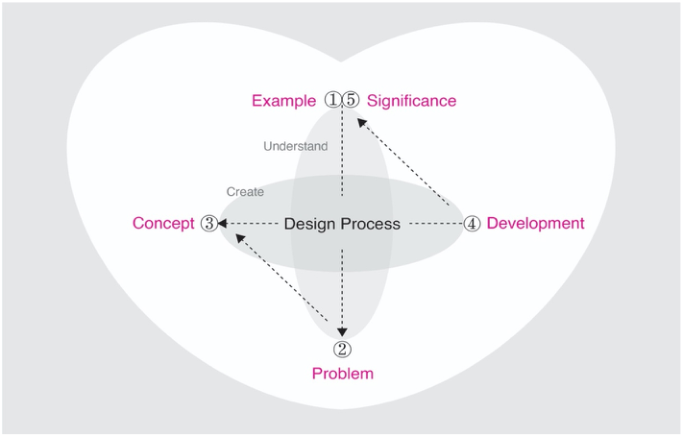
THE DESIGN PROCESS MODEL Based on Dewey’s inquiry theory, a design process model with five phases was proposed (see Figure 1). The design process moves from observing care examples in daily life (why) towards analyzing current problems (whether), proposing future design concepts (what), along with the design develo- pment (how) before moving to the significance (why). This is a reciprocating dynamic design process. The five stages are as follows:
x Example: Students can recall and observe typical care examples in their daily life. Learning ideal care examples can be taken as a starting point of designing care. y Problem: A stackeholder network has to be constructed. Students can reveal conflicting relationships between clients and their environment (other people and things). z Concept: Students need to put forward the design concept to repair the conflictual relationship and rebuild a care-relationship between clients and the environment. { Development: A concrete and detailed product design should be delivered. | Significance: This phase evaluates final design results and propo- ses suggestions for further improvement. By comparing with the care examples learned in the first stage, students can generate new understan- dings on the concept of care.
A Care-Oriented Design Process Model for Sustainable Design Education 355
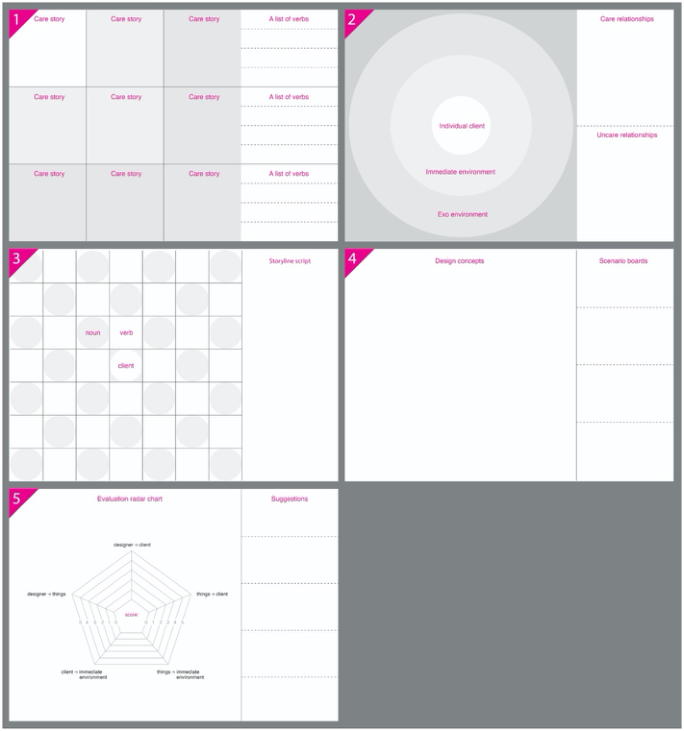
Figure 2: Storytelling canvas.
In order to operate the care-oriented design process model in design proje- cts, a set of canvas as a supporting tool was developed. Storytelling is applied as the method of designing canvas. Good stories can transmit sustainable knowledge, attitude, and values, which could provide practical solutions. Since the mid-1990s, sustainability-themed storytelling has been used in a planetarium in Germany to introduce the potential of scientific mitigation strategies in the field of climate change (Storksdieck, 2006). Thomas Berry claims: ‘The deepest crises experienced by any society are those moments of change when the story becomes inadequate for meeting the survival demands of a present situation’ (2015, p. xi). The storytelling canvas unfolds five layers corresponding to the five-phase design process (see Figure 2): example canvas, problem canvas, concept canvas, development canvas, and evaluation canvas. Each canvas includes two working areas.
(1) Example canvas: to learn about care examples by collecting stories related to care. The two working areas include story collection (left) and verb extraction (right).
356 Jiang
(2) Problem canvas: to analyze problems by identifying stories of care- lessness. The two working areas include system analysis (left) and relationship extraction (right). (3) Concept canvas: to propose design concepts by creating new care sto- ries. The two work areas include relationship reconstruction (left) and story scripting (right). (4) Development canvas: to deliver product prototypes. The two working areas include prototype conceptualization (left) and scenario boards (right). (5) Evaluation canvas: to optimize the design results. The two working areas include radar evaluations (left) and suggestions (right).
AN EXPERIMENTAL COURSE An experiemtal course was organized to promote students’ awareness and behaviour of sustainability by employing the design process model and canvas. The theme of the design project is ‘Care on Campus’, allowing stu- dents to experience care in their familiar environment. They have to consider how to encourage clients to care for their immediate-environment and to cre- ate green products. On the campus, other students can be viewed as ‘clients’; the whole campus can be seen as the students’ immediate-environment.
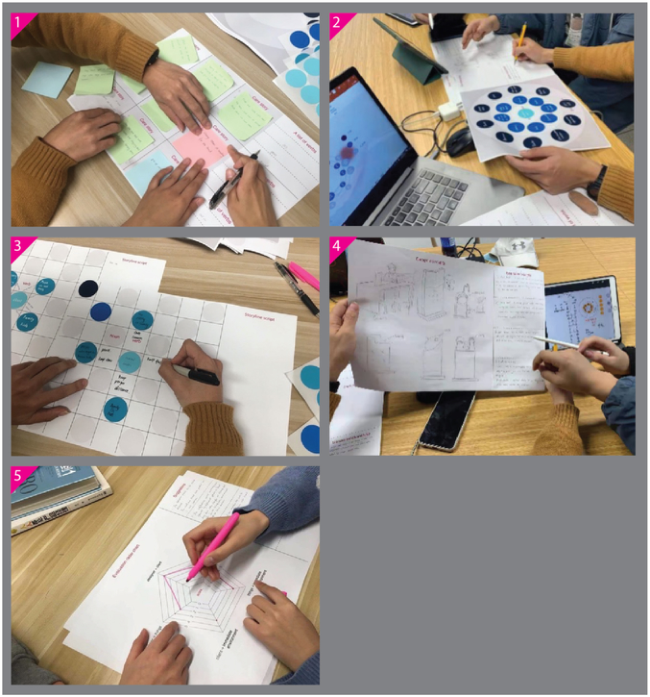
The first stage encourages students to recall care stories they have perso- nally experienced (see Figure 3). Discovering the problem is the second stage of the design process. Students were guided to visualize all stakeholders and define the conflicting relationships among them. The third stage is to propose design concepts. Students shift from understanding the concept of care into creating care. Students need to conceive a care story to promote clients caring for their immediate-environment. The development of product design is the fourth stage. The function and form of a product are visualized according to the care story. The fifth stage is significance. This part is to evaluate the design results. As a result of the project, students can understand the meaning of care more deeply.
RESULTS
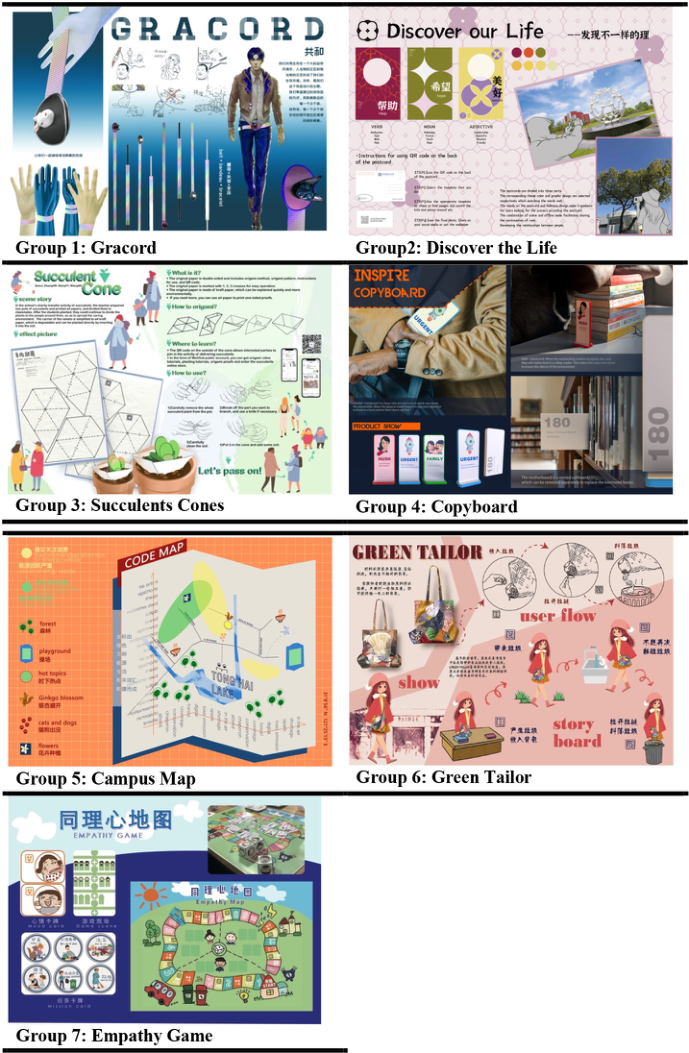
Seven design projects were completed in the course (see Figure 4). ‘Gracord’ is a set of fashionable accessories made from recycled waste materials. By wearing these accessories, students may remind themselves to self-regulate in environmental behavior. ‘Postcards’ encourage students to discover and care for all the beautiful things on campus. When postcards are given to other friends and relatives outside of school, other people are invited to appreciate the people and things in their immediate-environment. ‘Succulents Cones’ is a cylindrical device that can be used to divide, branch and present succu- lents to others as a gift. This idea encourages more people to care for plants and connects people to each other by sharing succulents. ‘Copyboard’ can be used to encourage students to care for other readers’ special needs in library, so as to provide help and convenience. ‘Campus Map’ collected and mar- ked important activities in campus life which will assist students to find new
A Care-Oriented Design Process Model for Sustainable Design Education 357
Figure 3: The whole process of Group no. 4 using the storytelling canvas.
friends, resulting in having opportunities to help each other. Green tailor’ is a bag that can be used to recycle and store garbage that is not immedia- tely thrown away. This concept calls on everyone to take away the rubbish around them and develop the habit of maintaining good hygiene. ‘Empathy Game’ is a game that encourages students to empathize with other people’s needs. Students can play it with friends or families.
In order to obtain a holistic view of using the design process, the researcher designed a set of questionnaires to collect students’ experiences and feedba- cks. The questionnaire was sent to 23 students, all of which were effectively received. Questions mainly investigated whether the care-oriented design pro- cess can help students learn sustainable design and what are the advantages and disadvantages of each stage. From a comprehensive analysis, the ave- rage score of 10 scale questions is 4.6, indicating that the design process can effectively guide students to understand sustainable design and to propose creative design ideas.
DISCUSSION
Based on the analysis of students’ conceptual design, it is clear that not only the topic of ‘clients care about immediate-environment’ can be realized,
358 Jiang
Figure 4: Students’ design proposals.
but also caring about the exo-environment can be achieved. For example, the Postcard design encourages customers to pay attention to the beautiful moments and things on campus, thereby inspiring them to love and preserve
A Care-Oriented Design Process Model for Sustainable Design Education 359
the campus environment. When postcards are given to other people, care can be spread to more stakeholders beyond the scope of the immediate- environment. In the design of succulents, clients will distribute plants to other friends in the exo-environment.
This discovery shows that the immediate-environment does not have a clo- sed structure, but an open one. Care can be spread by the act of giving across the borderline from one environment to another. When the care-receiver tran- sforms into a care-giver in the exo-environment, care is brought into this environment to continue its development. In addition, products could unite stakeholders from various backgrounds into a care-network.
CONCLUSION
The care-oriented design process can help students develop their creativity and find great opportunities to influence complex systems. Care can be used as the concept at the core of sustainable design courses to educate young designers. When the notion of care is interiorized by the students, design activities that embody care will naturally occur.
FUNDING This research received funding through the Tongji-Hong Kong PolyU PhD Scholarship scheme. The publication is supported by General Project Funding of Humanities and Social Sciences Research of the Ministry of Education, Ref No. 21YJCZH049.
REFERENCES
Berry, T. (2015). The dream of the earth. Counterpoint. Bhamra, T. Dewberry, E. (2007). Re-visioning design priorities through sustainability education. DS 42: Proceedings of ICED 2007, the 16th International Conference on Engineering Design, Paris. Coxon, I. R. (2017). Care as human being: Introducing a new field of study and
practice. Fusion Journal, 12. Fry, T. (2009). Design futuring, sustainability, ethics and new practice. University of New South Wales Press. Irwin, T. Kossoff, G. Tonkinwise, C. (2015). Transition design provocation. Design
Philosophy Papers, 13(1). Jiang, Y., Jachna, T. J., & Dong, H. (2020). Game for Complete Care: A Means of Connecting ‘User-Centered Design’with Sustainability. Sustainability, 12(24), 10555. Jones, P. H. (2014). Systemic design principles for complex social systems. In G.
Metcalf (Ed.), Social systems and design. Springer. pp. 91-128. Kim, Miso. (2020). Service is Not Perishable: Nurturing Ongoing Participation with Conceptual Models. Design Issues, 36 (4). Orr, Devid. (1992). Ecological literacy: Education and the transition to a postmodern
world. Albany, NY: State University of New York Press. Storksdieck, M. (2006). Field trips in environmental education. Berlin: BWV Berliner Wissenschafts-Verlag. UNESCO. (2005). United Nations decade of education for sustainable development
(2005-2014). UNESCO.
LISTED IN THE AHFE DIGITAL BOOKSTORE CATALOGUE
Explore the complete digital volume
Training, Education, and Learning Sciences
Read this individual research paper free through the original publisher, or explore the full digital proceedings book.
ISBN 978-1-958651-35-3
Explore this ISBN in the AHFE Bookstore ↗Listed in the July 2026 bookstore catalogue; search by ISBN to confirm current availability · Digital book purchase optional