Juan Hidalgo, Patricio Hidalgo, Alfredo Ordoñez, Boris Orellana-Alvear (2022). Building elements from totora stems joined with mechanical systems. In: Human Factors in Architecture, Sustainable Urban Planning and Infrastructure. AHFE Open Access, vol. 58, pp. 29–35. https://doi.org/10.54941/ahfe1002330
For centuries, fast-growing species such as reeds and herbs have been used by ancient cultures to build a wide range of objects from handicrafts to huts and rafts. Several communities worldwide still use these kinds of plants as part of their traditional materials and building techniques. One of these species is totora (Schoenoplectus californicus) which grows in lakes and ponds in the Americas from California to Chile and some Pacific Islands. The most important examples of the use of this plant in the world are the group of floating islands of the Uros in Lake Titicaca and indigenous communities of the Andes, where local peoples have been using totora for more than 500 years applying mechanical joining techniques such as weaving and lashing to build their houses, boats, and utensils. This study focuses on developing new strategies supported by current technological possibilities for joining totora stems using mechanical means to produce building elements and study how the different parameters influence the mechanical properties of the parts made with these techniques.
The use of well-managed forest-based products such as wood in constru- ction has been beneficial for the environment (Hidalgo-Cordero and García- Navarro, 2018; Bukauskas et al., 2019). However, forest resources should be carefully managed to guarantee a sustainable cycle between harvest, reno- vation, and use stages. With this consideration, the study of nonwood forest products such as reeds and herbs for their potential as materials applica- ble in the construction sector can become an exciting strategy for alternative materials that could cover part of the demand for forest-based products in construction (Youngquist et al., 1994).
Totora (Schoenoplectus californicus (C.A. Mey.) Sojak) is a macrophyte that grows in lakes and marshlands. Its geographical distribution goes from California to Chile, and some of the Pacific Islands (Mardorf, 1985; de Lange et al., 2008; Hidalgo-Cordero, García-Ortuño and García-Navarro, 2020). It can grow from the sea level in coastal regions up to 4500 m.a.s.l. This wide distribution indicates the adaptation capabilities of the plant and the potential for being a material source available in different climate zones. Totora has been used by other peoples around the world, such as the Ohlone in California, the native tribes in Hawaii, the indigenous communities of
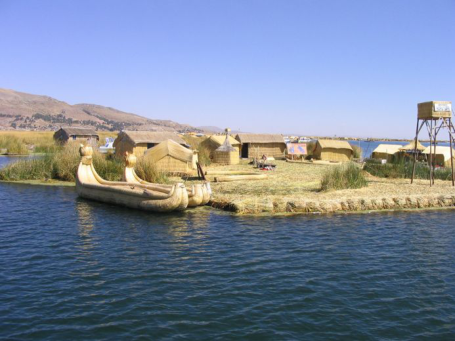
Figure 1: Totora use at the Uros islands in Lake Titicaca (Hidalgo et al., 2018).
the Andes in Bolivia, Ecuador, and Peru, where people have used this plant for building their huts, rafts, and handicrafts (Hidalgo-Cordero and García- Navarro, 2018). The most significant example of the use of this plant is in the floating islands of the Uros in Peru. The Uros people use this plant for buil- ding everything from the artificial floating islands where they live to boats, huts, handicrafts, and other utensils (Figure 1). This long tradition of using this plant indicates the versatility and other desirable properties for constru- ction material, such as the short renovation time, lightness, workability, and durability (Rondón, Banack, and Diaz-Huamanchumo, 2003).
Traditional construction methods use mechanical principles for joining the totora stems and holding them together to form mats of different thicknesses, tightly-lashed totora rolls for making beam-like elements, rolls tied together to build rafts and boats (Ninaquispe, Weeks and Huelman, 2012). Recent studies and experiments have demonstrated the significant gain in mechanical strength that can be achieved by joining the stems using only mechanical methods, thus avoiding using glues and other similar compounds.
This study will analyze different elements made with totora stems joined using mechanical joining systems and other construction parameters.
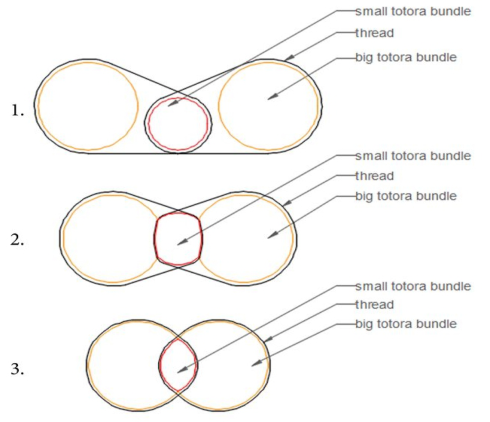
STATE OF THE ART Totora’s traditional techniques are based on mechanical joining systems such as weaving, lashing, sewing, or tying. These conventional techniques are limi- ted by the strength a human can apply to the rope or the fiber used in the process. However, the traditional boat construction techniques of joining tightly lashed totora bundles together (Figure 2) have been demonstrated to achieve considerable resistance. That is the case of the different experiments that started in the 1960s with the Ra expeditions of Thor Heyerdahl to con- firm that boats made with ancient techniques and natural materials might have made it possible for different cultures of America and Africa or Europe to have had contacts between them by sailing through the sea in these kinds of
Building Elements From Totora Stems Joined With Mechanical Systems 31
Figure 2: Schematic making process of totora boats (Hidalgo et al., 2018).
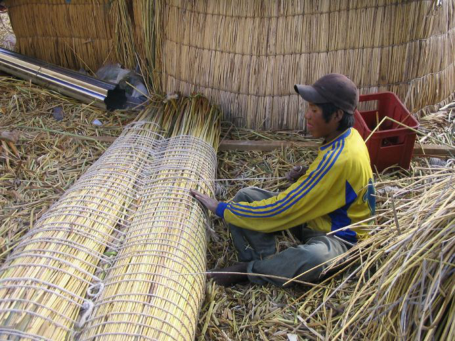
vessels (Heyerdahl, 1971). Although the first Ra expeditions were conducted with vessels built with Egyptian papyrus, which is also a plant from the cype- reaceae family as totora, the following experimental excursions Kitín Muñoz (Uru expedition, 1988), a German Crew (Chimok expedition, 1988), Kitín Muñoz (Mata Rangi 1, 2 and 3 expeditions, 1996, 1999 and 2001, respe- ctively), Paul Harmon and Alexei Vranich (QalaYampu expedition, 2009), Dominique Goerlitz (Abora 2 and 3 expeditions, 2002 and 2012 respecti- vely), Phil Buck (Viracocha 1, 2 and 3 expeditions, 2000, 2003 and 2019, respectively) (Allen, 2010) have used totora for building their boats. These expeditions, apart from the theories they aim to support, have successfully shown the resistance of the material built using only the traditional method of making totora rolls lashed tightly together. Hence, they form a consistent body (Figure 3).
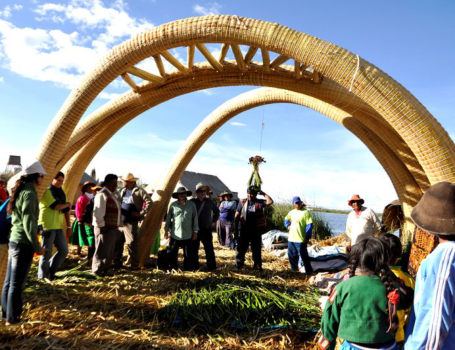
Another experimental project is the “Totora Project” done by the PUCP- Peru, the SAdBK-Germany, and the Uros community in the year 2010 (PUCP (Pontificia Universidad Catolica del Perú) and SAdBK (Stuttgart State Aca- demy of Art and Design), 2010). This project used mainly totora rolls tightly lashed that were then used to make self-standing structures that were desi- gned as possibilities for touristic attractions and other infrastructure that the Uros could use in their islands (Figure 4). Unfortunately, this project was not given continuity, and these structures were dismantled after approximately one year.
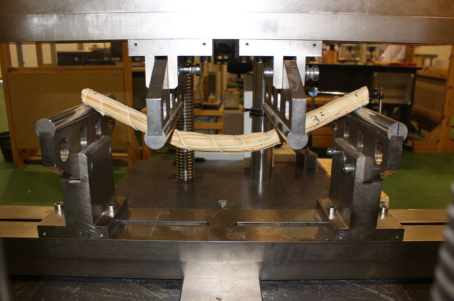
Studies conducted by Hidalgo et al. focused on studying the variables that influence the mechanical properties of totora rolls lashed using different rope tensions, diameter, and sample length (Hidalgo-Castro, Hidalgo-Cordero and García-Navarro, 2019) (Figure 5). This study showed that the rope tension had a more decisive influence on the rolls with smaller diameters. However, with the tensions studied, the flexural strength of the rolls was affected by the
Figure 3: Raft making process.Figure 4: Totora project, Community house structure. (PUCP&SAdBK, 2010).
higher rope tension, which may indicate a detrimental effect of the higher ten- sions on the single fiber structures, which affected the whole element strength. Although these results are an essential information source, the authors men- tion that further studies with a broader range of tensions and parameters are needed to confirm these trends.
METHODOLOGICAL APPROACH This research project is focused on studying how different mechanical joining systems and specific parameters could influence the mechanical properties of elements made with totora stems, depending only on the mechanical forces and interlocking between the stems and other factors.
Cut and dry stems are sourced from the communities that used to weave traditional mats in the zone of Paccha near Cuenca-Ecuador and from the San Pablo Lake communities in Imbabura-Ecuador.
Building Elements From Totora Stems Joined With Mechanical Systems 33
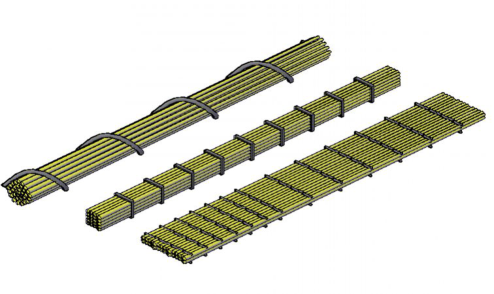
Figure 5: Flexural strength test of a lashed totora roll.Figure 6: Schematic mechanical joining techniques.
Joining techniques and sample preparation will include totora rolls lashed with continuous rope, square section metallic frames, and mechanical sew- ing for mat-forming (Figure 6). Parameters to study will consist of the agglomeration tension, the support separation, joiner thickness, and sample dimensions. All these parameters will be combined, and three samples will be tested for each combination.
Mechanical strength tests will be conducted on the samples, and results will be analyzed using ANNOVA analyses to determine the influence of each variable. Regression tests will determine the function that may predict the mechanical behavior of totora elements joined with mechanical systems.
Obtained results will be applied in a prototype that will be built in con- junction with the local community of San Rafael de la Laguna of the San Pablo Lake in Imbabura – Ecuador. Where the material grows abundantly, the local artisans know how to work with the material, and the community is well organized to execute a task using the Minga collaborative system.
This pilot project will test the simplicity of the developed systems and obtain a cost approximation and the durability of the structure.
CONCLUSION
Non-wood-forest-products such as totora can be used in applications that may cover part of the demand for construction materials with environmental and social benefits.
Mechanical systems of fibers and stems have been the main joining princi- ple for traditional construction techniques. The study of new methodologies aided by current technologies can improve the performance of construction elements made with these techniques avoiding the use of glues or similar compounds that can carry some environmental and health concerns. The involvement of the local communities of San Rafael de la Laguna of San Pablo Lake in Ecuador in this research will make it possible that the solutions deve- loped within the academic circle have a tangible impact on the society and a piece of very active information and experiences exchange.
REFERENCES
Allen, J. (2010) History of Reed Ships. Available at: http://www.atlantisbolivia.org/ areedboathistory.htm (Accessed: 10 December 2017). Bukauskas, A. et al. (2019) ‘Whole timber construction: A state of the art
review’, Construction and Building Materials. Elsevier Ltd, 213, pp. 748–769. doi: 10.1016/j.conbuildmat.2019.03.043. de Lange, P. J. et al. (2008) ‘Schoenoplectus californicus (Cyperaceae) in New Zealand’, New Zealand Journal of Botany, 36(3), pp. 319–327. doi: 10.1080/0028825X.1998.9512573. Heyerdahl, T. (1971) The Ra expeditions. Gerge Alle. Edited by P. Crampton.
London, Great Britain: George Allen & Unwin Ltd. Hidalgo-Castro, P., Hidalgo-Cordero, J. and García-Navarro, J. (2019) ‘Estudio del comportamiento físico-mecánico de rollos de totora amarrados: influencia de la tensión de amarre, diámetro y longitud’, DAYA. Diseño, Arte y Arquitectura., 1(6), pp. 53–84. doi: 10.33324/daya.vi6.219. Hidalgo-Cordero, J. F. and García-Navarro, J. (2018) ‘Totora (Schoeno- plectus californicus (C.A. Mey.) Soják) and its potential as a constru- ction material’, Industrial Crops and Products. Elsevier, 112, pp. 467–480. doi: 10.1016/j.indcrop.2017.12.029. Hidalgo-Cordero, J. F., García-Ortuño, T. and García-Navarro, J. (2020) ‘Compari-
son of binderless boards produced with different tissues of totora (Schoenoplectus californicus (C.A. Mey) Soják) stems’, Journal of Building Engineering, 27(June 2019), p. 100961. doi: 10.1016/j.jobe.2019.100961. Mardorf, M. C. (1985) ‘Artesanía y ecología de la totora (Scirpus sp.) en la provincia de Imbabura, Ecuador’, Sarance. Revista del Instituto Otavaleño de Antropología, 10(10), pp. 11–78. Available at: http://hdl.handle.net/10469/6697. Ninaquispe, L., Weeks, S. and Huelman, P. (2012) ‘Totora: A sustainable insu-
lation material for the andean parts of Peru’, in PLEA2012 - 28th Confere- nce, Opportunities, Limits & Needs Towards an environmentally responsible architecture. Lima. Available at: http://plea-arch.org/ARCHIVE/2012/files/T02- 20120130-0067.pdf. PUCP (Pontificia Universidad Catolica del Perú) and SAdBK (Stuttgart State Academy of Art and Design) (2010) Totora project | Peru: Exploring three current realities. Available at: https://peruexploring.wordpress.com/totora -poject-_panels/ (Accessed: 4 October 2017).
Building Elements From Totora Stems Joined With Mechanical Systems 35
Rondón, X. J., Banack, S. A. and Diaz-Huamanchumo, W. (2003) ‘Ethnobotanical investigation of caballitos (Schoenoplectus californicus: Cyperaceae) in Huanchaco, Peru’, Economic Botany, 57(1), pp. 35–47. doi: 10.1663/0013- 0001(2003)057[0035:EIOCSC]2.0.CO;2. Youngquist, J. A. et al. (1994) Literature review on use of nonwood plant fibers for
building materials and panels, General Technical Report FPL-GTR-80. Illinois, USA. doi: 10.2737/FPL-GTR-80.
LISTED IN THE AHFE DIGITAL BOOKSTORE CATALOGUE
Explore the complete digital volume
Human Factors in Architecture, Sustainable Urban Planning and Infrastructure
Read this individual research paper free through the original publisher, or explore the full digital proceedings book.
ISBN 978-1-958651-34-6
Explore this ISBN in the AHFE Bookstore ↗Listed in the July 2026 bookstore catalogue; search by ISBN to confirm current availability · Digital book purchase optional