Markko Liutkevicius, Sadok Ben Yahia (2022). The Use of Artificial Intelligence in Job Seeking and Competence Development. In: Human Factors, Business Management and Society. AHFE Open Access, vol. 56, pp. 128–136. https://doi.org/10.54941/ahfe1002260
Artificial Intelligence (AI) in the public and private sectors create new opportunities worldwide. One of such domains where the elements of AI play a critical role are recommendation systems related to finding a new job and offering training suggestions. Based on current literature, only a few attempts are made to implement intelligent recommendation systems in public sector environments such as employment agencies. In this regard, the existing state-of-the-art models should be explored for creating AI-enabled e-services helping unemployed citizens to find suitable jobs or to receive training suggestions based on their profiles. While job recommendation and training suggestion is still a constantly evolving area of research, the task of the current study is to support this research domain by firstly mapping the state-of-the-art AI techniques used in the current job and training recommendation system research literature. Secondly, in collaboration with multiple stakeholders in the Estonian public sector and universities from Latvia and Finland to conceptualize citizen-centered public service architecture that uses AI and is accessible to every European citizen.
With the recent pandemic, many people have lost their jobs and are forced to find new career opportunities. In 2021 the global shortfall of jobs cau- sed by the crisis was projected to stand at 75 million (International Labour Organization, 2021), which creates the need for better support by govern- ment institutions such as employment agencies. Their support to date has been built on human interaction between the citizen and career counselor and electronic tools such as portals to register for state support and search for a job. As we are increasingly moving towards proactive and automa- ted services in building better e-governance related solutions, the complexity related to how governments can satisfy the needs of their citizens in challen- ging times needs addressing. As one of the pioneers in e-governance, Estonia has only recently started implementing AI technologies into public e-services using modern technological concepts such as Chatbots (Government CIO Office of Estonia, 2019). Such concepts can be implemented parallel to the already existing citizen’s portals. To date, such portals’ functionality is incrementally being enhanced to meet the required functionality following local legislation. However, they are currently not exploiting the benefits of
The Use of Artificial Intelligence in Job Seeking and Competence Development 129
the technological revolution of artificial intelligence. This research aims to establish a conceptualized view of citizen-centered service for people over 50 years old and integrate it into the already existing Virtual Collaborative platform (Silver Hub).
Based on current literature, only a few attempts are made to implement an intelligent recommendation system in a public sector agency such as employment agencies (Rodriguez, et al., 2019). In this regard, the existing state-of-the-art models should be explored for creating new AI-enabled e- services to help unemployed citizens easily find suitable jobs or get training suggestions based on their profiles. The term recommendation system in information technology literature first emerged in 1997 (Resnick & Varian, 1997) and is widely used for various purposes. However, based on (Dhame- liya & Desai, 2019), a recommendation system and a job recommendation system have the following key differences: (1) increased difficulty in pro- viding ratings to jobs, (2) the importance of timeliness as seeking jobs is time-critical and (3) compared to recommendation systems job recommen- dation systems need to consider the characteristics of both the candidate and job needs. Although mainly in the current literature, job and training suggestions are often handled in separate research providing models. Still, some authors, especially in the recent literature, combine job recommenda- tion research with human skills (Dave, et al., 2018) (Giabelli, et al., 2021). However, little is researched focusing on the aspect of the AI field specifi- cally. For example, a systematic literature review done in 2020 categorized the existing e-recruitment recommendation systems into four well-known tra- ditional categories: Content-Based Recommendation (CBR), Collaborative Filtering Recommendation (CF), Hybrid, Knowledge-Based Recommenda- tion (KBR), and added the fifth category called Other Techniques (OT) where all state-of-the-art AI-based recommendation system models were added, including Machine Learning (ML), Artificial Neural Networks (ANN) and Deep Neural Networks (DNN).
This paper focusses on literature where AI is used. In addition to focusing only on AI in job recommendations, the work includes the latest develo- pments in training suggestion systems. To tackle these topics mentioned above, two research questions are formed: RQ1. What data and models have been used in studies concerning the use of AI in job and training recommendation systems? RQ2. How to design a new set of AI-enabled proactive solutions for supporting EU citizens with job recommendations and competence development?
METHODOLOGY
Our broader research aims to build AI-enabled public career services, such as Virtual Competency Assistants for the European labor market. Therefore, the overall research methodology is chosen as Action Research, where we aim to develop a technological artifact and intervention for the Estonian Unemploy- ment Insurance Fund. For this research, we have been conducting a literature
130 Liutkeviˇcius and Ben Yahia
survey, semi-structured interviews, and workshops building upon previously validated problems and gathered data for this research.
A literature survey is conducted to answer the first research question explo- ring current state-of-the-art recommendation systems. For finding the most significant articles, the query was limited to: (1) Title contains “recom- mendation system,” (2) Optional keywords in title: “job, training, artificial intelligence,” (3) Time range: All. In addition, the search sources were limited to Scopus (40 matches in total) and Google Scholar (141 matches in total). Finally, we excluded all studies which did not specify the AI methods, such as ML, ANN, or DNN, used in their research and analyzed if the remaining arti- cles had their data sets explicitly characterized. The total amount of articles left in the study after elimination was 34.
The interviews were conducted with open-ended questions to get insi- ght into current concerns and open ends to answer the second research question. The interviewees were the representatives of Nordic Institute for Interoperability Solutions, the Estonian Unemployment Insurance Fund, Tal- linn University of Technology, the Estonian Qualifications Authority, and universities from Latvia (Riga Technical University) and Finland (Häme Uni- versity of Applied Sciences and South-Eastern Finland University of Applied Sciences). In addition to the interviews, in total, three workshops were con- ducted. The next step in broader research aims to build an AI-enabled Virtual Competency Assistant for the European labor market.
RESULTS
What Data and Models Have Been Used in Studies Concerning the use of AI in Job and Training Recommendation Systems?
The collection of data sources used in the research involved can be prima- rily categorized into career-related social networks such as XING (Mishra & Reddy, 2016) (Zhang & Cheng, 2016) (Polato & Aiolli, 2016) (Pacuk, et al., 2016) (Xiao, et al., 2016), LinkedIn (Diaby, et al., 2014) (Heap, et al., 2014) (Patel & Vishwakarma, 2020) and Facebook (Benabderrahmane, et al., 2018). Another major category is job portals such as CareerBuilder (Shalaby, et al., 2017) (Dave, et al., 2018) (Zhao, et al., 2021), Work4 (Diaby, et al., 2013), (Diaby, et al., 2014), (Dong, et al., 2017) (Benabderrahmane, et al., 2018), beBee (González-Briones, et al., 2019) and JobStreet (Bakar & Ting, 2011). Some researchers used historical job transitioning data to predict the next jobs. However, others included different historical activities such as user clicks (Xiao, et al., 2016) (Benabderrahmane, et al., 2018) (Shalaby, et al., 2017) (Jiang, et al., 2019), passed training records (Benabderrahmane, et al., 2018) and history of former applications (Nigam, et al., 2019). Based on the results of data sources, one singular, remarkable event stands out from another research. In the year 2016, a particular topic of Job Recommen- dation was co-organized by the social network XING in a yearly challenge called RecSys’161, held in the US, contributing six papers to improve job 110th ACM Conference on Recommender Systems, Boston, MA, USA, 15th-19th September 2016. https://recsys.acm.org/recsys16/.
The Use of Artificial Intelligence in Job Seeking and Competence Development 131
recommendation with modern AI tools (Mishra & Reddy, 2016) (Zhang & Cheng, 2016) (Polato & Aiolli, 2016) (Liu, et al., 2016) (Pacuk, et al., 2016) (Xiao, et al., 2016).
Several investigated studies combine traditional recommendation system approaches (CF, CBR, KBR, and Hybrid) with new AI techniques. (Paparri- zos, et al., 2011) trained a machine learning algorithm using linear Support Vector Machines (SVM) to improve the performance and results of the CBR recommendation system. Another study created a multi-agent system capable of learning through the CBR model using ML with argumentation network (González-Briones, et al., 2019). Five distinct studies improve the CF model with AI techniques:
(Mishra & Reddy, 2016) created gradient boosting algorithm by appl- ying linear regression and gradient boosting methods while using Random Forests for missing values.
(Shalaby, et al., 2017) used content-based similarity measure, which is learned by the DL approach to computing the similarity scores from multiple data sources that capture users’ behavior and resumes and jobs content while proposing a homogeneous graph-based recommendation architecture.
(Hossain & Arefin, 2019) applied association rule mining to find posi- tive frequent skill sets and train collaborative filtering model with logistic regression and linear SVM model to classify the posted jobs to positive and negative.
(Patel & Vishwakarma, 2020) showed a concise review of CF rating prediction-based job recommendation system and their execution utilizing a tool called RapidMiner.
(Appadoo, et al., {2020) made use of NLP and correlation between mapping user skills with the job requirements and accounts for related skills.
Three different studies used AI techniques with Hybrid models (traditional CF and CBR), combining them with: (1) Word2Vec, Latent Semantic model (LSI) (Zhang & Cheng, 2016), (2) statistical relational learning (SRL) models (Yang, et al., 2017) and (3) clustering together with text mining techniques (Tondji, 2018).
Bayesian Network Model is involved in two separate studies for (1) pro- posing the optimal soft skills (Bakar & Ting, 2011) and (2) for improved performance evaluation (Qin, 2017). The latter included an additional fuzzy neural network model with mathematical optimization and SVM, which is similarly used in (Diaby, et al., 2014). Model training using Cosine Simila- rity is explored in (Heap, et al., 2014) and (Polato & Aiolli, 2016). NLP is used in three separate studies focusing on: (1) extracting meaningful data from job postings using text-clustering methods (Mhamdi, et al., 2020), (2) in combination with correlation mapping user skills with the job requirements while considering related skills (Appadoo, et al., {2020) and (3) assigning “interaction points” with different values to the various elements in a CV (Hernández, 2016). Neural Networks are used as follows:
132 Liutkeviˇcius and Ben Yahia
RNN is used by (Liu, et al., 2016) to explore the RNNs approach to capture job-vacancy behavior patterns and by (Feng, et al., 2021) to map a student questionnaire to a weight d in combination with K-means clustering of vacancies to help students find optimal jobs collection.
ANN is used: in combination with Logistic Regression to predict the suita- ble workout for each beginner in fitness using the Fitness Assistance system (Tran, et al., 2018) and for processing data from tested questionnaires to provide accurate recommendations for an internship place (Permana, 2019).
The first study using DL emerged in the field, proposing instead of the pro- babilistic models a DNN to predict future values of the clicks on job boards (Benabderrahmane, et al., 2018) (Benabderrahmane, et al., 2018). (Zhao, et al., 2021) construct a DL embedding model with domain-specific vocabu- lary to process information from CV-s and vacancies. (Nigam, et al., 2019) address an internal company-related solution and highly volatile job market while introducing a new machine learning model called Bidirectional Long Short Term Memory Networks (Bi-LSTM), which used candidate-job prefe- rence to propose future recommendations. (Shalaby, et al., 2017) use DL to compute the similarity scores from multiple data sources that capture users’ behavior and CV and vacancy content.
How to Design a New Set of AI-Enabled Proactive Solutions for Supporting EU Citizens With Job Recommendations and Competence Development?
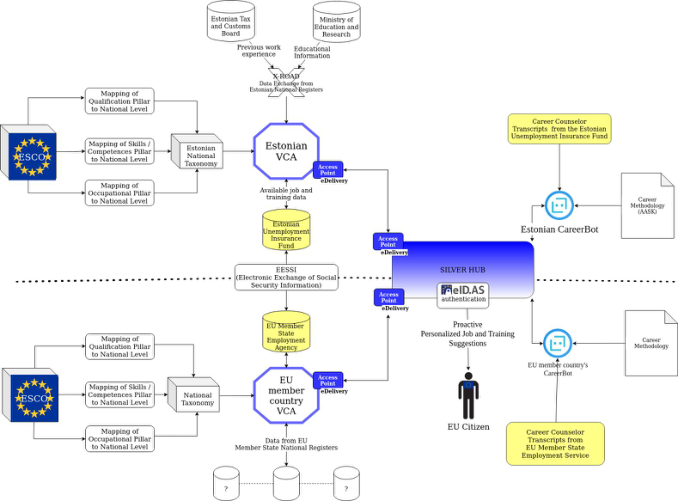
In Estonia and many other countries in the EU, a standardized occupatio- nal classification ISCO-08 is being used for multiple purposes such as its widespread acceptance, statistical simplification across organizations, etc. However, from mid-2021, another classification called ESCO2 is strongly recommended and, to some extent, mandatory classification for EU mem- ber states. The key difference between ISCO-08 and ESCO is that there are also skills and qualifications included in addition to occupational titles. As today’s employment agencies have only used ISCO codes and occupati- onal titles, there is a lack of matching citizens’ skills to specific vacancies or training for improved recommendations. According to NIIS, another EU-wide component that could assist in building EU-wide citizen-centered services is eDelivery. This set of specifications, standards, and software can enable secure data exchange between public registers, AI-enabled services, and citizen-centered platforms. Surprisingly eDelivery is already used for data exchange between employment agencies to determine the social secu- rity rights of persons in a cross-border situation. However, this solution is integrated into national social security systems and not directly related to citizen-centered services.
Interestingly, in some EU countries, including Estonia, the EU citizens can log in to the employment service with their national authentication solution, which must comply with IDentification, Authentication, and Trust Services
2ESCO is a European Commission project classifying skills, competences and occupations while covering 27 languages in the EU.
The Use of Artificial Intelligence in Job Seeking and Competence Development 133
Figure 1: Conceptualized view on AI-enabled services accessible through Silver Hub. (eIDAS) regulation and be certified by Certificate Authority. Combining such EU-wide components create the opportunity for AI-enabled service provisi- ons and could be integrated into modern platforms. In one of the workshops with the Estonian Unemployment Insurance Fund representatives, we achie- ved a crucial necessity to targeting the labor market’s less capable target group – the 50+ years old. After investigating this idea in a workshop with colle- agues from local and international universities, we achieved the standpoint to establish a pilot version of AI-enabled competency services, integrating them to a Virtual Collaborative platform (Silver Hub). During the Interreg Baltic-Sea Region project, Tallinn University of Technology developed the platform- “OSIRIS: Supporting the Smart Specialization Approach in the Silver Economy to Increase Regional Innovation Capacity and Sustainable Growth.”
DISCUSSION
In our previous research, we analyzed the current situation in the Estonian Unemployment Insurance Fund and proposed an initial model for a national VCA (Liutkevicius & Erlenheim, 2021). The main difference between Esto- nia and other countries in the EU is the usage of Estonian data exchange layer X-Road that is in use in Estonia for receiving citizen’s data from diffe- rent registers (i.e., occupational data from the Tax and Customs Board and educational data from the Ministry of Education and Research). This makes receiving the data for building AI models for VCA easier because the data already exists in a structured form. In this research, we gained initial feed- back from other EU member state countries (Finland and Latvia), the Nordic
134 Liutkeviˇcius and Ben Yahia
Institute of Interoperability Solutions (NIIS). Therefore, we can expand our concept to the international level (Figure 1).
CONCLUSIONS
This paper analyzed the existing research on job and training recommen- dation systems and conceptualized views on AI-enabled services supporting citizen-centered career services. The work is a step closer to bringing the servi- ces of employment agencies to the next level. Our objective is to target the 50+-year-old EU citizen by integrating the AI-enabled services to the alre- ady existing platform Silver Hub using the benefits of eIDAS authentication, eDelivery data exchange security, and ESCO. Besides having occupations and other essential background information about citizens, using ESCO, we additionally include skills and qualifications for improved recommendations using the new virtual assistant – Virtual Competence Assistant (VCA). In that way, if an EU citizen logs into the portal and presumes that her natio- nal employment agency has been successfully implemented, she can select the relevant skills based on the suggestions received from her background (former occupations and education from state registry) and start receiving recom- mendations for the next career choice. The VCA-s will proactively make personalized training and job recommendations using the citizens’ personal background information. In addition, we see the opportunity to develop a national career chatbot called CareerBot for more efficient career counseling performing standardized career suitability tests, and suggesting sources of information that can help find a new career. As many employment agencies have recorded the phone calls of career counselors, they can be transcribed and used for AI model training. For that, a separate state of the art resea- rch is required, which was not in the scope of this paper. Nevertheless, such a solution can be added with similar means as VCAs. Consequently, we are creating a new set of AI-enabled solutions, which will enhance data exchange and public service provision for European citizens.
ACKNOWLEDGMENT
This work in the project “ICT programme” was supported by the European Union through European Social Fund. The authors would like to acknow- ledge Mr. Sander Nõmmik from the Estonian Unemployment Insurance Fund and Ms Merilin Liutkevicius from Tallinn University of Technology for their support in data collection and arranging the workshops.
REFERENCES
Appadoo, K., Soonnoo, B. M. & Mungloo-Dilmohamud, Z., {2020. Job Recommendation System, Machine Learning, Regression, Classification, Natural Language Processing. s.l., Institute of Electrical and Electronics Engineers Inc. Bakar, A. A. & Ting, C.-Y., 2011. Soft skills recommendation systems for IT jobs: A
Bayesian network approach. s.l., IEEE. Benabderrahmane, S., Mellouli, N., Lamolle, M. & Mimouni, N., 2018. When deep neural networks meet job offers recommendation. s.l., IEEE Computer Society.
The Use of Artificial Intelligence in Job Seeking and Competence Development 135
Benabderrahmane, S., Mellouli, N., Lamolle, M. & Mimouni, N., 2018. When deep neural networks meet job offers recommendation. s.l., IEEE Computer Society. Dave, S. V. et al., 2018. A combined representation learning approach for better job
and skill recommendation. s.l., Association for Computing Machinery. Dhameliya, J. & Desai, N., 2019. Job Recommender Systems: A Survey. s.l., Institute of Electrical and Electronics Engineers Inc. Diaby, M., Viennet, E. & Launay, T., 2013. Toward the next generation of
recruitment tools: An online social network-based job recommender system. s.l., Association for Computing Machinery. Diaby, M., Viennet, E. & Launay, T., 2014. Taxonomy-based job recommender systems on Facebook and LinkedIn profiles. s.l., IEEE Computer Society. Dong, S. et al., 2017. Job and candidate recommendation with big data support: A
contextual online learning approach. s.l., Institute of Electrical and Electronics Engineers Inc. Feng, P. et al., 2021. Job Recommendation System Based on Analytic Hierarchy Process and K-means Clustering. s.l., Association for Computing Machinery (ACM). Giabelli, A. et al., 2021. Skills2Job: A recommender system that encodes job offer
embeddings on graph databases. s.l., Elsevier Ltd. González-Briones, A. et al., 2019. Case-Based Reasoning and Agent Based Job Offer Recommender System. s.l., Springer Verlag. Government CIO Office of Estonia, 2019. Estonia’s national artificial intelligence
strategy 2019-2021,”, Tallinn, 2019., Tallinn: Government of the Republic of Estonia. Heap, B. et al., 2014. Combining Career Progression and Profile Matching in a Job Recommender System. s.l., Springer, Cham. Hernández, O. F., 2016. Resuminer – A Résumé Recommender System for Job
Seekers using Cluster Analysis, s.l.: Polytechnic University of Puerto Rico. Hossain, M. S. & Arefin, S. M., 2019. Development of an Intelligent Job Recommender System for Freelancers using Client’s Feedback Classification and Association Rule Mining Techniques. s.l., International Academy Publishing (IAP). International Labour Organization, 2021. World Employment and Social Outlook:
Trends 2021, Geneva: International Labour Organization. Jiang, M. et al., 2019. User click prediction for personalized job recommendation.
New York, Springer New York LLC. Liu, K., Shi, X., Kumar, A. Z. L. & Natarajan, P., 2016. Temporal Learning and Sequence Modeling for a Job Recommender System. New York, USA, Proceedings of the Recommender Systems Challenge on - RecSys Challenge ‘16 . Liutkevicius, M. & Erlenheim, R., 2021. Validating the Usage of Occupational
Classification Systems in the Process of Creating a National Virtual Compe- tency Assistant within the EU Labor Market. Athens, Greece, Association for Computing Machinery. Mhamdi, D., Moulouki, R., El Ghoumari, M. Y. & Azzouazi, M., 2020. Job recommendation system based on text analysis, s.l.: Institute of Advanced Scientific Research, Inc. Mishra, S. K. & Reddy, M., 2016. Bottom-up approach to job recommendation
system. s.l., Association for Computing Machinery. Nigam, A., Roy, A., Singh, H. & Waila, H., 2019. Job recommendation through progression of job selection. s.l., Institute of Electrical and Electronics Engineers Inc.
136 Liutkeviˇcius and Ben Yahia
Pacuk, A. et al., 2016. RecSys Challenge 2016: Job recommendations based on preselection of offers and gradient boosting. s.l., Association for Computing Machinery. Paparrizos, I., Cambazoglu, B. B. & Gionis, A., 2011. Machine learned job
recommendation. s.l., ACM. Patel, R. & Vishwakarma, K. S., 2020. An Efficient Approach for Job Recommendation System Based on Collaborative Filtering. s.l., Springer. Permana, A. A. P. G. A., 2019. Recommendation Systems for internship place using
artificial intelligence based on competence. s.l., Institute of Physics Publishing. Polato, M. & Aiolli, F., 2016. Proceedings of the Recommender Systems Challenge on - RecSys Challenge ‘16. New York, USA, ACM Press. Qin, W., 2017. Application analysis of basketball training system based on persona-
lized recommendation systems, s.l.: Universidad Central de Venezuela. Resnick, P. & Varian, H. R., 1997. Recommender Systems. Communications of the ACM, 40(3), pp. 56–58. Rodriguez, L. G., Chavez, E. P. & Rodriguez, C. A., 2019. A Vectorization Model
for Job Matching Application of a Government Employment Service Office. Pro- ceedings of 2019 the 9th International Workshop on Computer Science and Engineering, 9(9), pp. 32–36. Shalaby, W. et al., 2017. Help me find a job: A graph-based approach for job recommendation at scale. s.l., Institute of Electrical and Electronics Engineers Inc. Zhang, C. & Cheng, X., 2016. An ensemble method for job recommender systems.
s.l., Association for Computing Machinery. Zhao, J. et al., 2021. Embedding-based Recommender System for Job to Candidate Matching on Scale. Georgia, USA, arXivLabs. Tondji, N. L., 2018. Web Recommender System for Job Seeking and Recruiting,
Dakar, Senegal: African Institute for Mathematical Sciences Senegal. Tran, T. T. et al., 2018. Recommender System with Artificial Intelligence for Fitness Assistance System. s.l., Institute of Electrical and Electronics Engineers Inc. Xiao, W. et al., 2016. Job Recommendation with Hawkes Process An Effective
Solution for Recsys Challenge 2016. New York, ACM Press. Yang, S., Korayem, M., AlJadda, K. & Grainger, T. N. S., 2017. Combining contentbased and collaborative filtering for job recommendation system: A cost-sensitive Statistical Relational Learning approach. s.l., Elsevier B.V.
LISTED IN THE AHFE DIGITAL BOOKSTORE CATALOGUE
Explore the complete digital volume
Human Factors, Business Management and Society
Read this individual research paper free through the original publisher, or explore the full digital proceedings book.
ISBN 978-1-958651-32-2
Explore this ISBN in the AHFE Bookstore ↗Listed in the July 2026 bookstore catalogue; search by ISBN to confirm current availability · Digital book purchase optional