Faisal Imran, Khuram Shahzad, Aurangzeab Aurangzeab Butt, Jussi Kantola (2022). Structural challenges to adopt digital transformation in industrial organizations: A multiple case study. In: Human Factors in Management and Leadership. AHFE Open Access, vol. 55, pp. 47–52. https://doi.org/10.54941/ahfe1002231
Digital Transformation requires significant changes in industrial organization’s setting to remain relevant in this fast-paced environment. This calls for modifications in their organizational structures. The existing organizational structures of industrial organizations are mechanistic, while, digital transformation needs organic and flexible organizational structure. Therefore, the main aim of this study is to identify the main challenges that industrial organizations face in the process of modifying their mechanistic structures into organic structures. To explore these challenges, we conducted multiple case study from three global industrial organizations. We interviewed 41 middle to high-level management personnel. The results of this study highlight six main challenges that industrial organizations need to cope for structural modifications. These challenges are structural rigidity, traditional hierarchy, silos, problems with resource allocations, organizational size and old-fashioned-leadership.
Digital Transformation (DT) has challenged industrial organizations’ exi- sting setups (Mitki, Shani, & Greenbaum, 2019; Shahzad & Imran, 2021) requiring them to rethink about their product and services, business models, business operations, organizational culture, new work roles and organiza- tional structures (Chanias, Myers, & Hess, 2019; Imran, Shahzad, Butt, & Kantola, 2021; Vial, 2019). Wherein, organizational structure holds a significant importance for DT as it defines the effectiveness of organizatio- nal transformation (Worley & Lawler, 2006). Industrial organizations are usually slow to embrace such change due to their long developed traditional approaches (Matt, Hess, & Benlian, 2015). While on the other hand, DT requires them to act quickly in order to meet fast changing external environ- ment (Worley & Lawler, 2006). Therefore, to match fast-paced digital world, industrial organizations have to reform their structures. DT requires flexible structures with low hierarchy, low formalization, less bureaucracy, and more cross-functional integration (Björkdahl, 2020).
Extant research has signified organizational structures as well as digi- tal transformation, and what kind of changes are required in organizations to embrace this change (Imran et al., 2021; Vial, 2019). However, limited research has focused on the intersection of DT and organizational structu- res (Mustafa, Solli-Sæther, Bodolica, Håvold, & Ilyas, 2022), especially on the challenges faced by industrial organizations in order to modify their structures for DT. Therefore, the main aim of this study to identify the main challenges in brining structural modifications in industrial organiza- tions. Our research question is that “what are the main challenges faced by industrial organizations when they move from mechanistic structures to orga- nic structures supportive to digital transformation?” Moreover, this study will contribute in the literatures of digital transformation, organizational structures and organizational change management.
LITERATURE REVIEW
Organizational structure is defined as “the way responsibility and power are allocated, and work procedures are carried out, among organizational members” (Nowotny, Hirsch, & Nitzl, 2022) and mainly categorized as a continuum between mechanistic and organic structures. Mechanistic organi- zations consist of more hierarchical levels, high formalization and centralized decision-making authority, which stays with top management. On the other hand, organic organizations contains inverse structural design to enable high flexibility in dynamic and uncertain environments (Mumford, 2000; Now- otny et al., 2022). The appropriateness of a structure is dependent on the extent to which it fits certain contingencies such as changing technologies or uncertain business work environment (Mustafa et al., 2022). As indu- strial world is moving towards digitalized organizations by adopting new and advanced technology, therefore they have to develop responsiveness, open- ness and efficiency in order to become truly digital organizations (Bonanomi, Hall, Staub-French, Tucker, & Talamo, 2020). Attaining such characteristics require industrial organizations to move from mechanistic structures towards organic ones, which is very critical for DT. Most of the recent DT researchers laid stress on organizational transformation, which include culture, roles, business models, business operations, product and services (Butt, Imran, Kantola, & Helo, 2021; Imran et al., 2021; Vial, 2019), however, organizati- onal structures remain one of most important factors in attaining successful DT. Some recent studies highlighted barriers to DT for organizations, such as unprepared organizations (Gupta, 2018) poor communication, rigid and highly formalized structures (Smet, Lurie, & George, 2018), however, the challenges faced by industrial organizations in modifying their structures for DT remained understudy.
METHODOLOGY
We conducted multiple case study (Yin, 2018) from three multinational Nordic-based industrial organizations. All three case organizations have been pursuing DT from past six years. As all of three case companies were
Structural Challenges to Adopt Digital Transformation in Industrial Organizations 49
Table 1. Number of Interviewees and their position.
Table available in the original PDF paper.
Case A Case B Case C Higher management personnel 14 8 8 Middle management personnel 5 3 3
developed during second industrial revolution (Imran & Kantola, 2018), the- refore they are viewed as traditional organizations with rigid, hierarchical, mechanistic structural organizations, which makes them a unique case to study DT process and its effects on their structures. Furthermore, we con- ducted semi-structured interviews with 41 respondents for middle to top management personnel of case organizations. Table 1 outlines the number of respondents from each case organization as well as their positions level. In addition to interview data, secondary data comprising publicly available documents – such as web blogs, online interviews, videos, reports, and infor- mation on websites – were used to gain further insights. For data analysis, we followed guidelines by (Gioia, Corley, & Hamilton, 2013) by putting statements into 1st order category, which generated six 2nd order codes iden- tified as challenges. These were further subcategorized under 3rd order coding which provides overall theme of study.
RESULTS
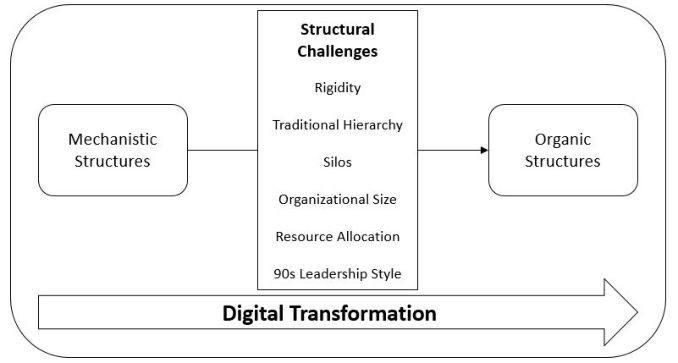
Our results identified several challenges related to structural changes asso- ciated with several factors, such as a long successful history of incumbent organizations, as well as longstanding, tried-and-true management styles that ensured success in the past. “Rigidity” is one of the main challenges identified in this study. As case organizations were established during 2nd industrial revolution, due to which they have long-lasting command-and- control management styles, which poses a big challenge in moving towards flexible structures. Director DT from case A stated about it “We are still having very old traditional organizational structures and processes”. Simi- larly, rigidity is associated with the “traditional hierarchy”, which second identified challenge in this study. A senior director from case B said in this regard, “There is a cultural element in it that we are (a) very traditional orga- nization, with (a) long history and being more hierarchical all the time”. Thirdly, as competition among different departments/businesses still exist within the case organizations, due to which they like to work in silos, which poses another challenge in bringing them close to each other and work on similar projects. A director from case C stated about it “All these business areas have worked pretty much independently (not only from the business side, but) also from processes, systems, and tools’ point of view, and that is challenging”. “Resource allocation” is another important challenge found in this study. Director digital development from case C stated about it “In order to deliver a complex project, you will need to have the capability of building networks quickly, regardless (of) how you are organized structu- rally…. In fact, one should think less in terms of their organizational home
Figure 1: Structural challenges.
(and) instead gather around the problem to solve it together with others”. Organizational size is also major obstacle in flexing the structures. Head of digital R&D from case A explained it as “We have 20,000 people; it needs to be structured one way or another… but if you want to meet the pace of (the) world, you need to give up old practices, for example, setting up five mee- tings for making a decision around a product.” Lastly, the leadership of case organizations is also learning to go beyond command and control style of management. Another director from case C put it in his words by saying “It has a lot to do with this ‘80s/’90s leadership style in the power game. They usually structure so they have the power.… Leadership needs to transform from power to empower (for digital transformation”. Figure 1 once summa- rizes these challenges, which case organizations faced during the process of their structural modifications.
CONCLUSION
The digital transformation of industrial organizations is increasing rapidly, and promises to improve their competitiveness, productivity and process efficiency (Talamo & Bonanomi, 2020) which raises the need of structu- ral readjustments. Currently, the mechanistic structures (Mumford, 2000) of incumbents poses them several challenges, which are identified as rigidity, traditional hierarchical approaches, the existence of silos, problems related to resource allocation, organizational size, and old-fashioned leadership. In the past, rigid structural models prevailed when case organizations were ope- rating in stable and predictable environments (Smet et al., 2018; Worley & Lawler, 2006). The pace and uncertainty of change in today’s business world, spurred by disruptive digital technologies, strongly argue for a different stru- ctural approach (Worley & Lawler, 2006). A significant effort has been observed in adoption of digital technologies, however, effective steps needs to be taken in order to cope with identified challenges by the practitioners and
Structural Challenges to Adopt Digital Transformation in Industrial Organizations 51
leadership (Imran, Shahzad, Butt, & Kantola, 2020) to enable the achieve- ment of the full benefits of DT as well as to move from mechanistic structures to organic or flexible structures.
This study has certain limitations that could be addressed in future research endeavors. Our study focused on large, multinational, hard-core engineering organizations, an aspect that must be considered when seeking to tran- sfer these findings to other types of organizations. Moreover, the inclusion of more organizations/more interviewees may reveal further contributions. Future research should study ongoing modifications in organizational stru- ctures, as well as how they are coping with the identified challenges. Further- more, deploying quantitative methods to validate the present paper’s findings is an opportunity for academic. It will be valuable to study these challenges and possible solution-approach from multiple theoretical lens.
REFERENCES
Björkdahl, J. (2020). Strategies for Digitalization in Manufacturing Firms. California Management Review, 62(4), 17–36. https://doi.org/10.1177/0008125620920349 Bonanomi, M. M., Hall, D. M., Staub-French, S., Tucker, A., & Talamo, C. M.
L. (2020). The impact of digital transformation on formal and informal orga- nizational structures of large architecture and engineering firms. Engineering, Construction and Architectural Management, 27(4), 872–892. https://doi.org/10. 1108/ECAM-03-2019-0119 Butt, A., Imran, F., Kantola, J., & Helo, O. (2021). Cultural Preparation for Digital Transformation of Industrial Organizations: A Multi-case Exploration of Socio-technical Systems. In: Goonetilleke, R.S., Xiong, S., Kalkis, H., Roja, Z., Karwowski, W., Murata, A. (Eds) Advances in Physical, Social & Occupatio- nal Ergonomics. AHFE 2021. Lecture Notes in Networks and Systems, Vol 273. Springer. Chanias, S., Myers, M. D., & Hess, T. (2019). Digital transformation strategy making
in pre-digital organizations: The case of a financial services provider. Journal of Strategic Information Systems, 28(1), 17–33. https://doi.org/10.1016/j.jsis.2018. 11.003 Gioia, D. A., Corley, K. G., & Hamilton, A. L. (2013). Seeking Qualitative Rigor in Inductive Research: Notes on the Gioia Methodology. Organizational Research Methods, 16(1), 15–31. https://doi.org/10.1177/1094428112452151 Imran, F., & Kantola, J. (2018). Review of industry 4.0 in the light of sociotechnical
system theory and competence-based view: A future research agenda for the evo- lute approach. Advances in Intelligent Systems and Computing, 783, 118–128. https://doi.org/10.1007/978-3-319-94709-9_12 Imran, F., Shahzad, K., Butt, A., & Kantola, J. (2020). Leadership Competencies for Digital Transformation: Evidence from Multiple Cases. Advances in Intelligent Systems and Computing Series. San Diego, California, USA: Springer. Imran, F., Shahzad, K., Butt, A., & Kantola, J. (2021). Digital Transformation of
Industrial Organizations : Toward an Integrated Framework. Journal of Change Management: Reframing Leadership and Organizational Practice. https://doi.org/ 10.1080/14697017.2021.1929406 Matt, C., Hess, T., & Benlian, A. (2015). Digital Transformation Strategies. Business and Information Systems Engineering, 57(5), 339–343. https://doi.org/10.1007/ s12599-015-0401-5
Mitki, Y., Shani, A. B. (Rami., & Greenbaum, B. E. (2019). Developing New Capabilities: A Longitudinal Study of Sociotechnical System Redesign. Journal of Change Management, 19(3), 167–182. https://doi.org/10.1080/14697017.2018.1490337 Mumford, E. (2000). A Socio-Technical Approach to Systems Design. Requirements
Engineering, 5(2), 125–133. https://doi.org/10.1007/PL00010345 Mustafa, G., Solli-Sæther, H., Bodolica, V., Håvold, J. I., & Ilyas, A. (2022).
Digitalization trends and organizational structure: bureaucracy, ambidexterity or post-bureaucracy? Eurasian Business Review, (February). https://doi.org/10. 1007/s40821-021-00196-8 Nowotny, S., Hirsch, B., & Nitzl, C. (2022). The influence of organizational structure on value-based management sophistication. Management Accounting Research, (April 2019), 100797. https://doi.org/10.1016/j.mar.2022.100797 Shahzad, K., & Imran, F. (2021). Surviving the Covid-19 Pandemic: The Role of
Digital Innovation and Transformation. In: Kalra, J., Lightner, N.J., Taiar, R. (Eds) Advances in Human Factors and Ergonomics in Healthcare and Medical Devices. AHFE 2021. Lecture Notes in Networks and Systems, Vol 263. Springer. Smet, A. De, Lurie, M., & George, A. S. (2018). Leading agile transformation: The new capabilities leaders need to build 21st-century organizations. McKinsey and Co, (October), 27. Retrieved from https://www.mckinsey.com Talamo, C., & Bonanomi, M. M. (2020). The impact of digitalization on processes
and organizational structures of architecture and engineering firms. In Research for Development. https://doi.org/10.1007/978-3-030-33570-0_16 Vial, G. (2019). Understanding digital transformation: A review and a research agenda. Journal of Strategic Information Systems, 28(2), 118–144. https://doi. org/10.1016/j.jsis.2019.01.003 Worley, C. G., & Lawler, E. E. (2006). Designing organizations that are built to
change. MIT Sloan Management Review, 48(1), 19–23. Yin. (2018). Case Study Research and Applications. In Case Study Research and Applications.
LISTED IN THE AHFE DIGITAL BOOKSTORE CATALOGUE
Explore the complete digital volume
Human Factors in Management and Leadership
Read this individual research paper free through the original publisher, or explore the full digital proceedings book.
ISBN 978-1-958651-31-5
Explore this ISBN in the AHFE Bookstore ↗Listed in the July 2026 bookstore catalogue; search by ISBN to confirm current availability · Digital book purchase optional