Ziqiang He, Dan Wang (2022). Interactive Design of Car Steering Wheel Touch Screen Interface Based on KANO Model. In: Ergonomics In Design. AHFE Open Access, vol. 47, pp. 53–61. https://doi.org/10.54941/ahfe1001919
With the innovation of automotive hardware and software technology, the application of touch screens and automotive steering wheels has become a new human-computer interaction design trend. The purpose of this research is to improve the driver’s experience when using the steering wheel touch screen interface and optimize the steering wheel. The safety, rationality and completeness of the touch screen interaction design. The method of this research is to find the driver’s needs when using the steering wheel, filter out various demand research samples, and perform qualitative analysis and quantitative statistics on each demand through the Kano model, thereby constructing the driver’s use of the steering wheel. Based on the user satisfaction index coefficient, the demand hierarchy tower when the driver uses the steering wheel is constructed. Through the sensitivity calculation, the importance ranking of each demand is finally obtained, and the design is carried out based on this.
Overview of the Steering Wheel Since its birth, cars have had a vital impact on people’s lives. Throughout its more than 100 years of development history, it is not difficult to find that the car is no longer a cold means of transportation, but has gradually become the main body of people’s emotional appeal. Excellent human-computer interaction is an important factor to improve the user’s driving and riding experience. The steering wheel, as an important contact point for the human- machine interaction in the driver’s car, is the place where the interaction occurs most frequently. The experience of using the steering wheel dire- ctly affects the quality of the human-vehicle interaction. At the same time, with the development and maturity of assisted driving technology, drivers can focus on more places besides driving, such as entertainment, social inte- raction, office, etc., which also provides new directions and new ideas for steering wheel interaction design.
Overview of the Research on the Function of the Steering Wheel In the history of automobile development, the main function of the stee- ring wheel has not changed much, that is, to control the direction of the
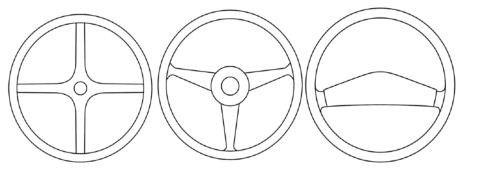
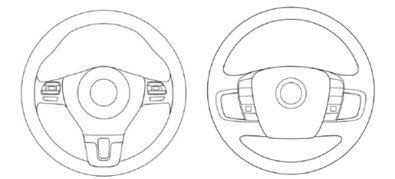
Figure 1: Early steering wheel design.Figure 2: Design of multi-function steering wheel.
car. The early steering wheel design also mainly served the above functions (see Figure 1).
However, with the continuous improvement of functions, the operation has also become complicated and cumbersome. At the same time, people’s needs and feelings when driving are constantly changing: they expect to ope- rate various devices in the car more conveniently and safely, which provides designers with more design possibilities. Therefore, placing some function buttons with high operating frequency on the steering wheel is the main design goal of the steering wheel at present (see Figure 2). The current steering wheel mainly adds some multi-function buttons in the modelling area of the ordinary steering wheel to realize remote control of different functions in the car. The control buttons of the steering wheel are generally concentrated in the area on the steering wheel spokes. Through the reasonable arrangement and functional integration of the buttons, the fast and accurate operation of the in-vehicle system can be realized, so as to improve the comfort and convenience of the driver during operation.
With the development of touch screen technology, more and more car com- panies have begun to use this technology. As we all know, the touch screen interface has more layers than the traditional button interface, which leads to it can provide more functions and services to meet the growing needs of users for in-car interaction. Therefore, applying the touch screen interface to the steering wheel is an important direction of the steering wheel interaction design.
Kano Model and Driver’s Needs The Kano model classifies products or services into five quality types, namely: Must-be Quality (M), One-dimensional Quality (O), Attractive Quality (A), Indifferent Quality (I), Reverse Quality (R). According to the related theory of
Interactive Design of Car Steering Wheel Touch Screen Interface Based on KANO Model 55
the Kano model, a product or service pays more attention to Must-be Quality, One-dimensional Quality, and Attractive Quality. Must-be Quality is usually the basic essential function of a product or service. When Must-be Quality is satisfied, users will pay attention to and care about One-dimensional Quality. One-dimensional Quality is a function expected by users. User satisfaction is proportional to the satisfaction of such requirements. Although users cannot think of Attractive Quality, satisfying Attractive Quality will give Surprise users and greatly improve user satisfaction. The driver’s steering wheel usage needs and experience studied in this paper are essentially the research on the intelligent car interaction system and related products of the car controller, and the applicability of the Kano model is high, so this study uses the Kano model to quantitative analysis of class requirements.
RESEARCH PROCESS The preliminary research method mainly includes the combination of field research method, interview method and observation method to analyze and extract the needs of the driver when using the steering wheel, and then classify, filter and grade the different needs collected, and classify them accor- ding to the sorted content. Divided into primary and secondary needs. After that, the questionnaire of the Kano model is designed based on this, the questionnaires are distributed and the results are collected, and the Kano category post-screening index to which each demand item belongs is analy- zed, and the user satisfaction index coefficient is introduced to assist in the classification of demand types. Finally, through the user satisfaction and dis- satisfaction, the sensitivity of the requirements is calculated, the importance of each requirement is ranked and the priority of the exact requirements is obtained.
RESEARCH ON THE WEIGHT OF STEERING WHEEL FUNCTION REQUIREMENTS First, the raw data was collected through the literature method, observation method and in-depth interviews with 24 drivers of different representative population types. Then, after keywording the obtained specific demand description, performing word frequency statistics and content classification, a specific initial demand description table (see Table 1). “Secondary requi- rements” are divided by specific types of functions, and finally “Secondary requirements” related to each other will be formed into “Primary requi- rements” to obtain a list of drivers steering wheel function requirements (see Table 2).
Determining the Driver Demand Kano Demand Category (1) Questionnaire design and survey. The questionnaire adopts a standardized form, briefly describes the functions required by the driver in the driving process and sets up two-way questions to obtain user satisfaction evaluation. In this study, drivers of different genders and ages were selected as the survey
56 He and Wang
Table 1. Survey of steering wheel function requirements.
Table available in the original PDF paper.
Description of Requirement 1 Navigation 9 Steering wheel lock 17 Control dashboard 2 Answer the phone 10 Use bootstrap 18 Meeting 3 Control the direction 11 Reading 19 Control the door lock 4 Play games 12 Cruise control 20 Photograph 5 Voice assistant 13 Vehicle status 21 Singing 6 Watch video 14 Shopping 22 Content recommendation 7 Airbag 15 Control lights 23 Online chatting 8 Control air conditioner 16 Whistle 24 Control the AV system
Table 2. Summary of steering wheel function requirements.
Table available in the original PDF paper.
Primary requirement Secondary requirement Coding Manipulate Requirement Control the direction MR1 Control lights MR2 Control the door lock MR3 Control dashboard MR4 Control air conditioner MR5 Cruise control MR6 Control the AV system MR7 Entertainment Requirement Photograph ER1 Play games ER2 Reading ER3 Watch videos ER4 Shopping ER5 Singing ER6 Information Requirement Navigation IR1 Voice assistant IR2 Content recommendation IR3 Vehicle status IR4 Use bootstrap IR5 Safety Requirement Steering wheel lock SR1 Airbag SR2 Whistle SR3 Communicate Requirement Answer the phone CR1 Online chatting CR2 Office Requirement Meeting OR1
objects through a combination of interviews and online surveys. A total of 259 questionnaires were recovered, of which 233 were valid. (2) Reliability and validity testing. The reliability coefficient value of the results of this questionnaire is 0.822, of which the positive question is 0.924 and the reverse question is 0.908, both of which are greater than 0.8. The reliability of the research data is of high quality. In the validity test, the KMO measure value is 0.873, which is greater than 0.8, which is suitable for factor analysis, and the statistical value of the Bartlett sphere test has a significant probability of 0.000, which is less than 0.01.
Interactive Design of Car Steering Wheel Touch Screen Interface Based on KANO Model 57
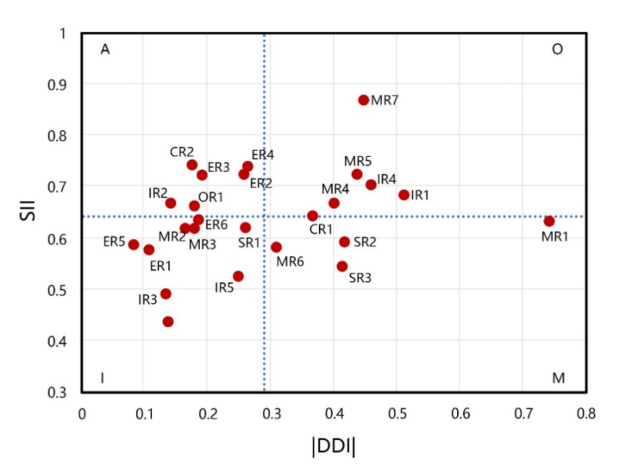
Figure 3: Demand quadrant scatter diagram of Kano model.
(3) Analysis of questionnaire data results and determination of Kano demand category. Compare the Kano model evaluation table, count the Kano category and quantity to which each requirement belongs, and designate A, O, M, I, and R to refer to Attractive Quality, One-dimensional Quality, Must- be Quality, Indifferent Quality, and Reverse Quality respectively. quantity. Since drivers are accustomed to the functions provided by the existing steering wheel, the requirements for new functions of the steering wheel are generally low. According to the classification standard determined by the traditional Kano model with a large proportion of demand categories, most of the obtai- ned Kano demand categories are Attractive Quality, so The user satisfaction index coefficient (CSI) is introduced to assist in the classification of demand types, that is, the closer the absolute value of the user satisfaction increase index (SII) and the user dissatisfaction decrease index (DDI) is to 1, the reali- zation of a certain design attribute will affect users. The larger the satisfaction effect, the smaller the effect is closer to 0. The calculation formulas of SII and DDI are SII =(A+O)/(A+O+M+I) (1) and DDI=(O+M)/(M+O+A+I) (-1).
Determining the Sensitivity and Importance Ranking of Driver Demands According to the relevant theory of Kano model, Must-be Quality is the basic essential function of products or services. If Must-be Quality cannot be sati- sfied, user dissatisfaction will increase greatly. One-dimensional Quality is a function expected by users, and users are satisfied the degree of satisfa- ction is proportional to the degree of satisfaction of this type of demand. Although satisfying Attractive Quality can greatly improve user satisfaction, when it is not satisfied, the impact on user dissatisfaction is not large, so
58 He and Wang
sort
sort Importance
category S Sensitivity
Table 3. Sample human systems integration test parameters.
Table available in the original PDF paper.
Code A/% O/% M/% I /% R/% Q/% SII/% |DDI| /% Category New
MR1 18.39 43.68 28.74 6.90 0.00 2.30 63.53 74.12 O M 0.976 2 1 MR2 45.98 14.94 1.15 35.63 1.15 1.15 62.35 16.47 A I 0.645 20 19 MR3 44.83 16.09 1.15 35.63 1.15 1.15 62.35 17.65 A I 0.648 19 20 MR4 43.68 21.84 17.24 14.94 0.00 2.30 67.06 40.00 A O 0.781 7 9 MR5 35.69 34.20 8.55 19.70 0.37 1.49 71.21 43.56 A O 0.835 5 8 MR6 36.78 19.54 10.34 29.89 1.15 2.30 58.33 30.95 A M 0.660 18 4 MR7 48.28 36.78 6.90 5.75 0.00 2.30 87.06 44.71 A O 0.979 1 5 ER1 41.38 9.20 0.00 36.78 9.20 3.45 57.89 10.53 A I 0.588 22 22 ER2 50.57 20.69 4.60 21.84 0.00 2.30 72.94 25.88 A A 0.774 8 12 ER3 52.87 17.24 1.15 25.29 0.00 3.45 72.62 19.05 A A 0.751 10 14 ER4 51.72 19.54 5.75 19.54 1.15 2.30 73.81 26.19 A A 0.783 6 11 ER5 50.57 6.90 1.15 39.08 1.15 1.15 58.82 8.24 A I 0.594 21 21 ER6 45.98 17.24 1.15 34.48 0.00 1.15 63.95 18.60 A I 0.666 17 18 IR1 33.33 34.48 16.09 14.94 0.00 1.15 68.60 51.16 O O 0.856 3 6 IR2 52.87 12.64 1.15 31.03 0.00 2.30 67.06 14.12 A A 0.685 15 16 IR3 39.08 8.05 4.60 43.68 2.30 2.30 49.40 13.25 I I 0.511 24 24 IR4 33.33 35.63 9.20 19.54 0.00 2.30 70.59 45.88 O O 0.842 4 7 IR5 33.33 18.39 5.75 40.23 0.00 2.30 52.94 24.71 I I 0.584 23 23 SR1 41.38 19.54 5.75 31.03 0.00 2.30 62.35 25.88 A I 0.675 16 17 SR2 31.03 26.44 13.79 25.29 1.15 2.30 59.52 41.67 A M 0.727 12 2 SR3 24.14 28.74 11.49 32.18 1.15 2.30 54.76 41.67 I M 0.688 14 3 CR1 34.48 26.44 8.05 25.29 4.60 1.15 64.63 36.59 A O 0.743 11 10 CR2 57.47 16.09 1.15 24.14 0.00 1.15 74.42 17.44 A A 0.764 9 13 OR1 49.43 14.94 2.30 29.89 1.15 2.30 66.67 17.86 A A 0.690 13 15
Interactive Design of Car Steering Wheel Touch Screen Interface Based on KANO Model 59
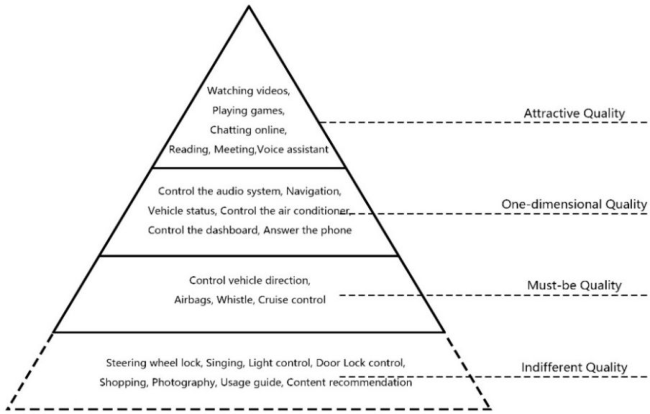
the importance of each Kano demand category varies from large the smallest order is Must-be Quality, One-dimensional Quality, Attractive Quality and Indifferent Quality, and based on this, the order of importance of the four gradients is first divided.
The user satisfaction sensitivity is represented by “S”, and S is the distance from the point with SII and |DDI| as the coordinate values to the origin. The user satisfaction sensitivity of each function can be visualized in Figure 3. That is to say, according to the characteristics of SII and DDI, the larger the S value, the higher the sensitivity, indicating that whether a certain function is satisfied or not has a greater impact on the user’s satisfaction, that is, the higher the importance of the function. Therefore, the importance of the same requirement categories is based on the size of the sensitivity S. That is, the order of importance of each functional requirement can be seen in Table 3.
Research Results According to the results (see Table 2 and Table 3), it can be seen that the Must-be Quality is to control the direction of the vehicle, airbags, whi- stle, and cruise control. One-dimensional Quality has control of audio and video systems, navigation, vehicle status, control of air conditioning, con- trol of dashboards, and answering calls. Attractive Quality includes watching videos, playing games, chatting online, reading, meeting, and voice assistants. Indifferent Quality has steering wheel lock, singing, light control, door lock control, shopping, photo taking, usage guide, and content recommendation.
Steering Wheel Touch Screen Interaction Design Design Strategy The basic strategy for the interactive design of the steering wheel touch screen is as follows: the coverage of Must-be Quality should be guaranteed, and part
of One-dimensional Quality should be properly satisfied, and the driver’s Attractive Quality should be further satisfied according to the actual situ- ation, and whether to satisfy part of Indifferent Quality should be selected under certain circumstances.
Design Practice When designing the interactive design of the steering wheel touch screen, the physical carrier of the touch screen, that is, the shape of the steering wheel, should be fully considered. Consider the human-machine size and interaction area when the user holds the steering wheel, and place the functions with high demand priority in a place that is convenient for the user to operate. Due to the cost of learning, it is not advisable to make too many innovative designs
Interactive Design of Car Steering Wheel Touch Screen Interface Based on KANO Model 61
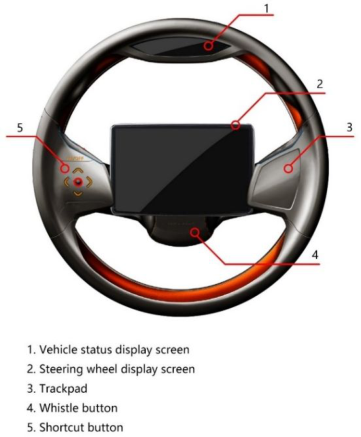
in terms of shape. Therefore, the shape design results of the steering wheel are shown in the Figure 5.
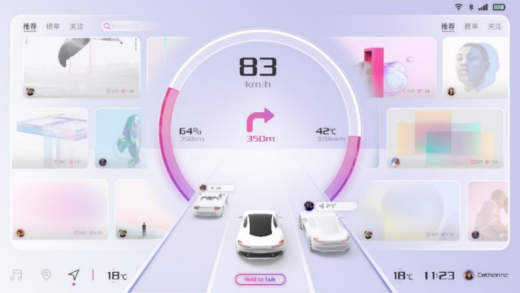
According to the above design strategy, the interface design of the stee- ring wheel touch screen can be carried out. Since the driver has a ranking of the importance of the functional requirements of the steering wheel, which is reflected in the interface design, the result is that the functions of different importance levels have different areas and entrances, and the interface is car- ried out according to the design strategy. Design, the design results are shown in Figure 6.
CONCLUSION
Based on the Kano model, this paper aims to meet the driver’s steering wheel usage needs through touch screen interaction. This paper takes the driver’s steering wheel usage demand as the research object, investigates and classi- fies it, and maps the driver’s demand to the steering wheel function. Through quantitative analysis, the demand category of each function and its impor- tance ranking are obtained, and the touch screen interaction of the steering wheel is proposed. Design strategy, on the basis of this strategy, the prelimi- nary design is carried out, and the design result is obtained. It is hoped that this article will provide a design reference for more diversified human-vehicle interaction methods in the future, and improve the user experience.
REFERENCES
Adam Richardson. [Design Essay]: From Twist to Touch. www.cardesignnews.com.
07 Jan 2008. Chauncey Wilson. User Experience Re-Mastered: Your Guide to Getting the Right Design. Morgan Kaufmann. 2009:278–335. David H Maister. The Trusted Advisor[M], Free Press, 2004:56. Fiona Doskocz. [Design Essay]: Interior Texture Trends – Europe vs USA. www.cardesignnews.com. 07 Dec 2005. Jennifer Preece Yvonne Rogers Helen Sharp.interaction design. Beyond Human-
computer interaction. New York, NY : J. Wiley & Sons. 2002:44–102. LI Lijun, Zhong Lei. On Urban Public Facilities Characteristic Design Idea, To Tianjin Bus Stations[J]. Art and Design, 2011, 2(10):94–96. Noriaki Kano. Attractive Quality and Must-be Quality. 1984: 28–32. Sam Livingstone. [Design Essay]: Instrument Panel Architecture. www.cardesignnews.com 24 Aug 2005. SUN Xiang-long, FENG Shu-min. WU Hai-yue. Influence of stop environment and
waiting behavior on perceived waiting time[J]. Journal of Harbin institute of technology, 2019, 51(2):186–190. WANG Shuang, YING Guo-fu, He Xiu-zhong. Research on Customer Requirements Target System Based on Kano Model[J]. Packing Engineering, 2006, 27(8): 209–213.
LISTED IN THE AHFE DIGITAL BOOKSTORE CATALOGUE
Explore the complete digital volume
Ergonomics In Design
Read this individual research paper free through the original publisher, or explore the full digital proceedings book.
ISBN 978-1-958651-23-0
Explore this ISBN in the AHFE Bookstore ↗Listed in the July 2026 bookstore catalogue; search by ISBN to confirm current availability · Digital book purchase optional