Bingquan Wang, Danhua Zhao (2022). How will the smart cockpits develop and facilitate a more social space in the possible, emerging, future business models of ownership?. In: Ergonomics In Design. AHFE Open Access, vol. 47, pp. 159–168. https://doi.org/10.54941/ahfe1001933
With the development of the vehicle industry and the diversification of lifestyles, as well as the prevalence of the sharing economy, the demand for intelligent cockpits is growing rapidly. If we still design from the perspective of the traditional car cockpit layout, the design of intelligent interaction and connected services will be strongly constrained. This also makes user behavior, new business models and future scenarios become the focus of this research. This paper investigates the above by questionnaire survey method as well as literature method. In this study, user knowledge of smart cockpits is obtained and the scenarios of smart cockpit usage in the sharing economy are predicted. Our findings show that user needs, user experience, EV market and business models have significant effects on the intention of smart cockpits to serve future usage scenarios and their reuse. Our findings also provide guidance and implications for the development of smart cockpits.Keywords: Smart cockpits, Sharing economy, User needs, Future scenarios
This paper examines the development of smart cockpits in the context of emerging business models and the impact on the in-cockpit interaction space and how this will change the behavior and needs of the in-cockpit users. It is clear that there is an acceptance that the automotive industry is cur- rently in the process of transitioning to mobile services and that this shift is seen as having the potential to redefine the relationship between users (Ferrero, 2018), and thus the future of the smart cockpit.
The emergence of new business models has changed the habits of users and the way they belong to the car, so that users do not need to participate in the whole process like traditional cars, and the focus of users gradually shifts from the car itself to the demand for space and the experience of the interior of the car, or the demand of users gradually shifts from the functionality and basic performance of the car itself to the consideration of their own needs (Panagiotopoulos, 2019).
INTERIOR OF CAR AND SMART COCKPIT Progress of Automotive Interior Design
Early automotive design, there is no clear concept of the interior, not to men- tion as the interior cockpit pattern, the interior design is not simply one aspect of the design, but a mishmash of different areas of design into one design (Möser, 2003).
In the early days of automotive design, there was no clear concept of inte- rior, much less as a pattern of interior cockpits, and interior design was not simply one aspect of design to a certain extent, but a mishmash of different areas of design (Möser, 2003). The development of the car interior so far, its function from point A to point B has never disappeared, which changes is the proportion of various fields of design in the interior design is increa- sing and changing, car interior design, in addition to the basic function of the design is minimal, the development of early car interior designers gradu- ally began to pay attention to the design in addition to the function (Lidwell, 2010), such as materials (Gao, 2012); since 1956 Ford established the Depar- tment of Ergonomics. Car manufacturers began to pay attention to the user’s feelings in the car (Leder, 2005). In recent times, interior designers began to study user characteristics and aesthetic tendencies in order to meet user needs. In the current era of intelligent cockpit, the car is gradually intelligent, intelligent cars instead of human decision-making, the user does not need to participate in the whole process like traditional cars, the focus of the user gradually from the car itself, shifted to the needs and experience of the car interior (JIN, 2016).
The purpose of this research is to push the boundaries of automotive design and stand up to the researcher’s perspective to solve the puzzle. It is to have an exploration of the business model of smart cockpits and to understand what the potential next generation usage scenarios are.
Smart Cockpit and Autonomous Definition of Smart Cockpit Concept The term “cockpit” is introduced by the aircraft and ship industries, and “cabin”refers to the internal space of an aircraft or ship (Marrenbach, 2000). The cabin can be divided into cockpit, passenger cabin, cargo cabin, etc. The cockpit is the driving and riding space in the car. Intelligent cockpit refers to the cockpit equipped with intelligent and networked in-vehicle produ- cts, so that it can interact intelligently with people, roads and the car (Sun, 2018). it is an important link and key node in the evolution of human-vehicle relationship from a tool to a partner.
The intelligent cockpit collects data and uploads it to the cloud for proces- sing and calculation, so as to make the most effective adaptation of resources and increase the safety, entertainment and practicality in the cockpit. The future form of intelligent cockpit is “intelligent mobile space” (Benevolo, 2016). Under the premise of 5G and car networking, the car cabin will get rid of the single scene of “driving” and gradually evolve into an intelligent space integrating “home, entertainment, work and social”.
How will the Smart Cockpit Develop and Facilitate a More Social Space 161
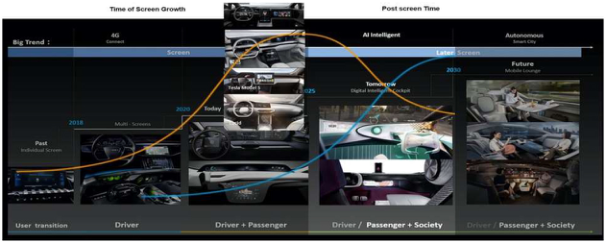
Figure 1: The development plan of smart cockpit.
The development of intelligent cockpit can be summarized into three stages, respectively time of screen growth, time of extreme screen and post screen time, which correspond to the user evolution process of driver, driver+passenger and passenger+society (Fig. 1).
The Relationship Between Smarrt Cockpit and Autonomous Driving The higher the degree of autonomous driving, the more space the intelli- gent cockpit can play. According to SAE’s autonomous driving level, L0-L3 is interpreted as the assisted driving level, where the driver must be in the dri- ving state, and L4-L6 is considered the autonomous driving level (Koopman, 2017), where the user does not need to drive the car. So, the intelligent cabin wants to usher in a truly disruptive development, to achieve the vision of the car into an intelligent mobile space, the premise is that autonomous driving has reached a very high degree, and the symptoms are ride comfort and home comparable, human-computer interaction experi- ence and consumer electronics equivalent, everything connected through all intelligent terminals.
FUTURE MARKET FORECASTING AND FUTURE SCENARIO EV Market and Global Connected Vehicles Forecast
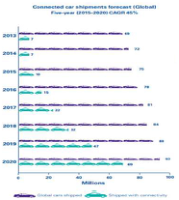
In the evolving industry, and vehicles become smarter, the cars transforms from traditional manufacturing to service (Shah, 2020). KPMG shows a data about how connected vehicles forecast until 2020, and from now to two years later, the growth rate for the connected vehicles is 100% in global (Fig. 2). Compared with all the cars sales, the connected vehicles will occupy 75% of the automotive industry until 2020.
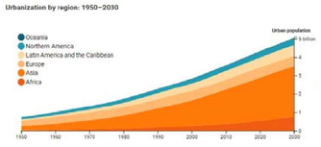
Urbanization and Commuting (Demographic) More than half of the people are living in the urban city, and it’s still growing, and the research shows in the 2050, nearly two of three people will live in the city (David, 2016). By 2030, the world is pretend to have 43 megacities with more than 10 million people. The yellow dots in the left picture shows the population for the 200 largest cities in the world, and bigger circles means
162 Wang and Zhao
Figure 2: Connected car forecast system.Figure 3: Urbanization by regions.Figure 4: Future transport.Table 1. Future scenario forecast.
Table available in the original PDF paper.
Demographic Economic 67% of people will move to cites, this will increase the city population density.
Business model tend to be “pay per use’ and “car as a service”
Environment Social Electric energy such as electric vehicle, and the energy can come from wind and solar.
Congestion problem Long ime in commuting
the more population, as people can see, the population of cities are growing especially the Asia part (Fig. 3).
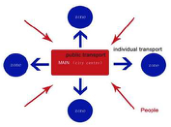
Future Transport System Another statistic also shows this future trend, environment energy will be used in our daily life and the figure below shows the market size for the future (Tan, 2016). The E-bus industry will have a huge increase, for the convenience commuting, global consumers are looking for innovation transport system (Fig. 4).
At the end of this section, the predictions of future scenarios are pre- sented (Table 1). I will explain the possible future scenarios in four parts,
How will the Smart Cockpit Develop and Facilitate a More Social Space 163
Figure 5: Frequency of private car and purpose.
Figure available in the original PDF paper.
Figure 6: Demand for car cockpits.
Figure available in the original PDF paper.
Figure 7: Demand for car cockpits.
Figure available in the original PDF paper.
demographic, economic, environment and social, and their respective con- tents are presented in the table.
USER INSIGHTS Method: Questionnaire Survey
Questionnaires will be distributed online to 50 car consumers from various occupations. They contain but not limited to designers, teachers, lawyers, doctors, workers, etc. They are 25 males and 25 females, aged between 20 and 50 years old, respectively, and through their opinions on electric or new energy vehicles, some users’ needs and experiences will be derived.
USERS’ DEMAND Frequency of Private Car use and Purpose of use
In this section will be related to the frequency of use of the user’s private car and the purpose of use. From the following pie chart (Fig 5), we can easily find that most of the users use their cars every day, and some of them never use their cars, and most of them use their cars as transportation. In the next section, we will analyze their car habits and behaviors through a table.
Demand for Car Cockpits This section analyzes the results of the user survey to derive the seating and space requirements for the interior of the car, as well as the expectations of all participants for the interior of the car (Figs 6 and 7).
164 Wang and Zhao
Figure 8: Demand for car cockpits.
Figure available in the original PDF paper.
Figure 9: User demand of smart cockpit progression.
In terms of interior space, 23 people wanted a more traditional seating distribution, and another 7 (Fig 6) people wanted a separate car belonging to the driver. Secondly, in terms of how much storage space they want inside the car, 32 people chose 3 luggage compartments, 14 people chose 2 luggage compartments, and 4 people thought one luggage compartment was enough space. In terms of interior features, everyone’s choices point to large space, followed by entertainment and extreme comfort.Above mentioned the favo- rite interior, so I will analyze the user’s preference for car styling style. There are 6 different styles, 14 people like sporty style. In the interior, as shown in (Figure 7), everyone’s choices point to a large space, a total of 42 people, 40 people choose entertainment and extreme comfort, next is extremely luxuri- ous, multi-function, new materials…; The importance of styling is mentioned above, there are 6 different styles, 14 people like dynamic style, 10 people like fashion and thick and heavy, 8 people choose compact style.
Preference for Cars In this part of the questionnaire, users’ preferences for the car and their expe- ctations for the smart car will be addressed, and this part will be implemented in the form of a questionnaire score and selection.
In terms of styling and performance, the user’s choice gives a very obvious directivity. According to the (Fig 8), the author divides the shape and perfor- mance on both sides, with 1-5 points in the middle, close to 1 and shape, close to 5 points. In the end, 19 people tend to be styling, 15 people pay attention to performance, and the rest of the number tends to be more people.
As shown in (Fig 8). The results show that the shape is the most impor- tant factor that everyone thinks, followed by safety factors. Comfort, price, handling, entertainment and other factors are listed. No fuel and no need to
How will the Smart Cockpit Develop and Facilitate a More Social Space 165
drive are considered to be the least important. Or because people don’t trust new technologies.
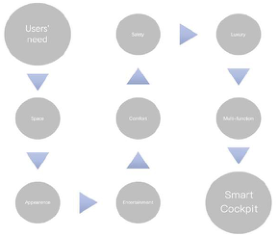
Therefore, based on the results of the questionnaire and after analyzing and sorting the data, the study concluded. In terms of user needs, basic needs such as space were the first to be considered, followed by appearance, safety, comfort and entertainment factors being taken into account one by one, with luxury as well as multifunction being the last to be mentioned (Fig 9).
USERS’ EXPERIENCE Experience of Quality Perception and Material
If you look closely at the interior of the car, you will find that many of the materials were available in the early days of the car – leather, wood, metal and fabric, giving a luxurious and retro feel (Gao, 2012). Subsequently, with the development of technology and the emergence of complex artifacts such as vinyl and fiberglass, automotive interior materials are more complex and durable.
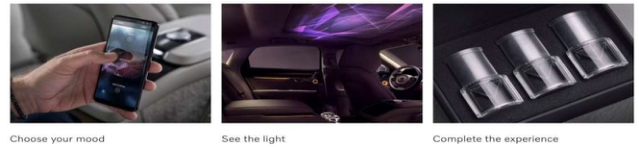
In recent years, new materials have become mainstream, namely carbon fiber, pseudo carbon fiber, piano black paint, pseudo piano black paint and translucent acrylic resin. These changes give people an aesthetic and tactile enjoyment. As shown in (Fig 10) of Volvo Ambience Interior,hree different moods create a sensory world inside the car, each with its own selection of themes inspired by the Scandinavian experience. Projected onto the inside of the panoramic roof, animated light shows create a symphony of atmospheric effects that are a visual delight. A collection of scents from perfumer Byredo enhances the feeling created by the cabin’s moods.
The Need of Digital Experience The digital screens under virtual technology support interact with physical controls, and the rough and simple controls that appeared in previous racing cars were replaced by softer, more upscale designs (Schmidt, 2010). The inte- rior is also designed with ergonomics, lighter, stronger, and more affable fabrics for a simpler, more comfortable and safer operation. The advancement of science and technology not only brings advances in virtual experience, but also advances in physical design and material application.
While digitalizing and interconnecting, it creates the simplest control expe- rience and the most comfortable driving experience (Krum, 2008). The two points reached equilibrium. And this balance point can even be customized according to personal preferences, thus improving driving pleasure.
Therefore, in terms of user experience requirements, first, material tech- nology continues to be innovative, exploring new synthesis and processing technologies, and creating materials and fabrics with better characteristics. The second is to make the design and material properties serve the users, and to provide users with a better experience in the design of touch and manipu- lation. Third, in the product design, the material fabric should go beyond the level of graphics, shape and color, and create emotional artistic conception to the user through different design themes. But the materialized design must
go hand in hand with the development of virtual intelligence technology, let the excellent physical experience and virtual experience combine, and create a better product of smart cockpit with synchronization.
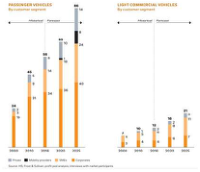
BUSINESS MODEL IN THE FUTURE The economics had a report recently, it said the use of the private and owned vehicles are about 5% and less than 10%. From Roland Berger (Mitchell, 2010), traditional automotive industry is developing into “car as a service” model, and customer model tend to be “pay per use” (Fig 11).
The statistics shows market participants work together to create greater value for the future, DiDi and VW established a partnership for the new business model to explore mobility projects. DiDi wants to change the car owners to car users in the future, and if people become part of the future mobility club, then the use cases are expanded (Shah, 2018).
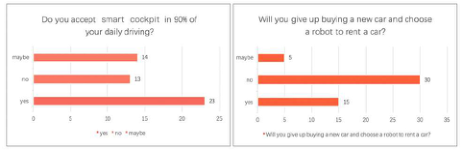
In this section, we will deal with the user’s acceptance of smart cockpit and the acceptance of smart car rental. The data is still from the questionnaire, in the graph we can see that 23 out of 50 and 14 out of 50 people choose to accept or may accept the smart cockpit, but 30 out of 50 people are not willing to go to the choice of renting a car to replace the private car to travel.
How will the Smart Cockpit Develop and Facilitate a More Social Space 167
Figure 13: Future business models.
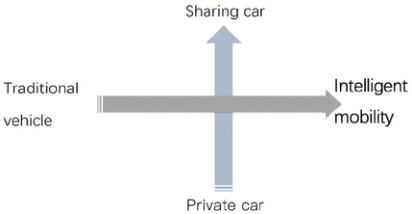
In the summary of this part, the content and data of this section will be (Fig 12) analyzed and summarized, and finally a trend analysis chart for future business models will be drawn (Fig 13), that is, the transition from traditional to intelligent, and the evolution of all models of vehicles from private to shared.
These trends may bring great opportunities for the new automotive busi- ness model, and the car-as-a-service model, including car sharing and carpoo- ling, will lead to a significant increase in the number of fleets and the overall number of vehicle users (Becker, 2017). Car sharing and pooling is simply the next stage in the evolution of the Car as a service model, although these trends may lead to reduce of overall the vehicle, but it will also lead to a large increase in the number of fleets and users (Ferrero, 2018).
CONCLUSION
Based on the discussion and study of the four main perspectives, some conclusions related to smart cockpits are listed below.
Due to the rise of smart vehicles and the gradual increase in demand for smart cockpits, the deep integration of cutting-edge business models with human needs is expected to serve people better. Looking at the smart car market and the development of vehicle interiors, smart cockpits are mostly attached to what we call Intelligent and Connected Vehicles (ICVs). In addi- tion, the increase of urbanization and the rise of sharing economy make the future car scenario more shared and smart. On this basis, interior design has to meet more types of needs, and interior space is very important to users. New energy models are mainly based on electric vehicles, which can save a lot of interior space. In addition, the introduction of new technologies can maximize the function of the interior, such as the panoramic cockpit artificial intelligence system and holographic screen.
Generally speaking, the user demand of intelligent cockpit and the tech- nical challenges brought by future scenarios are yet to be improved. The intelligent interaction of cockpit will bring us a new experience under the business model of sharing economy, and eventually the car will become an active, personalized, and emotionally intelligent mobile social space.
REFERENCES
Becker, H., Ciari, F., Axhausen, K.W., 2017. Comparing char-sharing schemes in Switzerland: user groups and usage patterns. Transportation Research Part A, Vol. 97, 17–29.
168 Wang and Zhao
Benevolo C, Dameri R P, D’auria B. Smart mobility in smart city[M]//Empowering organizations. Springer, Cham, 2016: 13–28. David M, Nicholas S. Use our infographics to explore the rise of the urban pla-
net, 2016. https://www.science.org/content/article/use-our-infographics-explore- rise-urban-planet. Ferrero, F., Perboli, G., Rosano, M., Vesco, A., 2018. Car-sharing services: An annotated review. Sustainable Cities and Society, 37, 501–518. GAO Shan. On Artistic Style Design of Automotive Interior Fabrics[J]. Journal of
Zhejiang Fashion Insti-tute of Technology, 2012, 11(4): 72—75. JIN Sheng-hui. The Interior Design and Research of Aisn’s Electric Car[D]. Changsha: Hunan University, 2016. Koopman P, Wagner M. Autonomous vehicle safety: An interdisciplinary chal-
lenge[J]. IEEE Intelligent Transportation Systems Magazine, 2017, 9(1): 90–96. Krum, D.M., Faenger, J., Lathrop, B., et al.: All roads lead to CHI interaction in the automobile. In: Proceeding of ACM CHI Conference on Human Factors in Computing Systems, Florence, Italy, pp. 2387–2390 (2008) Leder H, Carbon C C. Dimensions in appreciation of car interior design[J]. Applied
Cognitive Psychology: The Official Journal of the Society for Applied Research in Memory and Cognition, 2005, 19(5): 603–618. Lidwell W, Holden K, Butler J. Universal principles of design, revised and updated: 125 ways to enhance usability, influence perception, increase appeal, make better design decisions, and teach through design[M]. Rockport Pub, 2010. Möser K. The driver in the machine: Changing interiors of the car[J]. Tackling
transportation, 2003: 61–80. Marrenbach J. Advanced user interface design for aircraft cockpit devi- ces[M]//Human error and system design and management. Springer, London, 2000: 177–180. P Shah. Memory Market for Autonomous and Connected Vehicles | Industry Trend, Demand and Forecast 2030, 2020. Panagiotopoulos I, Dimitrakopoulos G. Cognitive intelligence of highly automa-
ted vehicles in a car-sharing context[J]. IET Intelligent Transport Systems, 2019, 13(11): 1604–1612. Schmidt, A., Spiess, W., Kern, D.: Driving automotive user interface research. IEEE Pervasive Comput. 9(1), 85–88 (2010) Sun X, Chen H, Shi J, et al. From hmi to hri: Human-vehicle interaction design
for smart cockpit[C]//International Conference on Human-Computer Interaction. Springer, Cham, 2018: 440–454. Tan, YH; Zhang, CL. Semantic Presentation and Fusion Framework of Unstructured Data in Smart Cites. WJ Mitchell, LD Burns, C Borronibird. Reinventing the automobile: personal urban
mobility for the 21st century, 2010. https://www.rolandberger.com/.../roland_be rger_car_as_a_service_final.pdf.
LISTED IN THE AHFE DIGITAL BOOKSTORE CATALOGUE
Explore the complete digital volume
Ergonomics In Design
Read this individual research paper free through the original publisher, or explore the full digital proceedings book.
ISBN 978-1-958651-23-0
Explore this ISBN in the AHFE Bookstore ↗Listed in the July 2026 bookstore catalogue; search by ISBN to confirm current availability · Digital book purchase optional