Automobile Cabin's light, as a novel emotional feedback medium, has attracted considerable attention. In this experimental study, we investigated the effects of the Cabin's light on the user's emotional feedback while the light’s color varied in hue, chroma and dynamic patterns. A total of 20 hunan University students visually experienced 18 different kinds of lights and made subjective assessments from three dimensions: valence, arousal and uniqueness. As a result, We observed that light’s chroma had a significant effect on the emotion of dynamic patterns, and there were differences in the effect of chroma among dynamic patterns under different light’s hue. The low chroma smooth light patterns performed more positive valence, on the contrary, the high chroma sudden light patterns brough higher arousal level, and the uniqueness was related to personal choice tendency. This study provides experience for designing satisfactory Cabin's light from the perspective of user emotional feedback.
Since smart cars have less restrictions on Automobile Cabin’s space, the sensory attributes of Automobile Cabin, including light, sound and smell, are discussed as the focus of improving user experience. Automobile Cabin light can bring positive emotional experience to users. An industry report pointed out that the intelligent lighting system of Automobile Cabin, as the top user’s intelligent configuration demand, has attracted more and more attention. And, its influence in automobile purchase factors is rising. The design of light for Automobile Cabin is being actively explored. Designers believe that light is a novel emotional medium, and explore its new design opportunities in combination with the increasing demand for Automobile Cabin light design in the market. For example, lights can be used to support the natural notification system in Automobile (Balogh et al. 2019).
User’s Emotional Feedback to Automobile Cabin’s Dynamic Coloured Light 137
EMOTIONAL EFFECT OF LIGHT Emotional Effect of Coloured Light
As an important medium of communication, the emotional effect of light on human comes from nature. The circadian rhythm of human body is controlled by the neural mechanism of biological clock. The light and dark mode of daily affects the setting of human internal biological clock. Light participates in and regulates many biochemical reactions of human body, especially circadian rhythm, hormone secretion and alertness, that is, the so- called human non-visual biological effects. Melatonin secretion associated with alertness is influenced by color temperature and light intensity. Usually, bright and high color temperature of the morning light acts as a wake-up call, while the evening sunset gradually darkened and lower color temperature of the sunset, bring people calm, tired and relaxed feeling.
With the development of technology, it becomes easy to manipulate the spectrum to achieve rich coloured light effects. Westland et al reviewed the non-visual effects of light on humans with the aim of developing a theory of emotional feedback for light color (Westland et al. 2017). Several other studies have made relevant findings. Blue light has a quick wake-up effect, while green light, on the other hand, triggers drowsiness (Bourgin and Hub- bard, 2016). Lower chroma are generally more popular than higher chroma, while higher chroma of red can bring a sense of tension (Lee et al. 2017). This study attempts to examine whether the emotional effect of coloured light on human can be replicated in the Automotive Cabin environment.
Emotional Effect of Automotive Cabin Light Previous research on Automotive Cabin light has focused on the emotional impact of static ligh conditions, for example, Chroma intensity produced a greater degree of different emotional feedback on the green light, chroma intensity for the red hue, blue hue of monochromatic light emotional impact was not significant (Jiong and Jiaying. 2019). By using ambient light while driving, the overall perception of the Automotive Cabin was improved and that blue light looked brighter than orange under the same conditions (Caberletti et al. 2010). Large areas of bright light with a high blue compo- nent and a reduced configuration of visual and auditory stimuli promote a reduction in cognitive workload (Pollmann et al. 2019). However, the emo- tions of the driver and passengers in the Automotive Cabin are often in a dynamic change, with the change in human expectations of emotions, the light should also be adjusted accordingly.
Izso introduced the term “dynamic light” to denote lighting that provi- des light output parameters that change over time and can be perceived as such, thus distinguishing this type of changing light from traditional static light (Izso. 2009). Recently, some conclusions have been drawn from dynamic light studies where the dynamic patterns are more pronounced. For example, dynamic light with visually continuous smooth transitions brings a feeling of safety and comfort (Wang et al. 2014). Continuous sudden flashes of light bring a strong arousal (Kozaki et al. 2018). Research is also being conducted on dynamic light in Automotive Cabin. For example, changes in ambient light
138 Wang and Zhao
at different speeds can alter the driver’s perception of vehicle speed and thus affect the driving experience (Huysduynen et al. 2017). The use of different dynamic visualization effects of light emitting diodes can convey different messages while attracting the attention of the driver (Tr S et al. 2018). And, a smooth dynamic light setting was assessed as more positive and that sudden flashes of red led to the creation of tension while subjects’ satisfaction decre- ased (Kim et al. 2021). These studies have explored the dynamic patterns of different lights and some of the effects under the influence of coloured light hue changes. However, studies on the emotional feedback of different dyna- mic patterns light under the influence of different chromas are still relatively blank.
EXPERIMENT Experimental Assessment
This experiment involved three subjective assessment dimensions: valence, arousal, and uniqueness. Based on previous studies in the literature, we iden- tified two criteria for assessment dimensions. First, we selected a pair of indicators proposed by Russell in the field of psychology to determine the emotional framework, valence and arousal (Russell and Mehrabian. 1977). Valence refers to the performance of the emotional feedback elicited by the experimental light group in terms of negative versus positive levels, and arou- sal indicates the intensity of the light’s effect on emotion. Secondly, due to the novel attribute of Automobile Cabin lights, the uniqueness assessment dimension is set to be measured at the level of personal preference.
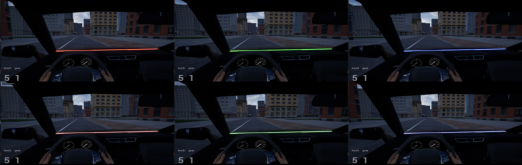
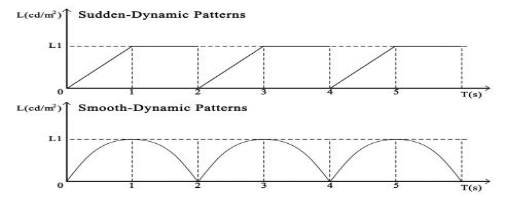
Experimental Conditions and Environment In this study, we placed a model of a self-driving automobile in a VR envi- ronment simulating an urban road, and set up dynamic experimental light settings with different hues, chromas, and dynamic patterns in its Automo- bile Cabin. In particular, by adjusting the virtual environment settings to the VR environment weather environment was defined as cloudy, the cabin mate- rial was dark, in order to ensure the degree of experimental simulation under the premise of reducing the impact of interference from other factors in the environment. The experimental light settings were combined by 3 primary hues (R, G, B), 2 chromas (High, Low), and 3 dynamic patterns (smooth, sudden, and on) to form 18 sets of settings. Because the light intensity was not the focus of this study, all experimental light settings were uniformly pla- ced on the IP panel of the Automobile Cabin in the form of lower intensity (light intensity = L1) light strip models (see Figure 1). The current study did not factor in the speed of dynamic change. In addition to the static continu- ous light setting (dynamic patterns for the on light setting), the smooth and sudden light dynamic patterns over time are shown below (see Figure 2).
Experimental Procedure The experiment was conducted in the Simulation Cockpit Laboratory of the School of Design, Hunan University. The subjects were 20 college and
User’s Emotional Feedback to Automobile Cabin’s Dynamic Coloured Light 139
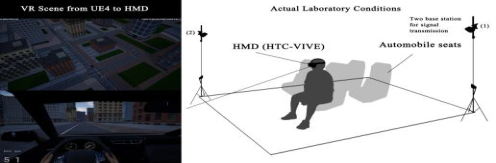
Figure 1: Three primary hues (R, G, B) and Two chromas (High, Low).Figure 2: Smooth and sudden light dynamic patterns.Figure 3: VR scene (self built by the author) and actual laboratory conditions (adapted from Yonezawa and Yoshioka, 2021).
graduate students (10 women and 10 men) who were tested for red-green color blindness to confirm that they had normal color vision. Scene rendering software (UE4 4.26.2) with a VR connection port was used to build a virtual environment including low-speed autonomous automobile on an urban road and allowed subjects to experience it through a head-mounted display (HTC - VIVE) (see Figure 3).
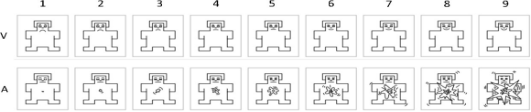
Before the experiment started, subjects were informed in detail about the purpose of this experiment and the meaning of the experimental asses- sment dimensions. Through the Self-Assessment Manikin (SAM) instrument was used to assess participants’emotional valence (1 = extremely negative, 9 = extremely positive) and arousal (1 = lowest arousal, 9 = highest arousal) based on their emotions feedback elicited by experimental light (Bradley and Lang. 1994) (see Figure 4). The uniqueness assessment dimension also took the form of a 9-level division (1 = extremely common, 9 = extremely unique). We provided relevant adjectives for all assessment dimensions. During the preparation phase of the experimental procedure, the subjects were instructed to sit in a simulated driving seat and wore the VR device correctly. They then
140 Wang and Zhao
Figure 4: A 9-level model for assessing valence and arousal scales (Bradley and Lang, 1994).Table 1. Results of Valence. An asterisk indicates significance at p < 0.05.
followed the experimenter’s prompts to confirm the automobile operation (approximately 5 KM/h uniform speed) and to focus their eyes on the road in front of the automobile. None of the subjects reported any motion sickness.
RESULTS
To examine the results statistically, we performed the Three-Way ANOVA for light hues, chromas and dynamic patterns were set as independent vari- ables. The assessments of valence, arousal, and uniqueness were included as dependent variables. The significance test (sig.) and Estimates of effect size (Partial Eta Squared) for the Three-Way ANOVA are outlined here (see Tables 1, 2, 3). According to the significance test, results are reported as significant for p < 0.05.
Results indicate that hues, chromas and dynamic patterns all indepen- dently had a significant impact on the assessments of valence, arousal, and uniqueness. Moreover, the interaction between hues and chromas and the
User’s Emotional Feedback to Automobile Cabin’s Dynamic Coloured Light 141
Table 3. Results of Uniqueness. An asterisk indicates significance at p < 0.05.
Figure 5: Estimates of effect size of Valence dimension.
interaction between hues and dynamic patterns also had a significant effect on the assessment of valence and arousal dimensions. However, the factor interaction did not have a significant effect on the assessment of uniqueness dimension. From the Estimates of effect size results, dynamic patterns had the most significant effect on the assessment of arousal dimension. The most significant effect on the assessment of valence dimension was the hues factor.
Further, based on the results of the Estimates of effect size test section, we can conclude the following.
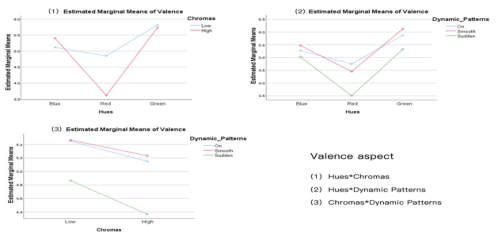
Valence assessment dimension. Overall (with the exception of the blue settings) the low chroma experimental settings scored more positively and higher. The red color had the lowest overall valence dimension scores among the three hues, but was the most influenced by chroma factor, and the low chroma red color had the most significant increase in valence dimension sco- res. The green color had the highest valence dimension scores regardless of the chromas, which was consistent with the previous significance test results. In addition, the low chroma settings in the smooth dynamic patterns scored the most positively. The experimental settings with sudden dynamic patterns had the lowest valence dimension scores (see Figure 5).
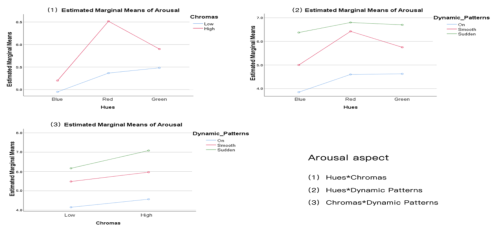
Arousal assessment dimension. The experimental light settings with sud- den dynamic patterns had significantly higher arousal dimension scores for each hue and its chroma than the other dynamic patterns, which was con- sistent with the significance test findings. In contrast, the on light settings without dynamic changes all had significantly lower arousal levels than the
142 Wang and Zhao
Figure 6: Estimates of effect size of Arousal dimension.Figure 7: Estimates of effect size of Uniqueness dimension.
light settings with dynamic changes, which was consistent with the previous experimental findings of Kim et al. The arousal levels were also significantly higher in the high chroma settings, especially in the red high chroma settings, than in the low chroma settings. In terms of hues, the blue light settings all had the lowest arousal dimension scores (see Figure 6).
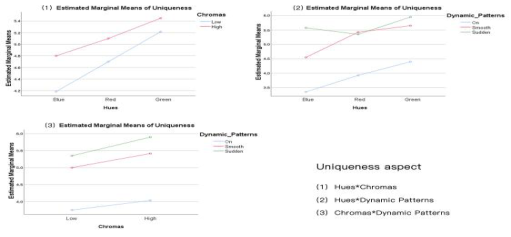
Uniqueness assessment dimension. The overall Estimates of effect size in terms of uniqueness dimension is smaller. Relatively speaking, the high chroma light settings exhibited higher scores on the uniqueness dimension. Green color scored higher compared to the other two hues. The sudden dynamic patterns contributed more to uniqueness, and the on light settings without dynamic changes had significantly lower levels of uniqueness than the other light settings (see Figure 7).
DISCUSSION
There is growing agreement that the emotional value of Automobile Cabin has a significant impact on user decisions, so Automobile Cabin lighting is being explored as an important dimension affecting the emotional experie- nce of users. Previous studies on the emotional feedback of Automobile Cabin lighting patterns have focused on static lighting or the dual influence effect between hues and dynamic patterns, but in this study chromas was added as a supplement to the study of dynamic coloured light emotional feed- back influences. Subjects entered the VR environment with the first view
User’s Emotional Feedback to Automobile Cabin’s Dynamic Coloured Light 143
of the driver for the subjective experience of the experimental light settings. Different from the experimental environment of previous static videos, the empirical evidence therefore provides a valuable reference and contributes value to thinking about Automobile Cabin light design. As summarized in Tables 1, 2, and 3 and Figures 5, 6, and 7, the red color had the most signi- ficant effect on chroma changes on the valence and arousal dimensions. The sudden high chroma red valence dimension scored the lowest and arousal dimension scored the highest. In combination with the post-experimental subjective interviews, this group of light stimuli brought about strong fee- lings of tension and uneasel. Green light showed a more positive emotional feeling overall in the user interview session, but its arousal dimension asses- sment was also more influenced by the changes in chroma. The feedback results of high chroma red and green may be related to the habitual semantic perception of users resulting from the usual display of red and green as traf- fic signals. Blue had the most stable trend performance among all hues, and its performance was less affected by changes in chroma in the valence and arousal assessment dimensions.
In particular, some subjects indicated that the high chroma light settings brought more unique associations. For example, the high chroma of green brings similar associations related to the use of fashion colors in recent years, and the high chroma of red has feelings related to game E-sports. Combined with the outstanding performance of dynamic patterns in enhancing unique- ness, High chroma plus dynamic Changing patterns light settings can be used to create exclusive experience scenes. Subject interviews showed that low chroma smooth light brought more positive emotional value. Low chroma smooth dynamic light settings, especially green and blue, were described by some subjects as a breath-like emotional experience, and red low chroma smooth dynamic light settings also substantially enhanced similar warm, soft emotional feedback compared to high chroma sudden light settings. Similar results have the potential to be applied in entertainment and leisure scenarios to enrich and enhance the emotional experience of travelers. And, the high arousal level brought by the dynamic patterns for the sudden experimen- tal light settings has the potential to become a new medium of information feedback.
CONCLUSION
We demonstrated a cloudy city road driving scenario through a VR virtual environment to study the effect of emotional feedback on subjects when the experimental light settings was changed in hues, chromas and dynamic patterns. A total of 20 college and graduate students participated in the experiment and subjectively evaluated the presented light designs in terms of valence, arousal and uniqueness dimensions. We conducted a Three-Way ANOVA test with repeated measurements and found that chroma variation had a significant effect, but the sensitivity of different hues to the effect of chroma varied. The effect of dynamic patterns on emotional feedback was also significant, with low chroma smooth light settings scoring higher and more positive on the valence dimension, while high chroma sudden light settings performed more strongly on the arousal level. Uniqueness was mainly
144 Wang and Zhao
influenced by personal preference, but overall light settings with dynamic changing pattern attributes scored higher and more unique. The subjective interview content largely validated the findings of the Three-Way ANOVA in significance and estimates of effect size tests. The results of this experi- ment are expected to be used by designers to design Automobile Cabin light solutions that better meet the emotional experience expectations of travelers.
REFERENCES
Balogh R., M Lipková, V., Lukani, et al. (2019). “Natural notification system for the interior of shared car - ScienceDirect”. IFAC-PapersOnLine, 52(27):175–179. Bourgin, P. and Hubbard, J. (2016). “Alerting or somnogenic light: pick your color”.
PLoS Biology, 14,8, e2000111. Bradley, M. M. and Lang, P. J. (1994). “Measuring emotion: the self-assessment manikin and the semantic differential”. Journal of Behavior Therapy and Experimental Psychiatry, 25 (1), 49–59. Caberletti, L., Elfmann, K., Kummel, M., et al. (2010). “Influence of ambient lighting
in a vehicle interior on the driver’s perceptions”. Lighting Research & Technology, 42(3):297–311. Huysduynen, H H V., Terken, J., Meschtscherjakov, A., et al. (2017). “Ambient light and its influence on driving experience”. the 9th International Conference. Izso, L. (2009). “Appropriate dynamic lighting as a possible basis for a smart ambient
lighting”. Int. Conf Universal Access in Human-Computer Interaction, San Diego, CA, USA. Jiong, F., Jiaying, L., (2019). “A quantitative approach to the emotion of ambient light color based on perceptual engineering”. Mechanical design and research, 35(05):104–107. Kim, T., Kim, Y., Jeon, H., et al. (2021). “ Emotional Response to In-Car Dynamic
Lighting”. International Journal of Automotive Technology, 22(4):1035–1043. Kozaki, T., Hidaka, Y., Takakura, J.Y., Kusano, Y. (2018). “Suppression of salivary melatonin secretion under 100-Hz flickering and non-flickering blue light”. J Physiol Anthropol. 37.23. Lee, J. S., Choi K. H., and Park, J. Y., (2017). “Emotional responses and preferences
according to flie chromacity of LED lighting”. Korea Society of Color Studies, 31, 1, 103–112. Pollmann, K., Stefani, O., Bengsch, A., et al. (2019). “How to Work in the Car of the Future?: A Neuroergonomical Study Assessing Concentration, Performance and Workload Based on Subjective, Behavioral and Neurophysiological Insights”. The 2019 CHI Conference. Russell, J. A. and Mehrabian, A. (1977). “Evidence foraftree- fector theory of
emotions”. Research in Personality 11, 3, 273–294. Tr S, sterer, Streitwieser, B., et al. (2018). “LED Visualizations for Drivers’ Attention: An ExploratoryStudy on Experience and Associated Information Contents”. The 10th International Conference. Wang, HH., Luo, et al. (2014). “A study of atmosphere perception of dynamic
coloured light”. Lighting Research & Technology. Westland, S., Pan, Q. and Lee S. (2017). “A review of the effects of colour and light on non-image function in humans”. Coloration Technology, 133, 5, 349–361. Yonezawa, K., Yoshioka, Y. (2021). “Effect of Path Width on Human Distance Perce-
ption and Gaze Position During Walking”, International Conference on Applied Human Factors and Ergonomics. Springer, Cham, 743–751.
LISTED IN THE AHFE DIGITAL BOOKSTORE CATALOGUE
Explore the complete digital volume
Ergonomics In Design
Read this individual research paper free through the original publisher, or explore the full digital proceedings book.
ISBN 978-1-958651-23-0
Explore this ISBN in the AHFE Bookstore ↗Listed in the July 2026 bookstore catalogue; search by ISBN to confirm current availability · Digital book purchase optional