Maria João Pereira Neto, Maria Inês Leal (2022). From Binary Fashion to Bio-Segmentation: Body Biotypes and Somatotypes as Main Bases to Fashion Design. In: Design for Inclusion. AHFE Open Access, vol. 45, pp. 63–71. https://doi.org/10.54941/ahfe1001870
In this moment in history, products cannot only be about aesthetics, quality, and fabrics.The design process begins long before the idealization of a creation and its mandatory for professionals and brands to comprehend the weight of values,content and concept to the user, and use them to express and educate all consumeers. This paper aims to recognize, clarify, and document the specific subject of bio-segmentation: body somatotypes and biotypes, as the new base of construction in fashion design, instead of basing it in binary genders. For this, mind mapping, brainstorming organization charts, observation, stakeholder maps and surveys will be used to help in the structuring of this paper.Somatotypes are the three types of bodies that everybody has, women and men: ectomorph, mesomorph, and endomorph. Ectomorph is the leaner somatotype, with a light and narrow bone structure.Mesomorph is the athletic one, men with inverted triangle biotypes, and women with hourglass biotypes are usually in this category. Lastly, the endomorph somatotype, is the most common one, has a slow metabolic system propitious to fat increase. As to biotypes, there is six female ones (triangle, rectangle, diamond, oval, inverted triangle, and hourglass), and five male ones (triangle, rectangle, trapeze, oval, and inverted triangle), from which four match, meaning that there are only seven in total to build the segmentation system form.Gender issues, genderless fashion design, sustainability, inclusion, and ethics are some themes of relevance to new generations, and it is imperative to find new ways to stop them from remaining social stigmas. So,we suggest a new segmentation method that divides fashion and patterns through biotypes and somatotypes. It is also a goal to try to understand and predict how to reinvent design to fit this ideal and which are the essential modifications that need to be do be done the current design production, making this issue a relevant phase of the design process.We aim to promote some relevant research, helping genderless fashion to become a viable way for brands to stop making binary divisions, boosting the end of acceptance of sexist social norms and culture as well as the stigmatization of gender issues.We hope, that after this purpose is accomplished the real meaning of freedom will be achievable in clothing and fashion.
“We ‘re creating art that people feel like they can live their lives [in] and be authentic [to] who they are” (Reed, 2002). Throughout all these years,
fashion has been binary, following the idea that humans are only men or women, segmenting itself by that and contributing to the perpetuation of this non-inclusive ideology. According to Barnard (2002) there is as many genders as people since everyone lives their individuality and identity in a different way and that leads to the thought that we live in a non-binary soci- ety. Fashion is not accompanying science developments and demonstrating how our society is, keeping itself from going against more skeptical ideas and consumers to maintain social norms, resulting in non-inclusive beha- vior from brands, keeping out non-binary people. The new generations are demanding change, and displaying different preoccupations with the world, being noted in fields as sustainability about everything around them, inclu- ding ethics and inclusion. According to Gonçalves (2018) genderless fashion is all about the freedom of everyone being able to feel included and wea- ring what they think it is fit, without normative judgements. According to the European Union (2019) the evolution of gender equity is subjected to the developing of cultural and ethical values, as well as our societies’ mentality. According to Gatens (1991) female and male bodies have different meanings, having different commercial value, as well as if the femininity or masculinity is not shown on the appropriate and biologically right frame is not valued at all. As clarified in Body labs survey (2016), most consumers are not happy with fitting, since 58% of shoppers said they would buy more clothes if a proper fit was ensured. The usual sizes and fittings are not enough to today’s consumer, since clothes nowadays are all made for the one body type, lea- ving users with other body typologies left unsatisfied. With this paper, we aim to promote fashion design as something which embraces people through its inclusivity, making it possible for the industry to understand how this issue is relevant. It is mandatory to always have in mind subjects like eth- ics, sustainability, and inclusion through this process. Moreover, the goal is to promote content that enhances freedom, health, safety, and inclusion, and make it a natural theme for everyone to speak about, demystifying its complexity today.
GENDER BINARY IN FASHION: GENDERLESS AS THE INCLUSIVE WAY According to Braudel (2013) fashion mirrors itself, the economy, civiliza- tion, impulses, possibilities, demands and pleasures of living. Silva (2005) explains how it is a flexible industry showing the temporal location, society, aspirations, religion, ethnicity, age, job and lastly, gender. According to Butler (1993), gender is not something that has to do with your body, but with social construction, being therefore open for change. Fashion is heavily segmented, and the connection of this with gender is evident, since it is how clothing, and the industry is portrayed to consumers. As Paço A. (2008) explains, there is four types of segmentation: geographic, psychographic, demographic, and behavioral. The demographic one is mostly based on gender and, according to Posner (2015), also on ethnicity and culture, age and generation, mari- tal status, life stage, job, education, income, and social grade classification. For children it does not justify having segmentation since all have the same
From Binary Fashion to Bio-Segmentation: Body Biotypes and Somatotypes 65
anatomy, but when puberty strikes, generation and age begins to matter in terms of bodies, styles, behavior, etc, because it influences your buying decisi- ons. People give relevance to different things. Gen Z and Millennials are more familiar and opened to changes on the gender identity in fashion, since their own generations are the newest society and is full of gender diversity. They have a better understanding of gender expression and gender identity and its disassociation with the biological sex. Fashion brands should be empowering and responding to all their consumers needs for sizes, body types, genders, and inclusion, and it seems like it is choosing not to do it due to controversy with older generations.
Clothing and fashion in general are, either online or physically, presented to us divided by age and gender, “filter through which individuals experi- ence their social world” (Bristor & Fischer, 1993, p. 519). A family shop for example, will have six different parts, women, men, boy and girl, baby boy and baby girl. The shopping experience is cut in half when people are expected to be buying for some man or woman they are related to on the “wrong” side of the store, instead of acquiring garments that fit them and that they might like better. It is important to make everyone comfortable buying anything in the store. There have been studies about the female buying habits and how they see clothing and prefer stores, as well as about male, but there are not enough studies done to non-binary people, although, accor- ding to Reddy-Best & Pedersen (2015) the ones that have been done, did highlight the fact that the binary distribution is not in favor for retail. Boyd, Ritch, Dodd, and McColl (2020) have a discovered a better and ongoing understanding of gender roles and sexual orientations on the younger gene- rations, even though there is not enough information about the impact of binary fashion on culture and understanding of non-binary people. It is important for brands to give themselves more credit on educating consu- mers and “marketers need to recognize that place is a social construction; the service scape is molded by the very people who occupy it” (Johnstone, 2012, p. 1402). “One’s identity can be shaped by place if one feels that he or she belongs to that place” (Johnstone, 2012, p. 1413) Genderless is not unisex, but the simplification of fluidity and “is nothing more than the freedom of people to choose how they want to dress. It is not an adapta- tion of designers and brands to make clothes with a straight cut and unisex. Quite the opposite! It’s the possibility of giving consumers the chance to choose what kind of clothes they want to wear, either in the boys or girls’ section.” (Vilaça, 2021) As explained by Oliveira (2007) it is a way of writing visual text, where each person expresses their identity and being in this time and space.
Even though expanding options and inclusion in fashion brands is the main objective, we cannot take away the already existing clothing typology or think people want to abandon their gender expression traits. Men must work towards a bigger range of garments in their wardrobes as women have done before, without avoiding privilege discussions. “When designers and retailers talk about the ‘issues’ behind androgynous fashion, they tend to focus on the freedom of queer sexual expression whilst completely failing to address the
66 Neto and Leal
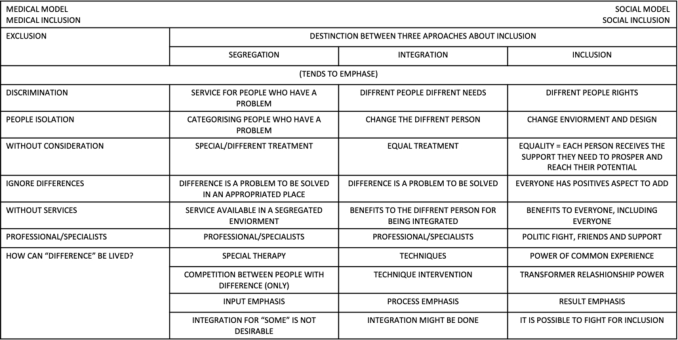
Figure 1: Inclusion Model inspired on Richad Rieser’s Work. Richard Rieser, Consultant on Inclusive Education and Disability Equality. See http://www.worldofinclusion.com/ integration_inclusion.htm.
elephant in the room – that is, the pervasive socio- economic power gap betw- een men and women that makes it almost shameful for straight, powerful men to slide over into female garb. (...) the norm is – and has always been – for women to adopt menswear, usually to gain more power in the workplace. And this goes deeper, too – it could be argued that for women to ‘make it’ in our society, they need to tone down anything associated with femininity: think, nurturing, kindness, non-violence, and intuition and ramp up ‘mascu- line’ traits like com- petition, logic and cunning.” (Boscio, 2017) Genderless fashion design is offering an inclusive and sustainable factor to brands as well as products to every person, of any gender and presenting clothing by bioty- pes/body types and product category seems to be the most inclusive way of selling and designing. “Inclusive Design responds to Design Exclusion and aims to create designs that are mainstream in nature, which can benefit the majority by including those who are design excluded (…) Inclusive Design ini- tiatives (…) have demonstrated that working with people who are excluded by design such as older and disabled people is an effective way of developing inclusively designed products, services, environments and communications for other groups in the population (…) ‘design’ is becoming a type of social activity, which relates to the development of societies” (Lee & Cassim, 2009) According to this researchers, the capacity of the designer creating produ- cts that are not related to their personal aesthetic is becoming increasingly relevant. In figure 1, we see that the best way to address difference, it is not to treat it like a hilliness, or integrating it on our reality, but to include it in our society with equity and giving out all the tools necessary for this peo- ple to reach their maximum potential. The example given is for people with disability but is easily relatable to this theme through its inclusive concept and treatment. It explains how design should be thought for everyone and not just for the people considered “normal” in society. For this, we need desi- gners who can step out of themselves and their comfort zones. If equity could be encouraged by genderless fashion, promoting it is a social contribute.
From Binary Fashion to Bio-Segmentation: Body Biotypes and Somatotypes 67
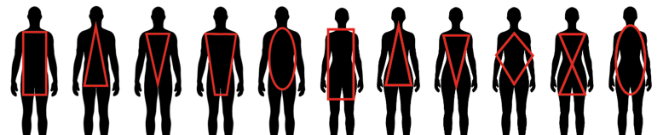
SOMATOTYPES AND BODY TYPES: BIOSEGMENTATION According to Tóth et al. (2014) Somatotypes are an investigation method to understand living people on their time, their proportions and morphology while Sterkowicz-Przybycie´n (2010) tells us this method gives us synthetic information about a person’s physique, which can help knowing more about their motor efficiency. It also can help understand how to set people in cate- gories like morphotype and morphologic or ectomorph, mesomorph, and endomorph. Ectomorph is characterized by its line and fragile figure, by the prevalence of length measures in detriment of diameters or perimeters, having a minimal development on a muscular or fat level. Mesomorph is portrayed as athletic, with robust physique, defined abdominal muscles and narrow pelvic waist, being the bone structure and muscular definition visi- ble. Finally, the endomorph is known by its voluminous body, characterized by its capacity to accumulate fat, being usually perceived with round sha- pes and a big concentration of mass on the pelvic waist. There are six types of biotypes for women and five for men. For women we have pear/trian- gle and apple/oval, as we have seen before, and then inverted triangle, hour- glass, rectangle, and diamond. For men we have the same four we have seen before, triangle, inverted triangle, oval and rectangle, plus the trapeze, which is larger on the shoulders comparing to the hips. This difference is the most noticed between biotypes as well as the wait proportions. It is hard to pass by these images and not notice the similarities between biotypes named after their biological sex and segmented binary, like fashion, when there is only six female biotypes and five male biotypes, from which four coincide, lea- ving only three out. There are only seven biotypes, and maybe instead of just designing for the binary brands should be focusing on new generations that no longer only divide in males and females and making products for the seven types of bodies that have been being studied. This would be a step tow- ards inclusive design in fashion, so that everyone could buy the product they like the most for themselves without the cultural judgment, less waist, since the products are being made for more biotypes and sizes and lastly, a step to promote freedom, confidence, and awareness in every generation. Science has already understood that gender has nothing to do with biological sex or sexuality, but with culture. The sex is “a bodily given on which the con- struct of gender is artificially imposed, but... a cultural norm which governs the materialization of bodies.” (Butler, 1993) According to Butler is true that there are anatomic differences between men and women, they are factual and visible, but gender is all about social conventions and has nothing to do with anatomy.
68 Neto and Leal
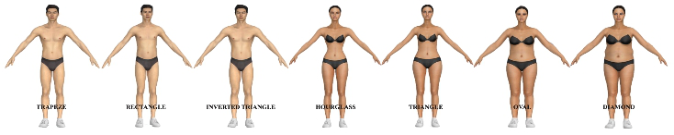
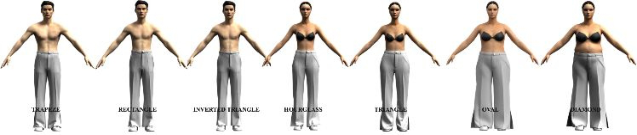
Figure 3: Avatars done on Clo 3D. Sourse: Author Inês Leal, 2022.Figure 4: Trousers model in every biotype. Source: Author Inês Leal, 2022.
APPLIED RESEARCH Considering the presented review, what we propose is an option for brands and designers to make fashion gender inclusive and portray society as it is today, using biotypes as the segmentation instead of gender, biosegmenta- tion, ending up with a better fitting product, sustainable and ethic, fitting more people and, therefore, producing less waste. We would be inviting peo- ple to discuss and see the issues as they are instead of hiding them behind the toxicity of binary fashion, making nonbinary feel wrong about them- selves. It is studied that most people wear mostly formal and basic wear to work and vary on the weekends (Morais, Carvalho & Broega, 2011), being this a good starting point. Taking basics and formal wear and tur- ning it into genderless sections on the store for habituation, would make everyone need to go to that part to the store, so when every other part of it was changed it would be normal. We chose a garment and a pattern while making avatars on Clo 3D, each resembling a biotype (figure 3). This were used as bases to alter the pattern for better fitting and comprehend if it was possible do add options without taking away the ones brands already have to offer in stores. In these images, we can understand the body diver- sity, and even though some sizes end up being larger due to somatotypes factors it does not mean that they can just wear a bigger size done for other biotype. This could be damaging to the level of making people feel like there is something wrong with their bodies, because they do not fit what is sold everywhere.
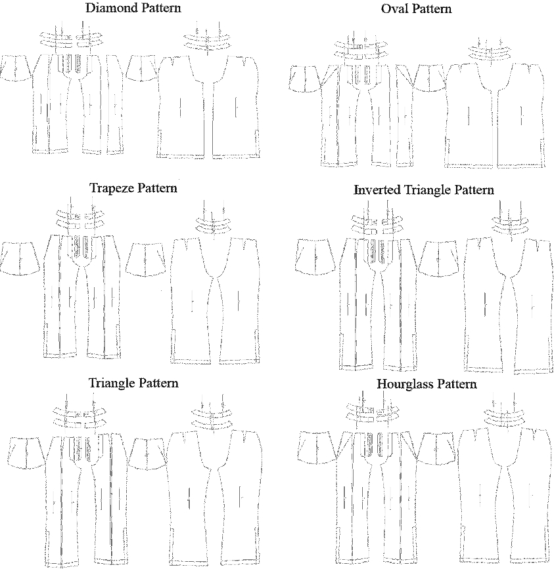
On figure 3. we see the biotypes and the possibility of adding content to brands and collections, as design and fitting becomes bigger than gender. The type of segmentation we are proposing makes it possible to add new niches and generations to the target user. On figure 4, is visible the same trousers with different pattern designs to all different bodies. We evidence the differences of fitting between bodies, some of them are presented with male bodies, others with female ones, but all of them can and should be worn by any person who sees fit.
From Binary Fashion to Bio-Segmentation: Body Biotypes and Somatotypes 69
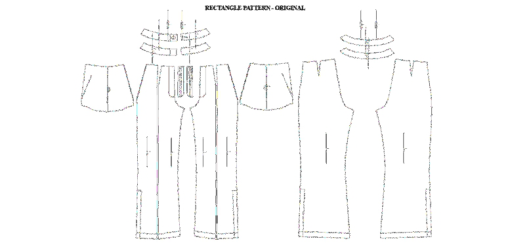
Figure 5: Trousers Pattern Design. Original Pattern from WGSN. Source: https://www. wgsn.com/library/results/712cb5b311c89985cfaf5c01311c2c83.Figure 6: Trousers Pattern design altered by author Inês Leal. Original Pattern from WGSN. Source: https://www.wgsn.com/library/results/712cb5b311c89985cfaf5c01311c 2c83.
On figure 5 and 6 we have the pattern designs, for each avatar, pointing out the most significative differences and similarities. The first pattern was altered for the trapeze body, and as a garment for the lower part of the body, is mostly like the inverted triangle, but with a bigger waistline. In this case there is a bigger difference in the upper body/shoulders size. Both of this were altered from the pattern done for the rectangle body. All three are different. The hourglass pattern has a wider curve between the hips and the waistband, some of the waistband was taken off, as well as the excess fabric on the back.
70 Neto and Leal
The triangle body pattern had almost the same process as the last but with an even bigger curve from the waistband to the hip. It was also added some fabric to the waist and length, to make the leg look longer. Lastly the Oval and the Diamond have similar alterations, but the oval has a smaller waistline. They were enlarged on the back and front, the curvature from the waistband to the hip is more prominent and the hook was altered proportionally. Through prototyping this product with Clo 3D, we could easily transform the pattern shown in figure 5 and understand the differences between bodies that truly deserve our attention for segmentation, instead of focusing on gender. Some pants were built on men, others on women, and tested on both, and it was possible to see that in contrary to the differences shown between body types, female and male bodies inside the same biotype are not that significantly different to justify the binary segmentation.
CONCLUSION
This applied research allowed us to understand the differences between pat- tern designs for the different body shapes briefly, what changes must be done and how to do them. We do not consider this work to be finished, there is a lot more research and development to be done, but we think to have delivered the idea, concept, and explanation it needed to be understood and developed further. There is a lot of new research being done in this area, with different approaches and solutions, making us think that maybe the real solution passes by joining most of them. This research promotes inclusive design, based in bodies, silhouettes and culture, a freer design process, based in forms, garments and everyday users. It answers to the need of genderless clothing for younger generations and non-binary people without taking away the models that were previously being done for more conservative consumers. Even though the purpose of this work is to create a new way of shopping and make it a more inclusive activity, we realize how it may seem utopic due to cultural barriers, but we strongly believe in a more inclusive fashion industry, focused on people instead of unreachable beauty standards.
ACKNOWLEDGMENT
This article had the support of CHAM (NOVA FCSH / UAc), through the strategic project sponsored by FCT (UIDB/04666/2020) and of the project PHI - Proportion Harmony and Identity, as well as Valérius Têxteis, S.A. for access to Clo 3D and WGSN.
REFERENCES
Barnard, M., 2002. Fashion as Communication. s.l.:Routledge. Boscio, C. D., 2020. Opinion: Why Genderless Fashion is Bad for Women. [Online] Available at: https://eluxemagazine.com/culture/articles/why-genderless-fashion- is-bad-for-women/ Access in February 2021]. Boyd, CS, Ritch, EL, Dodd, CA & McColl, J 2020, ‘Inclusive identities: re-imaging
the future of the retail brand?’, International Journal of Retail and Distribution Management, vol. 48, no. 12, pp. 1315–1335. https://doi.org/10.1108/IJRDM- 12-2019-0392
From Binary Fashion to Bio-Segmentation: Body Biotypes and Somatotypes 71
Butler, J.,1993. Bodies that Matter: On the Discursive Limits of ‘Sex’. New York: Routledge. Braudel, F. (2013) Structures of everyday life, Artforum International. Bristor, Julia M. and Eileen Fischer (1993), ‘Feminist thought: implications for
consumer research’, Journal of Consumer Research, 19 (1), 518–36. European Comission , 2019. Reflection paper towards a sustainable europe by 2030.
Bruxelas, s.n. Franco, D., 2016. Composição corporal, postura e produção de fala. [Online] Available at: https://repositorio.ul.pt/bitstream/10451/26130/1/ulfl 225073_td.pdf Gatens, M., 1991. “A Critique of the Sex/Gender Distinction” A Reader in Feminist Knowledge. Ed. Sneja Gunew. London/New York: Routledge. Gonçalves, M., 2018. Moda sem género. E se um dia usar-mos todos a mesma roupa?.
[Online] Available at: https://observador.pt/especiais/moda-sem- genero-e-se-um- dia-usarmos-todos-a-mesma-roupa/ [Access in December 2020]. Johnstone, 2012. “The Sevicescape: The social dimension of place”, Journal of Marketing Management, Vol. 28 (11-12), pp. 1399–1418. Kelly L. Reddy-Best & Elaine L. Pedersen (2015) The relationship of gender expres-
sion, sexual identity, distress, appearance, and clothing choices for queer women, International Journal of Fashion Design, Technology and Education, 8:1, 54–65, DOI: 10.1080/17543266.2014.958576 Lee, Y. & Cassim, J., 2009. How the Inclusive Design Process Enables Social Inclusion. London UK, Royal College of Art, Helen Hamlyn Centre. Morais, C., C. Carvalho, and C. Broega, A design tool to identify and measure
the profile of sustainable conscious fashion costumer in Autex2011 - 11th World Textile Conference at ENSISA. 2011: Mulhouse, France. p. 388–393. OLIVEIRA, S., 2007. Moda também é texto. First ed. São Paulo: Rosari. Paço, A., 2008. O “Consumidor”de Moda - Um estudo de Segmentação de Mercado.
Convergências - Revista de Investigação e Ensino das Artes, Volume I. Posner, H., 2015. Marketing de moda. s.l.:Laurence King Publishing. Business of Fashion Team, 2022. Harris Reed and Alok Vaid-Menon on Fashion’s Gender Fluid Future. [Online] Available at: https://www.businessoffashion.com/vi deos/luxury/harris-reed-and-alok-vaid-menon-on-fashions-gender-fluid-future/ Scarano,G., 2016. Survey: Shoppers Not Satisfied With Clothing Fit. [Online] Avai-
lable at: https://sourcingjournal.com/topics/retail/body-labs-survey-shoppers-are- not-satisfied-with-clothing-fit-gs-48360/ Silva, G. J. d., 2005. Design 3D em Tecelagem Jacquard como ferramenta para a concepção de novos produtos. – Aplicação em Acessórios de Moda. [Online] Available at:http:/repositorium.sdum.uminho.pt/bitstream/1822/3152/4/Cap. %20II%20-%20ESTADO%20DA%20ARTE%20-%20Moda.pdf [Access in 7 May 2021]. Sterkowicz-Przybycie´n, K., 2010. Technical diversification, body composition and
somatotype of both heavy and light Polish ju-jitsukas of high level. Science & Sports, 25, 194–200. Tóth, T., Michalíková, M., Bednarcíková, L., Zivcák, J., & Kneppo, P. (2014).
Somatotypes in sport. Acta Mechanica et Automatica, 8, 27–32. Vilaça, J., 2021. How Genderless Fashion has Been Rewriting the Binary Concept of Clothing. [Online] Available at: https://fashinnovation.nyc/genderless-fashion/ [Access in January 2022]
LISTED IN THE AHFE DIGITAL BOOKSTORE CATALOGUE
Explore the complete digital volume
Design for Inclusion
Read this individual research paper free through the original publisher, or explore the full digital proceedings book.
ISBN 978-1-958651-21-6
Explore this ISBN in the AHFE Bookstore ↗Listed in the July 2026 bookstore catalogue; search by ISBN to confirm current availability · Digital book purchase optional