Tian Chong Qiao, Yuting Gao (2022). Museum Interactive Space Design from Enactive Perception Perspective. In: Affective and Pleasurable Design. AHFE Open Access, vol. 41, pp. 161–169. https://doi.org/10.54941/ahfe1001793
In order to improve the user's experience in the museum exhibition area, we propose a method of designing the museum interactive space based on the generative perception theory, and carry out the exhibition area design practice in accordance with the user's audio-visual cognitive habits. Firstly, an evaluation system of exhibition space is established based on F.J. Varela and E. Thompson's generative perception theory. Subsequently, the Chinese opera museum and the National Museum of China were selected as the evaluation objects, and two sets of comparison schemes were established by extracting information and styles with representativeness. Thirdly, five exhibition design experts were used as subjects to subjectively evaluate the suitability of exhibition space using 5 Likert scales. Finally, design practice was carried out based on the evaluation results and generative perception theory to verify the effectiveness of the evaluation method. The results show that the design method of museum exhibition space based on generative perception theory can help to improve the user's experience in the exhibition area, and the interactive space design which is consistent with the viewer's behavioral experience and aesthetic preference can provide a basis for the design practice of digital media.
Museums are public cultural spaces with historical, cultural, collecting, displaying and educational characteristics. Interactive spaces that meet the behavioral experiences and aesthetic preferences of viewers can enhance the viewing experience of users (He Xi, 2021). The application of digital techno- logy breaks the limitations of traditional museum displays in time and space, and closely combines physical exhibits with virtual content, together creating a new experience space for the viewer. Audience, exhibits, media, and space are the core elements of museum user experience in the digital age (Wang Jin, 2010). The design of museum exhibition space with audience as the core, exhibits as the basis, media as the means, and space as the container, and with audience cognitive enhancement as the ultimate goal, helps create better lear- ning opportunities for the audience, encourages them to discover and solve problems in exploration, and ultimately obtain a satisfactory The museum experience is a satisfying one.
Most of the existing studies on museum space focus on the color system, exhibit form and exhibit arrangement, using physical parameters to reflect the characteristics of the exhibition space, but not enough to characterize the aesthetic experience and subjective feelings of users in the exhibition area (Zhu Rong, Wu Xiao, 2018). The study selects the National Museum of China and the Chinese Opera Museum as the objects, establishes an evalu- ation system based on generative perception theory, embeds the interaction between spatial organism and environment in the audience’s embodied beh- avior, and proposes a method for designing museum exhibition space in accordance with the aesthetic characteristics of human perception. Based on the evaluation results, we will carry out the practice of designing exhi- bition space in accordance with human aesthetic experience and verify the effectiveness of the method.
ANALYSIS OF INTERACTIVE SPACE EXHIBITION CHARACTERISTICS OF DIGITAL MUSEUM Museum visit experience is a special form of life experience, which is the experience and perception of the audience in the museum visit, with the commonality of daily experience, but also with distinctive characteristics. Museum visit experience includes both the emotion and cognition generated by the experience subject in a specific environment, and also the experience object such as exhibits, media, space and other display contexts. The audi- ence as the experience subject, together with exhibits, media and space to create the display context constitute the basic face of the museum context experience.
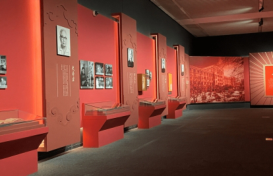
In terms of exhibition space design, the spatial environment of the Natio- nal Museum of China (NMC) lacks a historical environment of traditional Chinese opera culture, mainly with traditional panels, niches and electro- nic screens with displays, but a wide, bright and well-lit spatial perception environment can be used as a carrier of content related to Chinese opera education. The exhibition of the National Museum of China as a whole differs from the open spatial structure of the Chinese Opera Museum in that the spatial layout of the museum’s pavilion echoes its appearance and is a typical museum of modern design who lacks a historical environment of traditional opera culture like the one created by the Chinese Opera Museum.
The Chinese Opera Museum (COM) has preserved a large number of Gan architecture, and is the hometown of Tang Xianzu, the “Sage of Oriental Opera,” and the birthplace of Linchuan culture. The Chinese Opera Museum is located here, and the overall atmosphere of the museum is rich in history. The exhibition area of opera literature reflects the poem written by Lu You, which says, “The essay is made in heaven, but it is made by a wonderful hand”, and the manuscript is waved in the air. At the same time, an interactive game of script filling is played on the digital screen in the middle to enhance the perception of space, such as sight, sound and touch (see Figure 1). It can be seen that the different characteristics of museum exhibits can bring different audiovisual experiences to people in the same case of promoting
Museum Interactive Space Design from Enactive Perception Perspective 163
a. NMC b. COM
Figure 1: Exhibition environment of National Museum and Theater Museum.
opera culture, and the two museums studied are different and even opposed to each other in various aspects.
CONSTRUCTION OF EVALUATION SYSTEM BASED ON GENERATIVE PERCEPTION THEORY The evaluation of physical parameters can only reflect the unilateral chara- cteristics of the audiovisual space on perception or reverse, in order to explore the subjective feelings of the viewer in the exhibition space, with reference to the generative perception theory and behavioral landscape perception meth- ods, for the subjective evaluation of user preferences for spatial distribution and exhibition environment.
Generative perception theory, proposed by F.J. Varela and E. Thompson in 1991, treats the process of organism-environment interaction as a repre- sentation of embodied embedded activities, and constructs meaning spaces through the interaction of multidimensional factors such as body, experience, behavior and environment (Zhang Ming, 2015).In this theory, perception is defined as a dynamic, integrated and acted upon cognitive activity, which is the process of knowing objective things, i.e., the process of processing infor- mation. The process of interaction between the organism and the specific environment reflects the characteristics of objective things and the inner men- tal activity of the person in the physical activity from the surface to the inside, from the phenomenon to the essence.
According to generative perception theory design using 5 Likert questi- onnaires, 56 exhibition-viewing users with design practice experience were selected as subjects, aged 18–33 (average age 26), including 15 females, and a combination of questionnaires and structured interviews was used to construct the evaluation system of digital interactive exhibition space.
The data collection was implemented from December 10 to 17, 2021. A spacious, brightly lit and spatially fresh exhibition environment was selected, and 10 key factors were collected, of which 3 were interactive spatial factors and 7 perceptual factors. Respondents were asked to rate each factor in the exhibit environment with numbers 1-5 (strongly disagree = 1, to strongly agree = 5), and the collected data were processed using SPSS 25.0. The results as shown in Table 1.
In recent decades, most of the research has focused on psychological stu- dies, but recently there has been a lot of exploration of studies related to
Table 1. Critical factors and data of MIS evaluation.
Table available in the original PDF paper.
Dimension Critical factors Average Interactive space Harmony 3.7 Motility 1.88 Imaginative 2.6 Perceptual power Light 4.3 Significant color 3.89 Attention 2.21 Direction 3.01 Tension 2.16 Content to predict 2.57 Visual and auditory congruence 1.76
Table 2. Physical space perception parameters collected.
Table available in the original PDF paper.
Color (RGB) Lighting brightness Material Percentage of digital installations
art and technology. Since this study is exploratory and based on the data structure of the research, the questions that arise from the study are as fol- lows: How does the spatial distribution and the display environment affect the visitor’s perception of the interactive space? How does the involvement of spatial form in the audiovisual environment affect visitors’ perception and awareness of the interactive space? Does the perceived physical environment affect the comfort level of visitors to the Museum Interactive Space (MIS)?
For this purpose, we also measured and evaluated perceptual data on color parameters, illumination parameters, and interaction parameters in two museums: the National Museum of Chinese Opera Exhibition (NMC) and the First Exhibition Area of the Chinese Opera Museum (COM). The color parameters RGB were measured on-site/collected in the design program (Table 2), and semi-structured interviews were conducted in parallel with the questionnaire. The perceptual data were analyzed according to a subjective evaluation of the scheme using a 5 Likert scale and a grounded theory appro- ach in order to generate a conceptual framework for the physical data and design scheme concepts for the two museums.
DESIGN SCHEME Two different physical environments, the right exhibition space on the first floor of NMC and the first exhibition hall of COM, were selected to verify
Museum Interactive Space Design from Enactive Perception Perspective 165
a. PA b. PB
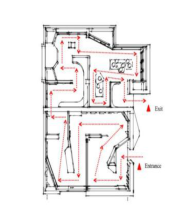
Figure 2: Interactive space dimensional design scheme.
the effectiveness of the proposed MIS design perception evaluation method by designing two sets of design solutions (Plan A and Plan B, respectively) in the two different physical environments.
Spatial Dimension of Interaction Plan A: As the overall space of NMC is very spacious, each passage section is wider than three meters, and the dynamic line is designed to ensure the sense of movement of the exhibition environment and avoid the feeling of losing direction in the huge closed space; the overall dynamic line is one- way clockwise, both based on the nature of the museum’s own environment and from the human walking habits, such an interactive space brings the exhibition viewing comfort (see Figure 2).
Plan B: The first exhibition hall of COM is located in a three-room inde- pendent Ganzhou-style building, the physical environment consists of an independent space and six internal columns, the overall left and right sym- metry, so the whole perceptual environment will make visitors feel a sense of balance. The spatial distribution is still designed to maintain the symmetry of the physical environment of the building, and the red line in the diagram is marked as viewing route 1, so that the open space can produce a variety of routes based on personal action experience, which enhances the freedom of viewing and thus comfort.
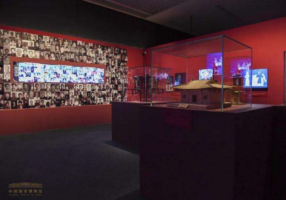
Perceptual Dimension PA: The content of this part of the digital interactive experience area is the Wall of Fame, which brings together the centralized display of thousands of photos of famous opera artists (Figure 3). To ensure the best content and viewing angle of the occupied space, a digital interactive celebrity wall was added. The overall color tone of the celebrity photos is adjusted according to the similar color tone collected from the pre-color data, and the focus of the frontal display part is changed by wrapping OLED screens around the traditional display board, while the dynamic photos move in the left direction so that visitors have the direction to go left, which plays a role in unblocking the subtlety of the exhibition area.
a. PA b. PB
Figure 3: Digital effect map of perception dimensions.
PB: Traditional opera culture is indispensable for the visual form of opera stage, as shown in the figure4, virtual reality projection for the performa- nce of opera repertoire, avoiding the overall space due to sound caused by the interference of viewing the exhibition, can reach the surrounding space content of foreknowledge. The color tone is designed and harmonized by combining the values in the data study with the traditional colors of opera to achieve complete visual and auditory unity. The floor is decorated by carpets, one of which is because carpets are indispensable items to protect the performers in traditional opera performances, and the carpets have a good sound-absorbing effect, so that visitors can achieve the best perceptual experience.
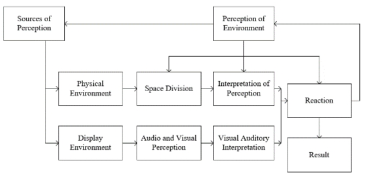
VALIDATION From the perspective of audiovisual perception mechanism, two theoretical concepts of “interactive space”and “perceptual force”were established. Inte- ractive space is the definition of different spatial divisions and special forms, and is the basic unit of perception research in museum interactive space (MIS). The perception of the experience of an object, landscape or event is defined as the perceptual sequence that integrates the key design factors that influence perception in museum interactive spaces (MIS). A conceptual framework was summarized to generate a conceptual framework for the phy- sical data and design solutions of the two museums (Figure 4), according to the subjective evaluation of the solutions using the 5 Likert scale of evaluation and the analysis of the perceptual data by the grounded theory approach.
Using the solution designed by this evaluation system, the validity of the generative perceptual theory MIS based on the design solution was again applied to the semi-structured interview, and the credibility of the con- tent results of this interview was measured by the Cronbach’s Alpha score. The value of the measured content result is 0.855, and the value of the x- credibility coefficient is greater than 0.8, which indicates the high quality of the credibility of the research data of this interview content. Since a per- son’s behavior and experience affects his or her perception and cognition of things, and since each person’s different perceptions can have a differential impact on the same spatial expectations, we included the impact of visitors’ expectations on the design of this study in order to better enhance the users’
Museum Interactive Space Design from Enactive Perception Perspective 167
Figure 4: MIS perception conceptual framework.Table 3. Critical factors and data of MIS secondary evaluation.
Table available in the original PDF paper.
The Critical factors Mark Average PA Average PB Coordinate Sporty Imaginative
A1 A2 A3
3.15 2.46 2.11
4.11 3.0 3.06 3.1 2.12 4.2 4.5
4.0 3.14 3.1 3.6 2.15 3.9 4.3
B1 B2 B3 B4 B5 B6 B7
3.1 2.04 2.0 The light Significant color The focus of The direction of tension Content to predict Visual and auditory congruence
viewing experience in the museum exhibition area. Through our interviews, the majority of visitors believe that their expectations of spatial distribution and audiovisual environment are guided by their personal experiences and behaviors.
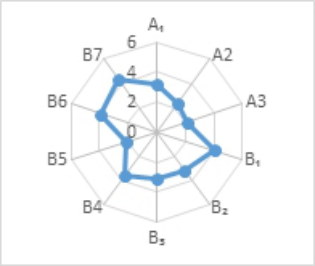
The 5 Likert questionnaire was used again within the relatively stable state of the perceived environment, and the selected persons were all the same as the previous persons for the second interview, and the score was evaluated again based on the 10 key factors. The data results are shown in Table 3.
Although the two sets of interactive space design did not change much in the physical environment, the data from the secondary evaluation of the MIS design by using the 10 key factors as the entry point showed a great improvement in both content anticipation and visual perceptual alignment, and the overall data level was improved overall, which made the visitors have a more comfortable feeling of the environment when perceiving the space.
PA and PB are designed in two completely different physical spaces, they have a high degree of similarity in the interactive spatial dimension. The dif- ference between the two is that PA focuses more on the relationship between the top and the bottom of the space, while PB takes a certain place as the focal point to display the spatial content in a diffuse manner. PA (2.46) is slightly higher than PB (2.04) in the level of spatial motion perception, which may be caused by the influence of both in the division of spatial morphology. (figure 5)
Figure 5: Relative values of MIS design works.
Generative perception theory is very important for digital exhibition design in MIS, where action as well as spatial perception has a pivotal impact on the comfort experience of the environment and landscape. Based on SPSS data analysis and literature research, a museum interactive spatial perceptual evaluation model was established, which includes 10 index items under two dimensions of interactive space and perceptual power. Based on the physical environment of NMC and COM for exhibit design, the behavioral environ- ment and perceptual power were evaluated using the index items, and PA and PB showed an increasing trend under each index item comparison, which improved the comfort and satisfaction of the visit. The results of this study will provide a theoretical basis for digital exhibit design in MIS based on generative intuitionism.
CONCLUSION
In this study, it is proposed that the factors of generative intuition should be considered in the design of museum interactive space, and its validity is verified by practical data, providing new design factors. Starting from the application of typical Interactive space design of Museums related to Chi- nese opera, this study establishes an exhibition space evaluation system based on the generative perception theory of F.J.Varela and E.Thompson. The rese- arch shows that the design method of museum interactive space based on generative perception theory can help improve users’ viewing experience in the exhibition area, and provide innovative ideas for the practice of digi- tal media design in line with visitors’ behavioral experience and aesthetic preference.
ACKNOWLEDGMENT
This work has been supported by Beijing Municipal Education Commis- sion Science Program (KM202110049001) and National Academy of Chi- nese Theater Arts Ideological and Political Education for College Students (XSCZD2022001).
Museum Interactive Space Design from Enactive Perception Perspective 169
REFERENCES
He Xi. Exhibition Design of Museum Exhibition Space [J]. Building Structure, 201, 51(11):156–158. 10.16824/j.carol carroll nki issn10082832.2010.12.061. Wen Jingbo,Ma Baoxia. Museum Contextual Experience in the Digital Era[J]. Fine
Arts Observation, 2019(10):79–80. Zhang Ming. Spatial Perception: Representation or generation? [J]. Philosophical studies of science and technology, 2015, 32(06):32–36. Zhu Rong, Wu Yao. Scottish national mining of the museum’s space narrative design
[J]. Journal of packaging engineering, 2018, 33 (4) 6:19–22. DOI: 10.19554 / j.carol carroll nki. 1001–3563.2018.04.005. Zhu Yongming. Visual Construction of image “Space” in graphic Design [J]. Wang Jin. Try to talk about the digital art museum space form design [J]. Journal of art and design (theory), 2010, 2 (12) : 166–168. The DOI: Literature and Art Studies, 2007(10):149–150.
LISTED IN THE AHFE DIGITAL BOOKSTORE CATALOGUE
Explore the complete digital volume
Affective and Pleasurable Design
Read this individual research paper free through the original publisher, or explore the full digital proceedings book.
ISBN 978-1-958651-17-9
Explore this ISBN in the AHFE Bookstore ↗Listed in the July 2026 bookstore catalogue; search by ISBN to confirm current availability · Digital book purchase optional