Pattarapong Bhongjan, Sakol Teeravarunyou (2022). The Effectiveness of Group Stacks and Funnel Filter for Mobile Online Shopping Application. In: Usability and User Experience. AHFE Open Access, vol. 39, pp. 497–503. https://doi.org/10.54941/ahfe1001747
The experience of using the existing mobile shopping applications is time-consuming because repeated images on the shopping lists are overwhelming information. New technologies such as image recognition, a subcategory of computer vision and artificial intelligence, can detect and analyze similar images of shopping products. In this study, the researcher wanted to investigate how image grouping could enhance the shopping experience. Besides the image grouping, the problem of redundant tasks on the filter feature was another investigation. A funnel filter is a design that can help users reduce information and task steps. For this study, subjects were asked to test the shopping application of consumer products. Thirty-one participants tested the grouped images versus random items in terms of time and satisfaction. They searched for a specific type of product for grouping. For the second experiment, subjects used the funnel filter to do the multiple layer filters for variables such as price range, users’ rating, and shipping cost. The funnel filter was also compared with the existing searching filter. The results from the experiment showed that subjects preferred the group of stacks over the existing searching items since it helped reduce the amount of information when they were searching. This technique followed the principle of Hick's laws. In the second experiment, the participants preferred the funnel filter to the existing searching filter. Because it was an accumulation of filtering layers, the decision-making was easier. The results of this study will benefit mobile shopping that can enhance the users’ experience in future.
Although the spread of the Covid19 virus has caused the economy to decline, the online e-commerce market is continuously growing. In 2021, many surveys found that online shopping of customer-to-customer (C2C) in Thai- land gained 220 billion Baht. Obviously, eMarketplace or online shopping applications are exponentially increasing (Leesanguansuk, 2020).
The problem of shopping applications is time-consuming even though the application has a search engine and filters. The appearance design layout is problematic since it is overwhelming information about sellers’ products.
Some sellers choose the same photographic image. Users spend unnecessary time using the application and cannot find the products they want to purch- ase. According to Hicks’ law, the more stimuli (or choices) users face, the more reaction time to make a decision (Hick, 1952). It also creates a clutte- red effect. Visual clutter is a set size for complex and real-world displays, i.e., the amount of information and how it impedes searching (Menon & Kahn, 2002). The more shopping items increase, the more difficult it may be to find something specific. Clutter is a factor in web design because it impacts subjective aesthetic ratings (Lavie & Tractinsky, 2004). The design with sim- plicity and minimal clutter is more accessible (Hoehl & Lewis, 2011). The visual components of a page affect how easy it is to use. Previous research shows that the high visual salient target is faster than the low salient (Hicks & Still, 2019). This result shows a negative effect on user experience. The research considers designs that focus on user achievement and positive user experience, those able to complete user tasks within a short time-consuming, and advantage visualization approach design. Computer vision can recognize the clothes for the online shopping experience (Li, Li, & Shao, 2016). The system recognizes the image and matches the cloth together. Moreover, it could group similar images together.
In this study, the investigation of image grouping is the first experiment. Currently, Apple uses the “group stacks”function of macOS in Monterey, Big Sur, Catalina to organize and manage the information on the desktop (Horo- witz, 2019). In the same way, the Windows PC (Window 11) allows users to group files and folders such as grouping by date like today, yesterday or grouping by type of files like images, documents (Hayes, 2020). The Window grouping folder has a bigger space than the mac that might not be efficient on a small mobile screen. As a result, the group of stacks is good for grou- ping the items. For this experiment, the group stacks differ from the desktop Mac OS. It will group only the same image rather than the similar image. The reason is that it reduces the decision-making choices when it groups the same thing.
The second experiment is on the filter that relates to the search engine. Wil- son (2011) claims that the search engines must adapt to meet users’ needs. If users cannot find the desired information in the results, they need to perform a new search. A new search is recursive and requires the user to go through many subtasks. Because of this, users have to exert an extra effort when per- forming a new search rather than viewing results that already appear in the display (Winckler et al., 2015). Many users purchase the product based on price, reviews, and shipping costs. This result is coming from an interview. Funnel filters can use those variables to screen out information.
Therefore, the objective of the study is to design a user interface that can reduce the visual clutter for a better shopping experience. The second objective is to visualize the filter information that assists users with a better purchasing decision.
The Effectiveness of Group Stacks and Funnel Filter 499
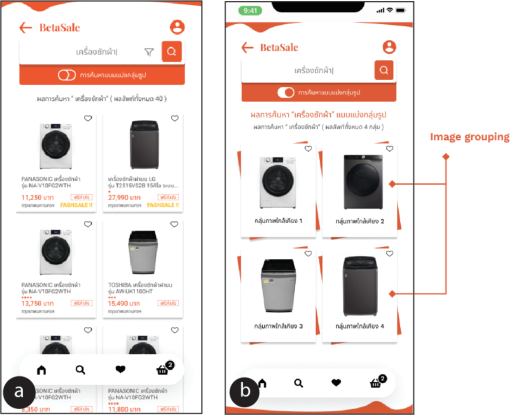
Figure 1: Application screenshot a) existing search items, b) group stacks.
METHOD
Apparatus The Figma prototype is a tool for simulating online shopping. This data was recorded and analyzed via SPSS.
Subjects tested the application designed for the screen size between inches (see Figure 1). There were 40 images of washing machines in total for the first experiment (Fig. 1a). Subjects were able to scroll down to search images. The group stack is a pile of the same photos (Fig. 1b). In the experiment, only four piles of images show. In reality, it could extend to more stacks of photos. When the subjects click on a stack, they can see the details such as specification and price of each washing machine.
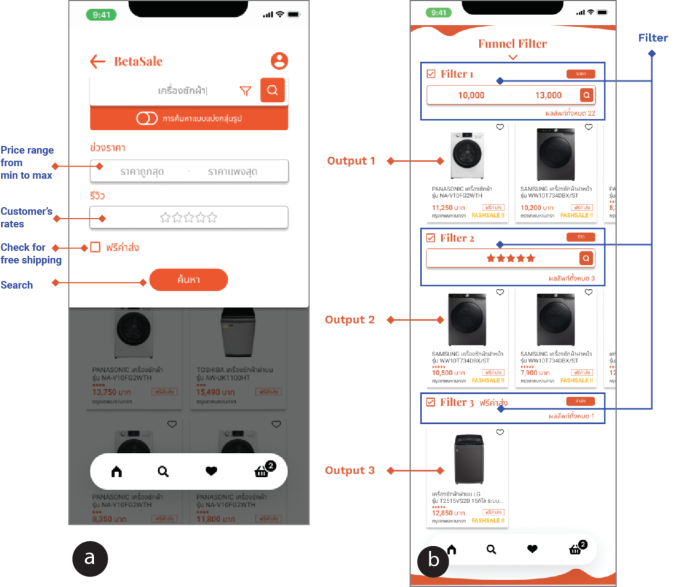
For the second experiment, the investigation was on the search time by using the existing and funnel filter. Figure 2a shows the existing filter search. Subjects can fill in the range price both minimum and maximum. Then they can filter based on the customers’ rates and free shipping price. On the other hand, the funnel filter search (Fig. 2b) will display the images as layers. All layers are the same as the existing search but the display of results is different. The top layer will show the results the most. Then the second filter reduces the number of results from the first result. In the same way, the third filter reduces the number of second results. The benefit of the funnel filter is that the subject can compare the products along each filter.
Participants This research targeted participants who needed to be familiar with shopping on online shopping platforms and were 20 to 30 years old, which is the age range that is very familiar with online shopping platforms. The total number of subjects was 31; 16 were males and 15 were females. During the current
500 Bhongjan and Teeravarunyou
Figure 2: Application explanation a) existing filter and b) Funnel filter.
situation of the global pandemic (COVID-19), the experiment was condu- cted through the video remote access on the mobile screen and questionnaire. Therefore, the data collection was utterly challenging.
Hypothesis H1. There is no significant difference between the existing searching items and group stacks in terms of searching time. H2. There is no significant difference between the existing filter and the fun- nel filter for single-purchase in terms of searching time. H3. There is no significant difference between the existing filter and the funnel filter for multiple-purchase in terms of searching time.
Procedure There were six tests divided into two main types. This was the existing inter- face compared with new designs such as group stacks and funnel filters. During the experiment, the researcher recorded the time spent. All the tests are detailed below:
1. Purchase an LG black washing machine (the images shown to the sub- jects) between 10,000 THB - 13,000 THB with free shipping, five stars review, and during the flash sale.
The Effectiveness of Group Stacks and Funnel Filter 501
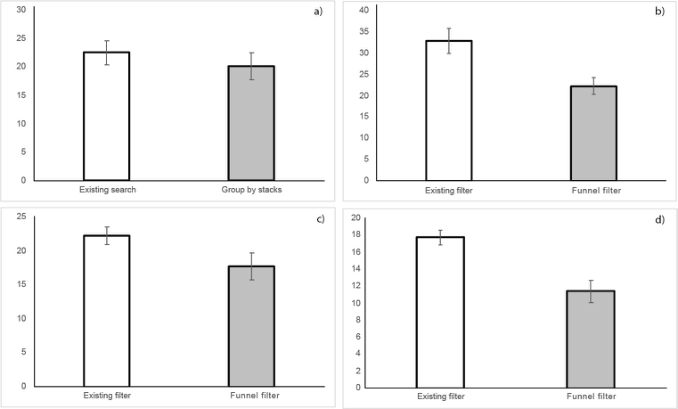
Figure 3: Means value of time a) Existing search vs group stacks, b) Existing filter vs Funnel filter, c) Existing filter with tap vs. Funnel filter with tap, d) Existing filter with swipe vs. Funnel filter with swipe.
a. Existing searching items b. Group stacks function design.
2. Purchase LG black washing machine and Panasonic white washing machine (the images shown to the subjects) a. Existing filters search b. Funnel filter function design.
RESULTS
The “Paired-Samples T-Test” is a method of analysis of two means. The pai- red data are as follows: existing searching data & group stacks, existing filters & Funnel filter.
The bar graphs show the mean value (see Figure 3). The grouping by stacks is faster than the existing search (Fig. 3a). The result is similar to the funnel filter (Fig. 3b). For the interaction style, subjects spent less time on funnel filters of both tap (Fig. 3c) and swipe (Fig. 3d).
Group Stack From the analysis of the data, there was a significant difference in the sco- res for the existing search (M = 22.58 sec., SD = .385) and group stacks (M = 20.19 sec., SD = .421) conditions; t(30) = 5.529, p = 0.00. The time of group stacks is less than the existing search. Then, we reject the null hypothesis of H1.
Funnel Filter There is no significant difference when there is a single purchase. The search time on a funnel filter was approximately the same as the existing filter. Then
502 Bhongjan and Teeravarunyou
we accept the null hypothesis on H2. When comparing the existing filter and funnel filter, the result shows that there was a significant difference in the scores for the current filter (M = 32.84 sec., SD = 3.01) and funnel filter (M = 22.29 sec., SD = 1.953) conditions; t(30) = 16.641, p = 0.00. The funnel filter used less time than the existing filter. As a result, we reject the null hypothesis of H3.
There are two types of gestures. One is the tap and another one is the swipe. From this funnel filter, users had fewer actions during the test. Sub- jects’ tapping decreased around 25.08 percent (22.19 sec. for existing and 17.74 sec. for funnel filter). Also, subjects’ swipe decreased around 15.01 percent (13.10 sec for existing filter and 11.39 sec for funnel filter). The funnel filter was better than the existing filter for both gestures.
For the tap gesture, the result shows that there was a significant difference in the scores for the existing filter (M = 22.19 sec., SD = 1.276) and funnel filter (M = 17.74 sec., SD = .855) conditions; t(30) = 17.875, p = 0.00. Similar to the swipe for the swift interaction, there is a significant difference in the scores for the existing filter (M = 13.10 sec., SD = 1.989) and funnel filter (M = 11.39 sec., SD = 1.283) 17.74conditions; t(30) = 17.875, p = 0.00. Both interactions are significant differences.
After testing both new functions, the participants rated a satisfaction score with the Measuring Usability with the System Usability Scale or SUS. The result demonstrates that 58.1% of 31 users agreed that these functions were easy to use. 54.8% thought that they could quickly learn to use this system.
DISCUSSIONS This study examined the effects of the group stacks and the funnel filters for mobile shopping. Previous literature shows that increasing clutter makes sea- rch time longer (Menon & Kahn, 2002). The group stacks, the arrangement or grouping as its name is the effect of deduction of choice, is avoiding the paradox of choice that leads the user to make an easier decision. The results follow Hicks’ law and visual cutter. The subjects complete their task much faster than traditional scrolling searches. For the future study, the investiga- tion is on the minimum images that make no significant difference from the existing search should be studied.
The funnel filter is layer-by-layer filtering. Users could see products during each layer of filtering instantly. It is an advantage of filtering in this format. The shortcoming of the funnel filter is that the single purchase is not faster than conventional or existing filters. It will be faster when there are more than two items of purchase.
The prototype limitation is that the total simulated product images can have only 40 products. We have the assumption that if the number of units is greater than 40, it may make the funnel filter more effective (purchasing with two or more items). The assumptions are based on our Hypothesis 2 and Hypothesis 3 results which compared the significant difference between the single purchase and the two-item purchase. The result is that the two-item purchase is faster than the single purchase.
The Effectiveness of Group Stacks and Funnel Filter 503
The shortcoming of research is the minimum number of items that can be used for group stack. The further study will be investigated.
CONCLUSION
The group stacks shows a better result in terms of visual search since it redu- ces the number of images that users must search. The funnel filter also shows a faster search time than the existing filter for a single purchase. There is a consideration when using the group stacks and funnel filter. The group stacks are effective for grouping the same image. It does not work for similar ima- ges. As same as the funnel filter, it works with the multiple purchase rather than single purchase.
ACKNOWLEDGMENT
My thanks go to all committees for all comments and guidance to complete this project. Additionally, I am grateful and would like to thank my family and colleagues who have supported me with the experiment in this study. I truly appreciated it.
REFERENCES
Hick, W. E. (1952) ‘On the Rate of Gain of Information’, Quarterly Journal of Experimental Psychology. SAGE Publications, 4(1), pp. 11–26. doi: 10.1080/17470215208416600. Hicks, J. M. and Still, J. D. (2019) ‘Examining the Effects of Clutter and Target Salience in an E-Commerce Visual Search Task’. Hoehl, J. and Lewis, C. (2011) ‘Mobile Web on the Desktop: Simpler Web Browsing’,
in The Proceedings of the 13th International ACM SIGACCESS Conference on Computers and Accessibility. New York, NY, USA: Association for Computing Machinery (ASSETS ’11), pp. 263–264. doi: 10.1145/2049536.2049598. Horowitz, P. (2019) How to Enable Stacks in MacOS to Clean Up Messy Desktops, OSX daily. Available at: https://osxdaily.com/2019/02/12/enable-stacks-mac- desktop/ (Accessed: 13 February 2022). Lavie, T. and Tractinsky, N. (2004) ‘Assessing dimensions of perceived visual aesth-
etics of web sites’, International Journal of Human-Computer Studies, 60(3), pp. 269–298. doi: https://doi.org/10.1016/j.ijhcs.2003.09.002. Leesanguansuk, S. (2020) 2020 online trade set to hit B220bn, Bangkok Post. Available at: https://www.bangkokpost.com/business/1921656/2020-online-trade-set- to-hit-b220bnThailands (Accessed: 13 February 2022). Li, Z., Li, H. and Shao, L. (2016) ‘Improving Online Customer Shopping Experi-
ence with Computer Vision and Machine Learning Methods’, in International Conference on HCI in Business, Government, and Organizations. Springer, pp. 427–436. Menon, S. and Kahn, B. (2002) ‘Cross-category effects of induced arousal and pleasure on the internet shopping experience’, Journal of Retailing, 78(1), pp. 31–40. doi: https://doi.org/10.1016/S0022-4359(01)00064-1. Winckler, M. et al. (2015) ‘Usability Aspects of the Inside-in Approach for Ancillary
Search Tasks on the Web BT - Human-Computer Interaction – INTERACT 2015’, in Abascal, J. et al. (eds). Cham: Springer International Publishing, pp. 211–230.
LISTED IN THE AHFE DIGITAL BOOKSTORE CATALOGUE
Explore the complete digital volume
Usability and User Experience
Read this individual research paper free through the original publisher, or explore the full digital proceedings book.
ISBN 978-1-958651-15-5
Explore this ISBN in the AHFE Bookstore ↗Listed in the July 2026 bookstore catalogue; search by ISBN to confirm current availability · Digital book purchase optional