Kexin Feng, Tao Xi (2022). The Information Visualization Design of Smart Museums Based on the Digital Twin Theory. In: Usability and User Experience. AHFE Open Access, vol. 39, pp. 353–359. https://doi.org/10.54941/ahfe1001728
Museums are vital to the promotion and protection of culture. However, traditional ways to express culture, such as holding exhibitions in venues, have physical limitations that block cultural outputs. With the development of digital information technology, digital twins can replace these traditional methods and assist museums in overcoming problems of limited information storage, management difficulties, and physical limitations, thereby allowing museums to disseminate culture over the world effectively. Specifically, digital twin is a process of establishing a multidisciplinary, multi-scale ,and multi-physics model that simulates objects in reality. Digital twin theory can store and represent detailed information of objects, such as their materials, textures, and 2D and 3D images. In fact, digital twin theory has already been applied in different usage scenarios in multidisciplinary fields. Also, digital twin has great importance to the modernization of smart museums. Here, we performed a literature review and qualitative and quantitative analyses to study how the digital twin theory and related digital information technologies promote the construction of smart museums. First, we summarized the process of realizing smart museums with the digital twin theory. Second, we discussed the interactive relationships among physical objects, virtual objects, service platforms, and digital platforms. Third, we described related technologies of digital twin theory from three aspects: The information representation, restoration, and exhibition of cultural relic. By combining concrete instances, we analyzed the construction of smart museums in the National Palace Museum and Mogao Grotto Digital Exhibition Center in Dunhuang and discussed the application of digital twin theory in visualizing museum information. Lastly, based on the digital twin theory, we summarized three characteristics of information visualization design of smart museums – high precision, multiple dimensions, and interactivity – and discussed the challenges faced by smart museums. The challenges that require further optimization of the digital twin system include but are not limited to immature technology, inconsistent standards, and high hardware requirements. Overall, our work will provide a reference for the future development of smart museums.
the core of museum construction. With the advancement of information tech- nology, digital twin has been applied to a variety of usage scenarios (Wang et al. 2021). The information of cultural relics, such as materials, textures, and 2D and 3D images, can be stored and reproduced using the digital twin theory, and thus this technology can make a significant contribution to the modernized construction of digital museums.
PROBLEMS The development of traditional museums is restricted because of their low information content. In particular, the exhibition and textual description of a cultural relic are insufficient to satisfy the demand for information dis- semination. Based on the example of the National Palace Museum and its related studies (Shi, 2017; Zhang, 2022), we summarized the limitations on the cultural dissemination of traditional museums using three aspe- cts: Internal construction, external construction, and internal and external communication.
Internal construction. In traditional museums, information systems tend to be independent, and their fragmented and mechanized information proces- sing causes barriers to information management. Also, the documentation of cultural relics tends to be manual, which is labor-intensive and time- consuming. Furthermore, errors in the documentation need to be searched manually and further consume time.
External construction. Inside a museum, objects that can be stored and exhibited are limited. Specifically, exhibitions can be restricted by small physical space, humidity, and temperature, and most objects cannot be displa- yed offline. Even when the physical space is sufficient, objects under strict preservation cannot be exhibited for a long period.
Internal and external communication. Traditional museums tend to invo- lve a low utilization rate of cultural relic information and independence of the information and physical objects. Thus, a third party is required to build connections, such as exhibition tours and supplementary text. The monoto- nous and static displays of cultural relicts form lead to inefficient cultural dissemination that is unsuitable for the mass communications of culture.
METHODS
Digital Twin Theory Digital twin theory is a theory of realizing digital transformation and pro- moting intelligentized upgrades. By establishing a bidirectional interactive platform for virtual models and physical objects, the digital twin system can monitor, forecast, and simulate the life cycles of physical objects (Tao, 2021). Since Digital Twin Theory enables two-way interaction between visi- tors and museum systems, so Digital Twin Theory is essential to investigating the museum UX.
Conceptual Model There are many conceptual models of digital twin theory. Chen and collea- gues (2020) proposed the realization process of digital twin technology. Based
The Information Visualization Design of Smart Museums 355
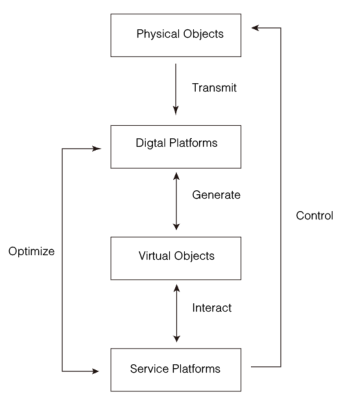
Figure 1: A basic digital twin model.
on their proposal and the construction process of digital museums, we sum- marized a basic digital twin model and presented the concepts of physical objects, virtual objects, service platforms, and digital platforms (Figure 1).
Physical objects. Physical objects are the targets of simulation. In museums, cultural relics are physical objects that provide data for the generation of virtual objects in the digital platform.
Virtual objects. Virtual objects are simulated models that have attributes of physical objects. They can be geared to the service platform and digital platform to monitor and mimic the physical objects. Virtual cultural relics are generated from data, and their attributes can be changed through the two types of platforms.
Service platform: A service platform allows individuals to conduct real- time monitoring, interaction, and updating of virtual and physical objects. It also provides various sensors to monitor the states of cultural relics and regulate the relicts’ physical environments. The platform is responsi- ble for operational maintenance, construction planning, and management coordination. It is the core of the digital twin system.
Digital platform. The digital platform collects and reproduces information of physical objects to generate virtual objects. The digital platform can receive the information from the service platform and give feedback. It is the database of digital museums and can store and compute data.
Digital-Twin-Based Information Visualization Design The information carried by the storage and dissemination of cultural relics is key to museum construction. Thus, information visualization design is impor- tant means of realizing the digitalized construction of the museum. Based on the typical conceptual model, we studied and summarized various technolo- gies that could realize the information storage, reproduction, restoration, and exhibitions of cultural relics. These technologies provide important support
356 Feng and Xi
to the digital twin system and help solve the existing problems of traditional museums.
Storage and reproduction of cultural relics. The visualizable information on cultural relics can be stored as 2D images and 3D models. Using the tech- niques for photography and image processing, photographers can process HD images in various formats and submit them according to given specifi- cations. These images can then be examined and documented by reviewers. Such techniques also support the retrieval, sorting, browsing, and annotating of information (Shi, 2017). The 3D models can store information of cultu- ral relics through scanning and multi-image reconstruction techniques. In a latest study by Ma and colleagues (2021), a neural tracing photography fra- mework was proposed to complete the work of 3D scanning without moving the target object. This framework can also optimize the lighting for irregular objects. Accordingly, such a framework can advance the 3D scanning of cul- tural relics. For the reproduction of cultural relicts, Zhang (2017) proposed to use Physically Based Rendering (PBR) to restore the materials of virtual cultural relics by displaying various degrees of roughness, metallicity, and transparency. Such rendering technology, originally used in the production of films, televisions, and games, can significantly improve the 3D models of cultural relicts.
Restoration of cultural relics. The digital restoration of cultural relics covers image and model restorations. In comparison to model restoration, the technique of image restoration is more mature and simpler. The mean of image restoration also resembles the real restoration process, and its tech- nical route is straightforward. However, for objects like sculptures, bronze wares, jade wares, and large-scale relics, the digital restoration technique is complicated. Studies on the restoration of ruins have shown progress in the research of 3D scanning techniques, postprocessing, and visualization. Also, studies on the restoration of cultural relics have suggested that the damaged parts of cultural relics can be accurately restored by collecting and compu- ting rich image data and making texture splicing through 3D scanning, 3D modeling, digital photography, and texture mapping techniques (Lv, 2021; Wei, 2021).
Museum exhibition. Currently, the virtual reality (VR) technique used in the exhibition of digital museums has occupied an important position. With this technique, immersive and detailed scenarios can be created. Curren- tly, a plethora of museums has completed the construction of online virtual exhibition halls. Additionally, screen projection, augmented reality, hologra- phic imaging, and virtual imaging techniques have become mature, allowing museums to fully reproduce cultural relics and narrate their stories. More- over, the re-designing of cultural elements can enrich the forms and effects of museum exhibitions and provide interactions and immersive experiences (Xiong et al. 2019).
CASES The digital twin theory has already been applied to museum construction, which promotes the transformation and upgrades of smart museums. Here,
The Information Visualization Design of Smart Museums 357
we present examples of such smart museums, including the digital exhi- bition centers of the National Palace Museum and the Mogao Grotto in Dunhuang.
1. National Palace Museum. Currently, there are 83,010 cultural relics in the digital exhibition center of the National Palace Museum. In addition to pictures and the detailed cultural relic entries, many collections include 3D models that are produced through 3D scanning and reconstruction techni- ques. Thus, tourists can browse real-time collections online and observe each object from multiple angles by dragging its image.
In addition to such a digitalized internal construction, the National Palace of Museum is devoted to using related technologies of digital twin theory to hold modern exhibitions. For instance, the 2018 digital exhibition held in Tai- yuan, which included seven themes, enabled audiences to interact actively by telling stories and reconstructing various scenes, thereby showing the charm of culture through multiple angles, like buildings, historical events, cultural relics, culture, and life (Li, 2019). However, the National Palace Museum has not yet achieved complete digitalization. There are 1,863,404 pieces of collections in the museum, and the digitalized objects consist of only 0.04% of the collections. Also, VR exhibitions are planned based on very few of the collections. Although the rich exhibition forms significantly improved the efficiency of cultural dissemination, the virtual exhibitions in this museum remain at the preliminary stage.
2. Mogao Grotto in Dunhuang. With 735 grottos, more than 2,000 pain- ted sculptures, and more than 40,000 square meters of wall paintings, Mogao Grotto in Dunhuang is a world-famous cultural treasure where the particu- lar Mogao Grotto culture has formed. To permanently protect the cultural relicts, the Dunhuang Academy China took photos to document the wall paintings in grottos, established the digital twin system for wall paintings, and created virtual exhibition spaces. In 2010, the Mogao Grottoes Visitor Center was established. The digital grottoes include images of 22 grottoes in Mogao Grotto and Yulin Grotto, and visitors can view the details of every grotto by the panorama. Also, 3D scanning and reconstruction techniques have been used to restore the Buddha in Dunhuang and provide a new way to protect the cultural heritages in Dunhuang. Dunhuang Academy China has promoted the Digital Dunhuang, which provides an online learning platform for individuals interested in the Dunhuang culture. By presenting the grottoes and 4,430 square meters of wall paintings in 30 dynasties, this platform is an important step in cultural dissemination (Du, 2022). However, the Digi- tal Dunhuang is currently at the preliminary stage, and many wall paintings are waiting for restoration and digitalization. Moreover, users of the plat- form are limited, and thus this construction has not yet shown its prominent advantage.
CONCLUSION
By combining real-world cases, we summarized three characteristics of infor- mation visualization design of smart museums based on the digital twin theory: High precision, multi-dimensionality, and interaction.
358 Feng and Xi
High precision. Techniques like 3D scanning enable the collection of cultu- ral relic data without making contact with the cultural relics themselves. Such techniques also allow individuals to obtain high-quality images and accurate information.
Multi-dimensionality. The information on cultural relics is no longer pre- sented as a combination of texts and pictures. Time and environmental information allows cultural relics to be expressed through various dimensi- ons, converting the relicts from static objects to dynamic objects that present their life cycles.
Interaction. The wide application of VR technology enriches ways to con- struct museum exhibitions. In consequence, museum visitors are encouraged to interact with cultural relics actively instead of passively receiving infor- mation on them. Visitors can also feel the Immersive cultural atmosphere by “walking into” ancient paintings and ruins. Such interactive exhibitions can arouse visitors’ interests and meet their curiosity, thereby improving the efficiency of cultural communication.
Even though museums have made numerous achievements in informa- tion visualization, real-life examples and past studies (Dai, 2021; Wu, 2020) suggest that smart museums continue facing several problems.
Immature technology. Scanning techniques have enhanced the efficiency of data collection and storage, but museums often cannot achieve real-time data loading due to the high quantity of collections and high resource occupation rate. Also, the scanning results of cultural relics may not meet the archiving requirements, so certain information may be ambiguous or missing, and the need to invest large human resources and funds remain. Overall, the tech- nology of restoring digital cultural relics is currently immature and requires optimization to reduce manual work.
Non-uniform standardization. Even though many museums are devoted to improving the database construction of digital museums, the standards of information acquisition, information storage, information transmission, and information service of cultural relics are not uniform. In other words, the non-uniform standards prevent cultural relic information from being tran- sferred to and applied by other museums, which causes barriers to the cultural exchange among museums.
High hardware requirements. The strict hardware and environmental requirements for VR exhibitions can raise the cost involved in exhibition preparation. Also, the database of cultural relics has high requirements for the data acquisition, storage, and transmission of hardware.
In conclusion, smart museums need to keep pace with the continu- ous development in the information age. The digital twin theory provides an important theoretical basis for the optimization and the upgrading of smart museums, making smart museums breakthrough physical limits. Smart museums can allow tourists to visit exhibitions at any time and provide an immersive interactive experience. Nevertheless, more efforts are required to overcome the technical difficulties that museums face. This paper proposes a model that links the various systems of a smart museum to the digital twin theory, which can provide a rough theoretical reference for other researchers.
The Information Visualization Design of Smart Museums 359
REFERENCES
Chen, C., Chen, Y.F., Zeng, L., Fang, X., (2020). Application and research progress of digital twin in the field of intelligent manufacturing. Metrology Science and Technology, (12), pp. 20–25. Dai. Y.L., (2021) . Integration and Construction: A Study of Innovative Design and
Communication of Cultural Heritage in the Digital Age. Beijing, ChinaTextile & ApparelPress Du, R.F., (2022). Digital Technology-based Conservation and Communication of Chinese Cultural Heritage: The Case of Dunhuang Mogao Grottoes. Technology and Innovation, (01), pp. 114–117. Hou, S.P., (2020). Talking about the role of digital technology in museum exhibitions.
Identification and Appreciation to Cultural Relics. (08), pp. 146–147 Li, Y., (2019). “Digital Forbidden City - Forbidden City” - on the design of the digital exhibition hall of the Forbidden City of Taiyuan Museum. art education, (09), pp. 190–191. Lv, J., (2021). Application of Texture Mapping Techniques in the Digital Restoration
of Bronze Artifacts. Art Research, (05), pp. 79–81 Ma, X., Kang, K., Zhu, R., Wu, H. and Zhou, K., (2021). Free-form scanning of non-planar appearance with neural trace photography. ACM Transactions on Graphics, 40(4), pp. 1–13. Shi, X.M., (2017). Digital management of the collections of the National Palace
Museum. China Cultural Heritage Scientific Research, 2017(04), pp. 38–43. Tao, F., Zhang, H., Qi, Q.L., Xu, J., Sun, Z., Hu, T.L., Liu, X.J. Liu, T.Y., Guan, J.T., Chen, C.Y., Meng, F.W., Zhang, C.Y., Li, Z.Y., Wei, Y.L., Zhu, M.H., Xiao, B., (2021). Theory and application of digital twin model construction. Computer Integrated Manufacturing Systems, 27(01), pp. 1–15. Wang, N., Xu, B., Qiu, M., (2021). Overview of digital twin and its application
prospect. Telecommunications Information, (08), pp. 6–9+12. Wei, M.Q., Chen, H.H., Sun, Y.X., Wang, J., Guo, Y.W., Yan, X.F., (2021). Digital restoration of damaged artifacts: the example of excavated Chinese bronzes. Journal of Computer-Aided Design and Computer Graphics, 33(05), pp. 789–797. Wu, X.F., (2020). Exploring the bottleneck of digital museum construction. China
New Telecommunications, 22(15), p. 87. Xiong, J.J., (2019). Digital display technology and virtual exhibition in museums under information technology environment . World of Antiquity, (04), pp. 63–65. Yan, C.L., Zhang, Z.X., Pa, R.J., (2006). Research on system framework and some
key technologies for computer aided cultural relics reconstruction. Journal of System Simulation Zhang, J.G., (2022). Research on the guarantee strategy of digital museum for cultural relic protection and global dissemination. Information Science, 40(02), pp. 59–64. Zhang, Y.C., (2017). Discussion on PBR technology to enhance the display effect of
digital cultural relics . Digital Museums in the Internet Age. pp. 63–67.
LISTED IN THE AHFE DIGITAL BOOKSTORE CATALOGUE
Explore the complete digital volume
Usability and User Experience
Read this individual research paper free through the original publisher, or explore the full digital proceedings book.
ISBN 978-1-958651-15-5
Explore this ISBN in the AHFE Bookstore ↗Listed in the July 2026 bookstore catalogue; search by ISBN to confirm current availability · Digital book purchase optional