Liang Tan (2022). Designing Meaningful Interactions for Social Innovation: An Application of Design Thinking. In: Usability and User Experience. AHFE Open Access, vol. 39, pp. 329–335. https://doi.org/10.54941/ahfe1001725
This paper aims to explore how design thinking as a methodology can facili-tate interaction design for social innovation. Design thinking is an interdisci-plinary approach to developing human-centered products, services, and expe-riences. Following the approaches of design thinking and research through design, we conducted an interaction design workshop with the topics of UN global goals. A series of works were developed through a design workshop in consideration of three social innovation topics. The findings show that de-sign thinking is an applicable methodology in interaction design practice. We propose that interaction designers and researchers should develop their own design thinking mode and establish their place in the design research. Limita-tions and future work are also presented.
In traditional design practice, designers are dedicated to improving the appea- rance and functional aspects of products, environments, and media. However, the design paradigm is shifting from designing for practical function into desi- gning for experience and meaning. This requires designers to apply related research methods to better understand people. In this regard, design thin- king combines reasoning with generating, which enables designers to create innovative solutions based on analytical thoughts. It combines an open- ness to explorative thoughts with an exploitative mentality (Martin, 2009). Design thinking is widely applied as an approach in design practice, especi- ally in product design and interaction design. Design thinking also refers to a series of methods and procedures used to facilitate business innovation. Social innovations are new social practices that aim to meet social needs in a better way than the existing solutions, resulting from working condi- tions, education, community development or health. These ideas are created with the goal of extending and strengthening civil society (Howaldt and Sch- warz, 2010). Rather than the focus on designing for business innovation, this study explores how design thinking can facilitate designing for social innovation, especially for people’s well-being in both physical and psycho- logical senses. The methodology of this study mainly follows a process of research through design. First, we conducted an interaction design workshop
with a topic of designing for UN global goals, which was initiated by Uni- ted Nations as a blueprint to pursue a better and more sustainable society. It addresses the global challenges we face, including poverty, inequality, climate change, environmental degradation, peace and justice. In this workshop basic concepts and procedures of design thinking were introduced to the partici- pants, and we emphasized that the major purpose of the workshop was to develop new interaction design concepts on improving life quality and well- being. A series of works were developed in regard to three topics. Finally, we reflected on the workshop and presented limitations as well as future work.
RELATED STUDIES In this section, we review literatures related to the studies of applying design thinking into social innovation. As an interdisciplinary methodology, design thinking has been applied into design practice and other fields for over one decade. Design thinking is a human-centered approach to design produ- cts, services, and experiences (Brown and Wyatt, 2010). Docherty (2017) considers that design thinking can be regarded as a mindset to address “wicked problems” and explore different possible futures. When our world is becoming more and more complex, design thinking provides alternative ways to thinking of a problem. Jon Kolko, in his Harvard Business Review paper, describes Design Thinking as a tool “allowing nonlinear thoughts when tackling nonlinear problems” (Kolko, 2015). Design Thinking is a good tool for simplifying and making human sense of things when solving wicked problems in social innovation, the inherent ethical dilemmas of its practice need to be carefully addressed in order to drive the “right” kind of change.
As a representative scholar in social innovation, Ezio Manzini emphasizes that design thinking and interaction design play an important role in social innovation and sustainability (Manzini, 2014). Social innovation is a process of change where new ideas emerge from a variety of actors directly involved in the problem to be solved: final users, grass roots technicians and entrepre- neurs, local institutions and civil society organizations. Interaction designers can play a fundamental role in social innovation. The core of interaction design is the way in which people interact (with products and/or with other people). At the same time, the core of the new social innovation initiatives are service-oriented solutions where, also in this case, the core of the overall systems are the interactions: their qualities and their effectiveness. It therefore appears that the social innovation could be a “core business” for interaction designers.
Unlike engineer’s working extensively from technology or science, desi- gning interactions for social innovation start from people. It tends to under- stand the needs in a better and more empathizing way and in-turn come up with solutions which never existed. It has to look at participatory pro- cess such as large-scale people movements using social media and examine communication designs that help spread and scale social innovation.
Designing Meaningful Interactions for Social Innovation 331
METHODS
As the goal of this study is to explore the application of design thinking in designing interactions for social innovation, we adopted research through design as the main research approach. First, we conducted an interaction design workshop with a topic of designing for UN global goals. In this work- shop basic concepts and procedures of design thinking were introduced to the participants, and we emphasized that the major purpose of the workshop was to develop new interaction design concepts on improving life quality and well-being. The five-step design thinking model includes Empathy, Defining, Ideating, Prototyping, and Testing phases (Hekkert and Van Dijk, 2011). During the Empathy phase, designers start doing user investigation to get an empathetical understanding of the people and context related to a certain pro- blem. The emphatical methods can be interviews, role playing, observation and other methods. Defining stage is to synthesize and analyze the data colle- cted from the first stage in order to define a clear design problem and vision. By using a series of design methods such as brainstorming, metaphorical design, mind map, random words, designers develop innovative design ideas in the third stage. Prototyping is about making physical models and actu- alizing the design ideas, which provides possibilities for further testing and evaluation. In the final stage, the prototype is tested and evaluated through experiments (e.g., A/B testing, think aloud, cognitive walkthrough). On the other hand, this study incorporates embodied design methodology (Tan and Chow, 2018) into design process, which is comprised of a range of specific design strategies and models. The previous studies show that the methodo- logy is applicable for designing meaningful interactions in public spaces (Tan, 2020). We invited 15 students, who were from interaction design program, to par- ticipate the workshop. At first, we introduced the concepts of design thinking and social innovation, and showed some related design works. Three embo- died design principles were also provided to the participants. 1) Aligning bodily interaction with metaphorical mapping: Bodily interaction activates the metaphorical mapping from immediate action (source domain) onto a conceptual meaning (target domain), which is the most important considera- tion in designing ambient media. 2) Linking embodied schematic structures with spatial features: The physical affordance of a space is inherently in with a certain embodied schema. The spatial features inform audience to perform certain bodily actions, which facilitates constructing an embodied metaphor that is structured by an embodied schema. 3) Designing action-perception (Input-Output) relations for eliciting unexpectedness and facilitating meta- phorical mapping: The sensory feedback triggered by bodily actions may not accord with the current context (source domain) but be congruent with the target domain of the metaphor.
The main topic of the workshop is interaction design for UN global goals, which was initiated by United Nations as a blueprint to pursue a better and more sustainable society. In the first stage, participants were divided into four groups, and each group can choose one theme from the global goals. Then, they conducted empathic research on stakeholders, such as potential users
332 Tan
of trash can and cleaners. The methods used in the empathic research phase include observation, interview and focus group. After collecting related infor- mation, each group analyzed it using comparative analysis, persona, journey maps, and empathy map. Based on analytical results, each group defined a vision statement for design, which embodies the design objective and scena- rio. For example, a group defined their vision statement is to increase the awareness of ocean protection in public spaces. In the third stage, designers aimed to generate design ideas or solutions to achieve the targeted goal. The tools of ideation can be brainstorming, mind map, metaphor, storyboard and other ideation methods. The fourth stage is to build prototypes to actua- lize a design idea. They built both low-fidelity and high-fidelity prototypes. Finally, each group conducted design evaluation to test their design conce- pts and prototypes. The testing methods include observation, think aloud, and qualitative interviews. The whole design process also involves partici- patory design methods by inviting related stakeholders to join ideation and prototype testing.
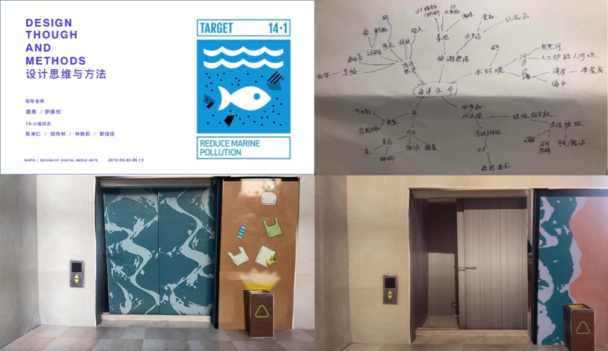
DESIGN CONCEPTS The workshop gave rise to three design concepts: Trash Wave, Behind the Door, The 80s. The theme of Group 1 focuses on the problem of marine plastic pollution. They collected related data on marine plastic pollution. An estimated 8 million tons of plastic enters our oceans every year. There are 5.25 trillion pieces of plastic waste estimated to be in our oceans. In order to get first-hand information on people’s attitudes and understandings, they distributed online questionnaires and interviewed people living in urban areas and fishermen in coastal villages. The empathic research shows that although most people have a certain understanding of marine pollution and think that it will affect their own lives, some people still do not know whe- ther this will have an impact on their own lives. Based on the investigation, Group 1 set up the design target is to advocate marine environmental pro- tection and raise the awareness of reducing plastic pollution. In the stage of ideation, the team adopted ideation methods including brainstorming, mind mapping and embodied design thinking to generate design ideas (Figure 1). Inspired by the embodied design strategy, they decided to utilize “elevator door” as a medium for interaction design. Existing public environments are employed as basis and provide affordances for designing embodied intera- ction and engaging people’s bodily actions. The elevator as a part of public space involves a large flow of people, which provides more possibilities for public engagement. The elevator doors are projected with motion image of sea waves containing garbage on the beach, such as cans and plastic bags. When the doors are opening towards two sides, the virtual wastes are pushed on the two sides of the elevator. Then, people can wave their hands to drop the wastes to the trash bin. They built an interactive prototype to demon- strate the idea, and invited some people to participate in usability and user experience testing.
Behind the Door is concerned with the problem of school bullying. Group 2 interviewed students aged from 13 to 22 to investigate their past experiences on school bullying. The empathic research shows that bullying is more likely
Designing Meaningful Interactions for Social Innovation 333
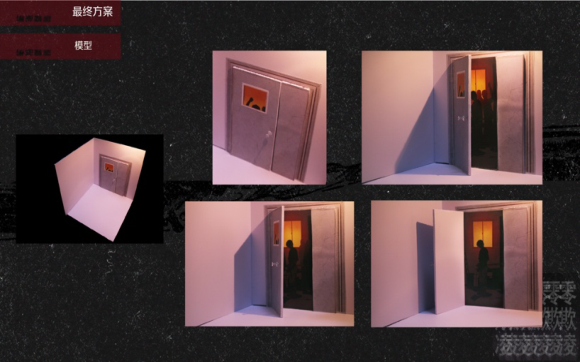
Figure 1: Trash wave.Figure 2: Behind the door.
to happen in some school locations such as enclosed stairwell, toilet, and rooftop. Inspired by the embodied design principle: linking embodied sche- matic structures with spatial features, the team proposed a conceptual design that the fire door of stairwell (Figure 2) is transformed into an interactive interface. A video is displayed on the frosted glass window, and the outline faintly shows that a person is beating up a victim. After the door is ope- ned, the violence is stopped, which means that the truth of school bullying is always hidden behind mundane life.
The 80s is targeted at the problem that the elderly do registration in community healthcare center. The percentage of old population increasin- gly grows in many major cities in China. Many old people prefer visiting community healthcare centers to get medical service. According to the inve- stigation on the elderly’s experience in community healthcare centers, many
334 Tan
problems exist in the current environment. For example, the height of regi- stration machine is not suitable for the elderly. Elderly people don’t know how to operate the machine, and they need to ask nurse for help. Most elderly people hesitate for a long time in front of the machine, which leads to mista- kes of in choosing outpatient clinic. The design team adopt empathy map, persona, matrix analysis to define the design vision “designing self-service registration systems for elderly”. Based on the design principles, the design simulates old television to construct an embodied metaphor. The everyday artifact can help the users get a new understanding and interpretation of regi- stering outpatient clinic. The prototyping testing shows that the installation was easy to use for the elderly, as they were familiar with the operations of the knobs and buttons.
REFLECTION AND CONCLUSION The workshop shows that design thinking as a methodology can guide desi- gners to design interactive works for social innovation. Design thinking play an essential role in interaction design practices. In regard to designing for social innovation, interaction designers should develop their own design thin- king mode and establish their place in the design research. Apart from the typical methods of design thinking, we introduce embodied design appro- ach to the workshop. In light of the approach, designers pay attention to the everyday things and people’s bodily habits in both the research and design phases. The physical affordance of a space or object is inherently in line with a certain embodied meaning. In the work of Behind the Door, the door meta- phorically represents the hidden fact of bullying. The common view holds the role of interaction design is to create effortless and meaningful interactions between people and digital products. But we must go beyond the current description about the discipline and develop our own design language of human behavior. Through exploring the premise of interaction design’s form, we are possibly one step closer to this goal.
Based on design thinking and embodied design approaches, this short paper mainly introduces a study on designing interactions for social inno- vation. A series of works were developed through a design workshop in consideration of three social innovation topics. The findings show that design thinking is an applicable methodology in interaction design practice. Com- pared with other design disciplines, interaction design needs to place special emphasis on people’s behaviors and experiences in true scenarios. Interaction designers are linguists of behavior and storytellers who make effort to build a conversation that is in accordance with the context. This conversation is com- plex and requires researchers to develop new design thinking model for the discipline of interaction design. This study is an exploration that incorpora- tes embodied design approach into interaction design thinking, which focuses on bodily experience and metaphorical meaning making in interaction with physical spaces. As this study is work in progress, there are still some limi- tations. It needs further evaluations (i.e., expert review, thematic analysis) to improve the workshop procedure. Besides, the present study less considers the principles of social innovation. In future research, we will improve these
Designing Meaningful Interactions for Social Innovation 335
aspects and further develop an approach to designing interactions for social innovation.
ACKNOWLEDGEMENT
This study was supported by the grants from the Humanities and Social Sciences Research Youth Foundation of Ministry of Education of China (18YJC760074) and Guangdong Graduate Education Innovation Program (2019JGXM71). We would like to acknowledge all the participants for their contributions to the design workshop.
REFERENCES
Brown, T., & Wyatt, J. (2010). Design thinking for social innovation. Stanford Social Innovation Review, 12(1), 29–43. Docherty, C. (2017). Perspectives on Design Thinking for Social Innovation. The
Design Journal, 20(6), 719–724. Hekkert, P., & Van Dijk, M. B. (2011). Vision in design: A guidebook for innovators.
Amsterdam: BIS publishers. Howaldt, J., & Schwarz, M. (2010). Social Innovation: Concepts, Research Fields and International Trends. Retrieved from https://www.asprea.org Kolko, J. (2015). Design thinking comes of age. Harvard Business Review, 93(9),
66–71. Manzini, E. (2014). Making things happen: Social innovation and design. Design issues, 30(1), 57–66. Martin, R., & Martin, R. L. (2009). The design of business: Why design thinking is
the next competitive advantage. Cambridge: Harvard Business Press. Tan, L., & Chow, K. K. N. (2018). An Embodied Approach to Designing Meaningful Experiences with Ambient Media. Multimodal Technologies and Interaction, 2(2), 13. https://doi.org/10.3390/mti2020013 Tan, L. (2020). A Methodology for Designing Meaningful Interactions in Public
Space. Paper presented at the Advances in Industrial Design AHFE 2020. Adva- nces in Intelli-gent Systems and Computing, USA.
LISTED IN THE AHFE DIGITAL BOOKSTORE CATALOGUE
Explore the complete digital volume
Usability and User Experience
Read this individual research paper free through the original publisher, or explore the full digital proceedings book.
ISBN 978-1-958651-15-5
Explore this ISBN in the AHFE Bookstore ↗Listed in the July 2026 bookstore catalogue; search by ISBN to confirm current availability · Digital book purchase optional