Ahmed Seffah, Emad Bataineh (2022). A Process for Infusing User Experience Design Thinking into Web and Mobile Applications Engineering Education. In: Usability and User Experience. AHFE Open Access, vol. 39, pp. 365–370. https://doi.org/10.54941/ahfe1001730
This research paper reports on a successful experience of the College of Technological Innovation at Zayed University in integrating a new project-based learning approach – Called User Experience Design Thinking – into the curriculum, mainly two bachelors programs: Web and Mobile Applications (WAM, in the IT College) and Multimedia Design (MMD in Arts College) of IT. The journey started in Fall 2019; the experiments span five full semesters were various challenges, as well as lessons learned, were identified and successfully solved. The new approach infuses a combination and integration of the general framework of design thinking (Brown, 2013), user-centered design (Norman, 2003, Buxton, 2004) as well as various user experience and usability methods and techniques. The UXDT addressed the multifaceted HCI education stressed out by the role that the college needs to play in preparing graduates for competitive jobs in the software development area, which is evolving in UAE
There has been a growing trend and interest among the national college female population to have a career in the web and mobile development field after graduation. In 2018, the college launched a new degree program in Web and Mobile Development. This clearly shows a new way of thinking among the new waves of graduates, which is deviating from the traditional thinking of pursuing careers in the software and programming domain. This new path is not going to be free of challenges and frustrations.
As an education framework, the UXDT process is grounded in the hori- zons of user-centric design (UCD), interaction design (IxD), user experience design (UxD) as well as design thinking (DT). All together, they are being promoted and largely used for designing a wide variety of interactive techno- logies, services, and systems Web, and mobile applications included. Students, as future designers, and developers of user interfaces have been supported to use UXDT as one of the main paths, not only to creating and testing interaction/UX but also as open innovation, meaning creating innovative post-GUIs applications. Indeed, UXDT was developed with the spirit that the resulting educational framework combining the design thinking toolbox
with UCD and IxD elements provides not only an advanced environment for the co-creation of systems and services, but it is also paving the way for solving complex societal challenges, for example creating innovative services to sustainability challenges such as recycling; examples from students will be presented in this paper.
We will explain how the user experience design thinking (UxDT) infor- med the use of different techniques for prototyping, knowing the users, and capturing the experiences of the targeted audience, testing the usability, accessibility, adoption, usefulness of alternative design as well as the final products. The UXDT outcomes are documented using different artifacts, all together forming a design portfolio, including a textual description of scena- rios, paper-based and software prototypes, use cases, graphs, and a summary of discussions. The students – seen in the course as Professional designers – are guided in understanding the complex design process, mastering the underlying techniques, and managing the huge diversity of design artifacts that are needed to develop a fully functional usable yet useful innovative service or system.
One fundamental challenge that we tried to solve is the support to ado- pting the UX design thinking by developers that will design and implement products in companies, especially small ones, where there is no expertise in HCI or design thinking. UXDT aimed to be an effective tool that provides a holistic view of the design thinking process and assists software developers in developing and managing the entire UX design projects.
Overall, the paper discusses the use of the UC design thinking process in a course contents at Zayed University, both Abu Dhabi and Dubai campuses while demonstrating how the UXDT process was integrated, the resulting learning outcomes, delivery modes, and assessments used. Finally, the paper concludes with some key recommendations on how to infuse the process into other courses, beyond HCI, for example, game and Web programming, as well as strengthening and making software engineering education at ZU more robust.
AN OVERVIEW OF ZAYED UNIVERSITY In 1998, ZU was established as an academic public institution in the UAE. It operates two campuses, one in Dubai and the other in Abu Dhabi, see figure 1. Currently, the University is educating more than 10,000 students predominately females. It has adopted an outcome-based learning framew- ork to ensure that specific outcomes such as teamwork, critical thinking, and leadership, drive student education. Moreover, the purpose of such a frame- work is to prepare graduates for a rapidly changing and unpredictable future. The University was accredited by the Middle States Commission on Higher Education (MSCHE) in 2008 (Zayed University, 2015).
The College of Technological Innovation is one of the six colleges at ZU. CTI seeks to produce graduates recognized by business, government, and educational institutions in the United Arab Emirates (UAE), the Gulf Region, and the rest of the world. It also seeks to develop a strong applied rese- arch capacity in emerging technologies directed towards meeting the ICT
A Process for Infusing User Experience Design Thinking 367
Figure 1: Images of Zayed University campuses at both Dubai and Abu Dhabi.
needs of the UAE and Gulf region. The CTI academic programs are pra- ctical, competency-based, and designed to prepare students for successful careers as Information Technology professionals. It offers different specia- lizations in Information Technology: Security/Networking, Web and Mobile Development, Multimedia Design, Enterprise Systems, Business Intelligence. The college’s programs are ABET-accredited. Figure 2 shows images of ZU campuses.
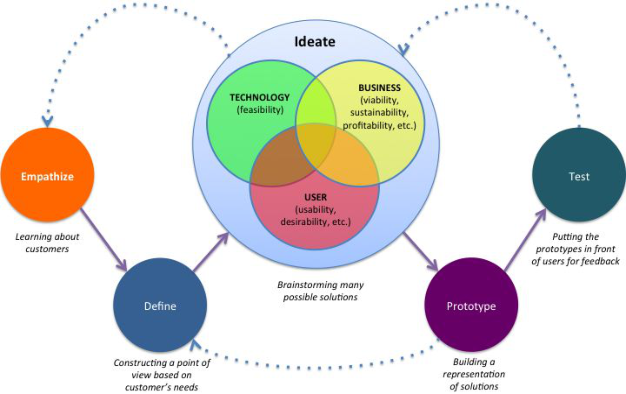
THE DESIGN PROCESS: COMBINING UX AND DESIGN THINKING As illustrated in figure 2, the UX design thinking process we proposed distinguishes five stages.
Empathizing, to Understand Users Including the Context of the Use and Design Challenges The common ways to achieve empathy are usually observation techniques, networking with the users via social media and crowdsourcing, and building a direct dialogue with them. The techniques used at this stage are interviews, watching and listening to users, and registering visuals such as photographs, videos, drawings, etc. (Plattner, 2010; Tschimmel, 2012). It includes, empathy mapping, persona, user journey mapping, stakeholder mapping, and user shadowing are used as empathy techniques in the process. The methods are chosen based on used ones.
Defining, to Clarify the Problem Statement and the Rationale for Building a New Solution or a Service Plattner (2010) names the result of the defined phase “point-of-view (POV): the explicit expression of the problem you are striving to address.” The define phase should continue until it delivers a well-defined POV. We implemented such a metaphor, as it is useful to cope with the design forces and as a valu- able entry to the next stage, ideating. Affinity diagramming, mind mapping, task modeling, touchpoints, and user scenario/stories are the most popular methods to support the POV and are counted as the most used in this phase as highlighted by our survey.
368 Seffah and Bataineh
Ideating, to Generate Ideas and Possible Designs for Solving the Problems Although a huge range of design methods exists for ideation, brainstorming techniques are the most important ones (Plattner, 2010; Stickdorn, 2011; Tschimmel, 2012; Vianna et al., 2012). Visual materials and representation of the design concept are highly recommended to facilitate the understanding of complex ideas by other group members (Stickdorn, 2011; Tschimmel, 2012). Body storming, card sorting to classify ideas, concept mapping to develop an idea and subsequent ones, storyboarding and video brainstorming are the methods we included in the process.
Prototyping, to Create Design Artifacts Representing the Different Possible Solutions Prototyping is itself a complex iterative process in which the generated solu- tions and ideas are being created and refined gradually. Sketching, mock-up, wireframing, and video prototyping are the methods used for prototyping and considered in the process. Many other methods could also be conside- red. Different reasons have been proposed for adopting these techniques: to ideate and to think by building, to communicate not only with words but also with lots of worthy pictures, to initiate a conversation with the users, to avoid the risks of failure, and to reduce the complexity of a problem (Plattner, 2010; Tschimmel, 2012).
Testing, to Get Feedback from the Users Using Various User Research Methods in the Lab and the Work Context In the process, we start the testing phase with the collection of feedback from users. Usability inspection is an effective evaluation method to find usability issues quickly in the design (Baskinger, 2008). The testing techniques inclu- ded in the process are AB testing, wizard of Oz, thinking aloud, cognitive walkthrough, and heuristic evaluation.
HOW IT HELPS BRINGING INNOVATION BY DESIGN TO THE CLASSROOM To demonstrate how the process works and how it can be used by designers and software developers, consider the following scenario.
Shaikha and her team are software developers working for a startup named UAE-UX. The company is creating a new line of software products for elderly people. Their product will be accessible as a service via different platforms and various user interfaces including Web, tangible and wearable ones. UAE- UX’s services focus on assisting seniors in handling a large set of their daily activities such as shopping, entertainment, hobbies, and social media.
UAE-UX developers neither are familiar with UX design methods/tools nor master the basics of using design methods for solving the problem. IDTP provides them with some features for searching and exploring the best design ideas from previous projects. IDTP supports the capture and storage of the
A Process for Infusing User Experience Design Thinking 369
Figure 2: The design thinking process.
whole design portfolio developed in other projects by expert designers. UAE- UX developers can be inspired by the designs posted on the process.
Moreover, Shaikha noticed that process is also a trustworthy source of information that could guide them step-by-step in adopting process. The- refore, she can create a group account for her entire team, named UAE UX-Design. She and the members of her team can view all the specific design portfolios that are in their area of applications. They can reuse other design portfolios while adding new design artifacts or adapting some of them. In the process, a design portfolio is organized like a container. It provides basic services to add, edit, remove and keep the track of the project and all the created design artifacts.
The team starts with creating a new project. The entire process is then instantiated, and they can start by gaining expertise about the first step, empa- thy. Emphasizing helps them to better understand the needs of the elderly by putting themselves in seniors’ shoes. The developers can read about the five design methods included in IDTP for emphasizing, which are persona, user shadowing, empathy mapping, stakeholder mapping, and user journey map- ping. They decide to start emphasizing by persona. They can know what persona is, why personas are used, what are the creation phases of persona. Moreover, they also have access to an example of persona and to the best persona tools. The developers can choose one of the tools suggested by the UXDT process. After creating a persona, Shaikha and her team can continue using different methods for different stages in an iterative manner until they build their design.
CONCLUSION
The paper discussed in detail the College of Technological Innovation’s expe- rience in introducing a new project-based learning approach – called User
370 Seffah and Bataineh
Experience Design Thinking – into the Human Computer Interaction curri- culum which is an essential part of two-degree programs. The new approach infuses a combination and integration of the general framework of design thinking (Brown, 2013), user-centered design (Norman, 2003, Buxton, 2004) as well as various user experience and usability methods and techniques. The experience shed the lights on the development of the material, learning outco- mes, assessments as well as challenges and lessons learned. The new approach stressed on the multifaceted HCI education stressed out by the role that the college needs to play in preparing graduates for competitive jobs in the softw- are development area, this will contribute to the critical role the college has to play in graduating students who will contribute positively to the future development of UAE. In addition, it will make students succeed in all aspects of their professional life. Finally, the paper concludes with some key recom- mendations on how to infuse the process into other courses, beyond HCI, for example, game and Web programming, as well as strengthening and making software engineering education at ZU more robust.
REFERENCES
Baskinger, M. (2008). COVER STORY: Pencils Before Pixels: A Primer in Handgenerated Sketching. Interactions, 15(2), 28–36. Brown, T., & Katz, B. (2011). Change by Design. Journal of Product Innovation
Management, 28(3), 381–383. Nielsen, J. (1994). Usability Engineering. Elsevier. Norman, D. A., & Draper, S. W. (1986). User Centered System Design; New Perspectives on Human-Computer Interaction. Hillsdale, NJ, USA: L. Erlbaum Associates Inc. Plattner, H. (2010). An introduction to design thinking process guide. The Institute
of Design at Stanford: Stanford. Stickdorn, M., Schneider, J., Andrews, K., & Lawrence, A. (2011). This is service design thinking: Basics, tools, cases. Hoboken, NJ: Wiley. Tschimmel, K. (2012). Design Thinking as an effective Toolkit for Innovation. In
ISPIM Conference Proceedings (p. 1). The International Society for Professional Innovation Management (ISPIM). Vianna, M., Vianna, Y., Adler, I. K., Lucena, B., & Russo, B. (2012). Design Thinking: inovação em negócios. 2012. Rio de Janeiro: MJV Press.Taubman, Philip. (June 25, 2008) Top Engineers Shun Military; Concern Grow. The New York Times Website: http://www.nytimes.com/2008/06/25/us/25engineer.html
LISTED IN THE AHFE DIGITAL BOOKSTORE CATALOGUE
Explore the complete digital volume
Usability and User Experience
Read this individual research paper free through the original publisher, or explore the full digital proceedings book.
ISBN 978-1-958651-15-5
Explore this ISBN in the AHFE Bookstore ↗Listed in the July 2026 bookstore catalogue; search by ISBN to confirm current availability · Digital book purchase optional