Xiaodong Gong, Zekun Wang, Qian Gong, Huiran Xie (2022). Usability evaluation of mobile navigation for the elderly. In: Usability and User Experience. AHFE Open Access, vol. 39, pp. 251–257. https://doi.org/10.54941/ahfe1001714
Mobile navigation has become a necessary tool for people to travel around because it provides functions such as GPS positioning, spot information, route navigation, etc. However, when using mobile navigation, the elderly often encounters problems like complex operation process and difficulties in learning.Focusing on the elderly, the influence factors on usability of mobile navigation are evaluated in this research. As a result, a usability evaluation system of mobile navigation for the elderly was conducted, which is composed of 3 dimensions (effectiveness, efficiency and satisfaction), 7 first-level indicators (learnability, ease of use, memorability, etc.) and 14 second-level indicators (ease of learning, effectiveness of help functions, ease of operation, etc.). Using the usability evaluation system, this research evaluates the usability of some mobile navigation products, and puts forward design suggestions for product optimization.This research applies the usability theory to the evaluation of mobile navigation for the elderly. It is hoped that this research can provide reference for the age-friendly design of related products, so as to make it more convenient for the elderly to use mobile navigation and make their traveling easier.
Web-based GIS applications are online services over the internet that provide maps to users (Khan & Adnan, 2010). The mobile navigation in this research refers to GIS applications on smart phones. Wherever people go, they can plan travel routes and browse traffic information through it. Data shows that more than 70% of smartphone users often use mobile navigation. But most of them are young (iiMedia Research, 2019). Due to the weakening of physiological and cognitive abilities, such as vision, memory and attention, elderly people can rarely use mobile navigation proficiently.
Usability is a product attribute that reflects whether a product provides appropriate functions in a suitable way, and whether users operate these functions efficiently, correctly and satisfactorily (Ge et al., 2014). By eva- luating usability, the product can be optimized, which provides a method for the age-friendly design of mobile navigation.
OVERVIEW OF USABILITY THEORY In ISO9241-11, usability was defined as the extent to which a product can be used by specified users to achieve specified goals with effectiveness, efficiency
and satisfaction in a specified context of use. In general, usability is a multidi- mensional attribute that involves the process and results of using the products and user’s feelings. Therefore, in order to evaluate the usability of a product, it is necessary to construct corresponding indicators from different dimensions (Ge et al., 2014).
Usability indicators refer to indicators that can be measured by specific methods and represent the usability level from a single aspect of a product (Ge et al., 2014). For example, Nielsen proposed 5 usability indicators: lear- nability, efficiency, memorability, errors and satisfaction (Nielsen, 1994). Therefore, it is necessary to integrate appropriate indicators into a system to evaluate the overall usability level of a product. The most commonly used usability evaluation system is the hierarchical usability model proposed by McCall et al. in 1977 (McCall et al., 1977). The model includes three layers: factor, criterion, and metric. Based on this model, this research constructs a usability evaluation system of mobile navigation for the elderly.
CONSTRUCTION OF USABILITY EVALUATION INDICATORS Literature Research
According to ISO9241-11, this research takes effectiveness, efficiency and satisfaction as the 3 dimensions of the usability evaluation system. Taking into account the comprehensiveness and pertinence of the indicators, this research sorts out the classic usability indicators, the usability indicators of map products and that of the digital products for the elderly in the current usability researches.
(1) Classic usability indicators This research sorts out the indicators cited commonly in usability resea- rches, including: the usability indicators proposed by Nielsen, ISO9241-11, the 5E principles proposed by Whitney Quesenbery and ISO/IEC 25010 (see Table 1).
(2) Usability indicators of map products Some scholars studied the human-computer interaction of map products with the usability theory. However, most of current studies are based on the indicators from Nielsen and ISO9241/11. This research sorts out two literatures that proposed relatively indicators for map products (see Table 2).
(3) Usability indicators of digital products for the elderly Although there is a lack of usability research of the mobile navigation for the elderly, some scholars had conducted usability research on other
Usability Evaluation of Mobile Navigation for the Elderly 253
Table 2. Usability indicators of map products.
Table available in the original PDF paper.
Source Indicators
Effectiveness, Consistency, Usefulness, Functionality, User Reaction, Architectural and Visual Clarity
Khan & Adnan (Khan & Adnan, 2010) Ren, Z.B. et al. (Ren et al., 2010) Effectiveness Completeness of function, Understandability of function, Operability of tools, Legibility of interface and map, Error rate, Severity of error, Effectiveness of help, Frequency of using help Efficiency Easy to learn, Ease of operation, Quickness of operation, Accessibility of map information, Difficulty of task, Consistency Satisfaction User sentiment
Table 3. Usability indicators of digital products for the elderly.
Table available in the original PDF paper.
Source Indicators Completion time, Errors, Number of hesitations, Meng, F.X. et al. (Meng et al., 2014)
Satisfaction Guo, F. et al. (Guo et al., 2016) Consistency, Legibility, Learnability, Ease of
Indicator Frequency Indicator Frequency Efficiency 8 Ease of use 4 Error tolerant 8 Consistency 4 Effectiveness 7 Engaging 3 Learnability 7 Memorability 1 Satisfaction 6 Difficulty of task 1 Legibility 6 Ease of navigation 1
age-friendly digital products. This study selects 3 literatures with complete usability studies and high citations. The indicators of them are as follows (see Table 3).
The above usability indicators are integrated and named uniformly. Besi- des, the frequency of each indicator is counted (see Table 4).
User Interview In order to figure out the use by the elderly, the pain points of mobile naviga- tion are found out by this research with semi-structured interviews. The pain points are taken as one of the basis for selecting indicators. The interview outline is as follows.
For experienced users: (1) What are the main functions you usually use? (2) How do you generally use this function? (3) Have you encountered any problems when using this function? (4) Have you encountered any problems when learning to use mobile navi- gation? (5) Have you encountered any problems identifying the directions? (6) Have you encountered any problems browsing the interface information? (7) Do you have any other suggestions for mobile navigation?
For inexperienced users: (1) Why don’t you use the mobile navigation? (2) How do you usually find the route when you go to a new place?
Eight elderly people were interviewed in this research. As a result, the problems found in interviews can be summarized into the following 5 items.
(1) Learning: the elderly cannot learn how to use it or forgets easily after learning; (2) Use of functions: only a part of functions is used; (3) Information recognition: some icons and navigation are not easy to understand; (4) Memory: on the one hand, it’s hard for the elderly to remember the opera- tion process. On the other hand, the elderly cannot remember the routes, so they have to copy down the routes or confirm the routes repeatedly on the way; (5) Security: the elderly worry about getting lost and other unexpected situations.
Analysis of Mobile Navigation Usability Problems In order to make the indicators reflect the characteristics of mobile naviga- tion, this research found out the usability problems of it as another basis for selecting indicators. This research selected Baidu Maps, Amap and QQ Map to analyze which are commonly used by Chinese users. This research used heuristic evaluation to find out usability problems based on the 10 usability principles proposed by Nielsen.
As a result, the usability problems of mobile navigation can be summarized into the following 4 items.
(1) Complicated functions: there are too many functions on some pages, so that the key functions are not prominent; (2) Unclear process: the process is complex and there are multiple operation paths; (3) Poor legibility of function names and icons: some function names and icons are difficult to understand and distinguish; (4) The help function is difficult to find: some products lack the help function or their help function is difficult to find.
Usability Evaluation of Mobile Navigation for the Elderly 255
Selection and Definition of Indicators According to the pain points and usability problems found in the resea- rch, ease of use, learnability, legibility and memorability are selected. In the meantime, security is supplemented. In addition, efficiency, satisfaction, effectiveness, and error tolerance are also selected which appear more frequ- ently in current research. With reference to the definition of indicators in the existing literature, the above indicators are redefined.
(1) Ease of use: whether the operation is simple and the functions are easy to be found; (2) Learnability: the efforts of the elderly to learn to use the mobile naviga- tion, and whether the help functions can solve problems effectively; (3) Legibility: whether the information on the interface is easy to find and understand; (4) Memorability: whether the operation and routes of mobile navigation are easy to remember; (5) Security: whether the mobile navigation provides security functions; (6) Efficiency: the efficiency of the elderly using the mobile navigation; (7) Error tolerance: the extent to which mobile navigation prevents the elderly from errors and the extent to which errors affect tasks; (8) Satisfaction: the feelings of the elderly in the process of using the mobile navigation; (9) Effectiveness: whether the functions of the mobile navigation can meet the needs of the elderly and whether the interface can support these functions effectively.
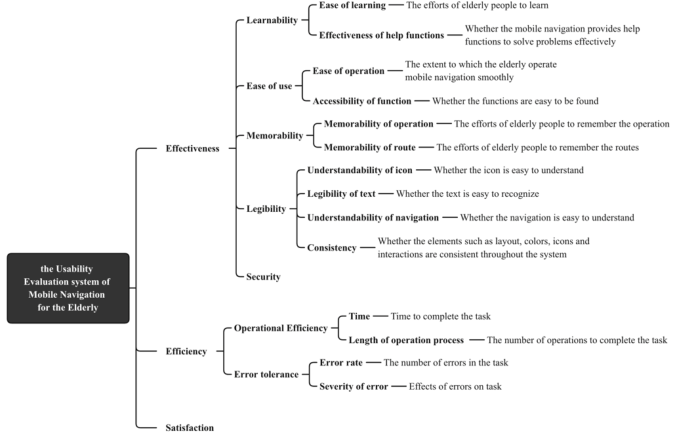
These indicators are taken as first-level indicators under the 3 dimen- sions according to definitions. Then, they are further refined into several second-level indicators. As a result, the usability evaluation system of mobile navigation for the elderly is finished (see Figure 1).
DISCUSSION
Based on the above usability evaluation system, the analysis of the mobile navigation is carried out according to the indicators, and the corresponding age-friendly design criteria are proposed.
(1) Learnability Firstly, too many functions on the page will increase the burden of lear- ning for the elderly. Therefore, mobile navigation for the elderly should only retain the functions commonly used by them. Secondly, the mobile naviga- tion should provide the elderly with help functions which could effectively solve their problems, such as introduction of functions and operation guida- nce. Meanwhile, the help function should be easy to be found and operated so as to reduce impacts on the original tasks.
(2) Ease of use In terms of the page, the commonly used and important functions of the elderly should occupy the main space and be highlighted so that it’s easy to find them. In terms of interaction, mobile navigation should use simple
Figure 1: The usability evaluation system of mobile navigation for the elderly.
interaction like clicking and sliding rather than complex interaction like long press and double click.
(3) Memorability In terms of operation, the operation process should be as simple as possible and in line with the mental models of the elderly so as to be easy to remember. In terms of routes, some age-friendly functions can be added to solve the problem that elderly people cannot remember the routes.
(4) Legibility Firstly, it’s significant to avoid abstract icons so that the elderly can under- stand them. Secondly, mobile navigation requires larger font size to deal with the decline in visual ability of the elderly. In addition, the function names and tooltips should be easy for the elderly to understand. Thirdly, since the elderly have difficulties in recognizing map information and directions, it can be considered to use a way that is easy for the elderly to understand to guide travel.
(5) Security In the view of safety, mobile navigation should be able to remind the elderly of places where accidents may occur to avoid danger. In the view of emergency treatment, when the elderly has an accident during travel, the mobile navigation needs to provide related functions, such as navigating to the nearest hospital and one-click first aid.
(6) Operational efficiency In order to improve the efficiency of the elderly, the mobile navigation should wisely plan the operation process of tasks and shorten the operation path as much as possible.
(7) Error tolerance On the one hand, mobile maps should be able to avoid users’ errors to reduce the error rate. For example, when users perform dangerous
Usability Evaluation of Mobile Navigation for the Elderly 257
operations, secondary confirmation should be provided. On the other hand, mobile maps can provide functions such as revocation to reduce the severity of errors of the elderly.
CONCLUSION
This research sorts out the indicators with high recurrence rate in the exi- sting usability researches. Based on the pain points of elderly users and the usability problems of mobile navigation products, the usability evaluation system of mobile navigation for the elderly is completed. According to the evaluation system, the usability of the mobile navigation is analyzed, and the age-friendly design criteria are put forward. This study expands the appli- cation of usability theory in the field of mobile navigation products for the elderly, provides theoretical guidance for the age-friendly design of mobile navigation as well as the basis for the usability evaluation of such products.
ACKNOWLEDGMENT
The authors are grateful for the support of the Study on Evaluation Index of Urban Environment Construction for Livable City for Old People in Beijing (Grant/Award number: 18YTA001).
REFERENCES
Dou, J.H. (2020). Research on Evaluation and Optimization Methods for Inclusiveness-Oriented Human-Computer Interface (Doctoral dissertation, Uni- versity of Science and Technology Beijing). Guo, F., Liu, C., & Liu, W.L. (2016). Analysis of Behavior Characteristics and Interface Usability Requirements of the Elderly Using Shopping Websites. Chinese Journal of Ergonomics, 22(4), 74–80. Ge, L.Z., Zhao, Y., Wu, X.T., & Liu, Y.L. (2014). How to Measure Usability:
Measurement Metrics and Their Selection and Integration. Chinese Journal of Ergonomics, 20(1), 72–75. iiMedia Research. (2019) 2019Q1 China Mobile Map Market Monitoring Report.
The iiMedia Website: https://www.iimedia.cn/c400/64147.html Khan, Z. A., & Adnan, M. (2010). Usability evaluation of web-based GIS applications: A comparative study of Google Maps and MapQuest. McCall, J. A., Richards, P. K., & Walters, G. F. (1977). Factors in software quality.
volume i. concepts and definitions of software quality. GENERAL ELECTRIC CO SUNNYVALE CA. Meng, F.X., Yang, H.S., & Wu, Q.C. (2014). Evaluation of the usability of social networking sites in the elderly in China. Ergonomics, 20(3), 42–46. Nielsen, J. (1994). Usability engineering. Morgan Kaufmann. Ren, Z.B., & Sun, Q.Z. (2010). Research on the Indicators System of Electronic Map
Usability Evaluation. Geomatics & Spatial Information Technology, 33(3), 14–17.
LISTED IN THE AHFE DIGITAL BOOKSTORE CATALOGUE
Explore the complete digital volume
Usability and User Experience
Read this individual research paper free through the original publisher, or explore the full digital proceedings book.
ISBN 978-1-958651-15-5
Explore this ISBN in the AHFE Bookstore ↗Listed in the July 2026 bookstore catalogue; search by ISBN to confirm current availability · Digital book purchase optional