Mengjiao Bai, Xiaodong Gong (2022). The Kitchen Product Design Oriented to the Motor Capability of Armless People. In: Human Factors in Aging and Special Needs. AHFE Open Access, vol. 38, pp. 16–22. https://doi.org/10.54941/ahfe1001659
Armless people face more difficulties in daily self-care activities such as cooking. Most of the existing kitchen products are based on the needs of normal people and rarely consider the characteristics of the disadvantaged group of armless people. Armless people can only use the product through the feet, chin and residual limb, which has high requirements for motor capability. Therefore, it is difficult to guarantee the efficiency, safety and operating comfort of the products, which has also become an obstacle to independent living of people without arms. The goal of this research is to design kitchen products suitable for people without arms. The research uses the definition and evaluation method of user capability in the capability-demand theory proposed by Clarkson et al. to disassemble the motor capability in user capability into strength, dexterity, reach and mobility. Through survey questionnaires, we can understand the scores of armless people on specific motor capabilities and use their higher-scoring motor capabilities to match the demands of product use in design practice, so as to improve the operability of the product. Based on the design strategy of P. John Clarkson and others for products using hands, the author summarizes the design strategy of products that use lower limbs and foot operations from the 6 dimensions of position, shape, force, precision, task and environment. It is proposed for guiding how to design products for armless people, the author also designs kitchen products based on this, hoping to help armless people cook like normal people. The analysis of the motor capability of armless people in this study can provide a reference for product design for this disadvantaged group. As a group with low levels of attention in the market, design, and society, the research on armless people has expanded the connotation and scope of inclusive design to a certain extent.
There are 24.72 million physically disabled people in China (China Disa- bled Persons’ Federation, 2021), of which the upper limb disabled account for about 18.43% (Zhiquan Liu, 2003). Armless people are the most seri- ous group of people with upper limb disabilities. At present, there are few auxiliary devices designed for the motor capabilities of armless people and most of them use products designed for ordinary people clamping by their feet during the process of cooking, which makes it difficult to ensure the operation efficiency, safety and comfort.
THEORETICAL RESEARCH ON MOTOR CAPABILITY The Capability-Demand theory was proposed by the i-design team in response to the initiative of Equal, which puts forward paying more atten- tion to the disabled and the elderly, and contributes to the social integration (John Clarkson et al., 2015). The capabilities in this theory represent the capabilities of users, which are divided into sensory, cognitive and motor capabilities. Among them, the user’s motor capabilities can be subdivided into reach, dexterity and mobility (Waller S. et al., 2010). Demands indi- cate the demands of products for user’s capabilities (hereinafter referred to as product demands). The relationship between the two depends on the specific ongoing activities and the background of the activities (Per- sad et al., 2007). When the product demands are higher than the user’s capabilities, there will be the user exclusion phenomenon. The more com- plex the product demands require, the more excluded users will be. And we can reduce the product demands to better match user’s capabilities to reduce exclusion.
The Kitchen Product Design Oriented to the Motor Capability of Armless People 17
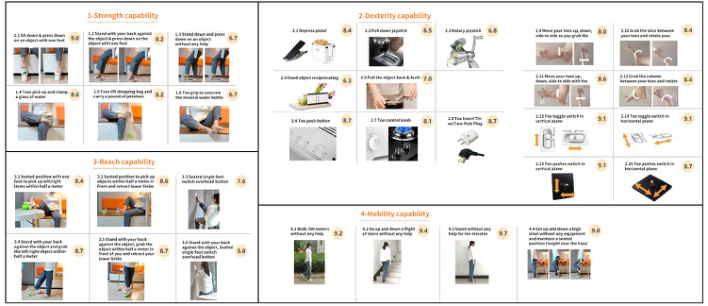
Figure 1: Result of motor capability questionnaire for armless people (under kitchen scenario).
RESEARCH ON MOTOR CAPABILITIES OF ARMLESS PEOPLE Studying the motor capabilities of armless people will help designers under- stand the advantages of this kind of people’s motor capabilities. It is assumed that users’ sensory and cognitive abilities are normal in order to exclude the influence of other users’ capabilities on the experiment. From the perspe- ctive of research dimension, the user’s motor capabilities are divided into four dimensions: strength, reach, dexterity and mobility. The questionnaire design refers to the research on users’ motor capabilities in capability-demand the- ory. For example, according to the dexterity of the user’s main hand, it is set that there is no need to do any precise action to control the cooker knob, pick up the pin from the desktop with fingers, write with a pen and do other more difficult things (Department of Social Security, 2000). After observing the behavior of high-frequency operation in the kitchen scene, the author abstra- cts and sorts it from easy to difficult (see Figure 1). The evaluation methods of participants mainly include the following five dimensions: 1⃝0 point mean “can’t do it”, which can’t be mastered by any practice; 2⃝1-3 points mean “relatively difficult”, which is still difficult to master after a long time of pra- ctice; 3⃝4-6 points mean “average”, which takes some time to practice and master; 4⃝7-9 points mean “relatively easy”, which requires certain strength and accuracy; 5⃝10 points mean “very easy”, which can be completed qui- ckly and comfortably. A total of 14 valid questionnaires were collected from armless people, of which 57.14% were men and 42.86% were women; most of which are young and middle-aged, accounting for 64.29% at the age of 31 to 40. Strength Capability: There are 6 items including 1.1-1.6 sorted out (see Figure 1). The results show that when pressing and other force application operations are needed, sitting posture is a better operation posture; the score of holding articles with feet is also high (especially when the weight is small) among various operation modes, suggesting that toes clamping mode can be considered as one of the user’s operation modes in the design of lighter pro- ducts. While some behaviors that require more fine movements and strength
18 Bai and Gong
ability score lower such as screwing the bottle cap, showing that we should try to avoid the product demands with excessive strength requirements.
Dexterity Capability: A total of 16 items including 2.1-2.16 are sorted out (see Figure 1) and we can see from 2.1-2.8 that movements that use the lower extremities and feet to perform simple non-fine movements (such as pressing), contact manipulations that require only part of the existing limb area (such as the bottom of the toes), and wide grasping without the toes or wide range of joint movement scored higher. 2.9-2.16 suggest that the design of cylindrical auxiliary experience is easier to clamp and transfer positions than flake things when it is necessary to transfer items. From different switch forms, the push switch is relatively simple and the experience of applying force on the horizontal or vertical plane is the same.
Reach Capability: 6 items from 3.1 to 3.6 are sorted out (see Figure 1). It can be seen that the standing posture with back against an object has stronger reach capability than the sitting posture and it is easier to reach the positions such as half meter in front and half meter on the right and left, while the upper half meter is more difficult, it requires the higher flexibility of the lower limbs and the balance of the body.
Mobility Capability: Total 4 items from 4.1 to 4.4 are sorted out (see Figure 1). The scores of going up and down stairs and walking are high. Most of the respondents are able to stand and walk normally, but the sco- res of going up and down high stools are relatively low, indicating that this action requires users to have good balance without the assistance of upper limbs.
It can be seen from the questionnaire results that the higher the score of the corresponding survey results, the easier the users’ action is to do and the stronger the users’ motor capability for the action. When the product use mode matches the user’s strong motor capability, the armless person will be easier to use and more friendly to the user.
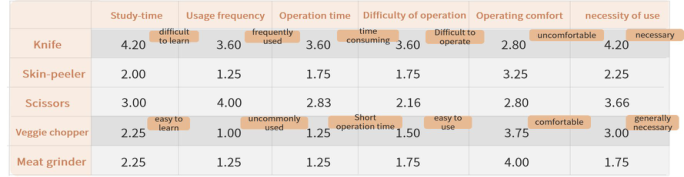
RESEARCH OF FOOD PROCESSING PRODUCTS FOR ARMLESS PEOPLE This paper takes the steps of processing food materials in the kitchen scene as an example to analyze and explain the key points and demands of armless people. The research adopts the methods of behavior observation and data collection combined with one-to-one in-depth interviews. A total of 6 armless people were observed and interviewed, and all 6 respondents had occupati- ons and sources of income. The interview mainly asked about basic personal information and scored the existing common kitchen food processing pro- ducts from multiple dimensions (see Figure 2). Among them, knives have the highest use frequency and necessity of the cutting tools, but its operation takes the longest time with the difficulties. Although the use frequency of the vegetable cutting tool is low, it takes the least time with the simplest opera- tion. It is a good supplement to cut. Therefore, we will focus on two products of knives and vegetable cutting tools when selecting research products.
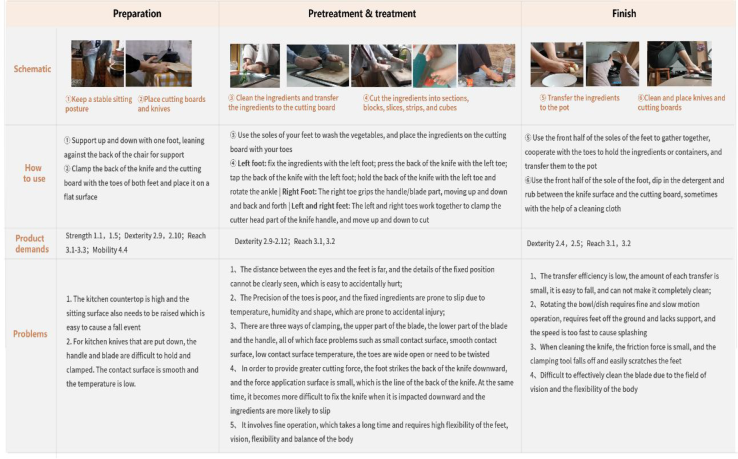
The research mainly discusses the use mode and process of Chinese kitchen knives, and it takes the right foot as an example (see Figure 3). One of the
The Kitchen Product Design Oriented to the Motor Capability of Armless People 19
Figure 2: Scoring results of armless people on common used food processing tools.Figure 3: Survey results on the use of cutting tools by armless people.
most prominent problems is that the lower limb operates tools without the suitable grasping and force application position, and armless people will use their toes to clamp the tool surface or handle. At this time, the toes are requi- red to open larger and clamp the cutting tool to twist, facing the problems of small contact surface, smooth and low temperature as well as the small downward cutting force. Secondly, due to the long distance and line of sight occlusion, users can’t see the fixed position and other details, or sit on a higher seat, or slip easily due to the shape, humidity of fixed ingredients, etc., which are very easy to cause injuries. Operating the cutting tool involves fine movements and it takes a long time, requiring high foot dexterity, strength and balance of body, even vision and so on.
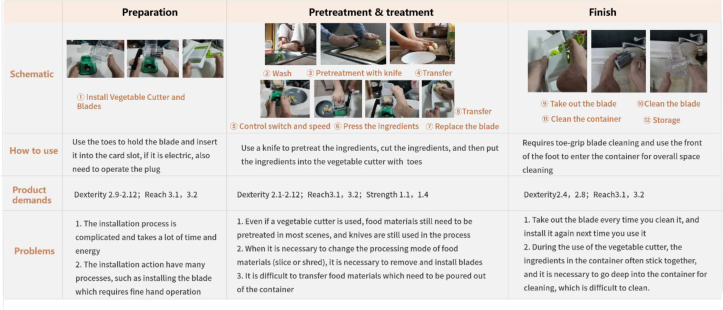
The vegetable cutting tools can save time and labor compared with using a kitchen knife. Currently, most of the vegetable cutting tools on the market need both upper limbs to participate while using. Meanwhile, it also involves a variety of complex motion behaviors such as rotation, pressing, fixation and reciprocating (see Figure 4). When dealing with large food materials, it is usually necessary to pretreat the food materials with a knife before using
20 Bai and Gong
Figure 4: Survey results on the use of vegetable cutters by armless people.Figure 5: Summary of armless people’s demands for food processing products.
the vegetable cutting tools. In addition, they are difficult foot operations that often disassemble and replace the blade, and clean the container and blade after use.
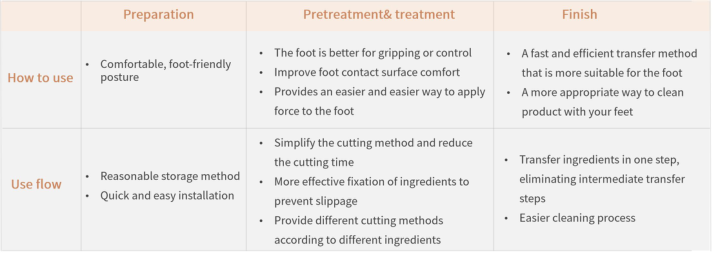
Based on the above research on knives and vegetable cutting tools, the paper comprehensively sorted out and analyzed the demands of armless people while using food processing products (see Figure 5).
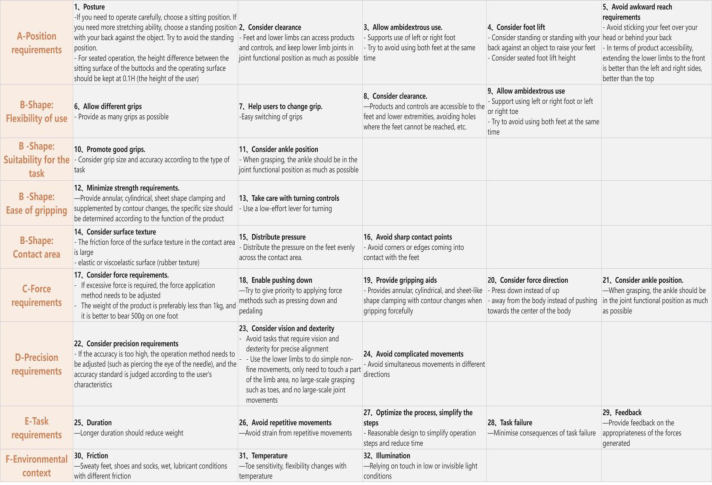
Product Design Strategies for Armless People According to the design strategy of products using hand interaction in the Capability-Demand theory (Inclusive design toolkit, 2022), combined with the specific motor capabilities and demands of armless people, we analyze and summarize the design strategy of using foot interaction with products, which can be used to guide the follow-up design practice (see Figure 6).
x Position Dimension: The product design requires to consider the use posture, use gap, flexibility and foot lifting height of armless users as well as avoiding the discomfort while using. By taking the food processing products discussed above as an example, it is recommended that armless people choose the sitting position, and the height difference between the hip sitting surface and the operating surface is 0.1H (H is the height of
The Kitchen Product Design Oriented to the Motor Capability of Armless People 21
Figure 6: Design strategies for using feet to interact with products.
the operator). y Shape Dimension: It needs to support the flexible use, is suitable for tasks and easy to grasp, and considers the contact area betw- een the product and the body. For armless users, there are a variety of gripping methods (such as toe gripping and instep gripping) provided, it selects the grip according to the task type and provides annular, cylin- drical and sheet shapes supplemented by changes in contour. And it can also be considered from the surface friction and contact area. z Force Dimension: It should take the force bearing capacity of lower limbs into considerations; the weight of a single foot shall be maintained at 500g (5 potatoes); the force application method of downward pressure shall be given priority; we should focus on the direction of force and try to make the ankle and wrist in the joint functional position, which could avoid joint damage caused by long-term force application (Yulan Ding, 2017). (see Figure 6).
CONCLUSION
This paper studies the motor capabilities of armless people and the demands for food processing products through two surveys. The research on armless people can provide the reference for product design for this vulnerable group. As a group with the low attention at the social, market and design levels, the research expands the connotation and scope of inclusive design to a certain extent. More importantly, it can help more newly created armless people to reduce the cost of learning, quickly adapt to life and improve their self- care ability, and to a certain extent, it can also reduce the psychological and physical pressure of such users and their family members.
22 Bai and Gong
ACKNOWLEDGMENT
The authors would like to acknowledge the support of Study on evaluation index of Urban environment construction for livable city for old people in Beijing (18YTA001).
REFERENCES
China Disabled Persons’ Federation, C. D. P. F. (2021). Progress of Major Undertakings for The Disabled in China (2016-2020). Retrieved January 15, 2022, from https://www.cdpf.org.cn/zwgk/zccx/ndsj/zhsjtj/2020zh/7507622c2e774b3d adacb7dc8f9f3bc2.htm Clarkson, P. J., Waller, S., & Cardoso, C.. (2015).Approaches to estimating user
exclusion. Applied Ergonomics, 46, 304–310. Grundy, E., Ahlburg, D., Ali, M., Breeze, E., & Sloggett, A.. (1999). Disability in Great Britain: results from the 1996/97 disability follow-up to the family resources survey. Persad, U., Langdon, P., & Clarkson, P.. (2007). A framework for analytical inclusive
design evaluation. University of Cambridge, U. of C. (2017). Inclusive design tool- kit. Reach and Dexterity. Retrieved January 15, 2022, from http://www.inclusivedesigntoolkit.com/UCdex/dex.html#further_information Waller, S. D., Williams, E. Y., Langdon, P. M., & Clarkson, P. J.. (2010). Understanding the co-occurrence of ability loss. Yu-Lan Ding. (2017). Man machine engineering (5th edition). Beijing Institute of
Technology press. Zhi-Quan Liu. (2003). General situation of physical disability in China. Chinese Journal of Rehabilitation Medicine (08), doi:
LISTED IN THE AHFE DIGITAL BOOKSTORE CATALOGUE
Explore the complete digital volume
Human Factors in Aging and Special Needs
Read this individual research paper free through the original publisher, or explore the full digital proceedings book.
ISBN 978-1-958651-14-8
Explore this ISBN in the AHFE Bookstore ↗Listed in the July 2026 bookstore catalogue; search by ISBN to confirm current availability · Digital book purchase optional