Hannah Dammers, Luisa Vervier, Lukas Mittelviefhaus, Philipp Brauner, Martina Ziefle, Thomas Gries (2022). Usability of human-robot interaction within textile production: Insights into the acceptance of different collaboration types. In: Usability and User Experience. AHFE Open Access, vol. 39, pp. 213–223. https://doi.org/10.54941/ahfe1001710
With the advent of digitization and automation in industry, the use of technological innovations is increasing especially in areas that were previously exclusively processed manually. The interdisciplinary research cluster “Internet of Production” (IoP) has made this very fact its research task precisely to reshape production through technologies such as machine learning or cloud computing. In this way, fully networked processes as well as digital shadows of real production chains and products are expected to achieve major advantages for production companies. However, the reality in most production processes using limp materials (e.g. textiles or foils) is different as these processes are difficult to automate. In textile composite production, for example, about 40 % of all components are manufactured manually. Human experts are skilled in dealing with the brittle textiles and have an excellent sense of materials, enabling them to flexibly manufacture even very complex components. Nevertheless, these manual processes cause problems like slow production speed as well as back or wrist problems for employees due to working in bent positions and applying a lot of force. In addition, the shortage of skilled workers and ageing workforces are compelling companies to react and prevent a loss of existing tacit expert knowledge. Fully automated processes cannot be used for many composite components due to unproportioned costs, limited flexibility or a too high level of complexity. In order to still save time and costs, besides improving working conditions and securing tacit knowledge, the approach of human-robot interaction is promising. A successful and appropriate integration can be achieved by considering the technical possibilities as well as the workers specific needs. The current empirical state of the art on human-robot collaboration mainly focuses on performance, safety and task assignment. So far the human factor remains underexposed. This study therefore focuses on the user and investigates motivational and acceptance-relevant factors that enable a qualitatively valuable division of labour in relation within the human-robot interaction.In a user-centered design the acceptance of the interaction with a cobot during a textile composite production process is examined. The within-subjects experimental design requests participants (n = 21) to form a textile into 3D-shape to the best of their ability. The cobot acts as a technical assistant and supports the execution of tasks in three different levels of autonomy (low, middle, high). Based on the technology acceptance model (TAM), the general acceptance of the interaction is assessed. Furthermore, perceived autonomy, perceived control, bodily security, perceived mental and physical effort is surveyed after each task. It turns out that the intention to use a cobot is generally high. The greatest influence on the acceptance is characterized by hedonic motivation, followed by ease of use, trust and usability. The evaluation regarding perceived autonomy and control over task performance and physical safety increases with decreasing cobot activity. Based on the results, we derive recommendations for an optimal use of a human-robot interaction, in which the cobot is perceived as a supporting component and at the same time the maximum autonomy of the worker can be maintained.
Through the digital transformation of production, smarter control through machine learning, improved sensors and robot actuators, more previously exclusively manual production activities can be automated (Brauner et al. 2022, Villani et al. 2018). However, production processes using limp materi- als (e.g., textiles or foils) are more difficult to automate (Dammers et al., 2021). For example, in textile-based composite production about 40 % of all components are manufactured manually (Reux and Mikdam, 2019). Human experts are skilled in handling the limp textiles and have an excellent sense of materials, enabling them to flexibly manufacture even very complex components. Nevertheless, these manual processes cause problems like slow
production speed as well as back or wrist problems for employees due to working in bent positions and applying a lot of force. Due to dispropor- tionate costs, limited flexibility, or excessive complexity not all processes for manufacturing composite components can be fully automated (Elkington et al., 2015). To still save time, reduce costs, and improve working conditions human-robot interaction (HRI) is promising. A successful and appropriate integration can be achieved by considering the technical possibilities as well as the workers’ specific needs. Yet, the current state of the art on HRI in com- posite production mostly focuses on technical factors (Dammers et al., 2021, Eitzinger et al., 2021) while neglecting the human perspective.
This study therefore focuses on the user and investigates satisfaction and acceptance-relevant factors that enable a valuable task sharing within HRI. In a user-centered design the acceptance of HRI during a textile composite production process is examined based on the technology acceptance model (TAM). Furthermore, ratings about satisfaction of performance, perceived autonomy, and control as well as mental and physical effort are surveyed. Three research questions are guiding our study: (1) Does the type of colla- boration have an impact on the satisfaction rating? (2) To what extend does the type of collaboration influence the perceived autonomy and control?, and lastly (3) Which factors have an influence on the acceptance rating regarding the human-cobot-interaction? The sample is drawn from experts in the field (n = 21). In a within-subject design, participants are asked to form a textile into a three-dimensional shape to the best of their ability. The cobot acts as a technical assistant and supports the execution of three tasks in different collaboration types (low, medium, high).
STATE OF THE ART To answer the research questions addressed, this chapter provides the basics of composite production, HRI and the investigated factors such as accepta- nce.
Composite Production A textile-based composite is basically the combination of a textile reinfo- rcement with a matrix material (e.g., plastic). They are typically used in applications where high strengths combined with low weight are demanded, e.g., in aviation, automotive, construction and sports sectors. (Fleischer et al., 2018) To produce a composite part, the so-called preforming can be used that consists of four process steps: cutting to size, handling to the mold, draping (forming) into the final three-dimensional shape, and joining the individual layers, for example by using spray adhesive. (Elkington et al., 2015) Especi- ally demanding is the draping of the individual textile layers, since the fibers have to be aligned exactly in the direction of the occurring loads in order to achieve the required outstanding mechanical properties of the final com- ponent. In this context, the avoidance of wrinkles, fiber displacements or waviness is particularly important. Draping is not only the most error-prone but also the most time-consuming process step in sequential preforming and
Usability of Human-Robot Interaction within Textile Production 215
is therefore investigated in this study. (Chan et al., 2020; Dammers et al., 2021; Eitzinger et al., 2021; Elkington et al., 2015)
Human-Robot Interaction There are four main types of HRI (Otto and Zunke, 2015): Full automation. Original form of robotic operation. HRI is not possible because protective fences hinder the human from entering the work area. Thus, human and robot workspaces are separate. Human-robot coexistence. Human and robot have separate workspaces and tasks. Physical contact between human and robot is not necessary or required but possible. Human-robot cooperation. Human and robot carry out joint tasks in joint workspaces. However, physical con- tact is not necessary to fulfil the given tasks. Human-robot collaboration. Physical contact between human and robot is required to successfully com- plete the given joint tasks in joint workspaces. We address the last two mentioned types of HRI. Previous publications on HRI in composite pro- duction concentrate mainly on improving efficiency and safety of the textile process with little or no attention to humans. (Dammers et al., 2021; Eit- zinger et al., 2021) Thus, in our study, we focus on human factors such as acceptance, perceived autonomy, and satisfaction.
Measuring Acceptance and User Factors With the increasing integration of HRI in production, considering accepta- nce becomes more important. To understand which aspects are decisive when humans and robots work as a team, it is necessary to identify the influencing acceptance factors. Here, we define acceptance as the willingness to use a cobot for textile composite production. Building on the Theories of Reaso- ned Action (TRA) and Planned Behavior (Ajzen and Fishbein, 1977), the Technology Acceptance Model (TAM) provides the theoretical basis by lin- king perceived usefulness and perceived ease of use to attitudes towards use, behavioral intention, and later actual use of a technology (Davis, 1989). In our study, we added two factors, as they likely relate to acceptance: hedonic motivation (Lin et al., 2020) and trust (Lee and See, 2004). Trust in auto- mation is generated by the expected predictability, credibility, and usefulness of the technology. The current state of the art knows little about the keys of a successful HRI (Porubˇcinová and Fidlerová, 2020). At present, there is insufficient consideration of psychological factors. Affect, motivation, and perceived autonomy are likely promoters for successful HRI. Thus, this study also explores autonomy, seen as the quality of self-directedness, or freedom from outside control (Bradshaw et al., 2004).
METHODICAL PROCEDURE The user-study is designed on the basis of the state of the art. The study design, the type of tasks, and the assessment are explained in detail in the following subsections.
216 Dammers
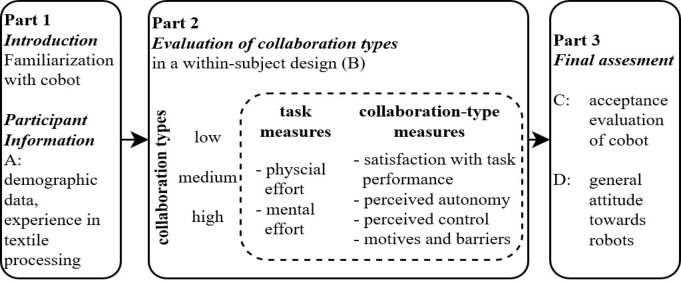
Figure 1: Overview of experimental procedure of the HRI acceptance study.
Study Design Fig. 1 shows the study procedure. Overall, the study consists of three parts. The respective parts of the questionnaire are indicated in alphabetical order (A–D).
The first part introduces the participants to the topic of human-robot- interaction, makes them familiar with the Franka Emika robot and informs participants that participation is voluntary and withdrawing from the study is possible at any time. Additionally, part A of the questionnaire is examined (demographic data and prior experience). The second part covers the intera- ction with the robot. All participants are instructed to drape a rectangular layer of glass fiber fabric (twill weave, 200 g/m2) accurately and flawlessly onto a mold in omega geometry with the support of the cobot. Participants repeat this task with three different collaboration types (low, medium, high) in a randomly assigned order (within-subject design). After each task, we assess the mental and physical effort scale, as well as the individual sati- sfaction with task performance, perceived autonomy, and perceived control, motives and barriers for collaboration (B). The third part assesses the acce- ptance using the TAM-items (C) and the attitude towards robots (D). The duration of the study is about 60 minutes.
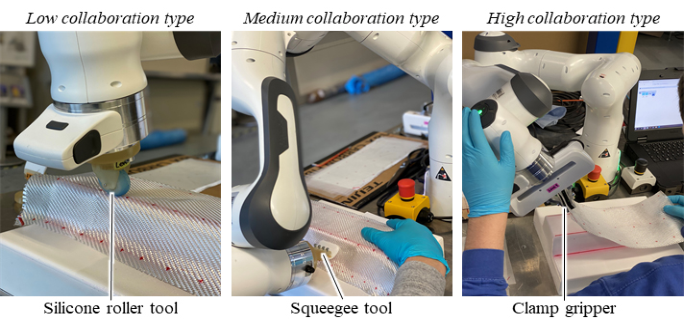
Collaboration Types To find out whether and which type of HRI is appropriate within preforming, three different collaboration types (see Fig. 2) are implemented differing in terms of the active division of labor between the robot and participant as well as the tool used.
Low collaboration type: Robotic Draping with Silicone Roller-Tool The first collaboration type is considered as human-robot cooperation. The cobot autonomously drapes the textile layer that is positioned by the participant and takes over the main part of work by using a silicone roller. While the cobot is completing its task, the participant is checking the quality of work in order to intervene in the event of faults or unexpected complicati- ons. Meanwhile, the participant is encouraged to rework areas already done by the cobot to achieve the best possible draping result.
Usability of Human-Robot Interaction within Textile Production 217
Figure 2: Low, medium and high collaboration type investigated with respective cobot tools.
Medium collaboration type: Human-Robot Task Sharing with Squeegee- Tool In the medium collaboration type, the participant is instructed to position the textile layer on the mold without tightening or draping it. Afterwards, the participant initiates the cobot which is equipped with a squeegee-tool to drape the fabric on parts of the mold. The remaining parts are dra- ped independently by the participant. Accordingly, in this task a sequential human-robot cooperation is aimed at.
High collaboration type: Robotic Assistance with Clamp Gripper In the high collaboration type, a high level of autonomy is left to the human. Human and robot are intended to work together in human-robot collaboration. A clamp gripper is used as a cobot tool which holds one side of the glass fiber fabric while the participant manually adjusts the position and orientation of the cobot so that the textile layer can be draped manually in the best possible way. Thus, the cobot assists the participant in draping independently on the mold.
Study Measures In the first part of the questionnaire (A), demographic data and prior experie- nce in textile processing is assessed. The participants’ age, highest educational attainment, professional background and current profession is surveyed. Additionally, prior experience in textile processing with four items is eva- luated on a 6-point-Likert scale from no agreement at all to total agreement. Technical knowledge in textile engineering, experience with composites, dra- ping and experience with automated systems is assessed. The first three items are calculated to an overall experience score (α = .723). The fourth item is kept single due to low scale reliability. Moreover, participants are asked to self-assess their experience of processing textile on a 10-point-sale (1 = no experience, 10 = immense experience).
218 Dammers
Table 1. Surveyed items - satisfaction of task performance, perceived autonomy and perceived control. Items marked with * are reversed.
Table available in the original PDF paper.
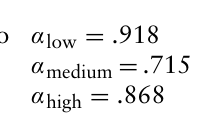
Scale Items Cronbach’s Alpha (α) Satisfactionwith task performance αlow = .682 αmedium = .842 αhigh = .647 I am satisfied with the result of the draping in collaboration with the cobot. I could have achieved a better result without the cooperation with the cobot.* For an optimal draping result, I had to manually rework the processed area of the cobot.*
Perceived auto- nomy
Equation reproduced from the original PDF.
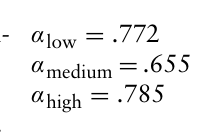
If I could have chosen, I would have preferred to drape in a different way.* The way I draped was according to my ideas. I had the choice to drape as I wanted. I was very restricted by the cobot when draping.* I was able to do the draping in my own way.
Perceived control
Equation reproduced from the original PDF.
The cobot responded to my commands by touch- ing the arm accordingly. I was afraid that the cobot would hurt me.* I thought the cobot’s movement was predictable. I felt like I was in control.
Part 2 is the main part of the study and evaluates each collaboration type with the Rating Scale of Mental Effort (RSME) by Paas (“How much mental/physical effort did you invest in the task?”) on a 10-point Likert- Scale (Paas, 1992). To evaluate the collaboration types, we surveyed three self-administered scales: the individual satisfaction of task performance, perceived autonomy, and perceived control. For the assessment of the used tool, one single item is surveyed (“I found the tool useful for performing the task”). Table 1 lists the individual items of the scales with additional informa- tion about the internal reliability (Cronbach’s Alpha). Moreover, qualitative data concerning motives and barriers of each collaboration type are collected.
Part 3 of the study includes the final assessment according to the accepta- nce model of (Venkatesh et al., 2012). Four dimensions are rated each with three items: Usability (e.g., “I am convinced that the cobot works well”), ease of use (e.g., “Dealing with the cobot will be clear and easy for me.”), hedo- nic motivation (e.g., “Using the cobot will be fun”) and behavioral intention (e.g., “I can imagine myself working together with the cobot”). Additionally, trust is added as an extended dimension (e.g., “I will trust the cobot.”). Items with sufficient internal consistency with one another are summed up into an overall score. (Venkatesh et al., 2012). The study ends with a scale on attitude towards robots with seven items (GESIS, 2018).
Sample Description and Statistical Analysis The user study was conducted at the Institut für Textiltechnik (ITA) at RWTH Aachen University, Germany, with 21 male participants in the age range from 21 to 35 years (M = 24.6, SD = 3.8). Most participants (n = 13, 62 %) are
Usability of Human-Robot Interaction within Textile Production 219
studying engineering. Seven participants (33 %) had a university degree while one participant had completed vocational training (5 %). Since only partici- pants from the field took part, 95 % had a degree in mechanical engineering as a technical background, one came from the field of materials science. The information on current jobs ranged from student, research assistant, bach- elor candidate, to PhD student. Prior experience in textile processing was very high (M = 5.02, SD = 0.62). The same picture occurred in the self- rating with a mean of 7.05 (max.10, SD = 1.63). Experience with automated systems within the textile production was low (M = 2.76, SD = 1.51). The attitude towards robots was slightly positive (M = 4.25, SD = 0.65).
For the various variables we report descriptive statistics. Due to the small sample size, we use non-parametric tests: Spearman’s rank correlation coef- ficient r, Friedman’s test for analysing differences in means, Cohen’s d to determine effect sizes, and χ2 tests. We set the level of significance to 5 % (p).
RESULTS
The evaluation of the collaboration types is reported firstly, followed by the results of the acceptance evaluation and completed by the description of the qualitative results. The significance level of the correlations is identified with * (* indicates a significance level of p < .05, ** represents a significance level of p < .01) Evaluation of Collaboration Types
Satisfaction rating of performance. The ratings according to the individual satisfaction of performance with the cobot are positively evaluated with an average value rating above 3.5 (min.1, max.6). The highest rating is recor- ded for the high collaboration type (M = 3.93, SD = 1.22), followed by the medium (M = 3.88, SD = .9) and finally the low collaboration type (M = 3.77, SD = 1.38). Even though small descriptive statistical differences are noted, the type of collaboration does not have any statistically significant impact on the satisfaction rating (χ2(2) = 1.132, p = .568, n = 21).
Perceived autonomy. The rating about the perceived autonomy shows a similar result. Again, all collaboration types are associated with an existing perceived autonomy, when interacting with the cobot by ratings above the average scale of 3.5. The highest collaboration type enables the highest sense of autonomy (M = 3.93, SD = 1.32), followed by the low type (M = 3.62, SD = 1.02). The least perceived autonomy is observed with the medium collaboration type (M = 3.54, SD = .86). No significant impact is dete- cted between the collaboration types concerning the perceived autonomy (χ2(2) = 1.904, p = .386, n = 21).
Perceived control. On average, the perceived control while interacting with the cobot is high. The highest perceived control is attributed to type high (M = 5.05, SD = .88). Type medium achieves the second-best evaluation (M = 4.95, SD = .72), followed by type low (M = 4.74, SD = .96). Since all types are generally rated almost equally positive, no significant differences are found (χ2(2) = 2.113, p = .348, n = 21).
220 Dammers
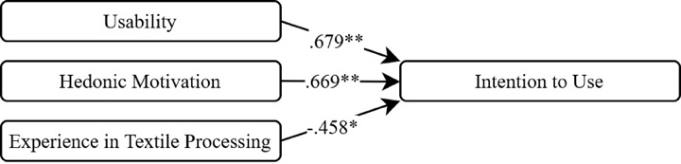
Figure 3: Significant correlations between usability, hedonic motivation and experie- nce in textile processing on intention to use cobot (n = 21).
Mental and physical rating of collaboration type. Both efforts are rated relatively low and below the center of the scale (4.5). Collaboration type high gets the highest rating (Mmental = 3.67, SD = 1.88/ Mphysical = 1.76, SD = 0.99), followed by the lowest (Mmental = 2.95, SD = 1.88/ Mphysical = 1.19, SD = 0.4) and lastly the medium collaboration type (Mmental = 2.14, SD = 1.62/ Mphysical = 1.05, SD = 0.22). The collabo- ration types medium and high differ significantly on both effort scales ( χ2mental(2) = 12.237, p = .002, r = .20, n = 21 / χ2physical(2) = 13.867, p = .001, r = .15, n = 21). Thus, in both collaboration types where the human is left with more autonomy (medium, high), more effort is required in the first place mentally and in the second place physically.
Evaluation of Acceptance Generally, the evaluation of all acceptance-relevant factors is positive above the center of the scale (3.5). Ease of use is rated highest (M = 5.29, SD = .56), followed by trust (M = 5.02, SD = .63). Hedonic motivation turns out to be high (M = 4.94, SD = 1.81). The intention to use (M = 4.35, SD = 1.11) and usability (M = 4.01, SD = 1.21) are given a barely positive rating. Determi- ning which factors predict usage intention, usability (r = .679**) and hedonic motivation (r = .669**) are decisive. The other TAM factors do not show any significant correlations. User factors such as experience or attitude-related factors moderate the relationship to the predicted intention to use (Venka- tesh et al., 2012). Therefore, in this study correlations are calculated as an exploratory attempt to get first hints what may influence the intention to use. Figure 3 illustrates the significant findings of one additional factor, in particular the experience in textile processing.
The results imply that the higher the usability of the cobot, the more fun it is to interact and the less experienced users are with textile processing the higher the predicted usage intention.
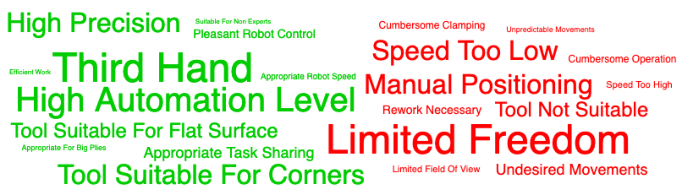
Motives and Barriers Asked about motives and barriers of using a cobot for textile proces- sing, participants associated more negative (nred = 82) than positive ideas (ngreen = 78) (see figure 4).
Motives. For the low collaboration type, using the roller tool, most of the participants state that the tool is suitable for draping corners (n = 10) and that
Usability of Human-Robot Interaction within Textile Production 221
Figure 4: Qualitative statements: motives (green) and barriers (red) for HRI in draping. The size of the words corresponds to the frequency of namings.
robot-human task sharing is satisfactory (n = 5). Due to the good repeata- bility of the process, the high automation level is mentioned as an advantage (n = 4). Similar applies for the medium collaboration type, where the squee- gee tool to a s suitable for flat surfaces (n = 8) and the high automation level (n = 7) is commended for allowing parallel work on multiple molds. Most participants mention the use of the clamp gripper as a third hand as major advantage for the high collaboration type (n = 17). They also find precision high (n = 6) and robot control pleasant (n = 6).
Barriers. In all collaboration types, low (n = 5), medium (n = 9) and high (n = 9), a major barrier is seen in the limited freedom of action for the human, as the robot obstructs human movements. Besides, participants mention that the draping result is highly dependent on the initial manual positioning (low: n = 5, medium: n = 4). In addition, for the low type, the tool is mentioned as not suitable for flat surfaces (n = 5). In the medium type, the participants consider the robot speed to be too low. For the high collaboration type, undesired robot movements (n = 7) as well as cumbersome operation (n = 7) and cumbersome clamping (n = 5) are mentioned as disadvantages.
DISCUSSION AND RECOMMENDATIONS We presented an empirical user study on the acceptance of HRI in textile pro- duction with different collaboration types varying in the degree of autonomy from the human perspective (low, medium, high). In summary, the evaluation shows that the cobot is seen as a technical assistant which enables carrying out the given draping task well. However, no dependence on the collabora- tion type is discernible regarding the specific tasks given (research question 1). Therefore, future research should address the extend of interaction and the differences between collaboration types. In addition, the disadvantages and perceived barriers of the different tools (e.g., poor suitability for certain mold areas) should be mitigated or eliminated in future developments.
Regarding the second question, perceived autonomy tends to be positive for all three collaboration types, with no major differences. Overall, perceived control is rated higher than perceived autonomy for all types. It is percei- ved to be the highest for the high collaboration type. This can be attributed to the possibility of adapting the robot’s movements to the worker’s own movements. Nevertheless, many participants mention the restriction of their freedom of action and undesired robot movements as disadvantages. Mental
222 Dammers
and physical effort are rated as low in all collaboration types, with tasks being more mentally than physically challenging. More effort is required in the medium and high collaboration type, where more autonomy is left to the indi- vidual. The Self-Determination Theory suggests that autonomy and control are related to higher task performance and job satisfaction (Deci and Ryan 2008). For higher autonomy, we recommend adapting the robot movements and workflows to the workers and setting up smart interfaces for improved individual robotic support.
The third research question referred to the general acceptance. In gene- ral, all investigated factors are rated positively, with ease of use, trust, and hedonic motivation rated highest, and intention to use as well as usability rated barely positive. The results show that usage intention depends mainly on hedonic motivation, usability, and experience in textile processing. Limi- ted usability can be attributed to the low complexity of the geometry and thus the draping task. Within the qualitative statements, some participants refer to the possibility of improving the used robot tools, as well as the use of the technology for large plies and complex geometries. Furthermore, the results show that participants with little experience in textile processing rate usability higher. This could be explained by the fact that more experienced individuals do already have accustomed workflows. Thus, they perceive the cobot to limit their freedom and restrict possibilities to intervene. To increase usability and acceptance of HRI, workflows and robot operation should be improved and user diversity factors should be more deeply illuminated.
LIMITATIONS AND FUTURE RESEARCH The small sample size impacts the results of this study. For future studies, we suggest investigating a broader and more diverse sample, particularly including women and a wider age range. Also, the consideration of different professional and educational backgrounds is interesting. An experimental study design was chosen to investigate the cobot and its tool specifically for textile processing. Thus, the (free-form) answers mostly refer to concrete robot movements or tools depending on the respective draping tasks. For this specific use case, the interaction and task sharing between human and robot should be redefined in further research, as well as more complex tasks should be chosen. Due to the very specific use case, it is difficult to transfer the results to HRI in general, so that further factors should be investigated independen- tly. This could include the use of human digital shadows to detect the worker in the work environment (e.g., position tracking, fatigue detection) to achi- eve improved collaboration and adaption of tasks (Mertens et al. 2021). As a result, other human factors such as information privacy become relevant. Questions arise such as: What can and should technology know about the user for productive and pleasant HRI? In this context, trust in automation becomes particularly relevant and should be investigated in further studies.
ACKNOWLEDGEMENT
Funded by the Deutsche Forschungsgemeinschaft (DFG, German Research Foundation) under Germany’s Excellence Strategy - EXC-2023 Internet of Production - 390621612.
Usability of Human-Robot Interaction within Textile Production 223
REFERENCES
Ajzen I and Fishbein M (1977) Attitude-behavior relations: A theoretical analysis and review of empirical research. Psychological Bulletin 84(5): 888–918. Bradshaw et al. (2004). Toward trustworthy adjustable autonomy in KAoS. Trusting
Agents for Trusting Electronic Societies, Springer, Berlin, Heidelberg: 18–42. Brauner, P. et al. (2022) A Computer Science Perspective on Digital Transformation in Production. ACM Trans. Internet Things (3)2, Article 15. Chan, W. et al. (2020) An augmented reality human-robot collaboration interface
design for shared, large-scale, labour-intensive manufacturing tasks, In: 2020 IROS. IEEE, p. 11308–11313. Dammers H, Lennartz M, Gries T, et al. (2021) Human-robot collaboration in composite preforming: chances and challenges. CAMX proceedings, Dallas, TX. Deci, E. L. and Ryan, R. M. (2008) ‘Self-Determination Theory: A Macrotheory
of Human Motivation, Development, and Health’, Canadian Psychology, 49(3), pp. 182–185. doi: 10.1037/a0012801. Davis FD (1989). Perceived Usefulness, Perceived Ease of Use, and User Acceptance of Information Technology. MIS Quarterly 13(3): 319. Eitzinger C, Frommel C, Ghidoni S, et al. (2021) System concept for human-robot
collaborative draping. Baden/Zürich, Schweitz. Elkington M et al. (2015) Hand layup: understanding the manual process. Advanced Manufacturing: Polymer & Composites Science 1(3): 138–151. Fleischer J, Teti R, Lanza G, et al. (2018) Composite materials parts manufacturing.
CIRP Annals 67(2): 603–626. GESIS (2018). European Commission and European Parliament, Brussels (2018): Eurobarometer 82.4 (2014). TNS opinion [producer]. GESIS Datenarchiv, Köln. ZA5933 Datenfile Version 6.0.0, https://doi.org/10.4232/1.13044 Lee JD and See KA (2004). Trust in automation: designing for appropriate reliance.
Human factors 46(1): 50–80. Mertens, A et al. (2021): Human Digital Shadow: Data-based Modeling of Users and Usage in the Internet of Production. In: 2021 HSI. IEEE, S. 1–8. Otto M and Zunke R (2015) Einsatzmöglichkeiten von Mensch-Roboter- Kooperationen und sensitiven Automatisierungslösungen: Zukunft der Arbeit - die neuen Roboter kommen. Paas FGWC (1992) Training strategies for attaining transfer of problem-solving skill
in statistics: A cognitive-load approach. Journal of Educational Psychology 84(4): 429–434. Porubˇcinová M and Fidlerová H (2020) Determinants of Industry 4.0 Technology Adaption and Human - Robot Collaboration. Research Papers Faculty of Materials Science and Technology Slovak University of Technology 28(46): 10–21. Reux F and Mikdam M (2019) Overview of the Global Composite Market
2018–2023: Continuing Growth. JEC Composites Magazine (SI #1): pp. 34–42. Venkatesh, Thong and Xu (2012) Consumer Acceptance and Use of Information Technology: Extending the Unified Theory of Acceptance and Use of Technology. MIS Quarterly 36(1): 157. Villani, V. et al. (2018) ‘Survey on human–robot collaboration in industrial settings:
Safety, intuitive interfaces and applications’, Mechatronics. Elsevier, 55(February), pp. 248–266. doi: 10.1016/j.mechatronics.2018.02.009. Venkatesh V and Bala H (2008) Technology Acceptance Model 3 and a Research Agenda on Interventions. Decision Sciences 39(2): 273–315.
LISTED IN THE AHFE DIGITAL BOOKSTORE CATALOGUE
Explore the complete digital volume
Usability and User Experience
Read this individual research paper free through the original publisher, or explore the full digital proceedings book.
ISBN 978-1-958651-15-5
Explore this ISBN in the AHFE Bookstore ↗Listed in the July 2026 bookstore catalogue; search by ISBN to confirm current availability · Digital book purchase optional