Yahui Wang, Chunrong Liu (2022). A DEMATEL Approach to Exploring Influencing Factors of the Elderly Satisfaction with Park Fitness Facilities. In: Human Factors in Aging and Special Needs. AHFE Open Access, vol. 38, pp. 182–189. https://doi.org/10.54941/ahfe1001679
Healthy aging has risen to the strategic level of the government, and the fitness activities of the elderly has been widely valued by the public sector. Parks are the main places for the elderly to exercise, and the elderly satisfaction with park fitness facilities is regarded as an important topic. Based on Maslow's hierarchy theory of needs and previous research results, this paper conducted interviews with the elderly, and further determined 12 key factors affecting the elderly satisfaction with park fitness facilities. This study uses the Decision-Making Trial and Evaluation Laboratory (DEMATEL) method to conduct an empirical analysis of 12 influencing factors. According to the results of the data analysis, mental relaxation and social entertainment are the two most influential factors among 12 influencing factors. These two factors are located in the upper level of Maslow's hierarchy of needs theory, which indicates that the basic needs of the elderly for park fitness facilities have been met, and the basic fitness needs are not the main consideration of the elderly for their satisfaction. Through the analysis of experimental results, three strategies were proposed: (1)Space Design needs to be taken seriously, so that functional space division and soft partitions are necessary; (2)Park fitness facility adopts the concept of service design, which allows the elderly to have a higher level of satisfaction through a process-oriented experience; (3)The body size of the elderly needs to be taken into account in the design phase of the park fitness facilities.
According to the seventh census data released by the Bureau of Statistics, China’s population aged 60 and above has reached 264 million (Li, 2021, pp. 62-64). Taking Shanghai as an example, Shanghai ranks high in terms of aging in the country, with a population of 5,815,500 people aged 60 and above, accounting for 23.4%. Reasonable fitness exercise plays a very impor- tant role in the health of the elderly, and the park is an important place for the elderly to exercise. Urban parks are one of the main carriers of urban landscape culture, and also provide venue conditions for people’s daily lei- sure and fitness activities. With the progress of the times, people’s needs for fitness and entertainment in urban parks are no longer only satisfied with pla- ces that can provide fitness, but also for the planning and layout of the site,
A DEMATEL Approach to Exploring Influencing Factors 183
the types of facilities, the convenience of surrounding auxiliary service facili- ties, and the surrounding environment, landscape and people. The Shanghai Municipal Bureau (2021) concluded that the interactivity of the system puts forward higher requirements. City parks are the main places for citizens to carry out leisure sports, and have the functions of urban greening and leisure activities. Many elderly people exercise here, which not only brings physical health, but also promotes mental health through social behaviors (Wu, 2017, pp. 1-2). Considering the use of park fitness facilities by seniors as a closed- loop activity, there are many factors that influence this activity. This study starts from the satisfaction of the elderly and conducts an investigation to explore the influence of various factors on the psychological demands and cognitive characteristics of the elderly from the perspective of the elderly, and to propose corresponding countermeasures.
METHODS
DEMATEL Method The DEMATEL method calculates the causal relationship among all elements by using the matrix and related mathematical theory by observing the pai- rwise influence relationship between the elements of a problem or structure and the degree of influence, and expresses the strength of the causal influe- nce relationship with numbers. With this method, complex causal structures can be effectively understood. Therefore, the related application fields of this method are very wide, and it has been widely used (Liu et al., 2019, pp. 9-10). The advantage of the DEMATEL method is that it can simplify complex pro- blems. Through the influence relationship between various factors, an N*N rectangular determinant can be obtained. After data processing, the causal logic and the causal logic between the problems can be visually displayed in a graphical way.
Theoretical Basis This study discusses the perceptual cognition of the elderly on the use of park fitness facilities. These perceptual cognitions further reflect the elderly’s demand for park fitness facilities. Maslow’s Hierarchy of Needs Theory is introduced for this purpose. Maslow’s Hierarchy of Needs Theory points out that different levels of needs have different levels of motivation for people’s psychology and behavior. According to the characteristics of the study, the influencing factors are summarized according to the second edition of Mas- low’s Hierarchy of Needs Theory. Abraham Harold Maslow (1970) changed Maslow’s hierarchy of needs into seven layers in Motivation and Persona- lity, 2nd edition, namely physiological needs, safety needs, belonging needs, and esteem needs, cognitive needs, aesthetic needs, self-actualization needs. Based on Maslow’s Hierarchy of Needs Theory, the perceptual appeals of the elderly to park fitness facilities can be divided into the above seven levels, and then the influencing factors of each level can be summarized according to the results of interviews and research and literature summary.
184 Wang and Liu
Table 1. Numbers of influencing factors.
Table available in the original PDF paper.
Score Influencing degree
0 No influence 1 A little influence 2 A moderate influence 3 A strong influence
ANALYSIS OF INFLUENCING FACTORS Interview Research
According to the theme of “use satisfaction of park fitness facilities”, the elderly were interviewed to find the influencing factors of the elderly’s sati- sfaction with the use of park fitness facilities, as the judgment basis of the decision-making laboratory method. The interviewees are the elderly who often go to the park to exercise, randomly selected between the ages of 60 and 75, and the main factors are summarized and ranked according to their feedback. According to the interview results, 12 main influencing factors are summarized and correspond to Maslow’s seven-level theory.
Physiological needs: good maintenance (Xie, 2007), ease of operation, functional diversity, easy access, and rest facilities; Safety needs: safety; Belonging and love needs: social entertainment (Shi and Dai, 2017); Respect needs: psychological relaxation; Cognitive needs: easy to understand (Zhang and Cheng, 2007); Aesthetic needs: equipment appearance (Yu and Wu, 2012), environment (Huang, 2017); Self-actualization needs: providing sense of satisfaction.
DEMATEL Questionnaire According to the 12 influencing factors mentioned above, the DEMATEL questionnaire was organized. The questionnaire is composed of scale items, and each item is scored by one factor on the degree of influence of the other factors as Table 1:
Through offline and online methods, a survey was conducted on the elderly in Shanghai, and a total of 19 questionnaires were collected. The influencing factors are numbered as Table 2:
A DEMATEL Approach to Exploring Influencing Factors 185
Table 2. Numbers of influencing factors.
Table available in the original PDF paper.
Numbers Influencing factors 1 Good maintenance 2 Ease of operation 3 Functional diversity 4 Easy access 5 Rest facilities 6 Safety 7 Social entertainment 8 Psychological relaxation 9 Easy to understand 10 Equipment appearance 11 Environment 12 Providing sense of satisfaction
Table 3. Averaging direct impact relationship matrix.
DATA ANALYSIS Averaging Direct Impact Relationship Matrix
The influence degree of each factor is used to obtain an averaged direct influence relationship matrix, as shown in Table 3.
D+R and D-R Use the averaged direct influence relationship matrix to perform normali- zation operation to obtain the standardized direct relationship matrix, and further obtain the direct/indirect influence relationship matrix. Use the sum- mation of the values of the rows and columns of the total influence matrix to obtain the values of the cause (D) and the result (R), and further obtain the values of the centrality (D+R) and the cause (D-R). The values of D+R and D-R are as follows (Table 4).
186 Wang and Liu
Table 4. Values of D+R and D-R.
Table available in the original PDF paper.
D+R D−R
8. Psychological relaxation 4.92 −1.33 7. Social entertainment 4.87 −1.07 2. Ease of operation 4.42 0.35 12. Providing sense of satisfaction 4.22 −1.59 11. Environment 4.00 0.09 1. Good maintenance 3.97 1.79 6. Safety 3.82 −0.30 9. Easy to understand 3.77 0.28 3. Functional diversity 3.72 0.53 10. Equipment appearance 3.34 0.66 5. Rest facilities 2.87 0.41 4. Easy access 2.34 0.18
Table 5. The total influence relationship matrix after setting the threshold value.
Relationship Diagram The quartile (0.13) was taken as the threshold value, and the values whose influence intensity did not reach the threshold value were omitted to obtain the total influence matrix after setting the threshold value, as shown in Table 5.
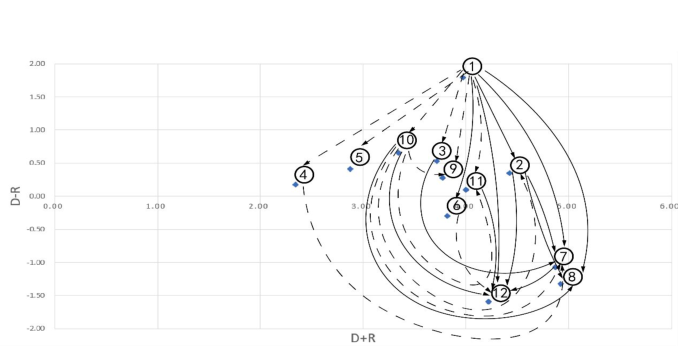
Establish the horizontal and vertical coordinates according to D+R and D-R, then input the coordinate values of 12 factors. Obtain their positio- nal relationship in the coordinate system, and draw the arrows in the causal diagram according to the total relationship matrix. The causal relationship between the factors is show directly in Figure 1.
Relationship Analysis D+R stands for centrality. According to the ranking of D+R, the most critical factor affecting satisfaction is “8. Psychological relaxation”, which has the
A DEMATEL Approach to Exploring Influencing Factors 187
Figure 1: Relationship diagram of the evaluation factors greatest overall impact on satisfaction. Meanwhile, “7. Social entertainment” and “2. Ease of operation”are also very important. According to this method, it can be seen that “4. Easy access”, “5. Rest facilities”, and “10. Equipment appearance” have the least impact on satisfaction.
D-R shows the degree of causation, and the influence degree of factors is ranked according to the order of D-R. “1. Good maintenance” is the most important causal factor that mainly causes other factors, and “12. Provi- ding sense of satisfaction” is the most important result factor caused by other factors.
According to the Relationship diagram, it can be clearly seen that “1. Good maintenance”, “10. Equipment appearance”, and “2. Ease of operation” mainly point to other factors, which are the first three important factors that mainly lead to other factors. Conversely, “12. Providing sense of sati- sfaction”, “8. Psychological relaxation”, and “7. Social entertainment” are mainly pointed by other factors.
DISCUSSION
From the relationship diagram analysis, “Psychological relaxation” is the most critical factor affecting the elderly’s satisfaction with the use of park fitness facilities, which directly affects the overall satisfaction. It reflects the importance that the elderly attach to the relaxation and peace of the venue atmosphere, as well as psychological respect. In this study, it was also found that “Social entertainment” has become one of the core determinants of potential satisfaction, which indicates that the needs of the elderly for exe- rcise areas in parks are not limited to physical fitness, and park fitness areas are also serving as places for social leisure.
The first two factors are both located at the third level and above of Mas- low’s hierarchy of needs, indicating that the basic needs of the elderly for fitness facilities have been met, and basic fitness needs are no longer a major factor in seniors’ satisfaction.
188 Wang and Liu
“Psychological relaxation”can be improved in various ways, such as better design of park space, soft partitions around the fitness equipment, ornamen- tal plants and so on. It can also provide a certain degree of privacy when exercising, reducing the tension in the hearts of the elderly.
“Social entertainment” involves both the entertainment design of fitness equipment and the scope of service design. A community in the United Sta- tes has introduced modular gamification design. This model can allow more elderly people to participate in a fitness activity at the same time. At the same time, the step-by-step links can stimulate the desire of the elderly to explore gradually and bring a continuous sense of achievement. In the form of game clearance, the elderly are encouraged to participate more in group activities, communicate with each other in game exercise, and gain a happy experience (Zhao et al., 2018).
When designing park fitness equipment, the body size and physical function of the elderly should be fully considered. Enterprises should design and produce general fitness products that can be used by both the elderly and ordinary people, so that it is more convenient for the elderly to use fitness equipment.
CONCLUSION
Through the DEMATEL method, this study found that the elderly attach great importance to psychology, social interaction, self-actualization and the environment, and the basic needs have been basically met. The future public fitness business should put the ultimate goal at a higher level and develop towards higher quality. The designer should regard the fitness activities of the elderly park as a system, combining services and hardware facilities. By creating better services and a better public environment, the elderly can not only strengthen their bodies, but also gain physical and spiritual improvement in a relaxed and warm environment.
REFERENCES
Huang, W. (2017). Research on the factors affecting the satisfaction of the use of fitness facilities in Beijing based on grounded theory., Capital University of Economics and Business, pp. 1–2. Li, L. (2021). ‘Viewing my country’s population aging from the seven general
statistics’, China Economic & Trade Herald, 37(15), pp. 62-64. Li, H. and Zhu, L. (2018). ‘Design of public fitness facilities for the elderly based on systematic thinking’, Design, 31(01), pp. 31–33. Liu, C. et al. (2019). Product innovation design strategy development. Shanghai:
Shanghai Jiaotong University Press. Maslow, A. (1970). Motivation and personality. New York: Harper & Row. Shanghai Municipal Bureau. (2021). ‘Bulletin of the Main Data of the Seventh National Population Census in Shanghai’, Jiefang Daily, 19 May, p. 2. Shi, Y. and Dai, L. (2017). ‘Analysis on the design method of outdoor fitness
equipment for the elderly’, Design, 30(08), pp. 126–127. Wu, B. (2017). Research on fitness and entertainment facilities in urban parks., Tianjin University.
A DEMATEL Approach to Exploring Influencing Factors 189
Xie, M. (2007). Design Analysis and Research of Outdoor Fitness Facilities for Urban Elderly., Shandong University. Yu, P. and Wu, N. (2012). ‘Investigation and Research on Physical Fitness Modes of
the Elderly in Xuanwu District, Nanjing City’, Contemporary Sports Science and Technology, 2(25), pp. 68–69. Zhang, F. and Cheng, J. (2007). ‘Application of barrier-free design principles in furniture for the elderly’, Packaging Engineering, 28(03), p. 119. Zhao, X. et al. (2018). ‘Research on Spatial Movement Cognitive Model of Fitness
Path in Cold City Park——Taking Harbin as an Example’, Journal of Architecture, 19(02), pp. 50–54.
LISTED IN THE AHFE DIGITAL BOOKSTORE CATALOGUE
Explore the complete digital volume
Human Factors in Aging and Special Needs
Read this individual research paper free through the original publisher, or explore the full digital proceedings book.
ISBN 978-1-958651-14-8
Explore this ISBN in the AHFE Bookstore ↗Listed in the July 2026 bookstore catalogue; search by ISBN to confirm current availability · Digital book purchase optional