Elena Laudante, Fabrizio Formati, Mario Buono (2022). Design, Robotics and Co-Working. A Human-Centric Perspective on Fifth Industrial Revolution. In: Human Factors in Accessibility and Assistive Technology. AHFE Open Access, vol. 37, pp. 144–151. https://doi.org/10.54941/ahfe1001653
In recent years, the introduction of collaborative robotic solutions is constantly revolutionizing and innovating production processes by identifying new types of physical, cognitive, sensory, social and emotional interaction between user-operator and robot aimed at enhancing human capital. Starting from the preliminary study already realized on the different user-robot collaboration categorizations present in the literature (Formati et al, 2021), the new contribution, through the review of the still insufficient regulatory framework, ergonomic factors and robotic systems existing in the manufacturing field, returns the definition of further specifications about the collaboration modalities. In the current technological ecosystem, through the discipline of design is possible to prefigure and reinforce the collaborative processes through the introduction of new protocols and tools to support the regulatory standards, synthesis and evolution of the investigated categorizations, in order to optimize the production system as a whole and improve the working conditions of the operator with the robotic systems in terms of predictability, reliability, and usability.
In technological and digital change, the new paradigm Industry 5.0 is making its way, direct evolution of Industry 4.0 that introduces the role of modern industry in society. The industry of the future will necessarily have to be “shaped” by the digital transition, through the adoption of new technologies by adapting the process to the needs of the operator.
In this direction, manufacturing 5.0 will exploit the collaboration between advanced robotic systems with the irreplaceable human potential.
In the last decade, human-robot collaboration has represented the growing trend in which robots demonstrate their ability to perform efficient and safe collaborative actions ensuring a significant reduction in costs and production time and preserving the specific skills and abilities of operators in the various activities to allow the ergonomic configuration of workstations.
In the context of collaborative robotics - characterized by the multidi- sciplinary approaches - it is necessary to consider a holistic perspective of
Design, Robotics and Co-Working. A Human-Centric Perspective 145
collaboration that integrates multiple key factors from areas such as enginee- ring, ergonomics, sociology and psychology, as well as production efficiency (Pinheiro et al., 2022).
In detail, we investigate the activities of robots as a function of production operators in industrial settings through the analysis of the types of collabo- ration that meet safety standards while performing tasks. In this context, the design of the dynamic task planning environment facilitates the division of roles between robots and humans and the performance of the task itself.
It is understood that an important issue is the well-being of the produ- ction operator who collaborates and cooperates with the robot during the different stages of the process. In fact, the added value of a collaborative workplace compared to manual and automated workplaces is closely rela- ted to the safe and ergonomic physical-cognitive interaction between human and robot, through the acquisition of relevant parameters such as posture, movements and tasks. (Di Marino et al., 2021).
SAFETY AND ERGONOMIC VALUE IN COLLABORATIVE ROBOTICS The integration of collaborative robotic systems has seen a large and rapidly increasing research effort, as evidenced by the number of publications in literature on this topic in recent years.
We assist to the rapid growth in the demand for applications in manufa- cturing workspaces and thus the consequent implementation of performing robots to help the operator in different tasks and arrive at safe work as well as optimization in terms of time and energy (Ajoudani et al., 2017).
In fact, human-robot collaboration in shared space represents a pow- erful enabler for the transfer of capabilities between humans and robots, starting from physical capabilities to cognitive and social “relationships” in order to respond to the growing need for flexibility and resilience of current production systems through the definition of roles and new skills.
In the new manifacturing scenario, where humans and robots work in close proximity, sharing the same space and resources, human safety is the enabling factor for the improvement of manufacturing itself.
In fact, it is clear that - despite the efforts and enormous interest in research - there is a lack of experience in the implementation of the processes (Kofer et al., 2021) and safety requirements are often lacking in detail, so as to generate uncertainties and “distrust” in human-robot relations, amplified by the lack of universal standards leading to a low level of acceptance of the human-robot combination (Wang et al., 2019).
The implementation of cobots in manufacturing systems requires a docu- mented and accurate prediction of potential safety-related factors in the inte- raction between human operators and robots through proper risk assessment, defining and developing specific approaches in human-robot collaboration applications (Teixeira et al., 2019).
According to Askarpour, M. (2016), it is necessary to follow some guideli- nes such as complying with the standards of risk analysis and robotic safety, ensuring the absence of unforeseen dangerous situations during the design
of the systems, analyzing the possible hazards caused by the behavior of the operators.
The main objective is to define solutions that allow a direct human-robot collaboration ensuring the safety of human operators, through the analysis of different aspects such as the collision that can occur between robots, humans, other auxiliary devices or possible obstacles.
In this context, active safety is capable of early detection of possible col- lisions, stopping the operation in a controlled manner through the use of proximity sensors, vision systems, and force or contact sensors, while ada- ptive safety “intervenes”in the proper operation and application of corrective actions that avoid collisions without stopping the operation of the device (Michalos et al., 2015).
In industrial environments, health and safety represent real growth drivers that positively influence productivity and simultaneously reduce ergonomic risks, especially in the case of spaces where operators and robots work together.
STATE OF ART OF CATEGORIZATIONS OF HUMAN-ROBOT COLLABORATION Inside the collaborative space, robots have shown to satisfy the needs of many industries, ensuring precision, efficiency, and flexibility.
In detail, planning and classification of tasks that includes shared dyna- mic adaptation capabilities that consider organizational contexts in different industries are necessary.
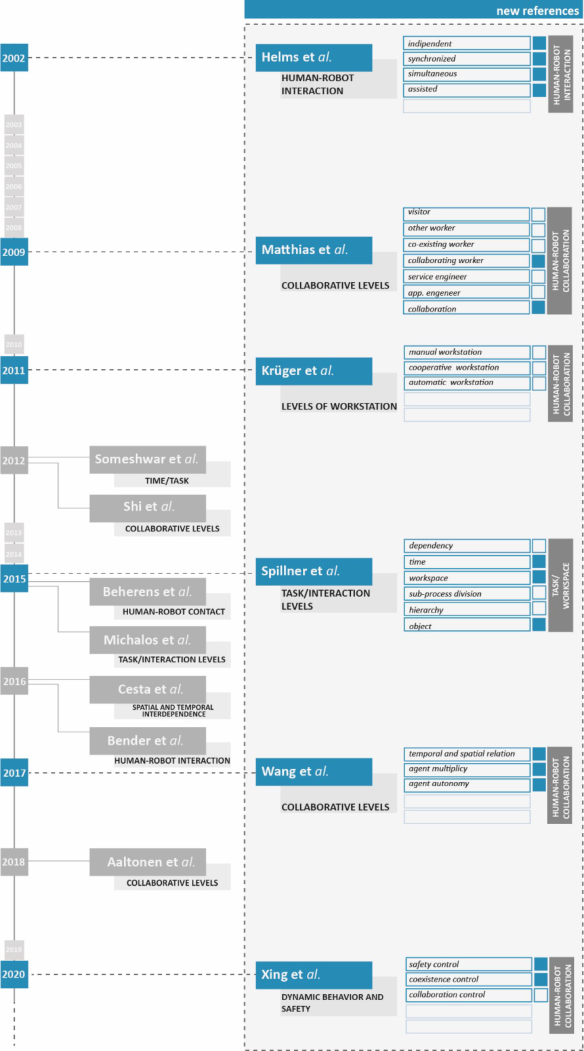
Therefore, it is essential to expand the investigation on the different ways of classifying human-robot collaboration present in literature in the context of industrial scenarios, this issue has already been addressed in the previous study by Formati et al., in which – starting from the study of the normative framework of the robotics discipline and the state of art – an overview of some of the main categorizations present in literature related to human-robot collaboration, on the basis of their respective capabilities and potentialities, is provided (Formati et al., 2021). This study continues with the analysis of fur- ther typologies to classify human-robot collaboration in industrial contexts (see Figure 1). Most of the new identified categorizations are more focused on the safety and well-being of the production operator, now called Operator 4.0, at the center of the entire process. In particular, the categorization of Helms et al. is deepened. Already in 2002 and therefore before the advent of collaborative systems, they have defined four models of cooperation: (I) independent operation where the operator and the robot perform operations on different products; (II) synch- ronized cooperation where the operator and the robot operate consecutively on the same product; (III) simultaneous cooperation; (IV) assisted coopera- tion where the robot and the production operator operate on the same part (Helms et al., 2002).
Subsequently, Krüger et al. in 2009 have investigated the various levels of cooperative work by combining the advantages of a robot in cooperation with the user and an automated system by making the best use of robotic
Design, Robotics and Co-Working. A Human-Centric Perspective 147
Figure 1: Evolution of categorization types in the collaborative scenario.
and human capabilities in the assembly system based on the sequential divi- sion of tasks. In detail, simple tasks suitable for robots are located upstream of the production line while complex tasks are performed downstream by production operators (Krüger et al., 2009). In line with previously identified
studies, Matthias et al. in 2011 have addressed the issue of the physical work- space of the moving robot intersecting with the workstation of the production operator, investigating the “role” and unsafe interaction between humans and robots in the following way: visitor approaching the robot for a visit not informed about hazard; other worker occasionally interacting with the robot without any particular task that involves the robot; co-existing wor- ker, that is an employee physically working in the workspace with the robot; collaborating worker interacting with the robot in a regular operating mode; service engineer who interacts with the robot to reconfigure, repair and recali- brate the robot and the sensors; application engineer who acts with the robot when safety systems can be disabled; development engineer who develops the hardware and control of the robotic system (Matthias et al. , 2011). In addition, in 2015, the categorization proposed by Spillner et al. has mapped the different forms of co-working based on: (I) dependence on the process flow of another operator, (II) time (sequential, intermittent, simultaneous, synchronous), (III) workspace (separate, overlapping, inclusive, shared), (IV) sub-process division, (V) hierarchy between human and robot; (VI) object (same or different object/process) (Spillner et al., 2015). Wang et al. have classified human-robot collaboration in 2017 by highlighting the distinct classes of HRC, with a few features: the temporal and spatial relationship of users and robots collaborating and sharing the same industrial workspace. After that comes the number of agents involved, which is distinguished betw- een single, multiple and in teams that interacting with the environment and other agents. Another categorization identified is by Xing et al. who in 2020 classified human-robot interaction into: (I) safety control in which the most important feature relates to the production operator’s work with the robot; (II) coexistence control which represents the robot’s ability to share the work- space with other users ensuring the user safety requirements necessary for safe coexistence; (III) collaboration control in which explicit and intentional contact occurs with exchange of forces between human and robot, the robot thus can predict the human’s movement intentions and consequently react (Xing et al., 2020).
HUMAN FACTORS FOR NEW COLLABORATIVE SCENARIOS Starting from the recognition of the different categorizations present in literature, it was possible to implement the collaborative classification, pre- viously proposed by Formati et al. in 2021, in consideration of the Technical Specification ISO/TS 15066 of 2016 Robot and robotic devices - Colla- borative robots, which refers to the criteria for assessing the risks gene- rated using collaborative robots and the safety levels. The proposed and integrated classification is consistent with the operations envisaged by the aforementioned standard that allow production operators to work near robo- tic systems without danger. In detail, it addresses safety monitored stop, speed and separation monitoring, hand guiding and finally power and force limiting.
In addition, the new categorization introduces the design criteria of EN ISO 13849-1 Safety of machinery - Safety-related parts of the control system
Design, Robotics and Co-Working. A Human-Centric Perspective 149
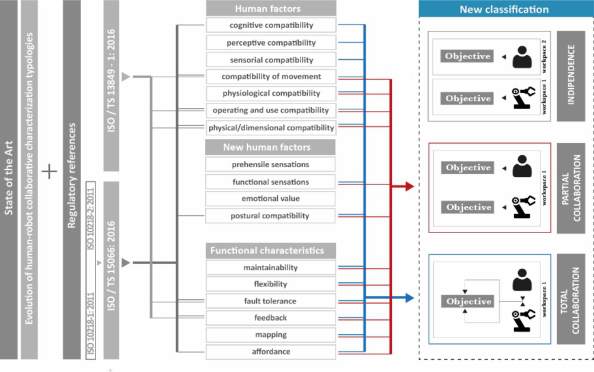
Figure 2: Definition of the main features of the proposed classification.
- General principles for design, which provides guidelines for the design of safe industrial machinery.
This standard defines the main safety functions of industrial machinery that provides a valid procedure for determining the Performance Level requi- red for each safety function (PLr) and identifies the main safety requirements applicable to control systems that perform the main safety functions in relation to industrial systems. The research activity has proceeded with the implementation of Human Factors and New Human Factor (Buono & Capece, 2016), which guide in psychophysiological assessments, integrating different sensory, emotional, experiential, and physiological in addition to physical factors.
The challenge in robotic design – understood not only for robotic systems but also for the definition of collaborative workspaces – is to identify and evaluate the ergonomic factors that “influence” different types of interaction (see Figure 2).
In the realized scheme, the implementation of these factors has guided the configuration of new collaborative classification, to define the design and characteristics of robots and workspaces.
The “links” between the previously analyzed collaborative robotics stan- dards, ergonomic factors and the main characteristics of a robotic system, fundamental for the design of new advanced solutions, have been represented.
These data were subsequently “reserved”within the defined categorization and specifically divided into independence, partial collaboration, total colla- boration. The objective is to provide a categorization that integrates the user’s variables from a physical, emotional, sensory, and cognitive point of view to allow the best human-robot collaboration and to optimize workstations in the industrial context.
CONCLUSION
The presence of collaborative technological solutions leads scientific resea- rch to address in depth factors related to safety and ergonomic standards
in human-robot interaction. In the this study, through the review of the regulatory framework, ergonomic factors and existing robotic systems in the manufacturing field, further specifications on collaboration modes have been defined, highlighting the representative features for the definition of future scenarios.
For the evolution of this study, the new classification and the further speci- fications about the collaboration modes are important to facilitate the design of new levels of user-machine interaction and increase the productivity and the operator 4.0’s wellbeing.
REFERENCES
Aaltonen, I., Salmi, T. and Marstio, I. (2018) “Refining Levels of Collaboration to Support the Design and Evaluation of Human-Robot Interaction”, in: The Manufacturing Industry.Procedia CIRP 72: 93–98. Ajoudani, A., Zanchettin, A., Ivaldi, S., Albu-Schäffer, A., Kosuge, K. and Khatib, O.,
(2017) Progress and Prospects of the Human-Robot Collaboration. Autonomous Robots, Springer Verlag, 2017, pp. 1–17. Askarpour, M. (2016) “Risk assessment in collaborative robotics”, proceedings of FMDS. Behrens, R., Saenz, J., Vogel, C. and Elkmann, N. (2015) “Upcoming Technologies
and Fundamentals for Safeguarding All Forms of Human-Robot Collabora- tion”, proceedings of the 8th International conference on the safety of industrial automated systems (SIAS), K. nigswinter, Germany, pp. 18–23. Buono, M., Capece, S. (2016) “Design ed Ergonomia nel settore aerospaziale: nuovo modello di validazione e valutazione dei Sedili Passeggeri”,in: AA.VV. Rivista Italiana di Ergonomia. Special Issue 1/2016 ISSN: 2037-3910. Cesta, A., Orlandini, A., Bernardi, G.and Umbrico, A. (2016) “Towards a Planning-
based Framework for Symbiotic Human-Robot Collaboration”, IEEE 21st Inter- national Conference on Emerging Technologies and Factory Automation. Di Marino, C., Tarallo, A., Vitali, A. and Regazzoni, D. (2021). Collaborative Robotics and Ergonomics: A Scientific Review, Proceedings of ASME 2021 Inter- national Mechanical Engineering Congress and Exposition. Volume 6: Design, Systems, and Complexity. EN ISO 13849-1 “Safety of machinery - Safety-related parts of control systems -
Part1: General principles for design” International Standards Organization, 2016. Formati, F., Laudante, E. and Buono, M. (2021) “Human-Centered-Design for Definition of New Collaborative Scenarios”, in: Raposo D., Martins N., Brand o D. (eds) Advances in Human Dynamics for the Development of Contemporary Soci- eties. AHFE 2021. Lecture Notes in Networks and Systems, vol 277, pp. 78–85. Springer, Cham. https://doi.org/10.1007/978-3-030-80415-2_10. Helms, E., Schraft, R. D. and Hagele, M. (2002) “rob@work: Robot assistant in indu-
strial environments”, proceedings 11th IEEE International Workshop on Robot and Human Interactive Communication, pp. 399–404. ISO 15066:2016. “PD ISO / TS 15066: 2016 BSI Standards Publication Robots and Robotic Devices - Collaborative Robots. International Standards Organization, 2016. Krüger; J., Lien, T.K. and Verl, A. (2009). Cooperation of human and machines in
assembly lines., 58(2), pp. 628–646. doi:10.1016/j.cirp.2009.09.009 Kofer, D., Bergner, B., Deuerlein, C., Schmidt-Vollous, R.and Heß, P. (2021) “Human–robot-collaboration: Innovative processes, from research to series stan- dard”, Procedia CIRP. 97. pp. 98–103.
Design, Robotics and Co-Working. A Human-Centric Perspective 151
Liu, X., Ge, S. S., Zhao, F. and Mei, X. (2021) “A Dynamic Behavior Control Framework for Physical Human-Robot Interaction”, Journal of Intelligent & Robotic Systems, 101(1), 14–.doi:10.1007/s10846-020-01286-x. Matthias, B., Kock, S., Jerregard, H., M. Kallman, M., Lundberg I., Mellander, R.,
(2011) “Safety of collaborative industrial robots: Certification possibilities for a collaborative assembly robot concept”, International Symposium on Assembly and Manufacturing, (0), 1–6.doi:10.1109/isam.2011.5942307. Michalos, G., Makris, S., Tsarouchi, P., Guasch, T., Kontovrakis, D. and Chryssolouris, G. (2015) “Design considerations for safe human-robot collaborative workplaces”, Procedia CIrP, 37, pp. 248–253. Pinheiro, S., Correia Simões, A., Van Acker, B., Bombeke, K., Romero, D., Vaz,
A. P. and Santos, J. (2022) Ergonomics and Safety in the Design of Industrial Collaborative Robotics: A Systematic Literature Review. doi:10.1007/978-3-030- 89617-1_42. Spillner, R., (2015) Einsatz und Planung von Roboterassistenz zur Berücksichtigung von Leistungswandlungen in der Produktion. Doctoral dissertation. Technische Universität München, Germany.Herbert Utz Verlag GmbH. Teixeira Schmidt Vieira, J., Mufato Reis, A., Boeng Mendes, F. and Garcia Lupi
Vergara L. (2019) Collaborative Robots and Ergonomics. Doi:10.1007/978-3- 030-14730-3_83. Wang, L., Gao, R., Váncza, J., Krüger, J., Wang, X.V., Makris, S. and Chryssolouris, G. (2019). Symbiotic human-robot collaborative assembly. CIRP Annals, S0007850619301593–. doi:10.1016/j.cirp.2019.05.002 Wang, X.V., Kemény, Z., Váncza, J. and Wang, L. (2017) “Human–robot collabora-
tive assembly in cyber-physical production: Classification framework and imple- mentation”, CIRP Annals - Manufacturing Technology, S0007850617301014–. doi:10.1016/j.cirp.2017.04.101.
LISTED IN THE AHFE DIGITAL BOOKSTORE CATALOGUE
Explore the complete digital volume
Human Factors in Accessibility and Assistive Technology
Read this individual research paper free through the original publisher, or explore the full digital proceedings book.
ISBN 978-1-958651-13-1
Explore this ISBN in the AHFE Bookstore ↗Listed in the July 2026 bookstore catalogue; search by ISBN to confirm current availability · Digital book purchase optional