Fernando Vazquez-Castro, Erika Garcia-Lopez, Jesus Sandoval-Robles, Elisa Vazquez, Omar Lopez-Botello, Ciro Rodriguez (2022). Fatigue Life Improvement in Laser Powder Bed Fusion of Stainless Steel via Electropolishing. In: Additive Manufacturing, Modeling Systems and 3D Prototyping. AHFE Open Access, vol. 34, pp. 76–80. https://doi.org/10.54941/ahfe1001592
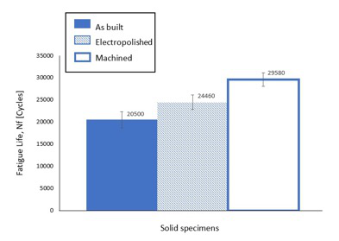
Additive manufacturing of metallic components with industrial-grade materials has shown great progress, but still face several challenges. In the present study the use of electropolishing to improve the surface finish of parts generated via laser powder bed fusion in stainless steel 316L is explored. A thorough assessment of the impact of the before-mentioned post-processing techniques on the fatigue life of the components was performed. Fatigue testing was conducted via rotating cantilever bar with solid samples and samples with lattice structures with strut sizes in 250 and 500 m. The stress amplitude for fatigue testing is set at 70% of the ultimate tensile strength of the samples. Considering 5 replications of each testing condition, the electropolishing surface treatment improves the average fatigue life from 20.5 cycles to 24.6 cycles when comparing with as build samples. The machining of the same kind of additively manufactured parts was used as a reference, achieving 29.6 cycles of average fatigue life. The samples with lattice geometries show an improvement in surface finish but did not achieve a significant improvement in fatigue life due to excessive loss of mass in the extremely small struts with 250 and 500 microns. The study reported here shows that electropolishing is a viable alternative for fatigue life improvement compared to other more expensive and/or complex post-processing approaches.
Additive manufacturing of metallic components with industrial-grade mate- rials has shown great progress, but still face several challenges. There has been significant research in the use of more common post-processing techni- ques such as hot isostatic pressing, polishing and heat treatment to improve the mechanical properties of this kind of components. In the present study the use of electropolishing to improve the surface finish of parts generated via laser powder bed fusion in stainless steel 316L was explored. The impact of this kind of post-processing on the surface roughness and its effect in the fatigue life of the components has been assessed.
Fatigue Life Improvement in Laser Powder Bed Fusion 77
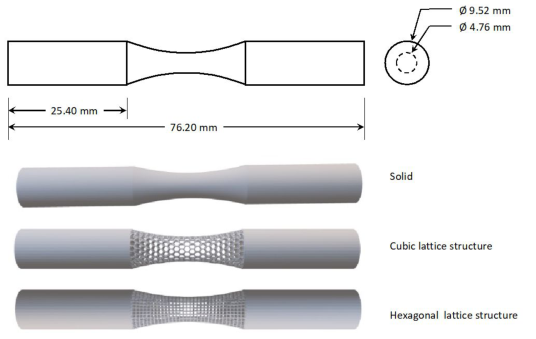
Figure 1: Geometry of test specimens.
MATERIALS AND METHODS
Geometry of Test Speciments The test specimens are based on standard dimensions for rotating beam fati- gue testing (Figure 1). In addition to the solid specimens, cubic and hexagonal lattice structures specimens with struct thickness of 250 and 500 µm were generated using nTopology version 1.23. The lattice structure was applied only at the neck region.
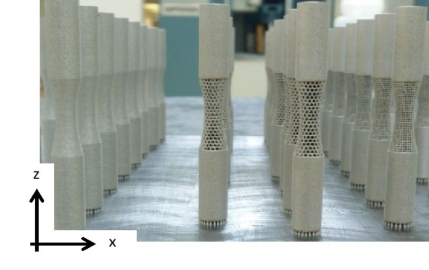
Laser Powder Bed Fusion The test specimens were produced using a Renishaw machine model AM400 (Gloucestershire, UK), with scan strategy type Meander (rectangular), laser power of 170W, hatch distance of 0.06 mm, scanning speed of 0.59 m/s and layer thickness of 40 µm. The building orientation was chosen as vertical (z-axis) because this maximizes the concentricity of the specimens. Stain- less steel SS-316L-0407 was provided from Renishaw (particle size average 40±15 µm). Five replications were built for each sample geometry (including both types of strut size for lattice geometries).
Specimen Postprocessing Electropolishing was carried out in a Betman Cleaner model E782EP from ESMA Inc (ESMA, IL, USA). The process involves passing a current through an electrolyte provided by ESMA, SS Electropolish E972 for SS316L (Ele- ctrolyte E972) then using a non-corroding alloy cathode and the test speci- mens as anode. Process parameters were a voltage of 13 V, temperature of 60 oC, with 9 minutes of electropolishing. Then test specimens were immer- sed in a concentrated solution of sodium bicarbonate (NaHCO3). Next, the specimens stayed into a nitric acid (HNO3) solution, 30% v/v, for 2 minutes. Finally, specimens were cleaned with distilled water and dried.
Solid specimens were also treated with conventional machining in a lathe. Tungsten carbide insert was used for the cutting tools, with spindle speed of 3,670 rpm, feed rate of 183 mm/min and depth of cut of 0.318 mm.
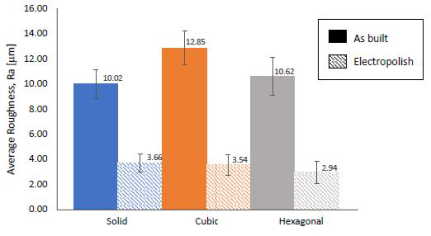
Figure 2: Impact of electropolishing on average surface roughness for different specimen.Figure 3: Impact of electropolishing on average surface roughness for different spe- cimen geometries (N=5). SEM images (lattice samples have a strut size of 250 µm): A) cubic lattice as built, B) cubic lattice electropolished, C) hexagonal lattice as built, D) hexagonal lattice electropolished, E) solid as built and F) solid electropolished.
Characterization Surface average roughness was measured with Alicona Infinite Focus micro- scope (Bruker, Graz, Austria). All the surface roughness measurements were taken at the neck of the test specimens, with two measurements per specimen. Scanning electron microscopy (SEM) (Carl Zeiss EVO MA25, Germany) images were collected to visualize the surface topography.
The fatigue tests were performed in a Fatigue Dynamics model RBF-200 (Systems Integrators, LLC.) under rotating beam conditions with one support (e.i. rotating cantilever beam). Five specimens of each specimen geometry and treatment were tested. The test was run at a frequency of 50 Hz and the bending stress was adjusted to 70% of the UTS for each specimen geometry under “as built” condition.
RESULTS
Figure 2 shows the 3D printed parts after laser powder bed fusion. Figure 3 shows the effect of electropolishing treatment for all specimen geometries. The SEM images clearly illustrate the benefits of electropolishing on the surface topography of the 3D printed parts.
Fatigue Life Improvement in Laser Powder Bed Fusion 79
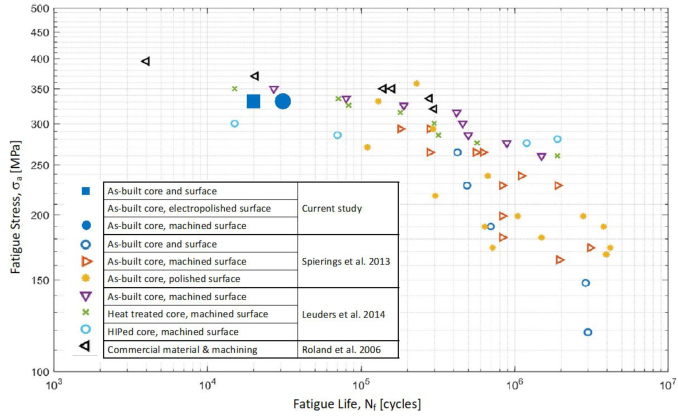
Figure 4: Average fatigue life for a) solid specimens (σ a=330 MPa) and b) lattice stru- ctures (σ a=49 and 43 MPa, for cubic and hexagonal respectively) under different treatments (N=5).Figure 5: Fatigue stress vs. fatigue life for 316L under rotating beam fatigue testing and different treatments (adapted from Elangeswaran et al. 2019).
The effect of electropolishing and surface machining on average fatigue life is reported in Figure 4. While the solid specimens show a clear advantage with electropolishing, the average fatigue life of lattice structures is reduced by the electropolishing treatment. The reduction in fatigue life due to electro- polishing is more significant for the smaller strut size (250 µm). This trend indicates that the electropolishing, while improving surface roughness, also significantly changed the strut size, therefore reducing the mass and structural integrity of the lattice structure samples. The results reported in this study are comparable to data reported by previous related work, as shown in Figure 5.
CONCLUSION
According to the results shown in the present research, electropolishing is a viable alternative for fatigue life improvement compared to other more
expensive and/or complex post-processing approaches. Future work involves optimization of lattice structures and the electropolishing process, avoiding a significant mass loss to improve fatigue life.
ACKNOWLEDGMENT
The authors would like to acknowledge the support of Consejo Nacional de Ciencia y Tecnologia with graduate level scholarships.
REFERENCES
Elangeswaran, C., Cutolo, A., Muralidharan, G. K., de Formanoir, C., Berto, F., Vanmeensel, K., & Van Hooreweder, B. (2019). Effect of post-treatments on the fatigue behaviour of 316L stainless steel manufactured by laser powder bed fusion. International Journal of Fatigue, 123, 31–39. Leuders, S., Lieneke, T., Lammers, S., Tröster, T., & Niendorf, T. (2014). On the
fatigue properties of metals manufactured by selective laser melting–The role of ductility. Journal of Materials Research, 29(17), 1911–1919. Roland, T., Retraint, D., Lu, K., & Lu, J. (2006). Fatigue life improvement through surface nanostructuring of stainless steel by means of surface mechanical attrition treatment. Scripta Materialia, 54(11), 1949–1954. Spierings, A. B., Starr, T. L., & Wegener, K. (2013). Fatigue performance of additive
Additive Manufacturing, Modeling Systems and 3D Prototyping
Read this individual research paper free through the original publisher, or explore the full digital proceedings book.
ISBN 978-1-958651-10-0
Explore this ISBN in the AHFE Bookstore ↗Listed in the July 2026 bookstore catalogue; search by ISBN to confirm current availability · Digital book purchase optional