Muthu Singaram, Vr Muraleedhran, Mohanasankar Sivaprakasam Sivaprakasam, Shashwat Pathak (2022). Monetization Canvas Framework to Efficiently Assess the Impact of Research Outcome. In: Creativity, Innovation and Entrepreneurship. AHFE Open Access, vol. 31, pp. 75–82. https://doi.org/10.54941/ahfe1001509
1 Healthcare Technology Innovation Centre (HTIC), Indian Institute of Technology Madras (IITM), Chennai, India ↗
2 Department of Electrical Engineering & Healthcare Technology Innovation Centre (HTIC), Indian Institute of Technology Madras (IITM), Chennai, India ↗
3 Atal Community Innovation Centre (ACIC), Meerut Institute of Engineering and Technology (MIET), Meerut, India ↗
In the current dynamically changing demands and aspirations of populations across the globe, nations are putting up impetus on innovations and entrepreneurship. There is huge disparity in demand as third world countries are struggling to fulfil the demands and developed nations are poised to fulfil aspirations while maintaining a balance with existing demands. Global economy has always been driven by innovation and in line with the Paris Agreement to create a sustainable business in different sectors while being responsible towards climate change. Inclusion of different policies such as Internal Carbon disclosure and policies to promote them through rebates at various levels. Adoption of science-based targets in sustainability is a buzz word these days. While these practices are creating a niche for the responsible organizations and nations, core still remains at development of innovative solutions to meet both demand and aspirations. Economies across the globe are spending a significant amount of their budget, after defense and healthcare, on research and development which acts like a pillar for this economic growth. It is significant to mention that the budget expenditure on research and development attracts a lot of attention and governments across the globe face wrath due to low percentage of return on investment. This happens majorly because the framework to assess the outcome of this investment is very vague and is scenario specific. It depends on many factors such as human resource, state of infrastructure, identifying needs, projection of need and many more. To understand the issue better we first need to gather information regarding the total spending by different nations from different strata of the economy. It helps us to understand that there is an urgent need to narrow down on outcome-based research, rather than lurking for some miracle to happen. A well-structured outcome-based framework, which is easy to adopt while framing the policies needs to be in place which can assess the impact and hence help in carving out the policies further. At least ninety countries around the world spent more than USD50 million based on Wikipedia (2022). The top ten countries spent over USD38 billion. The United States, China, Japan, Germany, India and South Korea amount to 70 % of the global Research and Development (R&D) spent, while the United States and China account for 50% of the spending. Based on The World Bank (2022) South. Korea and Israel are well ahead in terms of gross domestic product (GDP) spending on research the two largest economies U.S. and China are lacking in terms of GDP percentage. A report by the Organization for Economic Co-Operation and Development (OECD) (2015) reports not much impact on the economy of government funded R&D. Private R&D funding had an impact on the economy and University Research did have an impact. It also reports that private funding had a better impact on basic research compared to applied research. This paper describes a research monetization canvas to enhance research output in particular academic institutions.
Boeing et al. (2022a) studied the impact of exploration and development subventions on R&D inputs and their wider profitable goods in China and plant public R&D subventions allocated to large and medium-sized enter- prises increased the total R&D inputs proxied by total R&D help, despite reducing intimately- financed R&D inputs. In the last 40 years there is a substantial decline in exploration productivity in the United State Bloom et al. (2020). This was replicate by Boeing et al. (2022b) for China and Germany, using detailed establishment- position data gauging three decades and the results indicate that dwindling returns in R&D are a global trend, not just confined to the United State. Pray et al (2001) found declining support for public exploration and advances in technology and new forms of legal protection have convinced more private agrarian exploration they exami- ned empirically the consequences of reforms in India’s seed programs which loosened restrictions on the private sector. Gyedu et al. (2020) studied the impact of invention on profitable growth among the G7 and Brazil, Russia, India and China (BRIC)S countries grounded data were recaptured from the World Development Pointers database (World Bank 2019) from the period 2000–17. The study revealed that R&D, patent, and trademark as the deter- minants of invention have a significant impact on gross domestic product (GDP) per capita also as a determinant of profitable growth among G7 and BRICS countries but the impact is more among the G7 than the BRICS coun- tries. Czarnitzki and Toivanen (2013) establishes theoretically a link between investments in profitable growth and investments in R and D. As invention programs may be subject to crowding-out goods, we, second, empirically evaluate whether R and D subventions stimulate private investment in two countries of the European profitable area.
Franco and de Oliveira (2017) studied the significance of invention to glo- bal competitiveness and the significance that the Brazil, Russia, India, China and South Africa countries represent for the world frugality, to dissect the invention progress of BRICS as a block and its individual members from 2008 to 2013, plant the invention indicator of BRICS was drastic drop in the inven- tion indicator during the profitable heads of 2008–9 followed by a skittish recovery. However, there is immense need to create and assess an adopta- ble framework to study the nature of impact of several types of fundings and their actual tangible outcome. In this manuscript, we have attempted to frame one to gauge the impact both qualitatively and quantitatively. Next section of this paper contains the relevant literature review for same and subsequ- ent section presents a framework to target the goals as described earlier. The paper concludes with discussion on research monetization canvas to enhance research output in particular academic institutions
LITERATURE REVIEW
Mostafa and Mahmood (2015) assess the profitable growth prospects of the BRICS countries and their implicit capability to challenge and catch the G7 countries. Grounded on the data analysis, they concludes that the BRICS have the eventuality to catch the G7 eventually. Maradana, R.P et al. (2017)
Research Monetization Canvas Framework to Efficiently 77
examines the long- run relationship between invention and per capita pro- fitable growth in the 19 European countries over the period 1989–2014. They applied six different pointers of invention patents- residents, patents- nonresidents, exploration and development expenditure, experimenters in exploration and development conditioning, high-technology exports, and scientific and specialized journal papers to examine this long- run relati- onship with per capita profitable growth. The policy recrimination of this study is that countries should differentiate invention and per capita profi- table growth to maintain sustainable development in these countries. Ntuli et al. (2015) plant relation between exploration and profitable growth is of particular significance for political support of wisdom and technology as well as for academic purposes. They studied the relationship between exploration papers published and profitable growth in Organization for Economic Co- Operation and Development (OECD) countries for the period 1981–2011. They are chancing provides important policy counteraccusations for explo- ration programs and strategies for OECD countries. Argentino Pessoa (2007) examined the correlation between profitable growth and R&D (exploration and development) intensity, and given that the impact of R&D on profitable growth is intermediated by the rate of growth of technology, they tried to assess the relation between R&D expenses and profitable growth, through the use of the condition of free entry into R&D. We conclude that invention policy must always consider the complexity of the profitable growth process and the other ways, besides the bones grounded on formal R&D pointers, in which technology has an impact on growth.
Guindalini et al. (2021) found academic institutions to the technological, social and profitable development of societies is of adding significance. They identify that there is a connected exploration exertion disciplines that cha- racterize the multidimensional features of entrepreneurship in the academic setting, as well as a significant gap in the literature regarding studies assessing approaches to support the navigation of implicit scientific discoveries to the request. We bandy the applicability of each stage for the establishment of a further invention-friendly terrain and conclude by offering perspectives into unborn exploration openings. By encouraging studies that consider the acade- mic entrepreneurship process from a systemic perspective, to support a lesser donation of academic institutions to the profitable and social development of the nations and societies.
Vincett (2010) using a methodology, they estimate the continuance impa- cts of companies spun-off directly from academic research performed in 1960–98, and compare the impacts with all government backing, direct and circular, over the same period. Similar long- term studies are rare but essen- tial, they show that successful spin-offs grow (frequently exponentially) over several decades. With veritably conservative hypotheticals, and allowing for the time value of plutocrat, the impacts exceed government backing by a substantial periphery. Establishment continuances are long, with Canadian impacts abbreviated primarily by some foreign accessions. They argue that the spin-off impacts represent incremental benefactions to GDP, much larger (indeed on a time- blinked base) than the government backing and directly attributable to it.
Almudena Martínez et al. (2020) found it is presently getting decreasin- gly important in southern European countries, where the limitation of public backing following the profitable extremity in 2008 has put lesser pressure on their public universities to achieve excellence and better competitiveness. In this environment, the objective of this paper was to measure the relative spe- cialized (in) effectiveness of Spanish public Advanced Education Institutions in the period 2002–3 to 2012–13, comparing the situation ahead and during the period. After applying the data envelopment analysis methodology, the results show that Spanish public universities have come more effective during the last year few years. They findings are thus applicable for political and aca- demic decision-makers to know if public universities have been managed in the extremity period and to identify factors that could ameliorate their effecti- veness, and hence to help them to enhance their transnational competitiveness in the future.
Le et al. (2021) states frontier academic exploration is frequently allo- wed to be driven by recognition and creation rather than marketable values, its real donation to a country’s technological progress is occasionally mis- doubted. Against this dubitation, this paper argues that frontier academic exploration resembles a public good and creates important scientific foun- dations for artificial invention. Attained results indicate that both frontier academic exploration and artificial R&D are salutary to a country’s tech- nological progress, but a considerable proportion of the effect of frontier academic exploration on a country’s technological development is transferred through artificial R&D. These results are robust across different estima- tion styles, retrogression specifications, and different delegates of frontier academic exploration and technological progress.
Research Monetization Canvas From the available work, it is clear that research in particular from academic institution can bring a significant impact to the growth engine of a coun- try. This particular need is in the poorer and developing nation to get the population out of poverty and improving life.
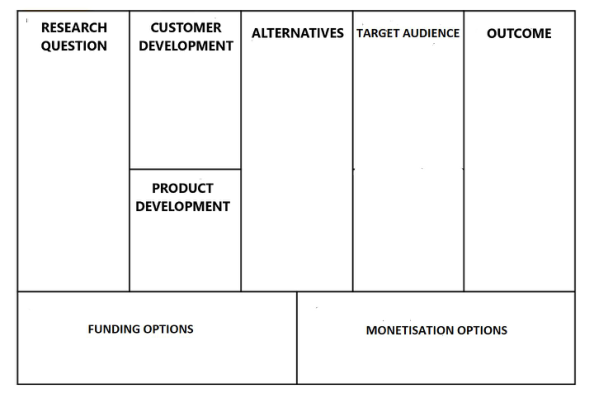
Studies are there on measuring the development around the world on Start-up and how countries are benefiting from adopting this culture. Over the several years with the application of business model canvas Osterwalder (2010), Lean Canvas Maurya (2020) and lean start-up methodology by Blank (2020) organizations have been successful in solving their issues. Ries (2011) have mentioned that start-ups have failed faster and moved forward at fast pace. If a similar methodology can be applied to research, we will be able to create a significant impact on the economy and the outcome of this can be useful to apply in a new framework, Muthu Singaram et al (2020). Based on this assumption we have now adapted the exiting canvases to the research monetization canvas Figure 1.
This adapted canvas has eight boxes. These boxes are research question, customer development, product development, alternatives, target audience, outcome, funding options and monetization options. Now taking a look at each of these boxes one by one:
Research Monetization Canvas Framework to Efficiently 79
Figure 1: Research Monetization Canvas.
1. Research Question
a. This is the start of the research road map, here the researchers should clearly define the research question and highlight the purpose of this work. It would do no harm to have three to five research questions.
2. Customer Development
a. In this box, it would be important to define and have a plan how the customers would be developed. We can use the customer discovery methodology by Blanks (2020) and Friedman’s (2009) recommendation in acquisition of customers.
3. Product Development
a. Once the customer development is in place, in this box a product development road map should be generated.
4. Alternatives
a. In this box, it is imperative, we are extremely careful to identify not only competition but are the alternatives to our research question by ensuring this we shall have a higher success rate.
5. Target Audience
a. This is the million-dollar box we must identify the right audience so our research solution would be productive.
6. Outcome
a. In this box the potential outcomes should be identified like new the- ory, model, publication, patent, product or service. By identifying this box thoroughly, it shall help the next two boxes identifications.
7. Funding Options
a. In this box we need to identify how the research would be funded i.e., self-funding, government or industry grants, angel, venture capital, industry funding, institution funding.
8. Monetization Options
a. This is the most crucial box to provide an idea if the research can be monetized. Options are a new start-up, licensing or a joint venture. This box will tell us if the research would have an economic impact.
CONCLUSION
Why another model or canvas if there are already several avaiable? Just like startups twenty years ago, only had the business plan as tool. Today they are used to many tools and most of these tools are easy to apply to a business and get a quick understanding of the outcome, at least on paper at a low cost. Similar, if a quick tool like our canvas is available to researchers, they would be able to use it and develop a good understanding of the outcome. This will help them target the right funding model by doing this, they would be able to conduct productivity research which can not only impact the economics but it would help create new jobs which in turn shall spur the economic growth and uplift the lives of population.
ACKNOWLEDGMENT
To all who provided inputs for in the many workshops conducted by us.
REFERENCES
Argentino Pessoa. (2007). https://ideas.repec.org/p/por/fepwps/254.html. Innovation and Economic Growth: What is the actual importance of R&D? FEP Working Papers 254. Universidade do Porto, Faculdade de Economia do Porto. Blank, S. (2020). The four steps to the Epiphany: Successful strategies for products
that win (1st ed). Wiley. Bloom, N., Jones, C. I., Van Reenen, J., & Webb, M. (2020). Are ideas getting harder to find? American Economic Review, 110(4), 1104–1144. https://www.aeaweb.o rg/articles?id=10.1257/aer.20180338. https://doi.org/10.1257/aer.20180338 Boeing, P., & Hünermund, P. (2020b). A global decline in research productivity?
Evidence from China and Germany. Economics Letters, 197. https://doi.org/10. 1016/j.econlet.2020.109646, PubMed: 109646 Boeing, P., Eberle, J., & Howell, A. (2022). The impact of China’s R&D subsidies on R&D investment, technological upgrading and economic growth. Technologi- cal Forecasting and Social Change, 174. https://doi.org/10.1016/j.techfore.2021. 121212, PubMed: 121212 Czarnitzki, D., & Toivanen, O. (2013). Innovation policy and economic growth,
482. Directorate general economic and financial affairs (DG ECFIN). European Commission. Franco, C., & de Oliveira, R. H. (2017). Inputs and outputs of innovation: Analysis of the BRICS: Theme 6-innovation technology and competitiveness. RAI. Revista de Administração e Inovação 14 (1), 79–89.
Research Monetization Canvas Framework to Efficiently 81
Friedman, M. (2009). Trying hard is not good enough: How to produce measurable improvements for customers and communities, published by amazon digital services. Govindarajan, V. (2020). Leading Innovation with Vijay Govindarajan Professional
Certificate on Edx. https://www.edx.org/professional-certificate/dartmouthx-lead ing-innovation-with-vijay-govindarajan Guindalini, C., Verreynne, M.-L., & Kastelle, T. (2021). Taking scientific inventions to market: Mapping the academic entrepreneurship ecosystem. Technologi- cal Forecasting and Social Change, 173. https://doi.org/10.1016/j.techfore.2021. 121144, PubMed: 121144 Gyedu, S., Heng, T., Ntarmah, A. H., He, Y., & Frimppong, E. (2021). The impact
of innovation on economic growth among G7 and BRICS countries: A GMM style panel vector autoregressive approach. Technological Forecasting and Social Change, 173. https://doi.org/10.1016/j.techfore.2021.121169, PubMed: 121169 Le, T., Pham, H., Mai, S., & Vu, N. (2021). Frontier academic research, industrial R&D and technological progress: The case of OECD countries. Technovation. https://doi.org/10.1016/j.technovation.2021.102436 Maradana, R. P., Pradhan, R. P., Dash, S., Gaurav, K., Jayakumar, M., & Chatterjee,
D. (2017). Does innovation promote economic growth? Evidence from European countries. Journal of Innovation and Entrepreneurship, 6(1), 1–23. https://doi.or g/10.1186/s13731-016-0061-9 Martínez-Campillo, A., & Fernández-Santos, Y. (2020). The impact of the economic crisis on the (in)efficiency of public Higher Education institutions in Southern Europe: The case of Spanish universities. Socio-Economic Planning Sciences, 71. https://doi.org/10.1016/j.seps.2019.100771, PubMed: 100771 Maurya, A. (2020). LEANSTACK. https://leanstack.com/lean-canvas Mostafa, G., & Mahmood, M. (2015). The rise of the BRICS and their challenge
to the G7. International Journal of Emerging Markets, 10(1), 156–170. https: //doi.org/10.1108/IJOEM-07-2012-0063 Muthu Singaram, Muraleedhran. V. R., & Sivaprakasam, M. (2022a). A Framework for Future Indian Healthcare Translation Research, International Conference On “Interdisciplinary Research InTechnology and management,” (Accepted to be published in IEEE Explore) https://irtm.smartsociety.org/ Muthu Singaram, Muraleedhran. V. R., Sivaprakasam, M & Pathak S. (2022b).
Adapting The Quadruple Aim for The Benefit of The Stakeholders in Academic Healthcare Research, Societal Challenges: Technology, Transitions and Resilience Virtual Conference. (Accepted to be published in IEEE Explore) https://2022.euro pe.temscon.org/ Ntuli, H., Inglesi-Lotz, R., Chang, T., & Pouris, A. (2015). Does research output cause economic growth or vice versa? Evidence from 34 OECD countries. Journal of the Association for Information Science and Technology, 66(8), 1709–1716. https://doi.org/10.1002/asi.23285 Organization for Economic Co-Operation and Development (OECD). (2015). The
impact of R&D investment on economic performance: A review of the econome- tric evidence. https://one.oecd.org/document/DSTI/EAS/STP/NESTI(2015)8/en/p df Osterwalder, A. (2010). Business model generation (1st ed). Wiley. Pray, C. E., Ramaswami, B., & Kelley, T. (2001). The impact of economic reforms on R&D by the Indian seed industry. Food Policy, 26(6), 587–598. https://doi.or g/10.1016/S0306-9192(01)00022-7 Ries, E. (2011). The lean startup. Penguin.
The world bank. (2022). Research and Development Expenditure (% of GDP).
https://data.worldbank.org/indicator/GB.XPD.RSDV.GD.ZS. Captured 9:25 IST 25/01.2022 Vincett, P. S. (2010). The economic impacts of academic spin-off companies, and their implications for public policy. Research Policy, 39(6), 736–747. https://doi:10.1016/j. https://doi.org/10.1016/j.respol.2010.02.001 Wikipedia. (2022). List of countries by research and development spending.
Ist, 15:22. https://en.wikipedia.org/wiki/List_of_countries_by_research_and_de velopment_spending#cite_note-1. Captured p. 24/01.2022.
LISTED IN THE AHFE DIGITAL BOOKSTORE CATALOGUE
Explore the complete digital volume
Creativity, Innovation and Entrepreneurship
Read this individual research paper free through the original publisher, or explore the full digital proceedings book.
ISBN 978-1-958651-07-0
Explore this ISBN in the AHFE Bookstore ↗Listed in the July 2026 bookstore catalogue; search by ISBN to confirm current availability · Digital book purchase optional