Sang Kwon Lee (2022). Pattern noise prediction using Artificial Neural Network. In: Artificial Intelligence and Social Computing. AHFE Open Access, vol. 28, pp. 214–220. https://doi.org/10.54941/ahfe1001465
In early design stage of tire pattern, it is very useful to predict noise level associated with tire pattern. Artificial neural network (ANN) was used for development of the model for the prediction of tire pattern noise recently. The ANN used supervised training method which extracts the feature applying Gaussian curve fitting to the tread profile spectrum of tire pattern and used it as the input of ANN. This method requests laser scanning for tire pattern of a real tire. In early design, there is no real tire. In this study, the convolutional neural network (CNN) to predict tire pattern noise was developed based on non-supervised training method. Two Learning algorithms such as stochastic gradient descent (SGD) and RMSProp were studied in the CNN model for the comparison of their learning performance. RMSProp algorithm was suggested for the CNN model. In this case, a pattern image of a tire to be designed was used as the input of CNN. The CNN to predict tire pattern noise was developed and its utility in the early design stage of tire was discussed. In the study, pattern noise for 28 tires were measured in the anechoic chamber and their pattern images were scanned. For the training of ANN and CNN, pattern noise for 24 tires and their pattern images were used. The trained ANN and CNN were validated respectively with 4 tires which were not used for the training of two neural networks. Finally, two networks were successfully developed and validated for the prediction of tire pattern noise. The trained CNN can be used for the prediction of pattern noise for a tire to be designed in early design stage using the only drawing image of tire whilst ANN can be used for the prediction of pattern noise for a real tire in development stage.
There are three major issues on tire noise. External noise, cavity noise and pattern noise are major noises due to a tire. External noise by tire is related to road surface. There are many researches on reduction of external noise searching favorable road surface properties (Teti et al., 2020; Del Pizzo et al., 2020; Ding, 2019). Cavity noise is the resonance between cavity modes of tire tube and contact force of road and tire. Cavity noise is interior caused by the resonance that the contact force of road and tire excites the cavity modes of tire tube (Mohamed et al., 2015; Masino et al., 2017). This noise affects the interior noise of vehicle. Pattern noise affecters interior noise of vehicle and external noise in environment. Pattern noise affects the interior noise of vehicle and the external noise in environment. There were appro- ximately 16,000 different tread patterns used on tires (Hanson et al., 2004) and they continue increasing with time. The tire tread pattern is designed as a compromise between traction, handling, ride, noise, safety, and tire longe- vity criteria (Hanson et al., 2004). As regulations for silent tires and vehicles
Pattern Noise Prediction Using Artificial Neural Network 215
are introduced internationally together with increasing customer needs for driving comfort (Nijland et al., 2003), a number of attempts to reduce tire pavement interaction noise (TPIN) have been made. Among the important aspects investigated, the tread pattern design is of great interest. Sandberg and Ejsmont (2002) presented three approaches to reduce the tire noise related to tread pattern: (a) pattern randomization to reduce tread impact concen- trated at specific frequencies; (b) groove ventilation to reduce air pumping. For the first approach, randomization often does not reduce overall tire noise levels, but it distributes the spectral energy over a wider frequency range and makes the sound more pleasant, e.g. less tonal. Optimal method for pat- tern randomization was developed based on genetic algorithms using image of tire pattern (Kim et al., 2012). For the second approach, it is good pra- ctice to avoid closed pockets (air pumping), cavities with narrow outlets and long grooves without ventilated side channels (pipe resonance). According to literature survey (Cusimano, 1992; Zhou, 2013), It has been known that uniform groove across the circumference of the tire reduced the air volume change and resulted reduction of air pumping noise (Cusimano, 1992). In addition, Increased groove depth also increased air pumping. It was indicated that groove depth is more important than groove width (Zhou, 2013). Several models were developed to correlate tread patterns with tire noise. The mech- anism of tire air-pumping noise was studied based on computational fluid dynamics (CFD) calculation (Kim et al., 2006). Although they shew that the flow properties in the tire groove are used as air-pumping sources and noise propagation is correlated with scattering process with full tire/road geometry, the prediction model of tire pattern noise was not presented. In recently, an excellent nonlinear model to predict tire pattern noise was developed based on artificial neural network (ANN) (Li et al., 2016).
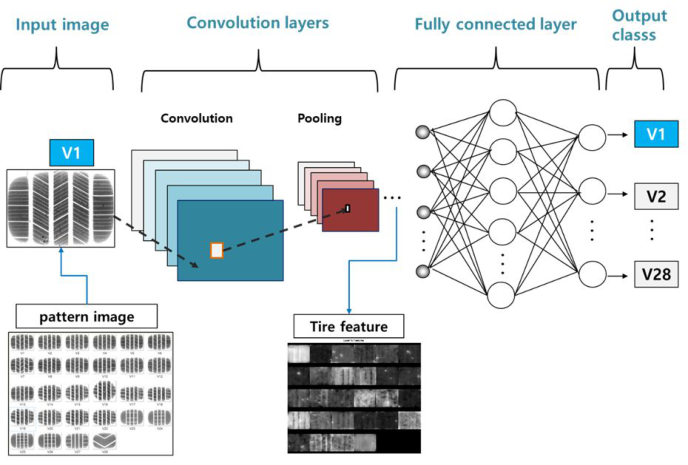
CONVOLUTIONAL NEURAL NETWORK CNN is mainly composed of three types of layers: convolutional layers, poo- ling layers, and fully connected layers. The fully connected layers are like ANN model. Convolutional and pooling layers are the most important layers. The convolutional layers are used to extract features by convolving image regions with multiple filters. The extracted features are used as inputs of fully connected layers. Fig. 1 illustrates typical CNN architecture for tire pattern classification task. Instead of classification work of tire pattern, the regression task for the prediction of tire pattern noise was performed by using a similar CNN architecture. The difference of CNN architecture between classifica- tion and regression is fully connected layer. Classification task uses softmax operator but regression does not used this function in the fully connected layer.
Training Algorithm of CNN For image classification of tire using CNN as shown in Fig.1, an image is input directly to the network, and this is followed by several stages of convo- lution and pooling. Thereafter, representations from these operations feed one or more fully connected layers. Finally, the last fully connected layer out
216 Lee
Figure 1: CNN pipeline for tire pattern classification.
puts the class label. The convolutional layers serve as feature extractors, and thus they learn the feature representations of their input images. The neu- rons in the convolutional layers are arranged into feature maps. Therefore, CNN uses the non-supervised training method because inputs of CNN are unknown features. These features are extracted throughout several stages of convolution and pooling. Therefore a priori knowledge for input features is not needed to use CNN.
PREDICTION OF TIRE PATTERN NOISE BASED ON CNN AT EARLY DESIGN STAGE This section develops the CNN model to predict sound pressure level of noise emitted from a test tire in early design stage without a test. The input of CNN is the image for full tread pattern of a new tire and the output of CNN becomes the predicted pattern noise.
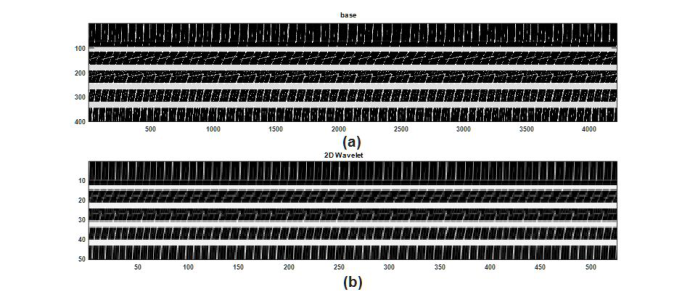
Input of CNN Full pattern images of 28 tires were used for the input of CNN and one of them was displayed as shown in Fig. 2 (a). While the scanned tread pattern images for 28 tires were used for the ANN to predict tire pattern noise. The tires have different tread patterns but with the same or very similar size and aspect ratio. The pixels size of this image was 400×4200. This size is too big to use as the input of CNN. Therefore, a need to reduce the size requested the preprocess of the input data without a loss of information about chara- cteristic of tire pattern noise. As the preprocess, in this study, 2D dimentional
Pattern Noise Prediction Using Artificial Neural Network 217
Figure 2: Full tread pattern images for one of 28 test tires (a) pixel size : 400 x4200 (b) pixel size: 25 × 263.
wavelet transform was used as shown in Fig. 2(b). The reduced pixel size was used for the input of CNN.
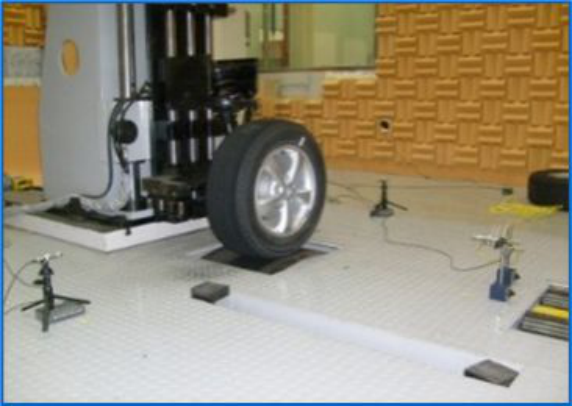
Output of ANN The pattern noise for 28 tires was measured in the semi-anechoic chamber in Nexen tire company as shown in Fig. 3. SPL for pattern noise is measured when test tire was rotated by the contact force due to friction with the sand pad fixed to roller of dynamometer. These pattern noises were compared to the measured SPL of the reference tire with no pattern. The measured SPL of the reference tire with smooth surface does not emit the trade patter noise related to pitch sequence because there is no pattern. The roller was rotated with rotating speed corresponding to the vehicle speed of 80 km/h and the simulated road condition. Three microphones were installed at the 1m position from the center of tire. Half inch low-noise microphone (B&K, type 4955, Denmark) were used. The measured noise signal was analyzed by the dynamic data analyzer (LMS SCADAS Mobile -8ch, USA) and the used sampling frequency was 12, 800 Hz. The 10 second was measure and 300 data samples used for training. The recorded SPLs were used as the output of ANN.
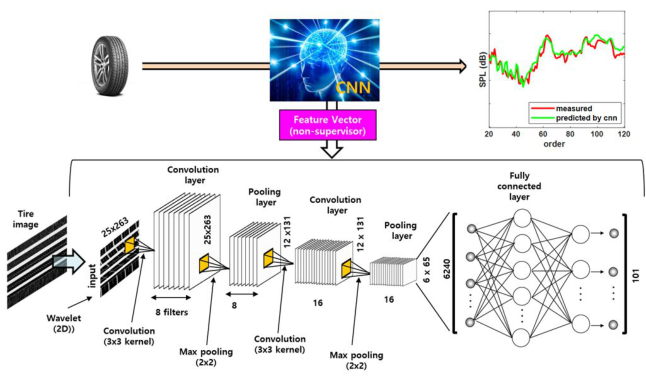
Application of CNN Model to Prediction of Pattern Noise Fig. 4 shows the pipeline of CNN used for prediction of tire noise. The input of CNN was pattern image for 28 tires. The output of CNN was the order power spectra of the measured tread pattern noise for 28 tires. In order to train the CNN network, the pattern images and the order power spectra of the measured pattern noise for 24 tires were used. The pixel size of tire pattern image was 400 × 4200 as shown in Fig. 2 (a). This sized was reduced to 25×265 as shown in Fig. 2 (b) by applying 2D DWT to tire pattern image. This compressed image was used as the input of CNN as shown in Fig. 4. The compressed image was convolved with the filter of kernel of size 3 × 3 in the two convolution layers and the pixel size was reduced in two pooling layers. The number of inputs and outputs in the fully connected layer is 6240 and
218 Lee
Figure 3: Microphone set up for measurement of tire noiseFigure 4: CNN structure for prediction of tire pattern noise.
101 respectively. The pattern images and the order power spectra for the remained 4 tires were used as the input and the output of the trained CNN for test of the trained CNN. During training process of the CNN model, the correlation coefficient between the output of the trained CNN and the order power spectra of the measured pattern noises was calculated.
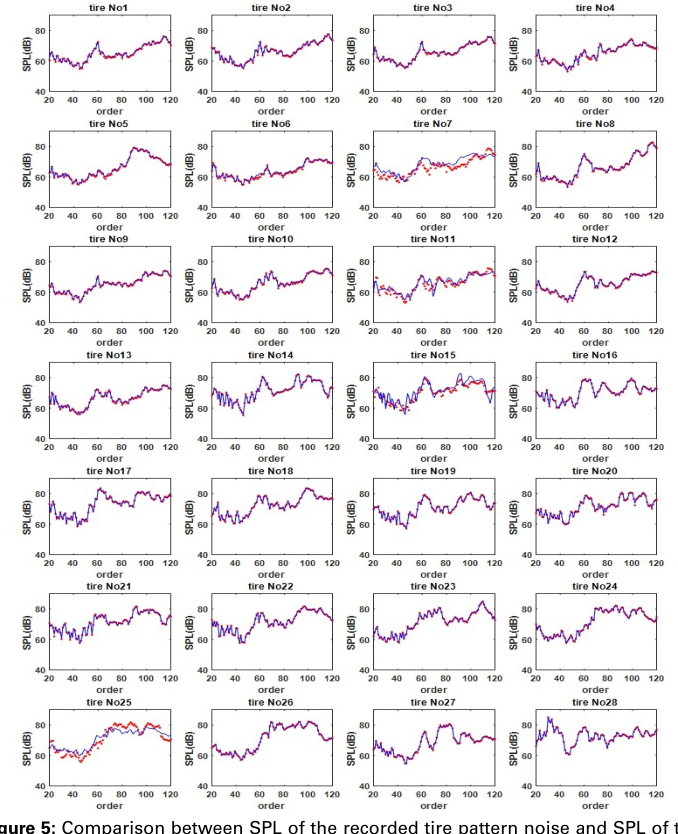
Order power spectrum of the measured pattern noise for 28 tires were compared with that of the predicted pattern noise by the trained CNN. Fig. 5 shows the order power spectrum for 28 tires. For the test of the trained CNN, the pattern images for the remained 4 tires were used. Tire number 7, 11, 15, 25 were used for the test tires. Tire number 7 11 15 and 25 has correla- tion 0.79, 0.91 .0.91, 0.91 respectively. Their mean correlation was 0.89. It inferred that the prediction percent of pattern noise using this trained CNN is about 89%.
Pattern Noise Prediction Using Artificial Neural Network 219
Figure 5: Comparison between SPL of the recorded tire pattern noise and SPL of tire pattern noise predicted by CNN based on RMSprop learning algorithm. Dot line notes measurement SPL and solid line notes predicted SPL.
CONCLUSION
In the patten noise point of view, pitch sequencing for tire tread designs has been the primary method for obtaining improvements in subjective tire noise quality. Pitch sequencing is a method of providing frequency modulation in the tire by selectively arranging tread elements of various sizes. According to the proposed method, pattern noise of a tire can be predicted by CNN and ANN. Therefore, the change of pattern noise due to modification of pitch sequencing for tire tread can be predicated by the CNN model. The optimized pitch sequence of tire can be designed by using the CNN model developed in the paper without the further measurement. In the algorithms point of view, in the regress problem, the performance of CNN algorithm is evaluated by using correlation coefficient but in the classification problem,
220 Lee
the performance of CNN algorithm is evaluated by accuracy. The difference of algorithm is the existance of softmax layer. The regress model does not use softmax layer but the classification model uses it.
ACKNOWLEDGMENT
This work has supported by the National Research Foundation of Korea (NRF) grant funded by the Korea government (MSIT) (No. 2019R1A2B5B02069400).
REFERENCES
Cusimano, F. J. I. (1992) Low noise pneumatic tire tread and method for producing same, European Patent EP0513676 A1, Google Patents: 1-14. Del Pizzo, A., Teti, L., Moro, A., Bianco, F., Fredianelli, L., Licitra, G. (2020)
Influence of texture on tyre road noise spectra in rubberized pavements. Applied Acoustics, 159, 107080. Ding, Y., Wang, H. (2019) FEM-BEM analysis of tyre-pavement noise on porous asphalt surfaces with different textures. International Journal of Pavement Engi- neering, 20(9), 1090–1097. Hanson, D.I., James, R.S., NeSmith, C. (2004) Tire/Pavement Noise Study, NCAT
Report 04-02. Kim, E. Y., Hwang, S. W., and Lee, S. K. (2012) Image-based approach to optimize the tyre pitch sequence for a reduction in the air-pumping noise based on a genetic algorithm. Proc IMechE Part D, J Automobile Engineering, 226 (9) 1171–1184. Kim, S., Jeong, W., Park, Y., Lee, S. (2006) Prediction method for tire air-pumping
noise using a hybrid technique, J. Acoust. Soc. Am., 119 (6) 3799–3812. Li, T., Feng, J., Burdisso, R., Sandu, C. (August 21-24, 2016) The Effects of Tread Pattern on Tire Pavement, INTER-NOISE 2016, 2185 - 2196, Hamburg, Germany. Masino, J., Pinay, J., Reischl, M., Gauterin, F. (2017) Road surface prediction from
acoustical measurements in the tire cavity using support vector machine. Applied Acoustics, 125 41-48. Mohamed Z., Wang, X. (2015) A study of tyre cavity resonance and noise reduction using inner trim. Mechanical Systems and Signal Processing, 50 498-509. Nijland, R., Vos, E., Hooghwerff, J. (2003) The Dutch Noise Innovation Program
Road Traffic (IPG), The 32nd International Congress and Exposition on Noise Control Engineering, Inter-noise 2003, Jeju, Korea. Sandberg, U., Ejsmont, J. A. (2002) Tyre/road noise reference book, INFORMEX, Kisa, Sweden; Harg, Sweden, ISBN 9789163126109; 9163126109. Teti, L., León, G. de, Del Pizzo, A., Moro, A., Bianco, F., Fredianelli, L., Licitra, G.
(2020) Modelling the acoustic performance of newly laid low-noise pavements. Construction and Building Materials, 247 (30) 118509. Zhou, H. (2013) Investigate into Influence of Tire tread Pattern on Noise and Hydroplaning and Synchronously Improving Methods, PhD Dissertation, Jiangsu University, China, 1–178.
LISTED IN THE AHFE DIGITAL BOOKSTORE CATALOGUE
Explore the complete digital volume
Artificial Intelligence and Social Computing
Read this individual research paper free through the original publisher, or explore the full digital proceedings book.
ISBN 978-1-958651-04-9
Explore this ISBN in the AHFE Bookstore ↗Listed in the July 2026 bookstore catalogue; search by ISBN to confirm current availability · Digital book purchase optional