Rute Gomes (2022). Sustainability (still) on Demand: Tools for Next Generation Designers. In: Human Dynamics and Design for the Development of Contemporary Societies. AHFE Open Access, vol. 25, pp. 53–61. https://doi.org/10.54941/ahfe1001371
CIAUD, Research Centre for Architecture, Urbanism and Design, Lisbon School of Architecture, Universidade de Lisboa, Rua Sá Nogueira, Polo Universitário do Alto da Ajuda, 1349-063 Lisboa, Portugal ↗
Design for Sustainability has been a persistent subject on bachelor Design Degrees curricula for the last decades. However, most of the outcome on students’ projects has been more focused on the use of recycled materials than with systemic sustainable solutions, that would generate a higher impact on the reduction of waste production and into the change into more responsible consumer habits.The actual emergency of a change in scenario in production and consumption habits, leads to the need of a refreshment in the subject of Design for Sustainability concepts and strategies, into schematic proposals as educational tools for next generation designers. Being so, this paper aims to answer the following question: How to synthetize conceptually operational design strategies, as learning tools for bachelor degree design students? To answer this question, a literature review centred on Design for Sustainability, Product Life Cycle Design, Product Service System and User-centred Design was carried out. The collected data was systematized into Design for Sustainability Innovation approaches: i) product design and ii) systemic design. The results led to a graphic systematization of design methodological steps and subsequent design questions that invite students into a reflection on the practitioner's proposals and their wider consequences into a near Future.
their design approach focused on news ways of a sustainable consumption and production (Papanek, 1985).
Although there are many efforts from universities to implement near their students a more sustainable projecting approach, the student proposals often are focused on choosing recycled and/or recyclable materials. This is not a negative response, but it is still a very shy answer when dealing with the urgent problem of global heating we are dealing with nowadays, and it is figures urgent that next generations of product designers have the awareness and thinking tools that will help them answer to real actual needs. For this, this paper aims to resume graphically methodological approaches and tools for next generation design partitioners, hoping to generate a map of main actions and questions that should be set when developing a design solution for a determinate problem. The set questions for this study were: i) how to synthetize conceptually operational design strategies, as learning tools for bachelor’s degree design students?
MATERIALS AND TOOLS A literature review on Design for Sustainability, Product Life Cycle Asses- sment (LCA), Product Service System (PSS) and User-centred Design (UCD) was carried out. The review led the information systematization into two innovation approaches, a product design innovation approach and systemic design innovation approach. The collected data, focused each innovation approach principles and strategies, addressed into a project development fra- mework. The results were systematized and set into a diagram, proposing to each methodological phase, a set of possible design operative questions during the creative process
As a project development framework, one as chosen Tim Brown’s Design Thinking five steps, as it is a user-centred methodology and involves the real understanding of contexts and of real needs among different contexts.
RESUMING DESIGN FOR SUSTAINABILITY Generally, the definition of sustainable development has been introduced into international politics lexicon, having been addressing to the need of adopting systemic conditions in different scales, either planetary or regional. This last including social and productive development: mainly in three fronts, i) redu- cing human impact on resources consumption, ii) providing the wellbeing for future generations, iii) moving towards equal resources distribution for everyone, country, or continent. Adding to this, it is important to recall the Sustainability 3P’s base line, or the triple bottom line – People, Planet and Profit. These are the main topics that need to be worked on, people equ- ality, planet resources balance between consumption and production and generating economy profitable solutions that contribute towards populations prosperity (Vezzoli et al., 2014).
Already in 1972, the research named The limits to Growth (Mea- dows et al., 1972) showed that the overconsumption of natural resources would lead to an ecosystem collapse. Papanek (1985) referred designers’
Sustainability (Still) on Demand: Tools for Next Generation Designers 55
co-responsibility for feeding the consumption world with more and more objects and tools that are not necessary. For him, designers only addres- sed superficially to problems, when developing a project, not addressing to real population needs. Having the goal of synthetizing and systematizing DfS tools and approaches, since it is a long and extend subject, one will resume main concepts that have been developed over last decades under this sustainability goal.
DfS approaches may be organized in different innovation levels, some can be more insular solutions, based on one product development, to more syste- mic ones, where the service and the need satisfaction is the goal, where there is a change in consumption patterns, from ownership, to need satisfaction service. Also, one can see some approaches that supply from more sustainable technical responses to others that are centred on changing people behaviour and participation (Cheschin & Gaziulusoy, 2016).
Following, one will systematize DfS approaches in two main sections: Pro- duct Design Innovation level and Systemic Design innovation level, either of them comprehend different concepts and strategies:
PRODUCT DESIGN INNOVATION APPROACH Concerning the reduction of natural resources consumption, green design is about the redesign of existent products, to make them more sustainable, or designing new products that follow green design principles. Papanek (1985) contributed greatly to this approach, as he presented a critique on designer’s irresponsible attitudes when promoting consumerism and not developing solutions focused on real users’ needs, besides developing disposable objects that would drive into a heavier use of natural resources. Green design came into scene for the re design of products, lowering their impact on resources consumption. This is focused the three Rs principle: Reduce – Reuse -Recycle (Burall, 1991; Mackenzie, 1997). Ecodesign came along and bring a great impact on this approach, by focusing on products’ whole life cycle, from raw materials to their disposal. With life cycle assessment methods, all phases’ environmental impact are studied, allowing the adoption of strategies that would reduce their impact. Ecodesign has seen developed a set of principles and tools (Bhamra & Lofthouse, 2007; Tischner & Charter, 2001; Vezzoli & Manzini, 2008). It has been consolidated in the last decades, having been adopted by the European Commission (EC, 2005) the Ecodesign Directive.
Within Life Cycle Assessment, one can include strategies that contribute for a longer product lifespan, avoiding products to become obsolete tech- nically and emotionally. Technically, offering services of maintenance and upgrade can help extending their functional purposes (Manzini & Vezzoli, 2008). Also, it is important to understand what the unavoidable obsolesce- nce of a product is, in some cases, some products get naturally obsolescent, and this can be because new and more sustainable solutions came in the mar- ket, for instance. In these cases, it is relevant to design objects that easily dismantled for recycling, or that have parts that can be used in other obje- cts. However, objects don’t get disposed just because they get technically obsolescent, but most of disposure cases, happen because users don’t feel
56 Gomes
emotionally attached to them. Emotionally, it is necessary to develop produ- cts that follow users’ changing emotional/ cultural needs, such as desire for social status emulation, new tends and style. This field is identified as emoti- onally durable design and design for product attachment (Chapman, 2005; Mugge et al., 2005). Some of the most common strategies is develop produ- cts enable personalization (Mugge et al., 2005), to design products that “age with dignity” (Van Hinte, 1997) and allow “users to capture their memoires” (Chapman, 2005).
Another approach is Design for Sustainable Behaviour (DfSB), where it is studied the way users interact with their products, aiming to let them adopt more sustainable ways of consumption. For instance, by letting users know how much energy they spend when using a certain product, will awake their attention into a more conscious use of it, and change their consuming behaviour (Bhamra & Lofthouse, 2007). DfSB design strategies have been developed, and focus mainly on “informing, empowering, providing feed- back, providing feedback, rewarding and using affordances and constraints” (Cheschin & Gaziulusoy, 2016, p. 124).
DfS is about developing solutions that contribute to equality also among People. So, as Papanek (1984) referred, it is essential that designers work for the Base of the Pyramid (BoP). BoP is the poor part of the population, that have very low income to live with daily, and have real basic needs. Praha- lad (2004) suggests that the problem of poverty needs to be solved using a market-based approach, where companies look for business opportunities in low-income economies, and the poor users are seen as consumers. This will bring job opportunities and prosperity, allowing the poor to have access to affordable products and services. Many researchers on BoP have been keen on addressing Product Service System approach to manage BoP problems, as its model may contribute to socio-economic development, moving towards a satisfaction-based consumption economy instead of the generalized owner- ship model, contributing to a low-resource service economy (Emili, Cheschin, & Harrison, 2016).
SYSTEMIC DESIGN INNOVATION One brings here the principle of systemic design, as a more complex design solution, not just focused in one product development, but where more sta- keholders, actors, production contexts, interact and are managed resulting in a more sustainable solution.
Designing a Product Service System (PSS) differs from of an individual product, as it is a complex conjugation of products, services, and a netw- ork of stakeholders that work on three fronts: production, management, and delivery (Mont, 2002; Dewberry, Cook, Angus, Gottberg, & Longhurst, 2013). A sustainable PSS offers more than a product, offers a service and is need-satisfaction focused. For a system like this to work, all involved sta- keholders’ interactions need to be well managed, as well as communication channels with users need to be clear, keeping updated with their needs, and their satisfaction levels (Vezzoli et al., 2015). These services are often related to sharing economy models.
Sustainability (Still) on Demand: Tools for Next Generation Designers 57
Design for Social Innovation (DfSI) can either aim to resolve social problems, or to work towards behavioural changing and social wellbeing (Manzini, 2007). Here the participation of people or communities is a major request. Participatory methodologies are essential to develop a better under- standing of the context, the users’ needs, and to work with them planning a solution that will profit that community somehow. The term “creative com- munities” is here used referring to communities who actively worked on a creative problem solving, and are part of the solutions, as local stakehol- ders, experts in a certain service, or local institutions or producers. These projects are often related to services that link community members or insti- tutions, such as caring for children or elderly, community gardens, local food producers, and so on.
Enlarging the scope of action, but focusing on production contexts, Syste- mic Design can also be addressed as focusing on sustainable productive systems development where the flows of materials and energy between pro- cesses are maximized to prevent the release of waste. Every system output, instead of waste, is seen as an opportunity, an input for another phase or product, generating value chains (Barbero, 2011).
Reframing Already in 1985, Papanek said that designers’ biggest fail was of not desi- gning for real needs, but for a small part of the population, where they were included. It is necessary to go deep into real contexts, to understand users’ needs. As Nigel Cross (2006) referred, innovation can come along with refra- ming the problem. What users wish for, may not be what they need to satisfy their problem. For that, it is necessary to start approaching a challenge with an active phase of understanding real problems, layered contexts, and users’ needs (Manzini & Vezzoli, 2008, Bhamra & Lofthouse, 2007).
User Centred Design is fundamental when developing design solutions and is naturally part of DfS approaches. Contacting directly with users is here essential for understanding their problems and needs, as well as to let them test prototypes actively (Brown, 2010). Users are called into action, rather than seen remotely on a google search.
RESULTS
Having organized DfS approaches in two groups, product focused and syste- mic focused, it is necessary to trigger student’s attention to the design oppor- tunities that may come along a design challenge. For this, reframing problems and identifying new design opportunities using participatory methodologies and contexts direct observation is a key starting point.
One has called into action some basilar principles of DfS and having as a goal synthesizing and systematizing approaches as a tool for design students, it figures necessary to set up a group of questions that can help students to think about strategies, depending on their ongoing design challenge. Follo- wing, we take as design project development reference Tim Brown’s Design Thinking design phases:
58 Gomes
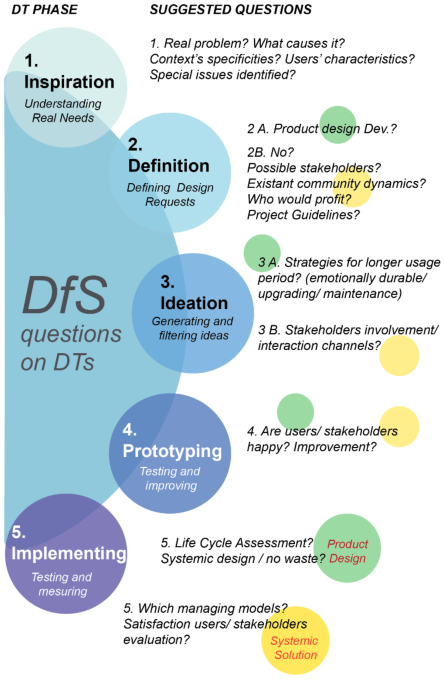
1. Empathy – getting to know the problems, demands, contexts, users’ cul- tural needs, constraints, and opportunities. It is important to make direct observation and “dive” into the contexts of use in order to understand which may be the real unsolved issues or reframed problems. For this, some design questions may help: a. What is the real problem, and what causes it? b. Which characteristics make this context different? c. Which characteristics better define these users? d. Is there any special observed issue during direct observation, that may contribute to the identified problem?
2. Definition – Having collected data about the context of the given chal- lenge, it is important to start filtering information, and define guidelines for project development. It is necessary here to start narrowing the nature of the proposal. For this, one should understand how far one can go, when it comes to product ownership/ product service system/ sharing economy/ design for social innovation and how deep can one go on syste- mic proposals. It is also important to study possible stakeholders in the region. For this, following are supporting design questions: a. Is this a straightforward product design development? b. If not, which are, so far, the involved stakeholders? Are there community ongoing dynamics, who would somehow gain from the solution? c. Which are the achieved guidelines for design development?
3. Ideation – With the given data and design requests, this phase is cen- tred on idea generation and filtering. Besides the design requests, from the previous questions, one could narrow the nature of the project, if product based, or systemic based. Either of these alternatives, can have sustainable strategies applied. Bellow there are some design questions, that follow previous definition questions a and b: a. Are there any strategies that can be applied to make the usage period longer (emotionally durable design or maintenance or upgrading)? b. How could the stakeholders be involved? Which would be the contributions and rewards? How would the interaction channels work?
4. Prototyping – testing and prototyping is essential to identify faults and improving opportunities. Model after model, prototype after prototype, one should adopt a model of testing and improving, until it is appro- ved by stakeholders and users, for this, it is crucial to stablish good communication with testers. 5. Implementing – Just in some cases students have opportunities to imple- ment their proposals in real contexts, specially if it comes to industrial production. However, for when this happens, some design questions should be set:
Sustainability (Still) on Demand: Tools for Next Generation Designers 59
Figure 1: Design Questions for developing sustainable solutions using Design Thin- king. Source: the author.
a. In case of product development, how can we contribute to sustaina- bility via Life Cycle Assessment? a1. Can we manage a systemic design assessment, directing all material waste into other product production cycle? a2. Is the product easily dismantled, upgradable, recyclable? b. In case of a Systemic approach based on need-satisfaction instead of product ownership, how can one manage user satisfaction, as well as stakeholders satisfaction? How would the managing model work?
Bellow, figure 1 presents a scheme on Design Thinking phases and sug- gesting design questions that will help develop a sustainable proposal, according to DfS approaches.
CONCLUSION
Resuming DfS approaches into two main innovation groups, made easier and clearer to communicate the difference in the depth of the sustainable strategy. As referred by most of the brought authors on DfS, the great needed global
60 Gomes
design change needs to be operated in people’s minds, by changing consuming behaviours and the ownership mindset still patent (Papanek, 1985; Manzini & Vezzoli, 2008; Vezzoli et al, 2014; Cheschin & Gaziulusoy, 2016; Emili, Cheschin, & Harrison, 2016).
The answer to the set research question How to synthetize conceptually operational design strategies, as learning tools for bachelor degree design stu- dents? was here presented visually as diagram that hopes to offer a generic but operating tool, for design development that helps students embrace a wider and deeper approach on the development of sustainable solutions.
This diagram is presented as an instrument to assist design students to cultivate the “eye” and the tools to observe contexts and identify possible involved stakeholders, finding great design opportunities, where there is a full engagement with local productions, and with local communities as a plus into finding solutions where there is a full win of the 3Ps. In the other hand, if product design development is the challenge, it is also important to propose the best ways possible for saving resources, and for generating solutions that are durable either by generating emotional attachments, or by letting them adapt to users’ cultural and physical needs throughout time (Chapman, 2005; Mugge et al., 2005; Manzini & Vezzoli, 2008).
ACKNOWLEDGMENT
The author would like to acknowledge the support of CIAUD, Research Cen- tre for Architecture, Urbanism and Design, Lisbon School of Architecture. This work is financed by national funds through FCT - Fundação para a Ciência e a Tecnologia, I.P., under the Strategic Project with the reference UIDB/04008/2020.
REFERENCES
Barbero, S. (2011). Systemic Design for the Development of Local Distributed Economies. (Unpublished PhD Thesis). Turin, Italy: Politecnico di Torino. Bhamra, T., & Lofthouse, T. (2007). Design or Sustainability. A Practical Approach.
Aldershot, UK: Gower Publishing, Ltd. Brown, T. & Wyatt, J. (2010). Design Thinking for Social Innovation. Stanford Social Innovation Review, winter 2010, vol. 8, no. 1. Stanford: Stanford Graduate School of Business. Burall, P. (1991). Green Design. London: Design Council. Chapman, J. (2005). Emotionally Durable Design. Objects, Experiences, and
Empathy. London: Earthscan. Cheschin, F. & Gaziulusoy (2016). Evolution of Design for Sustainability: From Product Design to Design for System Innovations and Transitions. Design Studies 47. Elsevier Ltd, 118–163. Cross, N. (2006). Designerly ways of knowing. Springer-Verlag London Limited. Dewberry, E., Cook, M., Angus, A., Gottberg, A., & Longhurst, P. (2013). Critical
reflections on designing product service systems. The Design Journal, 16(4), 408– 430. EC. (2005). Directive 2005/32/EC of the European Parliament and of the Council of6 July 2005 Establishing a Framework for the Setting of Ecodesign Requi- rements of Energy-Using Products and Amending Council Directive 92/42/EEC
Sustainability (Still) on Demand: Tools for Next Generation Designers 61
and Directives 96/57/EC and 2000/55/EC of the European Parliament and of the Council. Emili, S., Ceschin, F., & Harrison, D. (2016). Product-service systems applied to distributed renewable energy: A classification system, 15 archetypal models and a strategic design tool. Energy for Sustainable Development, 32, 71–98. Mackenzie, D. (1997). Green Design: Design for Environment (2nd ed.). Hong Kong:
Laurence King. Manzini, E. (2007). Design research for sustainable social innovation. In R. Michel (Ed.), Design Research Now (pp. 233–245). Basel: Birkhauser. Manzini, E. (2015). Design, When Everybody Designs. An introduction to Design
for Social Innovation. Cambridge, US: MIT Press. Mont, O. (2002). Clarifying the concept of product-service system. Journal of Cleaner Production, 10(3), 237–245. Mugge, R., Schoormans, J. P. L., & Schifferstein, H. N. J. (2005). Design Strate-
gies to Postpone Consumers’ Product Replacement: The value of a strong persone product relationship. The Design Journal, 8(2), 38-48. Papanek, V. (1985). Design for the Real World: Human Ecology and Social Change.
New York: Van Nostrand Reinhold. Prahalad, C. K. (2004). The Fortune at the Bottom of the Pyramid: Eradicating Poverty Through Profits. Upper Saddle River, NJ: Wharton School Publishing. Tischner, U., & Charter, M. (2001). Sustainable product design. In M. Charter, & U.
Tischner (Eds.), Sustainable Solutions: Developing Products and Services for the Future (pp. 118–138). Wiltshire, UK: Greenleaf. Van Hinte, E. (1997). Eternally Yours: Visions on Product Endurance. Rotterdam: 010 Publishers. Vezzoli, C., Kohtala, C. and Srinivasan, A. (Eds) (2014). Product-Service System
Design for Sustainability. Greenleaf Publishing Limited. Sheffield: UK. Vezzoli, C., & Manzini, E. (2008). Design for Environmental Sustainability. London, UK: Springer.
LISTED IN THE AHFE DIGITAL BOOKSTORE CATALOGUE
Explore the complete digital volume
Human Dynamics and Design for the Development of Contemporary Societies
Read this individual research paper free through the original publisher, or explore the full digital proceedings book.
ISBN 978-1-958651-01-8
Explore this ISBN in the AHFE Bookstore ↗Listed in the July 2026 bookstore catalogue; search by ISBN to confirm current availability · Digital book purchase optional