Ana Thudichum Vasconcelos, Joao Cruz (2022). Design Strategies for Socio-Environmentally Adverse Territories. In: Human Dynamics and Design for the Development of Contemporary Societies. AHFE Open Access, vol. 25, pp. 221–237. https://doi.org/10.54941/ahfe1001392
In an inland southern region of Portugal, pathologies that intersect social and environmental problems have been identified, such as low density, aged and dispersed population, as well as low rainfall and high temperatures. An applied research and development initiative endorsing those problems was carried out by students and staff of the University of Lisbon along two years. This text reflects on this experience and the role of design on such predicaments.The research questions are: how and what kind of innovation can design bring to the community's quality of life in territories under adverse conditions of that kind?A previous analysis, carried out between local authorities and our design school, allowed us to trace two lines of investigation, one aimed at intensifying the flow of people within the territory, and the other focused on promoting the relationship between Man and his environment.Considering that design can contribute to the process of social change, through design for social innovation and collaborative services, we reflect on the main characteristics that the design projects must contemplate, which are: a user-centered perspective; be a participatory process; to draft with a sustainability perspective; adopt a multilevel perspective; to endorse innovation and; sustain problem solving.The research methodology involves the transversal use of design methods and participatory processes, immersion in the territory, collection of primary and secondary data, definition of the concept, development of proposals, communication and validation by the municipal authorities.The results are a set of projects with a wide range of solutions in the field of social innovation, with the aim of valuing social interaction, valuing culture and regenerating the local landscape, namely: a cultural caravan service; a Lab-desk service; a cultural project to reactivate community wood-fired bread ovens; a website to publicize local projects focused on agroecological food; a Center for the Intangible Cultural Heritage; a co-working and co-living service; an environmental festival; a research service aimed at better understanding the needs of the “silent population”; a garden at the historic urban center of Mértola town; a public botanical garden; and, the renovation of a public area in a small village.The relevance of this work lies in the assertion of the potential of design strategies for social inovation, particularly in a context of social and environmental adversity, where design can fullfill a key role valuing the daily lives of populations. This article demonstrates that there is an immense space for work involving the public institutions managing this type of territories and the design academia. From our experience, a transversal line stands out: the intersection between local knowledge and the external population. This converges it the idea that the value that design brings to this kind of community is the drafting of arenas of social interaction where the local social fabric is nurtured and, simultaneously, beholding people´s awareness of the surrounding environment’s frailty.
PICTURE OF AN ADVERSE TERRITORY The object of study was the territory of the Mértola county (district of Beja, Portugal). This county is situated in Baixo Alentejo and, due to multiple long term circumstances, its populations currently acquaint quality of life issues demanding prompt improvement.
The local municipality, aware of the hardship faced by the territory, pro- posed to the head of the master’s course in design for Sustainability (D4S) of the University of Lisbon, to study and develop design proposals to attenuate the local difficulties. Two research topics were highlighted: a) increase the flow of people in the territory with the creation of collaborative networks between inhabitants and visitors to the municipality and, b) promotion of the relationship between humans and the surrounding environment.
From the social point of view, Mértola is a reflection, worsened, of some demographic pathologies that Portugal actually faces. The problem of popu- lation aging due to a very low birth rate, where “since 2009 the number of deaths has been higher than the total number of births” (Campos, 2021) is the apparent root cause of the current plight. In the municipality of Mér- tola, this setback has been taking place for a long time: people over the age of 65 account for about 35% of the today’s population. A similar condi- tion is found in all hinterland territories in Portugal. Specifically, the decline of population in the Mértola county accelerated significantly since the 1960 decade due to changes in agricultural employment, the reduction of mining activity in the S. Domingos mine (20km north of Mértola town) and the full alt of this extraction compound in 1968. The human population shrunk from 26.026 individuals in 1960 to 6.261 in 2018. Current estimations point to just over 5,000 persons living in the county, spread in 106 different locations in an area of 1,292.87 km2, with the highest concentration (around 2000) in the Mértola town. This high dispersion results in a population density of c.5.3 inhabitants/km2. The county is a low-density territory, with a dispersed, decreasing and aging population (Prodata, 2022 and INE 2022). The main employers are the local municipality, the building industry and, to a smaller scale, agriculture.
Mértola is located the southern inland of Portugal with a rigorous dry Mediterranean climate, previously classified as moderate, nowadays semi- arid, characterized by hot summers, high insolation, high evapotranspiration and nutrient-poor soils unprotected by vegetation, despite being crossed north-to-south by the Guadiana River. The environmental aspects that can be tuned to counteract the natural discomfort associated with the growing deser- tification are at the level of ecosystem regeneration, biodiversity conservation, the promotion of agroforestry practices that integrate the management of natural resources, and also the regeneration of soils. In the town of Mér- tola, where most of the county’s population now lives, its notorious the lack of shade, which is very significant issue when air temperatures, frequently, reach 42°C. Design for Sustainability initiatives applied to such geographic conditions must comprehend measures to mitigate the direct effects of cli- mate change and to integrate sustainable development goals to safeguard the medium-term inhabitability of the territory.
Design Strategies for Socio-Environmentally Adverse Territories 223
Presently the cultural and recreation agendas of the county are marked by: i) the activities of local associations dedicated to cement social cohesion and promote agroecological practices; ii) the regular activity of the Campo Arqueológico de Mértola (Archaeological Field of Mértola) of study, disclo- sure and musealization of the mostly Islamic and medieval heritages; iii) the activities of the local municipality to promote the county as a touristic destination (anchored on local gastronomy, handicrafts, Islamic culture, hun- ting grounds, birdwatching, nature contact, and, to a lesser scale industrial archeology).
In this socio-geographic context, the D4S course can generate value for this community through: 1) the provision of training in design for sustainable development rooted on the disciplinary framework of environmental, social, and economic sciences; 2) the promotion of reflection and debate devoted to specific sustainability issues that allow the design, development and imple- mentation of project at local, regional and global levels within the framework of the United Nations Sustainable Development Goals (UNSDG); and 3) the conception of design projects in real context and in collaboration with public and private entities.
ASSUMPTIONS OF DESIGN FOR SOCIAL INNOVATION AND COLLABORATIVE SERVICES Social innovation are “ideas that work in meeting social goals” (Manzini, 2015). Collaborative services are services based on collaboration, mostly between the user themselves (Penin, 2018).
The D4S course of action applied to the Mértola county was originally restricted to the production of design proposals for social innovation.
Social innovation projects generate new opportunities, where individu- als and communities are at the center, and they are the ones who promote change. These social change processes involve awareness of the need to acquire new behaviors, encourage interpersonal relationships and reinforce the social fabric and, simultaneously, putting into practice new and more sustainable ideas of well-being (Jégou and Manzini 2008). The D4S appro- ach to the Mértola demand was also aligned with the idea of targeting the common good derived from public utilities.
The effective way to promote dynamics of social innovation is through collaborative services. Collaborative services are an area of expertise that lies within service design. Service design is the process of creating the touchpoints (Wilson, 2015) which services are made of and that enable the contact betw- een people, information, products, and space. Collaborative services focus on creating processes where people are the bedrock, rather than designing the interface or using technology.
The needs and challenges of the municipality of Mértola are large and varied, that is, they are complex. A practical strategy was devised to frame and guide the development of design proposals at D4S. Seven premises were pointed to form the base for the creation of design processes prone to promote social change:
224 Vasconcelos and Cruz
1) A user-centered perspective - design starts with people both as an indivi- dual and collectively, rather than starting with organizations, structures, or processes. 2) A participatory process – design creates empathic strategies that allow stakeholders to be involved in decision-making processes. 3) Multi-level perspective - consists of an approach to the problem conside- ring its various dimensions. It is about decomposing complex systems into sub-themes, to deal with the amount of information, to find intersections that can promote innovation. 4) Innovation – stems from the multi-level and the user centered perspecti- ves. Each individual and each community are an identity, The empathic observation of those identities and the collaborative relationship with them constitutes a source of opportunities’ detection. If this reading is carried out in several ways, using a multi-level perspective, the num- ber of design opportunities detected and the possibility of thinking in a non-linear way are increased. 5) Problem-solving – design works to bring solutions to improve the quality of life, to simplify everyday life, to value people and their communi- ties. Problem-solving attitude is the ability to describe problems and find applied solutions. 6) Territory – its regarded as a physical space, which influences and contours social transformations, where interconnectivity, interdepende- nce and the complexity of systems coexist. Above all, the territory is understood as a space for people that is built and modified daily. 7) Design for Sustainability – an area of the design discipline committed to creating a better world, in an ethical attitude of promoting the common good. Considering that the lever of the processes are people framed in the various dimensions of life, in line with the UN guidelines on sustainable development (Design Council). In this way, Design for Sustainability dee- pens these issues from a holistic and integrative point of view to promote actions applied to local needs.
FROM THE IMMERSION IN THE TERRITORY TO THE COMMUNICATION OF DESIGN SOLUTIONS This section refers to the description of the work methodology and outputs of the D4S’s Mértola applied research and development initiative (D4S-M).
Forty-one students enrolled in the D4S course in the school years of 2020–21 and 2021–22 were engaged to develop design proposals targeting the current reality of the Mértola county territory. Limitations were defined regarding the scope of the proposals (design of services, of physical facili- ties or of equipment) and the preferred strategic domains (personal isolation, demographic decline, and relation of people with the surrounding environ- ment). Eleven teams were formed, each including three to four students from different graduation areas, ranging from design (industrial & interior, graphic, fashion, web) to architecture, visual arts, biology, geography, and philosophy. The team formation was tailored to maximize each team’s hetero- geneity in what refers to student gender, nationality, and previous education.
Design Strategies for Socio-Environmentally Adverse Territories 225
Table 1. List of proposals.
Table available in the original PDF paper.
D4S-M design proposals Team Original title Translated title
1 Ágora Ágora 2 Unidade Móvel de Cultura Culture Mobile Unit 3 Olhar Mértola Look at Mértola 4 Em torno do forno. Sabor do Saber Around the Oven. Taste of knowledge 5 Divulgação da rede alimentar com produção local agroecológica
Dissemination of the Food Network with Local Agroecological Production 6 CPIM Centro para o Património Imaterial de Mértola
Intangible Heritage Mertola’s Center 7 CALMértola Project CALMértola Project 8 FAM Festival Ambiental de Mértola Mértola’s Environmental Festival 9 Espaço verde de cocriação Co-creation Green Area 10 Escutar a aldeia Listen thePeople’s Village 11 Jardim Botânico de Mértola Mértola’s Botanic Garden
Along two separate semesters the teams could visit the county, collect infor- mation, and interview whom they wished with the loose supervision of the teachers. At the end of D4S-M, eleven design proposal were disclosed Students were trained to follow the methodology commonly known as the “Framework for innovation” or “Double diamond” devised in 2004 by the Design Council [9]. This model consists of two parts (“diamonds”) and four design phases. In the context of the first “diamond”, the study of the territory was carried out, consisting of: 1st phase to analyze the central issues affecting the county and a 2nd phase to select an intervention domain and to characterize a target-problem. The 2nd phase culminated in the elaboration of one design concept per team and formed the bridge to the next “diamond”. In the second diamond, along the 3rd phase, the concept was developed and communicated, and alternative solutions were assessed. Along the 4st phase the work consisted on the refinement, validation and disclosure of the design proposal of each team.
Depending on the work route of each team, students were encouraged to use participatory and ethnographic research tools, to collect case stu- dies of similar territories, to sketch stakeholder maps, system maps, service blueprints, compose storytelling boards, describe scenarios, and built scale mockups.
DESIGN FOR SUSTAINABILITY SOLUTIONS WITHIN THE SCOPE OF SOCIAL INNOVATION The D4S-M initiative produced eleven design proposals by eleven teams (Table 1).
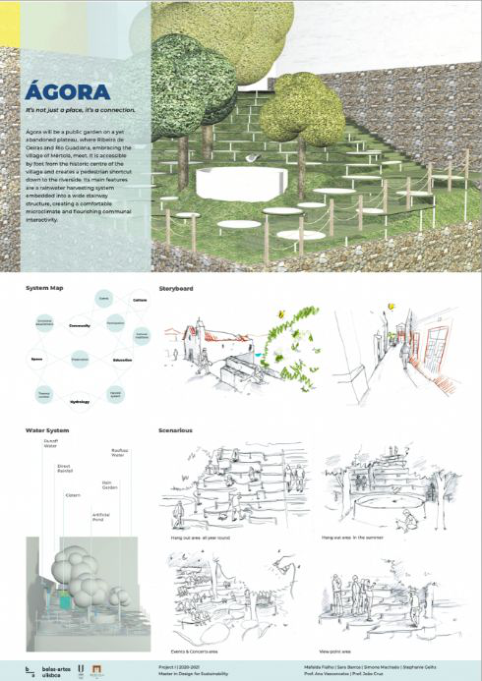
Team 1 designed a rain garden on an unused 400m2 slope area at the histo- ric urban center of Mértola town (Figure 1). The public garden was shaped
226 Vasconcelos and Cruz
Figure 1: Ágora, Team 1.
as an outdoor amphitheater to host community meetings and group activi- ties up to 50 persons and includes a system of pipes and tanks to collect and use the runoff and rainwater from the medieval hull uphill. The plot of land is part the natural path of runoff water descending the urbanized hill. The location of the garden enables a sightseeing view over the river valley below and enables the use as a gathering and rest area for pedestrians walking on the narrow streets of the historic hill. The proposal was tailored to facilitates outdoors activities on the hot season, decrease the dryness in the immedi- ate vicinity, foster neighborhood connections and meetings, attracts small scale public activities to the residential neighborhood and facilitate walking outdoors.
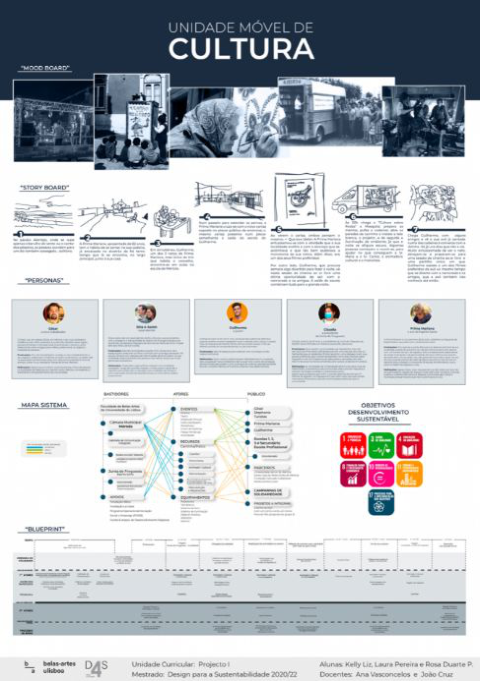
Team 2 designed a cultural caravan service to tour the smaller settle- ments of the county - mostly places with less than 20 permanent inhabitants (Figure 2). The service, kept by the local municipality, produces free pre- programmed cinema screenings, talks, reading sessions, music concerts, dance and theater plays outdoors, after sunset during the dry season. The service is shaped to create a pretext for the county inhabitants, and the occa- sional visitors, to visit the remotest settlements and their fellow inhabitants.
Design Strategies for Socio-Environmentally Adverse Territories 227
Figure 2: Culture mobile unit, Team 2.
Locals will be expressly exhorted to organize rides with their neighbors to reach the locations of the performances with the smallest possible number of cars, and to foster conviviality. The goal of this service is to improve people’s access to cultural events, attenuate social isolation and ignite cooperative ini- tiatives involving people living in isolated places. In winter months the service is limited to the locations where community halls still exist.
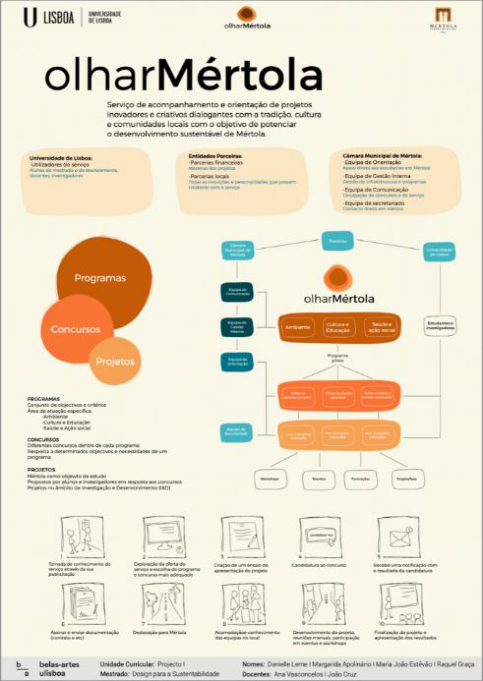
Team 3 designed a local Lab-desk with the mission to assist the realisation of R&D projects in the county (Figure 3). The bureau should assist, with financial advice and logistic aid, individual researchers, or organized teams of researchers to realize scientific or artistic expeditions, missions, or residences within the territory of the county. Only artistic or scientific projects focused on Environment, Human health, Social Care, Culture and Education issues applied to low density and semi-arid territories will be assisted. The Lab-desk, managed by the local municipality, is a tentative and indirect tool to: bring new inhabitants to the territory; enlarge the knowledge about the way of life of small and dispersed communities; and, enable the raise of the quality of life of local inhabitants.
228 Vasconcelos and Cruz
Figure 3: Look at Mértola, Team 3.
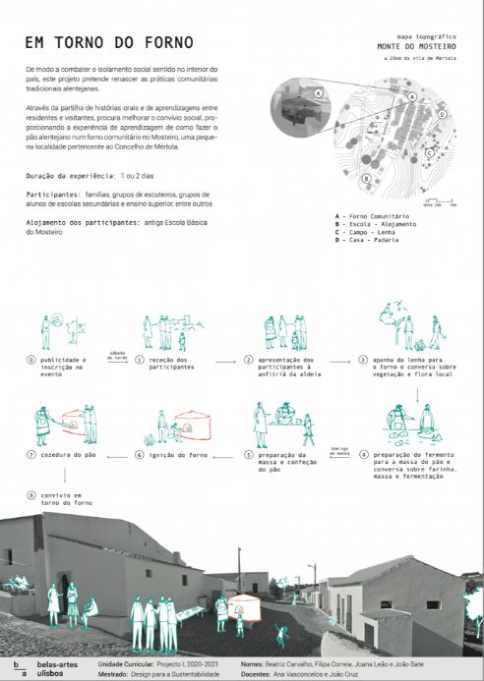
Team 4 designed a service to attenuate social isolation (Figure 4). The pro- gram, aimed at reactivating and preserving the out-of-use community bread wood-fired ovens that still exist on county, will mix local inhabitants, visitors, and a team of “oven-animators”. Around 12 ovens can easily be brought into operative condition. The animators will perform a program of preparation, cooking and tasting of communal meals using the ovens. The guests will be requested to participate on the performance, from fuel collection to cleaning, and will be served with talks on the historical aspects of the local ovens and diet. Sessions are tailored for adults or school age children. The service aims the preservation of the communal heritage facilities, to exhibit the ancient forms of cooperation among neighbors and to prepare the ground for the ignition of cooperative initiatives involving people living in isolated places.
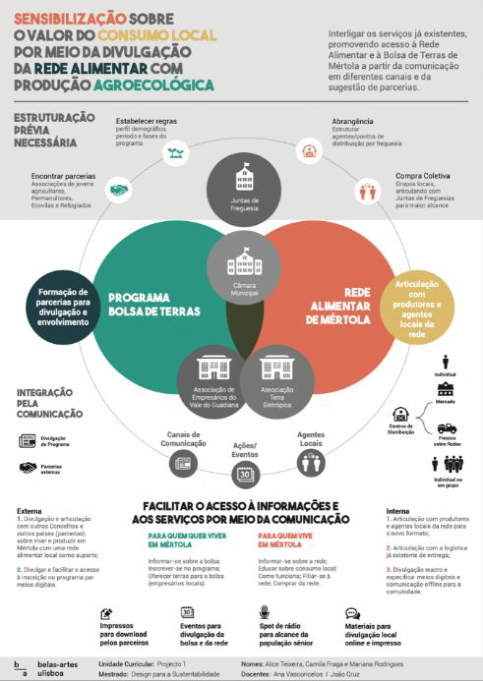
Team 5 designed a website to orderly and easily publicise the already existing local programs focused on the local production of agro-ecologic- food (Figure 5). Eight different programs, run by local individuals alone or with the aid of the municipality, professional or amateur-driven, where identified as working within the county to promote: the production of agro- ecologic-food; healthy diets; and, cooking habits among children and youth.
Design Strategies for Socio-Environmentally Adverse Territories 229
Figure 4: Around the oven, Taste and Knowledge, Team 4.
The website aggregates the information available about the programs and show it as “food network” in order to: disclose of the local initiatives; facili- tate the communication; demonstrate the viability of small-scale production on the territory; attract people to work on the programs. The website aims to promote the immediate sociability and food education of the people involved, and the networking between similar programs.
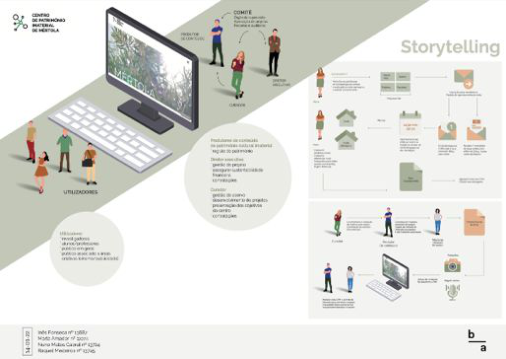
Team 6 proposed the creation of a Centre for the Intangible Cultural Heri- tage of the Mértola county (Figure 6). The Center would provide the services of inventory, study, safeguard, disclosure, and promotion of that heritage for both academics and public. The disclosure and promotion activities are expected to attract visitors to the county. The inventory and study activities should attract medium to long term visitors and new inhabitants.
Team 7 design a co-working and co-living service. The service is tailored for people who wish to live and work in a quiet environment away from their usual work location, for short to medium term periods, alone or with their families (Figure 7). The offer of services includes complementary activities to enable rest and leisure, contact with and part-time work in the initiatives of the local community.
230 Vasconcelos and Cruz
Figure 5: Dissemination of food network with local agroecological production, Team 5.Figure 6: Intangible Heritage Mertola’s Center, Team 6.
Design Strategies for Socio-Environmentally Adverse Territories 231
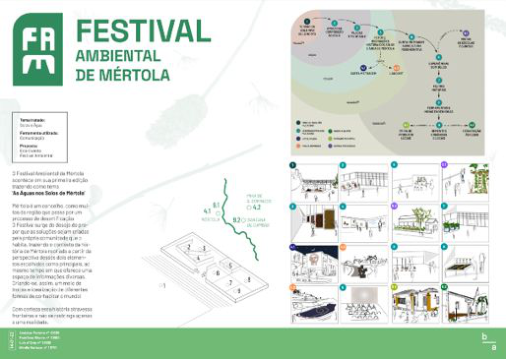
Figure 7: Mértola’s Botanic Garden, Team 7.Figure 8: Mertola’s Environmental Festival, Team 8.
The hospitality service and the workstation premises will occupy exi- sting and renovated buildings. The expected by-products of this service are:
232 Vasconcelos and Cruz
Figure 9: Co-creation Green Area, Team 9.
i) increasing the chances of immigration of highly qualified employees, ii) creating new local jobs, iii) reusing vacant buildings.
Team 8 conceived a temporary and biannual Environmental Festival which includes exhibitions, lectures, and practical events for the public, to be held in scattered locations in the municipality (Figure 8). The festival’s program is focused on the ecologic relevance of soil and water on semi-arid regions. The wide goals of the festival include call public’s attention to environmental desertification; publicize water and soil preservative and regenerative practi- ces; create a set of regular events that attract visitors to the county; locate the permanent staff of the festival within the county.
The expected by-products of this service are an increase of the number of visitors, the creation of local jobs and the propagation of benign water and soil handling practices.
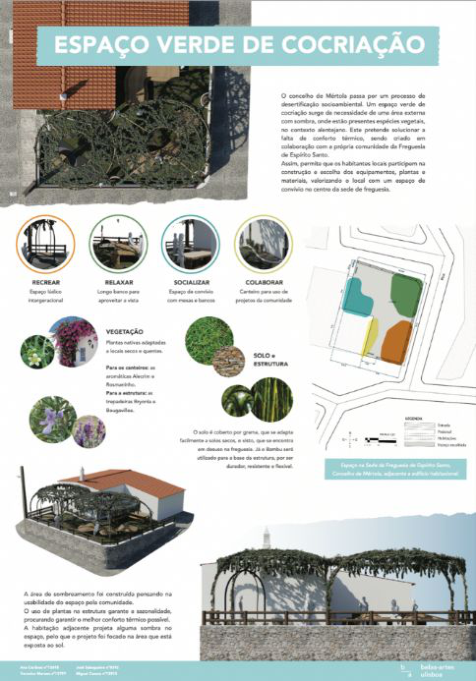
Team 9 designed the refurbishment of a 200m2 outdoor public area adja- cent to a private house in the settlement of Espirito Santo (c.60 inhabitants) (Figure 9). The sun exposure and dryness of the plot currently thwarts the use of that corner as the gathering place of the inhabitants, despite its central location and the panoramic view available. The proposed design includes a
Design Strategies for Socio-Environmentally Adverse Territories 233
Figure 10: Listen the People’s Village, Team 10.
vegetation covered pergola, new floor and “urban furniture” to instigate the use as an informal outdoors gathering place. The goal is to provide physical comfort outdoors on the hot season in a public space to attenuate social isola- tion, increased sociability and, promote the replication of ancient shadowing solutions.
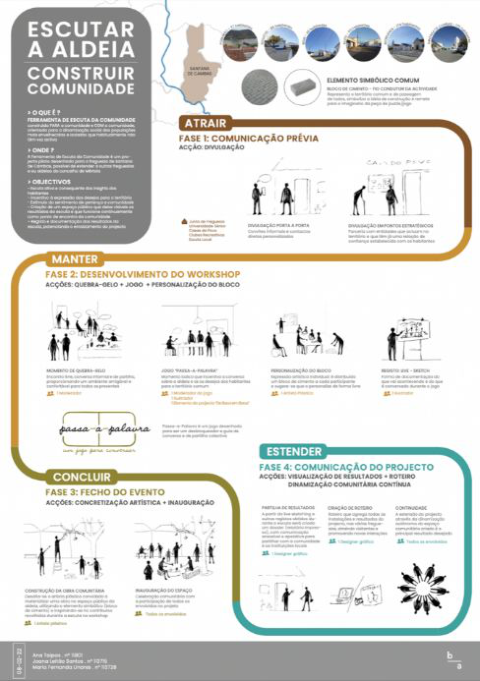
Team 10 designed a survey service to collect the aspirations and concerns of the inhabitants of the smaller settlements, by inviting participants to collabo- rate in an artistic activity (Figure 10). The survey, aimed at better knowing the needs of the “silent part” of the population regarding common goods issues, is a set of in-situ informal play-and-talk-session meetings. The inhabitants are guided by a team of social mediators to collectively play an especially designed table-top game (reminiscent of the conventional table-top games played by local elders) along which their aspirations and concerns are ver- balized. One of the social mediators keeps a record of the ideas revealed. Sessions are publicized and arranged with the cooperation of local authori- ties and run as casual moments of collective gathering. The sessions are held on community halls or similar facilities. Each session also includes handwork tasks by the local inhabitants to manufacture the components of a collective
234 Vasconcelos and Cruz
celebratory artwork that will mark the end of the survey. The findings of the survey will be publicized among the county inhabitants. The goals of this months-long survey are to identify urgent unsatisfied needs among “silent people” and to foster sociability. The expected long-term results are the raise of quality of life on smaller settlements, the raise of participation of inha- bitants on local decision-making schemes and the promotion of networking among settlements.
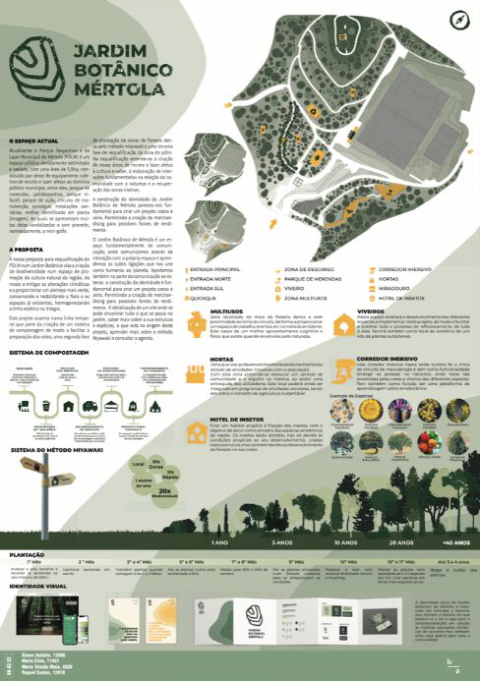
Team 11 conceived the conversion of a leisure and sports park, on the out- skirts of the town of Mértola (55,000m2, between 50 and 85m in altitude, about 1km from the valley of the Guadiana River) into a public botanical garden (Figure 11). The design proposal transforms the currently underused park, keeping its central facility, the football field, into a forested park of native and adapted species. The conversion follows the botanic Miyawaki methods along two to three decades of different phases of plant installa- tion and growing. This design proposal aims the human-induced formation of a green oasis within a currently semi-arid urban area and the elevation of outdoors comfort. The expected long-term results are an increase in the local vegetation and fauna, the creation of local jobs (keeping and using the garden), to bring visitors, be a live example of regenerative practices.
DISCUSSION
The D4S-M generic guidance were two-fold: a) intensifying the flow of peo- ple in the territory and, b) promote the relationship between people and the local natural environment. The characteristics of the resulting design proposals support the conjecture that those two guidelines are closely inte- rconnected once the quality of life of the community improves with the elevation of the physical and environmental qualities of the territory because this brings more people to visit and stay in the territory.
The set of design proposals resulting from D4S-M contribute to enrich- ing knowledge on the design for social innovation area. All of them, despite their diversity, are oriented towards meeting social goals. Even the designs proposals of green spaces were shaped to favor the stir and nourishment of interpersonal relationships.
Most of the proposals fall within the scope of collaborative service design, where the primary focus is on interpersonal development and the constru- ction of social fabric, although each solution has their specific and distinct objectives. From the diverse characteristics of those proposals, we were able to arrange them in three clusters. In this first cluster (named people/people) we gathered the 2-Culture Mobile Unit; 3-Look at Mértola; 4-Around the Oven. Taste of Knowledge; 5-CALMértola Project and 10-Listen the people’s village.
A second cluster (named people/digital platform) includes solutions that promote the diffusion of the local culture through the creation of a technolo- gical interfaces, joints two proposals: 5-Dissemination of the Food Network with Local Agroecological Production, and 6-Intangible Heritage Mértola’s Center.
The third cluster (named people/green space) gathers the proposals devi- sing green spaces or the expansion of green areas: 1-Àgora; and 8-Mértola’s
Design Strategies for Socio-Environmentally Adverse Territories 235
Environmental festival, 9-Co-creation Green Area, and 11-Mértola’s Botanic Garden.
It should be noted that the most innovative proposals, from the teacher’s assessment point of view, are those in which multidisciplinary really worked at the highest level inside the design teams, either because the student’s previ- ous education was the most disparate or because they were able to interview and investigate a wide variety of sources.
During the course of D4S-M several limitations were detected and unso- lved, namely: 1) how to involve the main local stakeholders in the design process and how to collaborate with the different stakeholders across the project; 2) how to communicate the project in order to find a motivating narrative and simplify all the inherent complexity of these processes; 3) how to overcome the fear of failure due to the impossibility of mastering and dee- pening all the issues of the project; 4) how to design flexible services and systems, leaving room for the implementation to be adapted and integra- ted by the local population and, at the same time, preserve the robustness, soundness and orientation of the initial proposal.
The quality and reach of the D4S-M proposals are also due to the Mértola City Hall’s particular disposition of 1) understanding the urgency and buil- ding policies tuned with the UNSDG, 2) promoting the dialogue and acting as facilitators among local stakeholders for D4S-M research, and 3) supplying data and providing logistical support for field work. According to the preli- minary assessment made by local D4S-M stakeholders, our design proposals are a) concurrent and or intersecting the strategies of the local municipalities and b) useful tools for the visualization of the ideas by the local population, and for the engagement of people on decision processes. The future develo- pment of this program requires the implementation of some of the proposals on the ground. The challenges that arise are dependent on the agency of the local players to implement the prescribed or similar solutions. On the acade- mic side, the concern is on how to motivate students or alumni to assist the implementation of that solutions.
CONCLUSION
The experience of joining academia and a local municipality in an endeavor to development urgent proposals prone to retard the progression of long-term human and environmental desertification processes in low density territories suggests that the innovation historically and conventionally associated with private entrepreneurship is not available anymore in such spaces. At least not in modes vital enough to halt the demographic loss or to expand the conveniences that nurture the desirability of those territories.
To preserve the sustainability of human presence in such geographic situa- tions demands an innovation of a different type. Local municipal authorities can assume the role of drivers of that unconventional innovation that wea- ves: the societal creative resources that still exist on the territory, the re-use of unused facilities existing on their realm, the reinforcement of convivia- lity, cultural activity and social support among the actual inhabitants and the exploration of the uniqueness of the regional material, intangible, and
236 Vasconcelos and Cruz
natural heritages. Such innovation, away from the conventional economic approach, might generate flows of people entering and exiting the territory that keeps a level of instant-population above the bare minimum needed to make the territory desirable for both permanent and temporary inhabitants. This might stop the demographic drain.
In hot semi-arid locations, the regeneration of soil, the expansion of vege- tation and the adoption of parsimonious uses of water seem to be mandatory ingredients of that innovation needed for the persistence of human presence. Under such environmental adverse condition, the expansion of the vegetation can only be localized and achieved with intense human labor.
The current Mértola experience suggests that the work methodologies adopted by the design for sustainability approach are prone to the produ- ction of design proposals within the frame of the unconventional innovation required by low density territories. Such proposals are, according to the local authority’s opinion, likely to kindle positive social innovation on the communities that inhabit such territories. The observation of the student’s behavior and output along this experience demonstrates that bringing exo- genous agents (students) into the investigation of a real context (Mértola county) that is significantly diverse from their everyday habitat fosters the generation of design proposals that amalgamate local resources in unimagi- nable ways for local people. This sounds the “fresh eyes approach” thesis. Or, otherwise, the freshness required to untangle old unsolved problems with new tools.
Our applied experience generated eleven design proposals that, despite their individual diversity, are all aligned with the goals of increasing peoples quality of live through mundane innovations as: outdoor facilities that pro- mote the informal meetings of neighbors (1-Àgora, 2-Culture Mobile Unit, 3-Look at Mértola, 4-Around the Oven. Taste of knowledge, 9-Co-Creation Green Area, and 10-Mértola’s Botanic Garden), facilitate walk, being out- doors and increase physical comfort (1-Àgora, 9-Co-creation Green Area, and 11-Mértola’s Botanic Garden) expand cultural and recreation liveliness (1-Àgora, 2- Culture Mobile Unit, 4-Around the Oven. Taste of Know- ledge, and 8-Mértola’s Environmental Festival), facilitate the permanence and installation of foreigners (3-Look at Mértola, 6-Intangible Heritage Mér- tola’s Center, and 7-CALMértola Project), deepens the knowledge about real people’s aspirations (10-Listen the People’s Village) and promote the dissemi- nation of routines tending to increase flora and judicious water use (1-Àgora, 5-Dissemination of the food network with local agroecological production, 8-Mértola’s Environmental festival and 11-Mértola’s Botanic Garden). The products of the design for sustainability perspective seem apt to improve the usability and desirability of low-density territories. The in-situ materialization of those outputs and the follow up of their performance along time, namely using the satisfaction of inhabitants and the demographic evo- lution as measurement gauges, will demonstrate their de facto capacity to improve people’s lives.
Design Strategies for Socio-Environmentally Adverse Territories 237
REFERENCES
Campos, Alexandra (2021, December, 24). Portugal volta a ter saldo natural negativo com ‘recorde histórico mínimo’ de nascimentos. Público. https://www.publico.pt/2021/12/24/sociedade/noticia/portugal-volta-saldo-n atural-negativo-recorde-historico-minimo-nascimentos-1989808, Retrieved February 5, 2022. Design Council (nd): What is the framework for innovation? Design Council’s evo-
lved Double Diamond. https://www.designcouncil.org.uk/news-opinion/what-fra mework-innovation-design-councils-evolved-double-diamond, Retrieved Febru- ary 5, 2022. INE Statistics Portugal (2022). Population statistics. https://www.ine.pt/xportal/xma in?xpgid=ine_main&xpid=INE- Retrieved February 5, 2022. Jégou, F., & Manzini, E. (2008). Collabotative Services. Milan: Edizioni Poli.Design,
pp. 27–31. Manzini, E. (2015). Design, When Everybody Designs. MIT Press, p. 11. Neves, P. (2021). Smart and Sustainable Cities, Como Localizar os ODS. In L. M.
Martins (Ed.), Sonhar, transformar Cidades e Territórios (pp. 73–103). Territórios Criativos Penin, L. (2018). Designing the Invisible. An Introduction to Service Design. London, New York: Bloomsbury, p. 109 Pordata (2022). Base de Dados Portugal Contemporâneo. https://www.pordata.pt/T
ema/Portugal/Populaç~{a}o-1. Retrieved February 5, 2022. Stickdorn, M., & Schneider, J. (2011). This Is Service Design Thinking. New Jersey: Willey. United Nations (2015). Transforming our world: the 2030 Agenda for Sustainable
Development. https://sdgs.un.org/2030agenda. Retrieved February 5, 2022. Vasconcelos, A. T. ; Porto, R. G. (2019). O Design para a Inovação Social e a Criatividade na Promoção dos Objetivos de Desenvolvimento Sustentável. In J. Lopes, Marcelino; Oliveira, Gabriela; Perreira (Ed.), As Artes na Educação Especial. Teorias, Metodologias e Práticas Sociais, Culturais e Educativas para a Inclu- são Cultural, pp. 165–174. Chaves: Cultural, Intervenção - Associação para a Promoção e Divulgação. Vasconcelos, A. T. (2021). Design para afectividade. Agenda Mértola Cultura.
Câmara Municipal de Mértola. Wilson, Davies. (2015). Design methods for developing services, An introduction to service design and a selection of service design tools. Design Council. Retrieved from, https://www.designcouncil.org.uk/sites/default/files/asset/document/Design methodsfordevelopingservices.pdf
LISTED IN THE AHFE DIGITAL BOOKSTORE CATALOGUE
Explore the complete digital volume
Human Dynamics and Design for the Development of Contemporary Societies
Read this individual research paper free through the original publisher, or explore the full digital proceedings book.
ISBN 978-1-958651-01-8
Explore this ISBN in the AHFE Bookstore ↗Listed in the July 2026 bookstore catalogue; search by ISBN to confirm current availability · Digital book purchase optional