Tingyu Yang, Qian Ji, Yekai Wei, Chanchan Yao (2022). ‘Quick Charge’ Optimization Design and Service Practice for Campus Charging Piles. In: Human Dynamics and Design for the Development of Contemporary Societies. AHFE Open Access, vol. 25, pp. 391–398. https://doi.org/10.54941/ahfe1001413
Recently, with the expansion of campuses in China, school buses separately cannot meet the needs of students for daily travel. Electrical vehicles have been favored by students contributing to their environmental, convenient, and economical characteristics in their daily life, consequently, related problems emerged. It is considered that the charging of electric vehicles is inconvenient, unsafe, unclear payment details, mainly because of limited sites, lack of maintenance, and site occupancy. In addition, there are certain limitations and backwardness in the payment method of existing charging piles. Students cannot query and manage the charging status of their vehicles in real time. Therefore, it is significant for us to construct and improve electric vehicle charging facilities for better campus environment.Purpose: From the perspective of service design, a solution for the existing problems in the electric vehicles charging piles on campus in China is proposed to facilitate the daily life of teachers and students on campus.Method: Taking the campus of Huazhong University of Science and Technology as an example, the statistics of existing charging piles are collected to enrich our understanding of the pile distribution on the campus, deeper information are excavated via stakeholder interviews in the statistics. After the interview, questionnaires are designed and relevant user role cards are established. Service design related analysis methods: visual analysis by establishing user journey maps, service blueprints, sand table models, role playing, etc. The contact points are discovered to construct the service system design.Conclusion: We demonstrated the ‘instant flash charge’ service scheme, plan the service blueprint, and design the relevant service vouchers. Users can instantly receive convenient charging services through the APP. Operators can also detect the usage status on the back-end computing modules, check and repair the broken charging piles in time, and finally provide users with a complete and smooth charging service.
*Supported by a grant from the Natural Science Foundation of Hubei Province, China (2021CFB318). Supported by a grant from the Seed Foundation of Huazhong University of Science and Technology 2020kfyFPZX003).
In recent years, as schools have expanded, school buses alone are not enough to meet the daily needs of students commuting from west to east. The electric bicycle because of environmental protection, convenient, economic characte- ristics, has been favored by students, but also some problems. At present, students feel that electric bicycle charging is not convenient, unsafe, fee payment details are not clear. Charging piles have been installed in some dormitory areas, but the stations are limited, lack of maintenance, and are occupied by other vehicles that do not need charging, making it difficult to find charging piles and parking vehicles. In addition, most of the ele- ctric bicycle in the school require unified charging in the parking shed and consumption by swiping cards, so there are certain limitations and backw- ardness in the way of payment. As the charging equipment is not connected to the Internet, students cannot query and manage the charging situation in real time. Therefore, the construction and improvement of electric bicycle charging facilities are becoming more and more important.
FIELD RESEARCH The research site was Huazhong University of Science and Technology (Yan Jiaqi, 2021). The campus is divided into east, central and west areas. Specific research points include: (east area) under each dormitory building in Yun- yuan, carports, service area, behind the apartment building for international students, and eastern dormitory for staff (with charging piles downstairs); (Central) the socket of the security room of the building, the market repair shed (with quick charging piles), Qinyuan charging pile shed the charging pile shed of Qin Yuan, doctoral student apartment, international student apartment; (West) building entrance, Zisong (building 2, building 1 with charging device behind), Western Dormitory International Student Doctoral apartment.
Charging piles in the west campus are scattered, in front of the Zisong, experimental building and teaching building, but the number is small and it is difficult to find them (compared with the number of people and the num- ber of people with electric bicycle). Charging piles in the middle campus are widely distributed, but the number is relatively small, mainly distributed in the market and the door of the mail room, resulting in very inconvenient char- ging. Charging piles in the east campus are mainly distributed downstairs in dormitories, and there are charging piles in every dormitory building. There are also charging piles behind Yunyuan canteen and in places where cars are sold (Wang Zhan, 2015).
USER RESEARCH AND PAIN POINT ANALYSIS We found and interviewed four stakeholders (Gong Miaosen, 2011). At the same time, in order to better understand the students’ requirements and pro- blems of charging piles, we based on the observations of some phenomena and our actual experience, design a “charging pile use status investigation questionnaire”, we issued questionnaires through many social platform to
‘Quick Charge’ Optimization Design and Service Practice for Campus Charging Piles 393
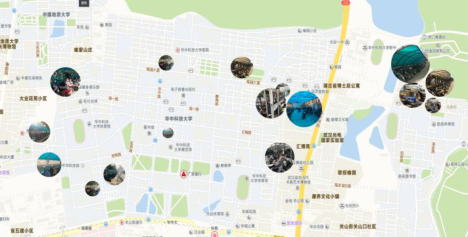
Figure 1: Distribution dynamics of campus charging piles.
the students of Huazhong University of Science and Technology, we collected the initial data of using electric bicycle charging piles. Through the analysis of the questionnaire results, we conducted field investigations on the use of charging piles in schools at several different times, to verify whether all the questions in the questionnaire are aspects that need to be improved. Through some methods of work research, the direction of our research optimization is given (Fu Lianqun, 2016).
According to the survey, we concluded the main pain points at present: there are few charging piles on campus, and many areas have not installed charging piles or the number of charging piles does not meet the requirements (including teaching, dining hall and library); Many electric bicycle park in the position of charging pile but do not use the charging pile, resulting in the idle charging pile and so on; electric bicycle have a certain weight, for girls and managers have a certain difficulty to move; Users do not know where there are charging piles that can be used, so it takes a lot of time to find them and consume a lot of time and energy. The position of charging piles outside the dormitory area is not obvious and difficult to find. It is impossible to judge whether the charging pile is good or bad. It takes time to determine whether it can be used after testing (see Fig. 1).
At the same time, there are some other problems in the campus charging piles, such as the low level of text visualization: users need to read a lot of text for the first time, which makes them impatient. There is no English sign in the international student office, so it is difficult to understand how to operate. There is no security office or phone number of logistics mainte- nance personnel in the charging office, so charging and maintenance are not guaranteed.
The research objects are students who use these charging piles to charge or park and the whole parking and charging system of electric bicycle. User behavior process: (1) search. Refers to from the first turn into the system, to find the charging pile can stop to charge; (2) Stop. Refers to the beginning of a search to complete parking to complete parking; (3) Plug in. Refers to the process from the completion of the stop to the completion of the plug; (4) Swipe the card. It refers to the process of inserting the plug, walking to the place where to swipe the card, and returning to the charging pile for inspection.
Through the stopwatch, we get the average time of each operation process. By observing the process and time, we can find that time is mainly spent in the steps of searching, parking and swiping the card. Therefore, we should focus on reducing the difficulty of searching, reducing the difficulty of parking and optimizing the process of swiping the card in the future.
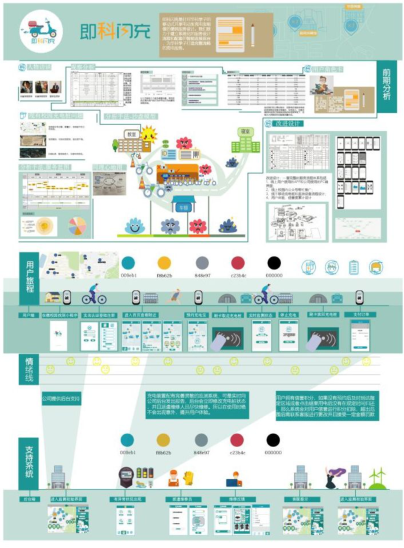
USER NEEDS ANALYSIS In the research process, we create user role cards, use the relevant analysis method of service design to establish user travel chart, service blueprint, sand table model, role play and other visual analysis, find out their contact points, and design a service system for them.
DESIGN THOUGHTS After analyzing the problems through service blueprint, empathy map, sand table simulation and other methods, we conducted field research again (Yu Senlin, 2008). This survey is mainly to understand the ratio of an ele- ctric bicycle to charging piles, and then redesign the demand for the number of collective charging piles.
According to our statistics, there is a serious imbalance between the num- ber of electric bicycle and the number of charging piles, and the number of charging piles is even less than 10% in places where there are many cars. There are also problems such as damage to charging piles and space taken up by other electric bicycle. Therefore, in the design of integrated charging piles, the most important consideration is how to reduce their time ratio and optimize management.
Therefore, our design goal is to design the contact point service system – optimization design of online and offline campus charging system.
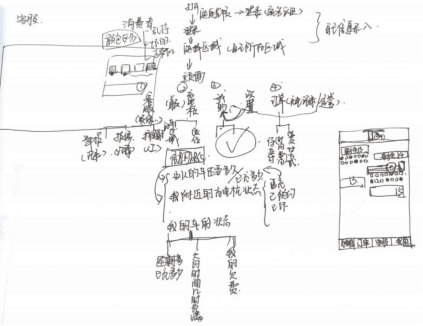
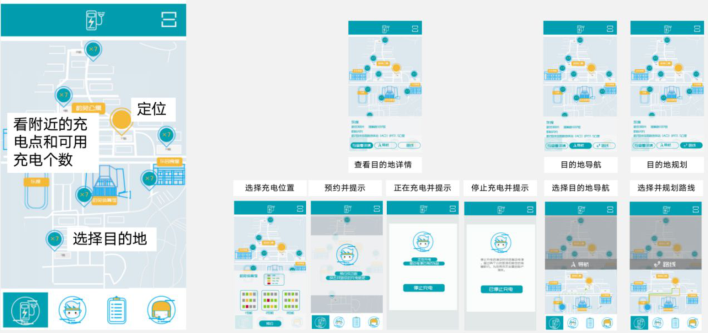
DESIGN SKETCH The online APP design scheme is Ji Ke Flash Power (see Fig. 2). “Ji” means “Instant”, we can provide charging service for you in time when you need service. “Ke” means “Huazhong University of Science and Technology”. Ji Ke Flash Power is a small program on campus, which is a mobile shared char- ging pile exclusively for students. We provide mobile shared electric bicycle charging service for teachers and students. Usage Guide: Process guide on how to use APP and mobile charging bank correctly. Description of rent: the minimum charge is RMB 2 yuan. You can check the description of rent after paying the rent. Customer service: systematic service design, to provide con- sumers with optimized services. Charging piles interface: Login registration page, you need to register an account when entering the APP for the first time. Fill in personal Information: Verify personal information using your real name.
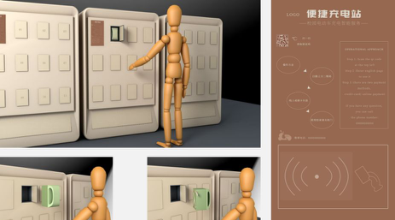
The offline entity interaction design scheme is the charging pile equipment model design. After making an appointment, place the campus card in the induction area of the machine, then open the door of the appointment cabinet and take away the charging bank for charging (see Fig. 3). Just click the end
‘Quick Charge’ Optimization Design and Service Practice for Campus Charging Piles 395
Figure 2: The sketch analysis.Figure 3: Introduction to charging pile interface.
of charging on the mobile phone to return the card. There is a fixed device at the bottom of the charging bank to prevent it from slipping off during cycling.
Figure 4: Panel display.
FINAL DISPLAY ‘Quick Charge’ is a charging rental device provided by enterprises. Users need to scan the QR code to register for use. After the use is completed, the user pays the fee according to the corresponding situation. After scanning the QR code, users can borrow a power bank with a deposit of more than 600 points of Sesame Credit; users with less than 600 points of Sesame Credit need to pay a deposit of RMB 29 yuan. After the power bank is used, the deposit will be automatically returned. The shared charging treasure is charged for more than one hour for 1 hour, and the fee is calculated as RMB 1 yuan/h- our for less than one hour. Scan the code - register - pay - lend, generally
‘Quick Charge’ Optimization Design and Service Practice for Campus Charging Piles 397
Figure 5: Panel display.
it takes about 2-3 minutes for users to use it. After the use is complete, the user can use GPS positioning on the official account platform to return it to the nearest location. Mobile sharing in mobile mode: This mode focuses on large scenarios, that is, both people and charging devices can be moved. For example, if a user borrows a power bank at Site A, it can be returned at Site B. Such large scenes include hospitals, shopping malls, railway stations, high- speed railways and other places with high traffic. Mobile sharing in fixed scenes: This mode focuses on small scenes, including bars, restaurants, etc. 1. The generation of rental fees for shared power banks. 2. Share the adverti- sing space of the charging treasure body. Since the charging treasure is in the hands of the user for a long time, the user is likely to see the advertisement and consume it. 3. The advertisement of the shared charging treasure cabinet can be placed on the side and screen of the cabinet box. 4. The advertisement after sharing the power bank link, that is, after the mobile phone is connected to the shared power bank, an advertisement will pop up for 1-2 seconds. It can be seen that the profit of ‘Quick Charge’ is still quite considerable (see Fig. 4).
The main contents of the exhibition board include the final effect drawing of the product, the visualization of the user’s process of using the charging device, and the scene simulation drawing (see Fig. 5).
CONCLUSION
In the case of shared bikes, we can see that shared goods still have great development potential. Shared bikes are to meet the needs of people to ride
for a short distance, shared charging banks are to satisfy the needs of people’s mobile phones for a long time, and shared cars are to meet the needs of people to rent cars in other provinces. However, shared charging piles aim to meet users’ cycling needs in a diversified way. For current users, most of them have their own electric bicycle and want to have them for a long time. They are not satisfied with the randomness and uncontrollability of shared electric bicycle, so we can solve this problem well.In the future, we expect to achieve the popularization of shared charging pile devices on campus.
Shared charging can meet the diversified needs of users and has great convenience and overall optimization of service process.So the overall process is very innovative and achievable.If the project can be promoted in the future, it will improve the overall experience of both the community and users.
REFERENCES
Yan Jiaqi, Ning Fang.Design and research of unmanned express delivery system based on service Design concept [J]. Industrial Design, 2021(11): 121–123. Wang Zhan. Research and Practice of Service Design Based on Service Blueprint and
Design Experience [J].Packaging engineering, 2015, 4 (12): 41–44 + 53. DOI: 10.19554/j.carol carroll nki.1001-3563.2015.12.011. Gong Miaosen, XIE Chenchen, Dong Yumei.Design for Chinese Social Innovation: A Preliminary study on sustainable lifestyle and Product service system design [J]. Creativity and Design, 2011(05):18–23.] Fu Lianqun, Wang Guosheng.Industrial Design,2016(05):63–64. Yu Senlin. New Idea of Design: Service Design – Taking community clothing cle-
aning Service design as an example [J]. Decoration, 2008 (10): 80–81. DOI: 10.16272/j.carol carroll nki cn11-1392/j.2008.10.045.
LISTED IN THE AHFE DIGITAL BOOKSTORE CATALOGUE
Explore the complete digital volume
Human Dynamics and Design for the Development of Contemporary Societies
Read this individual research paper free through the original publisher, or explore the full digital proceedings book.
ISBN 978-1-958651-01-8
Explore this ISBN in the AHFE Bookstore ↗Listed in the July 2026 bookstore catalogue; search by ISBN to confirm current availability · Digital book purchase optional