Rodrigo Morais, Jo Ribeiro (2022). Identity Design: A Procedural Approach for the Ideation, Construction, and Analysis of Logos. In: Human Dynamics and Design for the Development of Contemporary Societies. AHFE Open Access, vol. 25, pp. 128–134. https://doi.org/10.54941/ahfe1001380
1 Universidade Europeia, IADE, Faculdade de Design, Tecnologia e Comunicação, UNIDCOM/IADE, Unidade de Investigação em Design e Comunicação, Av. D. Carlos I, 4, 1200- 649 Lisboa, Portugal ↗
2 IADE – Universidade Europeia Lisbon, 1200-649, PT, Portugal ↗
The present research focuses on the analysis and later proposal of a logo's ideation, construction, and interpretation process. To fulfill this objective, the concepts and methodologies of graphic design and brand identity were collected to support the function and classification of a logo. However, this is not a closed model, being just an indication that can contextualize and guide professionals in their creative process in developing a logo.
Effective visual identity and coherent communication strategy generate value for the brand in the consumer’s mind (brand equity). Brands and desi- gners focus on visual identity to become more relevant and communicative (Munari, 2006). Thus, the design here does not assume a purely visual or aesthetic factor, but a tool aimed at generating value that differentiates and drives the brand when well-constituted, an idea reinforced by Gardner (2013) since in this scenario, the logo cannot just exist, having to act as an exceptional agent that breaks the static and boosts its value.
Having identity design as an essential purpose within the communication and identification of a brand, together with the understanding that it is pos- sible to be more impartial and analytical when developing a logo from its composition, this research aims to understand and propose a process for the ideation, construction, and analysis of logos, which delimit and indicate each moment of the project, thus facilitating its adoption and application.
LITERATURE REVIEW ON LOGO DESIGN With the studies present in the research Semiotics of the brand (Coelho, 2013), the author analyzed more than 50 brands present in the book Marks of Excellence (Mollerup, 1997), building and deconstructing them so that it
was possible, thus, to trace a model of interpreting free of partiality, provi- ding bases for the creation and analysis of graphic brands. Coelho concluded that the graphic marks portrayed by Mollerup that remained unchanged over time (or underwent few changes in their shape) had three characteristics in common, which make up the author’s proposal: groupings; activities; and concepts (Coelho, 2013).
In his book Rhetoric of Logos, Eduard Helmann (2017) presents the five essential components of any graphic brand and four attributes to analyze and interpret the final result, reinforcing the importance of an analysis free of personal tastes. The author is based on the effects of the aesthetic-formal and communicative aspect when using the concepts of classical rhetoric (logos, ethos, and pathos) and Matthias Beyrow’s (2013) relevance model to defend his ideas.
Lupton and Phillips (2008) present some of the fundamental concepts of design in the structure of the visual piece. It can be observed that the act of composing a piece uses several elements, however, and even if unconsciously, it will be up to the professional to provide themselves with the knowledge of the formal bases that will help in the rigorous composition of a logo: shape; space and volume; grouping principles (Gestalt); texture; color; composition, framing, and hierarchy; typography and archetypes.
Munari (2006), in the work Design and Visual Communication, focuses his study on the way visual elements are composed, both in their particular form and when combined with others of different particularities. Even with his studies focused on product design or real media (attributing here the real to the existing and the virtual to what is digital and seen through an interface), it is plausible to apply his theories to the scope of brand design since, as, like Lupton and Phillips (2008), the author touches on points regarding shape, color, texture, and visual interpretations.
In addition to the examples above, Helmann (2017) argues that a well- built visual identity will result from the detailed work of “five elements of corporate design”, emphasizing the importance of correlation to reinforce the value of the brand: grid and shape; typography; color; visual style; logo.
Authors such as Gui Bonsiepe (1965), Ellen Lupton and Hanno Ehses (1996), and Eduard Helmann (2017) are some of those who sought, from the concepts of rhetoric, elements of application to design and its communi- cation, so that such persuasive elements and understanding strengthened the area in search of better developed and defended projects. In identity design, it can be associated with the function of the logo since it will act as a repre- sentative and ambassador of a brand, focusing on the consumer by bringing about a change in behavior and opinion (Helmann, 2017).
Within the studies in design, Bonsiepe (1965) - when noting that rheto- ric is a natural element to communication and that visual language in the form of graphic design could use its principles to improve the way of tran- smitting messages - drew parallels of rhetoric in this area through image and text advertising. Helmann (2017), in addition to presenting the rhetorical instruments exposed above, also explores the stylistic instruments, separa- ted by colors, font, and typography. Also, according to Matthias Beyrow’s (2013) relevance model based on visual rhetoric, the logo can be divided into
130 Morais and Ribeiro
three categories (Beyrow apud Helmann, 2017, p. 104): presence; essence; reference.
Niemeyer (2007), through semiotics, provides concepts – like Helmann (2019) – that underlie the creative solutions that professionals can adopt when developing a visual element that will act as a logo. In this case, a previous associative study must be carried out, which will indicate which will be the most effective solution and capable of being recognized by the interpretant.
METHODOLOGICAL APPROACH This research will be supported by the strategy of triangulation of metho- dologies and references, which “appears as a way to alleviate problems of credibility in research, by adopting as an investigation strategy, multiple views and methods of obtaining information” (Azevedo, 2013).
It is known that identity design has two critical parts for its success: the strategy for capturing and interpreting information (called briefing) and its result, which will be the visual development of the brand. In this first moment, the concepts of Gui Bonseipe’s project methodology (1965) will be used to structure the reasoning to be developed by the designer to explore the precepts that will shape the logo.
In addition, different but convergent techniques will be analyzed to achi- eve the objectives proposed here: with the use of rhetoric as a strategic tool to compose the concept and the visual to be explored in the graphic brand (Hel- mann, 2017) together with the formal-structural analysis exercise proposed by Rita Coelho (2013).
This study seeks a synthesis of these values so that, once unified, they can bring greater clarity to the matter of logo design as a creative-rational develo- pment activity, providing readers with points to be analyzed and considered during the creative process as a whole.
Therefore, in a certain way, this research does not seek to build a metho- dology focused on logo design in the format of steps, but observations that professionals should keep in mind during their creative process and in the way they create. After all, as Munari emphasizes in his methodology, design is not limited to methods but open to processes.
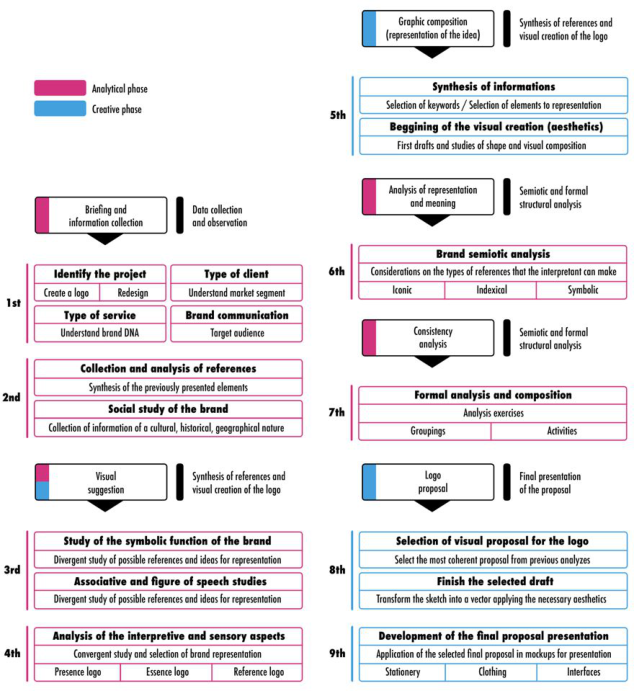
EXPECTED CONTRIBUTIONS Supported by the previously analyzed models of design methodologies, repre- sented here by Munari (2006), Bonsiepe (Siqueira et al., 2014) and Archer (Neves, 2017), as well as in the matter of logo design, with the bases of Coelho (2013), Helmann (2017) and Airey (2019), this proposal is divided into two general phases that are part of the entire process: the analytical phase and the creative phase, present in the four macros central moments: (1) data collection and observation; (2) synthesis of references and visual creation of the logo; (3) semiotics and formal structural analysis; and, finally, (4) final presentation of the proposal. These, in turn, are subdivided into the steps to be followed: (1) briefing and collection of information; (2) visual
Identity Design: A Procedural Approach 131
suggestion; (3) graphic composition (representation of the idea); (4) analy- sis of representation and meaning; (5) consistency analysis; and (6) logo proposal.
This methodological process aims to offer an uncomplicated path for the visual development of a brand, building rational thinking fragmented betw- een moments of research (analytical phase) and development (creative phase) to facilitate what must be done at each stage and its details. Contributing to a more organized and, mainly, more rational project in terms of decision- making and creative paths to be followed, which, in a certain way, will result in more grounded graphic projects and a graphic brand that contains a strong emotional charge, which allows it to be filled with communicative and semantic power (Mollerup, 1999).
Once the general diagram of the methodological process and its function has been presented, these six steps must be detailed to understand what con- stitutes each of them. In addition, it should be considered that this process is based on the methodological concepts presented during this research, which will be applied here, directly or indirectly, since the purpose of this research is not to cancel or replace them but rather blend the points that make sense.
(1) Here, two analyses will be carried out to collect information. One focu- sed on the briefing and a candid discussion with the client, which will seek to identify the type of project, the type of client, the type of service the brand provides, its DNA, and the audience with which it communicates. “During the initial phase of the project, our main task is to ask the right questions and listen carefully to the client and, in some cases, the clients’ clients. It is necessary to distinguish between what the client thinks they need and what they really need” (Airey, 2019, p. 271).
(2) Once this information is captured, the designer starts their own resea- rch. Here, the collection of information is more focused on the environment in which the brand operates, understanding the cultural, historical, and geogra- phical scenario since this will influence the subsequent choice of associative elements, such as colors, shapes, or words, according to the method presented by Munari (2006).
(3) With the study in progress and using the mind map methodology along with the semantic connection for the chosen word, different elements can be associated that expand the associative levels. This step seeks to maximize the references that the designer will include in the project at this first moment and, thus, offer unprecedented solutions by joining two completely diffe- rent elements. Here, figures of speech can offer different perspectives on the same element since different ways of interpreting and idealizing its repre- sentation are different. This is when the symbolic function is applied to the project.
Even with this delimitation, associative studies can generate different insi- ghts, such as joining an animal silhouette to a letter forming a typographic mark with iconographic particularities. At this point, semiotics will be used with the association of one word to another through the composition of an icon, index, or symbol.
(4) Once the semiotic associations that the logo can present are made, this is the moment to converge the ideas, but with the use of a filter that is based
132 Morais and Ribeiro
on the type of representation related to the shape, being these three: Logos that create Presence – no directly represent elements associated with the com- pany, but are distinguished by color, shape, and weight; Logos that create Essence – converge with the company’s values, providing direct associative information to its area of operation; Logos that create Reference – generate associations that establish the values of other areas not directly associated with the company. Such concepts were presented by Helmann (2017).
(5) Here, the designer will synthesize all the information collected above and, when selecting what can be considered associative keywords and the type of function of the logo, will start their drafts, seeking visual coherence in the shapes and composition. In this step, the Aesthetics function is applied to the project.
(6) At this moment, with some draft proposals already developed, the desi- gner must analyze them from the point of view of interpretation through semiotics before proceeding with the project, seeking to understand what associations can be made by the interpretant so that communication is more effective and there is no noise when associating such an image with the brand. The visual representation of the logo can work as an iconic, indexical, or even symbolic associative element and this analysis can generate new drafts and, therefore, new values to add or translate the brand.
(7) Once the brand is well defined within its interpretation, it is neces- sary to analyze the logo as its composition, aiming at a coherent final shape that brings an easy reading to the observer, in favor of visual synthesis, a characteristic associated with the Grouping character. At this point, the method proposed by Coelho (2013) is applied as an instruction to seek to simplify the developed brand. Also, within the classifications of Groupings and Activities, the author recommends that the shape has a maximum of 7 Groupings, while Activities should not exceed the limit in which its use becomes noisy. “Brands show this resumption of a more refined, leveled geometry that reduces excesses of details” (Coelho, 2013, p. 112).
(8) Finally, after the previous analyses, it remains for the designer to select which would be the best proposal developed to complete it. At this stage, the development of the logo within the software takes place and leads to the application of colors and effects (which must be analyzed when studying the visual suggestion).
(9) Once the brand has been developed, the professional must know how to present the project to the client. This research does not seek to go into this detail. However, it is worth mentioning the importance of using images (mockups) that contextualize and represent the brand in environments and coherent means for its use, whether physical or digital. This is a detail that may influence how the client analyzes the whole and the acceptance of the proposal.
With the steps presented above, the methodological process for identity design development seeks to guide professionals in their research and creation moment. In addition to a well-founded project, it supports its justifications in its presentation.
Below is the diagram (Fig. 1) of the methodological process proposal:
Identity Design: A Procedural Approach 133
Figure 1: General presentation of all points of the systematic model for creating a logo.
CONCLUSION
This attempt to propose a linear process for the development of a logo must take into account that often the initial stages of research will depend on the person who intends to develop the brand, in this case, the client, who may present information that may not contribute fully to the project. The pro- fessional’s role is to guide them with questions that will serve as a basis for the subsequent exploratory phase. Therefore, the proposed procedural logic must adapt to each situation and not be seen as a closed model, understan- ding that, sometimes, it will be necessary to add new steps or regress if the solutions found are not under the procedure’s scope.
Concerning the limitations of this investigation, one can consider exploring the development of the brand as a whole, and not just its logo, since future investigations may refine the procedural model, reflecting a deeper analysis of the content present in each step, establishing and better understanding the elements to be analyzed more objectively during the process, leaving it more detailed in its function as a guide. At the same time, new studies may consider other steps as a methodological process for developing the logo design and the bases used in its interpretation.
134 Morais and Ribeiro
ACKNOWLEDGMENT
This study was supported by UNIDCOM under a Grant by the Foundation for Science and Technology (FCT) No. UIDB / DES / 00711/2020 attribu- ted to UNIDCOM / IADE - Research Unit in Design and Communication, Lisbon, Portugal.
REFERENCES
Airey, D. (2019). Identity Designed: The Definitive Guide to Visual Branding.
Rockport Publishers Inc. Azevedo, C., Oliveira, L., Gonzalez, R., & Abdalla, M. (2013). A Estratégia de Triangulação: Objetivos, Possibilidades, Limitações e Proximidades com o Pra- gmatismo. IV Encontro de Ensino e Pesquisa em Administração e Contabilidade. Brasília – DF. Disponível em: http://www.anpad.org.br/admin/pdf/EnEPQ5.pdf. Beyrow, M., Daldrop, N. & Kiedaisch, P. (2013). Corporate Identity & Corporate
Design das Kompendium. Ludwigsburg: aved. Bonsiepe, G. (1965). Education for visual design. New York: Allworth Press. Coelho, R. (2013). Semiótica da Marca: Contributos para a construção de uma sintaxe e retórica visual na prática do design de identidade. [Tese de Doutora- mento, Faculdade de Belas Artes da Universidade do Porto]. Repositório Aberto. https://repositorio-aberto.up.pt/handle/10216/71966 Gardner, B. (2013). Logo Creed: The Mystery, Magic and Method Behind Designing
Great Logos. Rockport Publishers. Helmann, E. & Switzer, B. (2017). Rhetoric of Logos: A Primer for Visual Language.
Zurich: Niggli. Lupton, E., & Ehses, H. (1996). Rhetorical Handbook: An Illustrated Manual for Graphic Designers. Department of Visual Communication Nova Scotia College of Art and Design. Lupton, E., & Phillips, J. (2008). Novos Fundamentos do Design. São Paulo: Cosac
Naify. Mollerup, P. (1997). Marks of Excellence: The History and Taxonomy of Trademarks. London: Phaidon Press Ltd. Munari, B. (2006) Design e Comunicação Visual: Contribuição para uma metodo-
logia didática. São Paulo: Martins Fontes. Neves, A. (2017) Design Como Pensamento Uma breve história da metodologia de Design. [Trabalho de conclusão de disciplina de Mestrado em Design, Univer- sidade Federal de Pernambuco]. Acesso: https://repositorio-aberto.up.pt/handle/ 10216/71966. Niemeyer, L. (2007). Elementos de Semiótica Aplicados ao Design. Rio de Janeiro:
2AB. Siqueira, O., Cunha, L., Pena, R., Corrêa, B., A, Moacyr. (2014). Metodologia de Projetos em Design, Design Thinking e Metodologia Ergonômica: convergência metodológica no desenvolvimento de soluções em Design. Cadernos UniFOA, 1809–9475. Retirado em http://revistas.unifoa.edu.br/index.php/cadernos/article/ viewFile/1112/998
LISTED IN THE AHFE DIGITAL BOOKSTORE CATALOGUE
Explore the complete digital volume
Human Dynamics and Design for the Development of Contemporary Societies
Read this individual research paper free through the original publisher, or explore the full digital proceedings book.
ISBN 978-1-958651-01-8
Explore this ISBN in the AHFE Bookstore ↗Listed in the July 2026 bookstore catalogue; search by ISBN to confirm current availability · Digital book purchase optional