Irina Kurnikova, Shirin Gulova, Tatiana Nikishova, Nikolay Kislyy, Sofia Buturlina, Oksana Demina (2022). Frequency Indicators of Heart Rate Variability in Assessing the Effectiveness of Antihypertensive Therapy in Patients With Metabolic Disorders. In: Human Interaction & Emerging Technologies (IHIET-AI 2022): Artificial Intelligence & Future Applications. AHFE Open Access, vol. 23. https://doi.org/10.54941/ahfe100876
Introduction. Modern computer technologies that allow analyzing the dispersion of signals from biological objects significantly expand the diagnostic capabilities of medicine. Heart rate variability analysis (HRV) is a very promising technology that allows us to evaluate not only the function of the cardiovascular system, but also the state of the mechanisms of autonomic regulation (AR) in general. Purpose: to identify the relationship between the initial autonomous status and the effectiveness of the use of antihypertensive drugs (AHT) in patients with metabolic disorders by comparative analysis of HRV. Materials and methodsThe study included 87 patients with diabetes (DM) and arterial hypertension (HTN). Clinical examination included metabolic status, hemoglobin A1c. 49 people (observation group - 1) had unsatisfactory glycemic control (HbA1c=11±3.1%), including 19 patients (32±6.7y.) with type 1 diabetes-DT1 (1а) and 30 patients (52±7.1y) with type 2 – DT2 (1b). The comparison group (2) included 38 patients with compensated diabetes (HbA1c=6.2±4.3%), 22 people had DT1– 2a (29.5±4.9y.), 16 - DT2 – 2b (55±4.4y.). As AHT, patients took moxonidine (0.2-0.4 mg/day). Holter ECG monitoring complex "Valenta"MN-08 (Russia) with a set of computer programs. The HRV spectral analysis: total power of the frequency spectrum – TC (ms2); LF (%) - the low-frequency component - waves of 0.04-0.15 Hz (reflects activity of the sympathetic system); HF (%) - high-frequency waves from 0.15 to 0.40 Hz (activity of the parasympathetic nervous system at the segmental level); ULF (%) - ultra-low frequency - waves up to 0.0033 Hz, (activity of the higher centers of HR regulation); VLF (%) – very low frequency - 0.0033-0.04 Hz (functional state of suprasegmental structures). Index of Centre (IC) - ratio of the activity of the central regulation loop to the autonomous = (LF+VLF)/HF; Index vagosympathetic balance (IVB) – ratio LF/HF.Results.There were significant changes in HRV, but the direction and severity of disorders in different types of DM was not the same. IC in patients with DT2 was low - 1.19 ± 0.08, which is possible only with a pronounced disturbance of central and autonomic links of HR regulation. The power of the low-frequency (LF-24.2±2.1%, VLF-23.4±3.7%, ULF-30.8±8.4%) prevailed over of HF-21.6±2.9%, which is characteristic of disruption of AR. Group 1a didn’t affect IC (1.32 ± 0.17), but was accompanied by decrease of TC, the predominance of ULF-36.5 ± 11%, VLF-33.9±4.7%, LF-17.4 ± 6.9% over the high-frequency (HF-11.7 ± 1.5%). LF/HF was higher than the average, confirming hypersympathicoton. Autonomous imbalance was observed in 1b, but against the background of increased activity of the parasympathetic nervous system (LF/HF=0.86±0.07). Pronounced clinical efficacy of moxonidine was observed in 92.7% of patients 2a regardless of compensation and 87.5% - 2b. After the appointment to group 1a, TC increased, which indicated the restoration of autonomous balance. The HF increased (18.4±1.9%) and LF/HF normalized - 1.23±0.14. VLF decreased, LF and ULF didn’t significantly change. The clinical efficacy of moxonidine in monovariant didn’t exceed 46.7% and combination therapy with other pharmacological groups was required. Conclusion. Insufficient effectiveness of therapy in patients of this group was associated with pronounced changes in autonomic regulation.
Modern computer technologies that allow analyzing the dispersion of signals from biological objects significantly expand the diagnostic capabilities of medicine. Heart rate variability analysis (HRV) is a very promising technology that allows us to evaluate not only the function of the cardiovascular system, but also the state of the mechanisms of autonomic regulation (AR) in general. The technique is important for obtaining information not only from healthy subjects, but also from patients with impaired function of regulatory mechanisms, for example, in patients with diabetes complicated by cardiac autonomic neuropathy (CAN). Registration of electrical potentials with subsequent computer processing allows you to see the structure of the received signals both in absolute values (time domain) and in relative values (frequency spectrum). CAN is a frequent complication of diseases with impaired metabolic processes, which leads to abnormal reactions to various, including drug effects. Modern computer technologies that allow analyzing the dispersion of signals from biological objects significantly expand the diagnostic capabilities of medicine (Vinik et al., 2013; Dimitropoulos et al., 2014; Tang et al.,2014; Balcıoglu and Muderrisoglu.,2015). The efficacy of moxonidine in patients with CAN was studied depending on the state of metabolic compensation, vegetative equilibrium and adaptive capabilities of the body of a DM patient.
PURPOSE The core challenge is identify the relationship between the initial autonomous status and the effectiveness of the use of antihypertensive drugs (AHT) in patients with metabolic disorders by comparative analysis of HRV. The efficacy of moxonidine in patients with diabetic cardiac autonomic neuropathy (CAN) was studied depending on the state of metabolic compensation, vegetative equilibrium and adaptive capabilities of the body of a DM patient.
Design The study was conducted in RUDN University (Moscow) - based on the Endocrinology Department of City Clinical Hospital. A.K. Eramishantseva (Moscow) from 2017 to 2018. The study included 87 patients with diabetes (DM) and arterial hypertension (HTN). Clinical examination included metabolic status, hemoglobin A1c and blood lipid spectrum. Of the examined 49 people (observation group 1) had unsatisfactory compensation for DM (HbA1c=11±3.1%), including 19 patients (average age - 32±6.7g) with type 1 diabetes (group 1a) and 30 patients (average age - 52±7.1g) with type 2 diabetes (group 1b). The comparison group (2) included 38 patients who achieved glycemic control targets (satisfactory diabetes compensation) (HbA1c=6.2±4.3%), of which 22 people (diagnosis of type 1 diabetes) was made – group 2a (average age - 29.5±4.9), in 16 people - type 2 diabetes - group 2b (average age - 55±4.4). The ratio of women and men in both groups was approximately the same and corresponded to the indicator 2:1. As antihypertensive therapy (AHT), patients took moxonidine at a dosage of 0.2-0.4 mg / day. The compliance of the study with the norms of biomedical ethics was confirmed by the conclusion of the Ethics Committee of the Medical Institute of the RUDN University (Moscow,Russia) - Protocol №. 9 of Marth 17, 2016. Participants were fully acquainted with the objectives of the study, its importance, and the method of selecting participants, the right to refuse to participate at any time, the benefits and risks of the study.
Instruments and data collection procedure Glucose level was controlled according to WHO recommendations: Glucose profile; Glycated Hemoglobin (HbA1c). Criteria of compensatory DM were determined according to European Association for the Study of diabetes. Holter ECG monitoring complex "Valenta"MN-08 (Russia) with a set of computer programs. After computer analysis of the results of daily heart rate monitoring, the report included indicators of the circadian index (CI), the average value of the heart rate during the day (H.Rd.med.), at night (H.Rn.med.), as well as the minimum and maximum heart rate values during the day (H.R.min; H.R.max). The analysis was carried out with the calculation of the power spectrum of slow oscillations in three frequency ranges: 0.004-0.08 Hz (very low frequencies - VLF); 0.09-0.16 Hz (low frequencies - LF); 0.17-0.5 Hz (high frequencies - HF). The evaluation of the indicators was carried out taking into account the absolute (MCP energy is measured in units of spectral power
Human Interaction & Emerging Technologies (IHIET-AI 2022) Artificial Intelligence & Future Applications https://openaccess.cms-conferences.org/#/publications/book/978-1-7923-8989-4 density - sec2 / Hz) and relative values of the power spectrum of each frequency range (VLF, LF, HF). The HRV spectral analysis: total power of the frequency spectrum – TP (ms2); LF (%) - the low-frequency component - reflects activity of the sympathetic system; HF (%) - high-frequency - activity of the parasympathetic nervous system at the segmental level); ULF (%) - ultra-low frequency - activity of the higher centers of HR regulation; VLF (%) – very low frequency - functional state of suprasegmental structures. Index of Centre (IC) - ratio of the activity of the central regulation loop to the autonomous = (LF+VLF)/HF; Index vagosympathetic balance (IVB) – ratio LF/HF. In our studies the analysis was carried out automatically. Methods of mathematical transformations with the subsequent physiological and clinical assessment of value of the received parameters were used for the analysis of variability. All patients also underwent daily monitoring of blood pressure (DMABP). According to the results of the DMABP, 4 groups of indicators were evaluated: time averages and their analogues (the level of systolic blood pressure - SBP, diastolic blood pressure - DBP, taking into account the time of day); pressure load indices (IA - area index, IT - time index); indicators of the circadian rhythm of blood pressure (DI - daily index); indicators of the variability of blood pressure (VSBP, VDBP) and additional indices (morning pressure rise rate – MPRR, the magnitude and speed of the morning rise of blood pressure - VUP and SKUP). The assessment of the daily heart rate variability (Holter monitoring - HM) and Daily monitoring of arterial blood pressure (DMABP) were carried out on "Valenta" (the devices of “BP LAB” (Russia), equipped with a program for computer processing of spectral analysis indicators. Data analysis procedures
Processing of received data - Program STATISTIC 10,0 (Matematica®, Matlab®, Harvard Graphics®) Stat Soft). Descriptive statistical measures including frequency and percentages were used to describe.
RESULTS
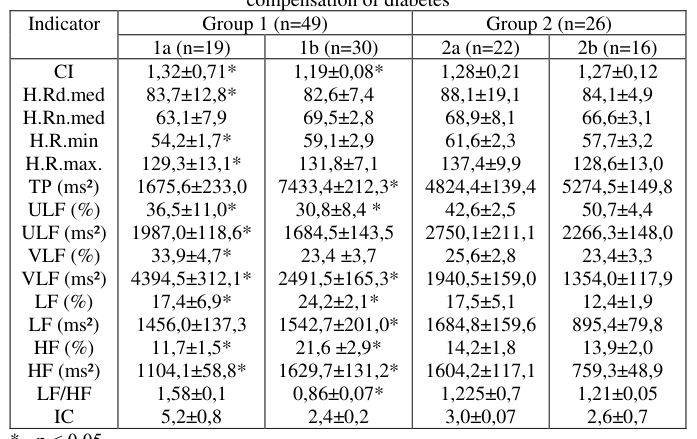
Despite the fact that the decompensation of diabetes mellitus (DM) was accompanied by significant changes in heart rate variability (HRV) in any type of diabetes, but the direction and severity of disorders in patients with different types of diabetes was not the same. IC in patients with DT2 was low - 1.19 ± 0.08, which is possible only with a pronounced disturbance of central and autonomic links of HR regulation. The power of the low-frequency (LF-24.2±2.1%, VLF-23.4±3.7%, ULF-30.8±8.4%) prevailed over of HF-21.6±2.9%, what is characteristic of severe CAN and disruption of
Human Interaction & Emerging Technologies (IHIET-AI 2022) Artificial Intelligence & Future Applications https://openaccess.cms-conferences.org/#/publications/book/978-1-7923-8989-4 autonomic regulation. At the same time, the age of the patient and the duration of diabetes did not matter in principle. The power index of the very low frequency VLF wave spectrum increased with unsatisfactory compensation of DM, which reflected the involvement of central (suprasegmental) ergotropic and humoral-metabolic mechanisms in the regulation of heart rhythm. Unsatisfactory compensation of DT1 did not affect the CI (1.32±0.17), but was accompanied by a decrease in the total power of the spectrum (TC 1675.6±233,0 ms2), the predominance of ULF-36.5 ± 11%, VLF-33.9±4.7%, LF-17.4 ± 6.9% over the high-frequency (HF-11.7 ± 1.5%). LF/HF was higher than the average, confirming hypersympathicoton. The vagosympathetic balance coefficient of patients with type 1 diabetes on the background of decompensation (LF/HF) was higher than the average - 1.58±0.4, confirming hypersympathicotonia. In patients with DT2 decompensation, also accompanied by autonomic imbalance, but proceeded against the background of increased activity of the parasympathetic nervous system (LF/HF= 0.86±0.07) (see Table 1). In type 2 diabetes, the predominance of parasympathetic activity in decompensation conditions contributed to an increase in HF and LF simultaneously.
Table 1: Spectral analysis of heart rate variability depending on the type and compensation of diabetes Indicator Group 1 (n=49) Group 2 (n=26) 1a (n=19) 1b (n=30) 2a (n=22) 2b (n=16) CI H.Rd.med H.Rn.med
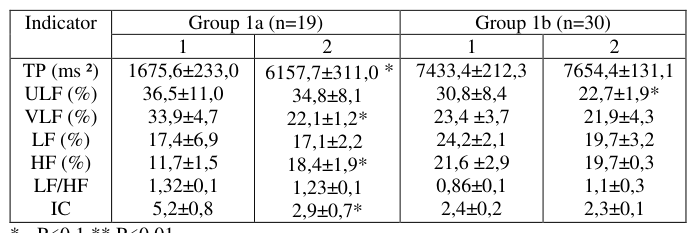
2). The clinical efficacy of moxonidine in monovariant didn’t exceed 46.7% and combination therapy with other pharmacological groups was required. The order of the study in tables’ №№ 2-5: 1 – the study before the start of moxonidine therapy; 2 – the study on the background of therapy 1.5-2.0 months later.
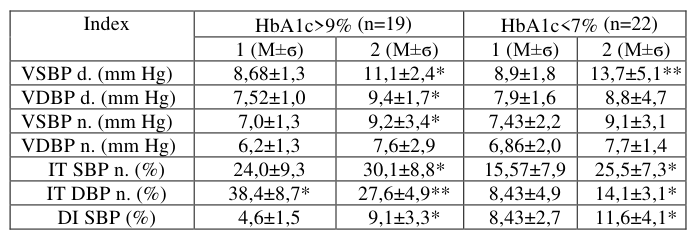
Table 2: Spectral analysis of heart rate variability during therapy in group 1 patients Indicator Group 1a (n=19) Group 1b (n=30) 1 2 1 2 TР (ms ²)Table 4: The effectiveness of moxonidine in cri of DMABP in patients with DT1 Index HbA1c>9% (n=19) HbA1c<7% (n=22) 1 (M±ϭ) 2 (M±ϭ) 1 (M±ϭ) 2 (M±ϭ) VSBP d. (mm Hg) 8,68±1,3 11,1±2,4* 8,9±1,8 13,7±5,1** VDBP d. (mm Hg) 7,52±1,0 9,4±1,7* 7,9±1,6 8,8±4,7 VSBP n. (mm Hg) 7,0±1,3 9,2±3,4* 7,43±2,2 9,1±3,1 VDBP n. (mm Hg) 6,2±1,3 7,6±2,9 6,86±2,0 7,7±1,4 IT SBP n. (%) 24,0±9,3 30,1±8,8* 15,57±7,9 25,5±7,3* IT DBP n. (%) 38,4±8,7* 27,6±4,9** 8,43±4,9 14,1±3,1* DI SBP (%) 4,6±1,5 9,1±3,3* 8,43±2,7 11,6±4,1*
DI DBP (%) 6,11±1,93* 7,4±2,7 12,9±3,9 13,8±2,3 IA SBP1 (mm Hg) 164,7±12,8 69,8±11,7** 55,7±3,57 51,5±14,0 IA DBP1 (mm Hg) 83,9±2,23 71,3±6,9* 51,0±4,33 49,8±13,7 IA SBP2 (mm Hg) 0,13±0,09 0,3±0,01 0,1±0,01 0 IA DBP2 (mm Hg) 0,33±0,02 0 0,9±0,03 0,4±0,1 VSBP d. - the variability of systolic blood pressure (day); VDBP d. - the variability of dystolic blood pressure (day); VSBP n. (mm Hg) - the variability of systolic blood pressure (nigth); VDBP n. (mm Hg) - the variability of dystolic blood pressure (nigth day); IA - area index (1 - Indicators of the high-pressure loading; 2 - Indicators of the reduced pressure loading); IT - time index; DI – daily index. Achieving the target indicators of glycemic control in patients with type 2 diabetes mellitus in combination with CAN is a prerequisite for achieving the therapeutic effect of moxonidine in a monovariant. The inclusion of moxonidine in the complex was accompanied by a significant improvement in the indicators of daily monitoring of blood pressure in patients with type 1 and type 2 diabetes on the background of compensation (see Tables 4 and 5). Table 5: The effectiveness of moxonidine in cri of SMAD in patients with DT1 Index HbA1c>9% (n=30) HbA1c <7% (n=16) 1 (M±ϭ) 2 (M±ϭ) 1 (M±ϭ) 2 (M±ϭ) VSBP d. (mm Hg) 10,7±1,1 7,9±1,7 10,5±2,0 12,8±6,1* VDBP d. (mm Hg) 8,4±0,84 9,4±1,5 8,7±1,8 11,1±3,3* VSBP n. (mm Hg) 8,1±1,17 9,1±2,4 8,0±2,1 8,8±1,5 VDBP n. (mm Hg) 6,8±0,87 6,9±1,0 6,1±1,9 9,4±2,3 IT SBP n. (%) 45,14±9,35 48,4±3,9 25,1±12,9 19,1±3,1* IT DBP n. (%) 47,6±9,2 43,9±6,7 32,3±13,8 21,7±5,0* DI SBP (%) 4,0±1,7 3,1±0,9 6,0±2,5 9,0±1,2* DI DBP (%) 6,9±1,8 4,5±1,0 7,6±3,2 7,7±2,2 IA SBP1 (mm Hg) 236,6±18,4 212,3±42,1 116,4±8,4 78,9±11,4* IA DBP1 (mm Hg) 139,6±3,6 151,2±12,9 63,8±2,45 39,9±9,1* IA SBP2 (mm Hg) 0,02±0,001 0,2±0,01 0,3±0,02 0,1±0,01 IA DBP2 (mm Hg) 0,2±0,001 0,4±0,01 0,13±0,09 0,2±0,07 VSAD and DI indicators of patients with type 1 diabetes on the background of taking moxonidine approached normal values, IA SBP 1 and IA DAD 1, although they remained, were far from normal, but the trend in dynamics was positive (see Table 4). The data obtained indicate not only the effectiveness of the antihypertensive effect of the drug, but also a positive effect on metabolic processes. The effectiveness of therapy depended on the compensation of diabetes in patients with cardiac autonomic neuropathy. Unsatisfactory compensation of DT2 was accompanied by activation of parasympathetic reactions, which not only reduced the effectiveness of moxonidine, but in some cases created undesirable effects, such as an increase not only in the total power of the spectrum (TC), but also in the ULF
Human Interaction & Emerging Technologies (IHIET-AI 2022) Artificial Intelligence & Future Applications https://openaccess.cms-conferences.org/#/publications/book/978-1-7923-8989-4 spectrum to 42.6 ± 7.1% and an increase in IA DBP 1. In this group, the TP also increased, but to a lesser extent (3801.3±544 ms2), and the ULF even increased to 42.6±7.1%, which did not allow us to consider the level of assistance provided sufficient. In patients with unsatisfactory DT2 compensation, the clinical efficacy of moxonidine therapy in the monovariant did not exceed 46.7% (14 people) and combination therapy with antihypertensive drugs of other pharmacological groups was required. Insufficient effectiveness of therapy in patients of this group was associated with pronounced changes in autonomic regulation.
CONCLUSIONS
As a result of the conducted research, it was found that the mathematical analysis of the frequency characteristics of the heart rate makes it possible to detect an imbalance of autonomous regulation at an early stage. The presence of CAN, even against the background of DM compensation, led to high activity of central energy- consuming mechanisms, disbalance of autonomic regulation, and the state of subcompensation was provided by the tension of humoral-metabolic processes. A disbalance of autonomic regulation leads not only to the progression of complications in dysmetabolic disorders, but also reduces the effectiveness of prescribed drug therapy. As a result of the study, we were able to prove that when prescribing drug therapy, it is necessary to take into account both the mechanism of action of the prescribed drug and the safety of functioning of one of the leading regulatory mechanisms – autonomous regulation. This makes it possible to predict the effectiveness of the therapy. In patients with type 1 and type 2 diabetes with cardiac autonomic neuropathy, multidirectional types of autonomic reactions are noted against the background of decompensation. The administration of moxonidine to patients with DT2 on the background of decompensation, which was accompanied by hyperparasimaticotonia, was less effective, since the effect of the drug is realized through central mechanisms, followed by a decrease in the activity of the sympathetic system, namely, this component is of minimal importance in the development of hypertension in patients with decompensation of DT2
REFERENCES
Human Interaction & Emerging Technologies (IHIET-AI 2022) Artificial Intelligence & Future Applications https://openaccess.cms-conferences.org/#/publications/book/978-1-7923-8989-4 general population. J Diabetes Res (2014) 2014:215473. World Health Organization: Definition, Diagnosis and Classification of Diabetes Mellitus and its Complications: Report of a WHO Consultation. Part 1: Diagnosis and Classification of Diabetes Mellitus (WHO/NCD/NCS/99.2). Geneva: World Health Org; 1999.
Read this individual research paper free through the original publisher, or explore the full digital proceedings book.
ISBN 978-1-7923-8989-4
Explore this ISBN in the AHFE Bookstore ↗Listed in the July 2026 bookstore catalogue; search by ISBN to confirm current availability · Digital book purchase optional