Irina Kurnikova, Ramchandra Sargar, Igor Tomashevsky, Natalia Zabrodina, Tatiana Meleshkevich (2021). Novel Trends for the Use of X-ray Computed Tomography for the Etiological Diagnosis of Iodine Metabolism Disorders. In: Human Systems Engineering and Design (IHSED2021): Future Trends and Applications. AHFE Open Access, vol. 21. https://doi.org/10.54941/ahfe1001152
1 RUDN University, Miklukho-Maklayast. 6, 117198 Moscow, Russia ↗
2 Private Healthcare Institution "Central Clinical Hospital", Russian Railways-Medicine Center of the Nuclear Medicine and PET positron Emission, Tomography. Moscow, Russia ↗
In the diagnosis of thyroid pathology, it is not enough to determine only functional disorder like, euthyroidism, hypothyroidism or hyperthyroidism; it is also necessary to rull out the cause of the identified disorders - is this the primary thyroid disease or caused by external influences, for example, iodine-induced (iodine-deficient) or iatrogenic. There are numbers of drugs, which can affect the metabolism of iodine, the synthesis of thyroid hormones and their storage in the thyroid gland. The thyroid gland differs from the surrounding tissues by a high level of absorption of X-rays due to the presence of iodine, which is reflected in the density index[1]. Despite the fact that X-ray computed tomography (CT) has long been used in clinical practice, the potential of the method in assessing disorders of iodine metabolism is far from not being used. Purpose: To develop a method of etiological and differential diagnosis of the genesis of iodine metabolism disorders based on the determination of the density of the thyroid gland by the X-ray CT method. Materials and Methods. A retrospective analysis of computed tomography data was carried out on 289 patients examined at the Center of Nuclear Medicine and Positron Emission Tomography of the Central Clinical Hospital of Russian Railways No. 2 (Moscow). The study was carried out on a single-photon emission computed tomograph combined with an X-ray computed tomography (SPECT/CT) "Symbia T16" (Siemens). The study time was 7-10 minutes, the local radiation exposure was 0.4-1 mSv. The density of the gland was determined by the intensity of the light image of the tissue in Hounsfield units (HU)[2]. Structural changes in the thyroid gland were studied according to ultrasonography, the functional state - according to the level of hormones TSH, f.T4 (enzyme-linked immunosorbent assay, analyzers from Abbott, Ortho-Clinical Diagnostics). Antibodies to thyroid peroxidase (AT-TPO) and thyroglobulin (AT-TG) were determined. The ethical norms were confirmed by Ethics Committee of RUDN University (Protocol No. 30 of February 22, 2018)Results: In the course of the study, the boundary values were determined for determining the norm (86-140 HU units), decreasing (less than 85 HU units) and increasing (above 140 HU units) density. The novelty of the obtained data is confirmed by a patent [3]. The majority of patients, when referred for CT examination, had thyroid disorders - 66.4% (192 people) and only 33.6% (97 people) had euthyroidism. However, a subsequent thorough examination made it possible to clarify the etiology of thyroid disorder (thyroidal or non-thyroidal genesis). In the group of patients with a reduced level of thyroid density, more than 20% were patients without thyroid pathology, but taking medications (10.1%) or having AT-TPO (13.2%) without changing the level of hormones and the structure of the thyroid gland. Among patients with a high index of thyroid density, there were two groups - with iodine-induced hypothyroidism (caused by taking potassium iodide at a dose of 200 μg / day for 1.5-2 years) and amiodarone-induced hyperthyroidism (using amiodarone 8-12 months). The low concentration of intrathyroidal iodine in patients with hyperthyroidism of autoimmune genesis indicates its rapid consumption for the synthesis of an excess amount of thyroxine, but in amiodarone-induced hyperthyroidism, the reason was its excessive intake (density increased). A poorly functioning organ that produces little of its own hormones always has a low density of 85 HU or less. In iodine-induced pathological conditions of the thyroid gland (iodine-induced hypothyroidism or hyperthyroidism), the density of the thyroid gland increases, and is expressed by an increase in the Hounsfield unit to 140 HU.Conclusion: The use of the X-ray CT technique allowed us, already at the stage of primary diagnosis, to identify the main etiological factors - thyroidal (thyroid disease) and non-thyroidal (exogenous or endogenous) causes of iodine storage disorders in the thyroid gland. Assessment of the density of the thyroid gland is effective in the differential diagnosis of iodine-deficient or iodine-induced disorders of the hormone-forming function of the thyroid gland.References1. Imanishi Y.et al. Measurment of Thyroid Iodine by CT || Journal of Computer Assisted Tomography -1991. - V. 15 - №2.- P.287-290.2. Hounsfield G.N. Computed medical imaging. Nobel lecture, December 8, 1979.J Comput Assist Tomogr. 1980 Oct;4(5):665-74. PMID: 6997341.3. Patent No. 2728261 dated July 28, 2020. "A method for the differential diagnosis of iodine-deficient and iodine-induced thyroid dysfunction in persons living in regions with iodine deficiency", authors: Kurnikova I.A., Tomashevsky I.O., Sargar R.V. and etc.
Human Systems Engineering and Design (IHSED 2021) https://openaccess.cms-conferences.org/#/publications/book/978-1-7923-8987-0 thyroid density
INTRODUCTION
In the diagnosis of thyroid pathology, it is not enough to determine only functional disorder like, euthyroidism, hypothyroidism or hyperthyroidism; it is also necessary to rule out the cause of the identified disorders - is this the primary thyroid disease or caused by external influences, for example, iodine-induced (iodine-deficient) or iatrogenic. There are numbers of drugs, which can affect the metabolism of iodine, the synthesis of thyroid hormones and their storage in the thyroid gland. The thyroid gland differs from the surrounding tissues by a high level of absorption of X-rays due to the presence of iodine, which is reflected in the density index [1]. Back in 1991, Imanishi et al. showed the capabilities of CT in determining the concentration of intrathyroidal iodine and proved that concentration of intrathyroidal stable iodine (CISI) in μg / g is directly proportional to the density of the thyroid gland in Hounsfield unit (HU) and derived a conversion formula in μg / g. In 2016, Shao et al. created a CT that can determine CISI at once in μg / g and since that time the index of the concentration of intrathyroidal stable iodine has become available to physicians, since it can be obtained using any device for CT, which is available in almost any clinic [4]. Despite the fact that X-ray computed tomography (CT) has long been used in clinical practice, the potential of the method in assessing disorders of iodine metabolism is far from not being used
PURPOSE To develop a method of etiological and differential diagnosis of the genesis of iodine metabolism disorders based on the determination of the density of the thyroid gland by the X-ray CT method.
MATERIALS AND METHODS
A retrospective analysis of computed tomography data was carried out on 289 patients examined at the Center of Nuclear Medicine and Positron Emission Tomography of the Central Clinical Hospital of Russian Railways No. 2 (Moscow). The study was carried out on a single-photon emission computed tomography combined with an Xray computed tomography (SPECT/CT) "Symbia T16" (Siemens). The study time was 7-10 minutes; the local radiation exposure was 0.4-1 mZv. The density of the gland was determined by the intensity of the light image of the tissue in Hounsfield units (HU) [2]. The X-ray CT method was used to determine the size, volume and structure of the thyroid gland (with a resolution of up to 0.75 mm), determination of the X-ray density (separately for the right and left lobes and the average). The study was carried out on a single-photon emission computed tomography combined with an X-ray computed tomography (SPECT / CT)
Human Systems Engineering and Design (IHSED 2021) https://openaccess.cms-conferences.org/#/publications/book/978-1-7923-8987-0
"SymbiaT16" (Siemens). The study time was 7-10 minutes; the local radiation exposure was 0.4-1 mZv. It was carried out by determining the density of the thyroid gland (TG) in the Hounsfield unit to determine the concentration of intrathyroidal stable iodine (the level of hormone formation and reserves of iodinated thyroid hormones directly in the thyroid gland) according to the formula.
[Equation or mathematical symbol available in the original paper PDF][Equation or mathematical symbol available in the original paper PDF] 104 1000 65 ) ( [Equation or mathematical symbol available in the original paper PDF][Equation or mathematical symbol available in the original paper PDF][Equation or mathematical symbol available in the original paper PDF] CT in Hu g mkg CISI
[1]
Structural changes in the thyroid gland were studied according to ultrasonography, the functional state - according to the level of hormones TSH, f.T4 (enzyme-linked immune sorbent assay, analyzers from Abbott, Ortho-Clinical Diagnostics). Antibodies to thyroid peroxidase (AT-TPO) and thyroglobulin (AT-TG) were determined. The ethical norms were confirmed by Ethics Committee of RUDN University (Protocol No. 30 of February 22, 2018). Statistical analysis was performed using Microsoft Excel and processing with IBM SPSS Statistics 11.0. To compare independent groups of patients for various grouping signs, contingency tables were constructed with the calculation of Pearson's goodness of-fit criterion (χ2 test), with a confidence interval of at least 95% (p <0.05) using weighted least squares distance. Data was presented in the form of 3D graphs.
RESULTS
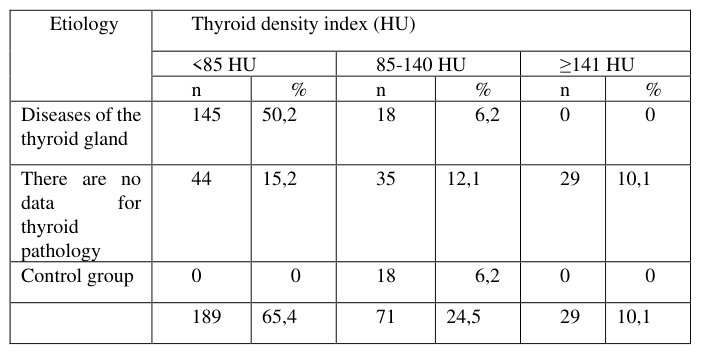
In the course of the study, the boundary values were determined for determining the norm (86-140 HU units), decreasing (less than 85 HU units) and increasing (above 140 HU units) density. By the intensity of the light image of the thyroid gland under the action of X-ray radiation, when compared with the standard, we established the presence of iodine and hormonal deficiencies, as well as an excess of iodine directly in the thyroid gland, and in case of iodine deficiency, the density of the thyroid gland was from 85 HU units and below, and in case of excess iodine intake thyroid density 140 HU and higher. The novelty of the obtained data is confirmed by a patent [3]. The analysis was carried out in two directions - the identification of thyroid pathology leading to dysfunction and the identification of non-thyroid pathology in each of the three groups of patients. The most numerous were the group of patients with a low concentration of intrathyroidal iodine- 189 patients (65.4%) of the total number of patients examined. Patients with normal values of the density of the thyroid gland accounted for 24.5% of patients (71 people), and this group included all patients of the control group. Patients with diagnosed thyroid disease in the group of the surveyed made up 66.4% (192 people). And most of them ended up in the group with
Human Systems Engineering and Design (IHSED 2021) https://openaccess.cms-conferences.org/#/publications/book/978-1-7923-8987-0 low thyroid density (Table 1). Groups depending on the density of the thyroid gland were defined as: observation group 1 - a group of patients with a decrease in the content of intrathyroidal iodine (<85 HU); observation group 2 - a group of patients with high intrathyroidal iodine accumulation (≥141 HU); comparison group - a group of patients with normal intrathyroidal iodine content and HU values (85-140 HU). A group of 18 healthy volunteers was also recruited. - Control group.
Table 1. Distribution of the examined patients into groups depending on the density of the thyroid gland and the cause of the disorder (n = 289).
Subsequent careful examination made it possible to clarify the etiology of thyroid dysfunction (thyroid or non-thyroid genesis). When comparing the traditional criteria for diagnosing thyroid dysfunction (the level of TSH, fT4 hormones) and X-ray CT data, we obtained convincing evidence of the great diagnostic value of the latter and the prospects for using this method, as in the early diagnosis of thyroid dysfunction (Table 2.) the level of CISI content (or by the density of the thyroid gland), and in determining the causative factor.
Table 2 - Comparative analysis of the assessment of the functional state of the thyroid gland by the level of intrathyroidal iodine and hormones Thyroid status n=238 HU [ед] f.Т4 ТSH [mkEd/ml]
Human Systems Engineering and Design (IHSED 2021) https://openaccess.cms-conferences.org/#/publications/book/978-1-7923-8987-0 hyperthyroidism 1115,3±41,56
* - p <0.05 in comparison with control In patients with iodine-induced hypothyroidism, an increase in thyroid density was observed in contrast to primary hypothyroidism.
At the same time, the level of the hormone TSH was increased, and the level of St. T4 was decreased in both cases, which only confirmed the fact that the patient had hypothyroidism.
The detection of low values of the average thyroid density in HU (less than 85) was evidence of a decrease in hormone genesis, which can occur in primary hypothyroidism (53.3 ± 7.1 HU) and in this case coincides with an increase in TSH levels and a decrease in St. T4, i.e. a decrease in the content of KISY confirms the presence of hypothyroidism. However, even among patients with hyperthyroidism (35 people), the density of the thyroid gland was reduced, which confirmed the increased consumption of intrathyroidal iodine for synthetic processes (Table 2). However, in the case of amiodarone-induced hyperthyroidism, despite a decrease in the level of TSH and an increase in the level of free T4 corresponding to thyrotoxicosis, the content of intrathyroidal iodine was not decreased due to the intake, but increased, which immediately made it possible to establish the secondary nature of the genesis of thyroid dysfunction (excessive intake iodine).
In the group of patients (19 people), also referred for CT examination against the background of diagnosed hypothyroidism (TSH - 6.08 ± 1.55 μU / ml; free T4 - 7.2 ± 0.9 pmol / L) increased content of intrathyroidal iodine (increased density of the
Human Systems Engineering and Design (IHSED 2021) https://openaccess.cms-conferences.org/#/publications/book/978-1-7923-8987-0 thyroid gland), and subsequent careful collection of anamnesis confirmed that patients were taking iodine or iodine-containing drugs.
Determination of the density made it possible to establish the etiological factor - what exactly is the cause of the thyroid gland disease (primary lesion) or is caused by other endogenous or exogenous influences (secondary lesion), and also, to determine the pathogenic mechanisms - is due to the state of excessive intake of iodine in the thyroid gland or its insufficiency. It is clear that the tactics in these cases will be chosen by the doctor completely different.
In the case of primary lesion of the thyroid gland, the density determination also made it possible to determine the "reserves" of intrathyroidal iodine in each specific case. Most of the patients, when referred to the CT examination, had thyroid dysfunction - 66.4% (192 people) and only 33.6% (97 people) - euthyroidism. However, a subsequent thorough examination made it possible to clarify the etiology of thyroid dysfunction (thyroid or non-thyroid genesis). The group of patients with no evidence of thyroid pathology included 108 patients (37.3%) of the total number of examined patients. In the group of patients with a reduced level of thyroid density, patients with hypothyroidism, which complicated the course of autoimmune thyroiditis, accounted for 67.7%, which was an expected and explainable result. However, the same group included patients with hyperthyroidism - 9.0% (decreased iodine accumulation due to excess production of thyroid hormones) (Table 3).
In the group of patients with a reduced level of thyroid density, more than 20% were patients without thyroid pathology, but taking medications (10.1%) or having AT- TPO (13.2%) without changing the level of hormones and the structure of the thyroid gland. Among patients with a high index of thyroid density, there were two groups - with iodine-induced hypothyroidism (caused by taking potassium iodide at a dose of 200 μg / day for 1.5-2 years) and amiodarone-induced hyperthyroidism (using amiodarone 8-12 months).
Table 3 - The structure of etiological factors in the examined patients, depending on the density of the thyroid gland Etiology Thyroid density index (HU) <85 HU n=162
Human Systems Engineering and Design (IHSED 2021) https://openaccess.cms-conferences.org/#/publications/book/978-1-7923-8987-0
Iodine-induced hypothyroidism is accompanied by an increase in the density of the thyroid gland and a high content of intrathyroidal iodine, since it is the exogenous iodine that blocks synthetic processes, which leads to a decrease in the synthesis of thyroid hormones. The use of the X-ray CT technique allowed us, already at the stage of primary diagnosis, to identify the main etiological factors - thyroid (thyroid disease) and non-thyroid (exogenous or endogenous) causes of disorders in the accumulation of iodine in the thyroid gland.
The low concentration of intrathyroidal iodine in patients with hyperthyroidism of autoimmune genesis indicates its rapid consumption for the synthesis of an excess amount of thyroxin, but in amiodarone-induced hyperthyroidism, the reason was its excessive intake (density increased). A poorly functioning organ that produces little of its own hormones always has a low density of 85 HU or less. In iodine-induced pathological conditions of the thyroid gland (iodine-induced hypothyroidism or hyperthyroidism), the density of the thyroid gland increases, and is expressed by an increase in the Hounsfield unit to 140 HU.
Human Systems Engineering and Design (IHSED 2021) https://openaccess.cms-conferences.org/#/publications/book/978-1-7923-8987-0
CONCLUSIONS
Certainly, the discovery of new diagnostic capabilities of existing ones, available due to the good provision of medical institutions with the available equipment, diagnostic methods can also be attributed to the optimization methods from the standpoint of healthcare organization. This approach will provide both increased diagnostic capacity and an economical use of public funds. Referring specifically to the method of X-ray computed tomography with the determination of the density of the thyroid gland, which is directly proportional to the concentration of iodine in it. The use of the X-ray CT technique allowed us, already at the stage of primary diagnosis, to identify the main etiological factors - thyroidal (thyroid disease) and non-thyroidal (exogenous or endogenous) causes of iodine storage disorders in the thyroid gland. Assessment of the density of the thyroid gland is effective in the differential diagnosis of iodine-deficient or iodine-induced disorders of the hormone-forming function of the thyroid gland.
REFERENCES
Imanishi Y.et al. Measurement of Thyroid Iodine by CT || Journal of Computer Assisted Tomography -1991. - V. 15 - №2.- P.287-290. Hounsfield G.N. Computed medical imaging. Nobel lecture, December 8, 1979.J
Comput Assist Tomogr. 1980 Oct;4(5):665-74. PMID: 6997341. Patent No. 2728261 dated July 28, 2020. "A method for the differential diagnosis of iodine-deficient and iodine-induced thyroid dysfunction in persons living in regions with iodine deficiency", authors: Kurnikova I.A., Tomashevsky I.O., Sargar R.V. and etc. Shao W. Evaluation of energy spectrum CT for the measurement of thyroid iodine
content / [W. Shao and et al.] // BMC Medical Imaging. – 2016. – V. 16, № 47. – P. 1–5.
Human Systems Engineering and Design (IHSED 2021) https://openaccess.cms-conferences.org/#/publications/book/978-1-7923-8987-0
LISTED IN THE AHFE DIGITAL BOOKSTORE CATALOGUE
Explore the complete digital volume
Human Systems Engineering and Design (IHSED2021): Future Trends and Applications
Read this individual research paper free through the original publisher, or explore the full digital proceedings book.
ISBN 978-1-7923-8987-0
Explore this ISBN in the AHFE Bookstore ↗Listed in the July 2026 bookstore catalogue; search by ISBN to confirm current availability · Digital book purchase optional