Yi Teng Shih (2022). Comparing Design Behaviours between Teams with the Same Design Background and Teams with Different Design Backgrounds during Brainstorming. In: Intelligent Human Systems Integration (IHSI 2022): Integrating People and Intelligent Systems. AHFE Open Access, vol. 22. https://doi.org/10.54941/ahfe1001017
This study concerned about cross-disciplinary team design behaviours in the brainstorming process. The aim was to better understand the similarities and differences in design behaviours between cross-disciplinary design teams and the same discipline design teams, and how cross-disciplinary designers may impact on team design processes. Protocol analysis was used to facilitate controlled observations and experimental analyses to investigate the research questions and objectives. All teams were required to think-aloud, verbally describing their activities during the design sessions. The preliminary findings were discussed in the following sections.
In practice, design is usually done in a team, including all stakeholders of the project. In fact, few professional designers work alone. Collaborative design is a way to combine the knowledge brought by these multiple experts to meet the requirements and needs of all participants (McDonnell, 2016).
In design schools, most students mainly learn how to design individually, which illustrates one of the differences between theoretical design methods in studio culture and the reality of design studio practice (Goldschmidt, 2002). In the studio, students go through different stages. The ideation process is a basic stage of conceiving, negotiating, and evaluating ideas to assess their design potential. Unfortunately, the process of generating ideas is rarely received adequate feedback. In most studios, students present the results of their personal ideas in design critiques, and teachers provide feedback on the quality of design concepts and discuss potential issues (McDonnell, 2016). In this way, the student's thought process is almost invisible to the teacher, as they develop projects between each critical review of the design processes (Wang, 2010). Avoiding the shortcomings of studio settings and promoting co-design is to better build the competencies and knowledge required in the co-ideation process.
Innovation, collaboration, and creativity are important drivers of economic growth and social progress. Collaboration is particularly important because it is generally believed that groups of people work together to solve more complex problems than they would as individuals. Lahti et al. (2004) proposed collaborative design as a process of active communication and cooperation to jointly build a design goal, determine design constraints, search for design problems and solution spaces, and construct design solutions. Looking at problems through members' different perspectives and sharing their understanding of design goals are elements of successful design teams. Therefore, the idea generation stage is crucial in design processes such as brainstorming.
Brainstorming is a technique where team members get together to explore different opportunities, such as removing obstacles to refine problems and/or to propose ideas that address specific areas of concern. Team members think freely and propose as many new ideas as possible. Some spontaneous new ideas may encourage deeper thinking and innovation. All ideas are recorded without critique and are then evaluated. The advantage of brainstorming is that it identifies a range of useful options, avoids design fixations and increases design creativity (Ball et al. 1998).
Design team members share their knowledge and feedback to adjust the design activities, which is an essential behaviour for the design team. Diverse design backgrounds and feedback methods may affect the team design results. However, there is little empirical evidence to support a comprehensive understanding of design behaviours in cross-
Intelligent Human Systems Integration (IHSI 2022): Integrating People and Intelligent Systems https://openaccess.cms-conferences.org/#/publications/book/978-1-7923-8988-7 disciplinary teams. Questions about the differences between cross-disciplinary and the same discipline design teams, and whether cross-disciplinary background impacts on design processes remain unanswered and are therefore important to explore.
RESEARCH PLAN AND METHODOLOGY The credibility of a research depends on the research method chosen and the way the research is conducted. Protocol analysis provides a potentially effective method for controlled observation and experimental analysis of cognitive behaviour (Tang et al. 2011). Protocol analysis can be used to understand the design process, the knowledge used, cognitive behaviours, and the strategies used. In the context of this research, one application of protocol analysis is to ask designers how they design artifacts. However, they often find it difficult to answer this question in detail. This is because designers often retain their design thoughts in their short-term memory while designing. Many studies (Tang et al. 2011, Kim & Maher 2008) show that protocol analysis can comprehensively record designers’ reasoning during the design process rather than simply relying on their design results for such insights.
There are two methods for collecting protocol data: retrospective and concurrent (spoken) verbal expressions (Dorst & Dijkhuis 1995). In general, retrospective verbal expression refers to designers performing tasks and then being asked about their thought processes during design activities. Another method is to videotape a design meeting and review the video with the designer so they can explain what happened. However, they may have difficulty remembering the thought process after the activity is completed, and the practicality of this method is limited (Newell, 1990). Another problem is that designers may show their thought processes more coherently and wisely than initially. They may not report their actual thoughts during the design process, but instead report false memories. This may give a misleading impression of completely rational behaviour (Newell, 1990). Retrospective means that information must be retrieved from long-term memory and then voiced. The disadvantage of this method is that the retrieval process may not be able to mine all the information actually encountered during the design process.
On the other hand, the ‘think aloud’ protocol requires designers to express their ideas during design. In other words, designers explain their ideas as they perform the task at hand. Unlike retrospective protocols for gathering verbal data, no set questions are asked. Designers are encouraged to give a concurrent account of their thoughts and to avoid interpreting what they are doing (Tang et al. 2011). This method is more successful because almost all of a designer’s conscious effort is aimed at achieving the design briefs, they are busy working on. This restricts the opportunities for them to reflect on their design activities and to refashion explanations of their activities. As a result, the data collected is very straightforward; no delays can cause data changes. The advantages of concurrent
Intelligent Human Systems Integration (IHSI 2022): Integrating People and Intelligent Systems https://openaccess.cms-conferences.org/#/publications/book/978-1-7923-8988-7 verbalisation fit the aim of this research because this process focuses on analysing designers’ cognitive actions rather than using subjective self-reports (Salman et al. 2014). Therefore, think aloud was selected as a suitable and robust approach for this study.
THE FBS CODING SCHEME Gero’s Function-Behaviour-Structure (FBS) framework was created in 1990 (Gero, 1990). The process represented by the FBS model (Figure 1) transforms design requirements into a design artifact. This model contains six design issues and eight design processes that describe all designed artifacts, irrespective of the specific design discipline.
Figure 1: FBS design model.
Figure available in the original PDF paper.
Gero proposed the six design issues begin with the goal of designing being to transform a set of requirements (R) into a set of design descriptions (D). The function (F) of a designed object is defined as its purpose. The behaviour (B) of that object is how it achieves its functions and is either derived (Bs) or expected (Be) from the structure. The structure (S) comprises the elements of an object and their relationships. A design description is never transformed directly from the function but undergoes a series of design processes related to the FBS design issues. These eight design processes include: a formulation (F→Be) which transforms functions into a set of expected behaviours; a synthesis (Be→S), where in a structure is proposed that is likely to exhibit the expected behaviour; an analysis (S→Bs) of the structure which produces its derived behaviour; an evaluation process (Be↹Bs) which acts between the expected behaviour and the behaviour derived from the structure; and documentation (S→D), which produces the design description (Gero, 1990). According to
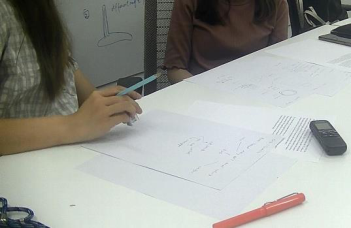
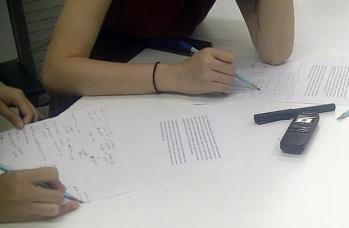
Intelligent Human Systems Integration (IHSI 2022): Integrating People and Intelligent Systems https://openaccess.cms-conferences.org/#/publications/book/978-1-7923-8988-7 the structure, there are three types of reformulations, where new variables are introduced: reformulation of structure (S→S), reformulation of expected behaviour (S→Be), and reformulation of function (S →F). The advantage of the FBS coding scheme is that it clearly shows the relationships between the eight design processes and the six design issues. Therefore, the FBS coding scheme has been used for this study. The preliminary study recruited four teams: two for cross-disciplinary teams (Figure 2) and two for the same design discipline teams (Figure 3). The three design briefs are used randomly. They were (1) Reducing food waste at home, (2) Promoting social interactions for the elderly people, and (3) Upcycling household items as repurposed new functions. Each team had one hour to complete their brainstorming sessions. Four participants with at least three design studio projects and good English communication skills.
Figure 2: Team 1(left) comes from communication designer and product designer, and Team 2 (right) comes from interaction designer and product designer.Figure 3: Team 3 (left) and Team 4 (right) are both from product designers.
PRELIMINARY RESULTS AND ANALYSIS All teams completed and satisfied the brainstorming design tasks, and their design activities were videoed, covering between 193 and 385 FBS design issues. Due to the varied quantities
Intelligent Human Systems Integration (IHSI 2022): Integrating People and Intelligent Systems https://openaccess.cms-conferences.org/#/publications/book/978-1-7923-8988-7 of each team’s segmentations in brainstorming, the occurrences of design issues were normalised as percentages of the total issues, as described in the following section. To increase the reliability of protocol segmentation and coding process, the Delphi method was applied for the study.
Figure 4 indicated that the four teams shared a similar FBS distribution of design is-sues. The majority of cognitive effort was expended in reasoning about the structure (S), the behaviour derived from the structure (Bs) (>20%) and expected behaviour (Be) (>17%). Both design issues of requirement (R) and documentation (D) had the lowest cognitive focus (<7.2%). In terms of requirements (R) and function (F), there are significant differences between cross-disciplinary teams and the same design discipline teams. After reviewing the design videos, cross-disciplinary teams were willing to spend more energy discussing the new variables in the briefing. Whereas the same design discipline teams were more likely to accept brief requirements and spend more energy on solving these problems.
45
40
35
30
25
20
15
10
5
0
R F Be Bs S D Team 1 (communication design + product design)
Team 2 (interaction design + product design) Team 3 (product design + product design)
Team 4 (product design + product design)
Figure 4: Four teams’ FBS distributions of design issues during brainstorming.
Figure available in the original PDF paper.
CONCLUSIONS AND FURTHER RESEARCH The aim was to better understand the similarities and differences in design behaviours
Intelligent Human Systems Integration (IHSI 2022): Integrating People and Intelligent Systems https://openaccess.cms-conferences.org/#/publications/book/978-1-7923-8988-7 between cross-disciplinary design teams and the same discipline design teams, and how cross-disciplinary designers may impact on team design processes. It turns out that cross- disciplinary teams are more likely to solve ill-defined design problems. In order to have more evidence to support this argument, more cross-disciplinary design teams need to be studied and their design results can also be evaluated. These research results can improve design cross-disciplinary education and different industry collaborations.
REFERENCES
Ball, L. J., Maskill, L., and Ormerod, T. C. (1998) Satisficing in engineering design: Causes, consequences and implications for design support. Automation in Construction, 7(2), 213–227 Dorst, K. and Dijkhuis, J. (1995) Comparing paradigms for describing design activity,
Design Studies, 16(2) 261-275 Gero, J. S.: Design prototypes: a knowledge representation schema for design, AI Magazine, 11(4): 26-36 Goldschmidt, G. (2002) “One-On-One”: A pedagogic base for design instruction in the
studio. In Proceedings of common ground, design research society international conference, 430-437 Kim, M. J. and Maher, M. L. (2008) The impact of tangible user interfaces on spatial cognition during collaborative design. Design Studies, 29(3), 222-253 Lathi, H., Seitamaa-Hakkarainen, P., and Hakkarainen, K. (2004) Collaboration patterns in
computer supported collaborative designing. Design Studies, 25, 351-371 McDonnell, J. (2016) Scaffolding Practices: a study of design practitioner engagement in design education. Design Studies 45:9-29 Newell, A. (1990) Unified theories of cognition. Cambridge, Mass: Harvard University Press. Salman, H., Laing, R. and Conniff, A. (2014) The impact of computer aided architectural
design programs on conceptual design in an educational context. Design Studies, 35 (4) 412-439 Tang, H. H. Lee, Y. Y. and Gero, J. S. (2011) Comparing collaborative co-located and distributed design processes in digital and traditional sketching environments: A protocol study using the Function-Behaviour-Structure coding scheme. Design Studies, 32(1) 1-29 Wang, T. (2010) A new paradigm for design studio education. International Journal of Art
and Design Education 29 (2)173-183
Intelligent Human Systems Integration (IHSI 2022): Integrating People and Intelligent Systems https://openaccess.cms-conferences.org/#/publications/book/978-1-7923-8988-7
LISTED IN THE AHFE DIGITAL BOOKSTORE CATALOGUE
Explore the complete digital volume
Intelligent Human Systems Integration (IHSI 2022): Integrating People and Intelligent Systems
Read this individual research paper free through the original publisher, or explore the full digital proceedings book.
ISBN 978-1-7923-8988-7
Explore this ISBN in the AHFE Bookstore ↗Listed in the July 2026 bookstore catalogue; search by ISBN to confirm current availability · Digital book purchase optional