Cestmir Serafin, Jana Depesova (2022). The personal development of teachers and pupils within the context of health and safety in education. In: Intelligent Human Systems Integration (IHSI 2022): Integrating People and Intelligent Systems. AHFE Open Access, vol. 22. https://doi.org/10.54941/ahfe1001016
This article concerns itself with questions of health and safety within the context of primary education as a prerequisite for the development of pupil competencies in the given area for their future education in the secondary and tertiary systems and also as a prerequisite for their prospects in their future professional lives. The article presents the results of research conducted among primary school teachers in the Olomouc Region and proposes measures aimed at increasing the level and quality of the education in the area of health and safety based on the conclusions of the research.
Intelligent Human Systems Integration (IHSI 2022): Integrating People and Intelligent Systems https://openaccess.cms-conferences.org/#/publications/book/978-1-7923-8988-7
INTRODUCTION
Health and safety education and training is an important societal issue that concerns many disciplines and activities. One of the most important areas is education, no matter whether this involves the preparatory education of children, pupils and students or the postgradual, life-long education of workers in various professions.
The initial preparation, where the health and safety education of children, pupils and students is combined with questions of health and safety during the work of school employees on the one hand and on the other hand is associated with a societal challenge in the form of inculcating good habits, approaches and conduct leading to a safe life and work, is becoming increasingly significant. Education is one of the most complicated health and safety segments due to the fact that health protection primarily involves children, who frequently do not respect the rules and regulations, despite having been acquainted with them. In any case, as has already been mentioned, the complexity of the question of health and safety in education mainly depends on the type of school education, but also on the technical difficulty, i.e. health and safety will be significantly more demanding in technical, chemical or laboratory disciplines than in the case of language or art schools (Tomková, 2017; Tureková, & Depešová, 2019; Tureková & Bagalova 2018; Feszterová, 2008) According to the National Action Program for Occupational Health and Safety issued by the Czech Republic for the last two years (MPSV, 2021), priority measures have been designated in the area of occupational health and safety, where the question of prevention, education and the training system play a crucial role. Health and safety education and training is an essential tool for systematically creating and developing expert knowledge, abilities and skills and also for creating the desired approaches and conduct among employers, employees and self-employed individuals, including the work environment, the safety of technical equipment and the optimization of working conditions.
LEGAL-LEGISLATIVE QUESTIONS OF HEALTH AND SAFETY The legal definition from the area of health and safety has a relatively long history in the Czech Republic, but also involves the connection of the Czech legal system with European legislation. In 1988, Czechoslovakia ratified Convention no. 155 of the International Labour Organization (MPSV, 2021; Černá, Brácha, Marek & Kocián, 2002) which constitutes one of the state’s decisive international obligations in the area of occupational health and safety. This ratification entered into force on 2 December 1989 in the form of Regulation no. 20/1989 Coll. on the Convention on the Occupational Health and Safety of Workers and the Working Environment (Regulation no. 20/1989 Sb. - Convention no. 155 on the
Intelligent Human Systems Integration (IHSI 2022): Integrating People and Intelligent Systems https://openaccess.cms-conferences.org/#/publications/book/978-1-7923-8988-7
Occupational Health and Safety of Workers and the Working Environment).
The fundamental document which sets out the requirements for securing health and safety within the framework of the European Union is Council Directive 89/391/EEC of 12 June 1989 on the introduction of measures to encourage improvements in the safety and health of workers at work, which characterises the occupational health and safety system in the European Union. This directive defines the basic limits for employers in the area of risks and the risk factors which could endanger the health and safety of workers. It is characteristic for Directive 89/391 EEC that it contains a number of requirements also pertaining to the provision of preventive healthcare or the participation of workers in the decision-making on matters of health and safety in the workplace. In the Czech Republic, the requirements of Directive 89/391 EEC have been incorporated into several legal documents which have secured harmonization with the legal system of the European Union (Paleček, 2002).
The Labour Code has become the fundamental regulation pertaining to occupational safety which, amongst other things, has introduced the term “risk” to our legal system as part of the process of harmonization with the law of the European Union which has been ongoing since 2001. Act no. 262/2006 Coll., the Labour Code, as amended, has been supplemented by Act no. 309/2006 Coll. which regulates the additional requirements for occupational health and safety in labour law relationships and secures occupational health and safety during activities or the provision of services outside labour law relationships (the Act on the Additional Requirements for Occupational Health and Safety) The inspection of the compliance with the legal regulations aimed at securing occupational safety and compliance in labour law relations is performed by Act no. 251/2005 Coll. governing labour inspections, which established the State Labour Inspection Office and the area labour inspectorates.
EDUCATION IN THE AREA OF OCCUPATIONAL HEALTH AND SAFETY Quality can only be achieved in education pertaining to the area of health and safety, if there is a qualified approach from the trainers/teachers which leads to the development of expert knowledge, attitudes and skills in the area of health and safety issues (Tomková, 2017; Tureková & Depešová, 2019; Romaněnko, 2006; Duke, 2001).
Expert education in the area of occupational health and safety at the level of the comprehensive educational program has not been adequately resolved in the Czech Republic and it is currently located within the zone of lifelong education in the form of expert courses and training. We can name three such facts within this context: [Equation or mathematical symbol available in the original paper PDF] The current legislation concerning educational facilities (primary, secondary and apprenticeship schools and universities) has not resolved the issue of occupational
Intelligent Human Systems Integration (IHSI 2022): Integrating People and Intelligent Systems https://openaccess.cms-conferences.org/#/publications/book/978-1-7923-8988-7 health and safety comprehensively but has only done so in partial steps within the framework of the individual disciplines and activities. [Equation or mathematical symbol available in the original paper PDF] In the case of employers, especially small and medium sized enterprises, the requirements of the Labour Code, which include the employer’s obligation to acquaint its employees with the occupational safety rules and therefore to comprehensively educate them in occupational health and safety, are never sufficiently met. [Equation or mathematical symbol available in the original paper PDF] Education in the area of occupational health and safety can essentially be provided by anybody without any guarantee of quality. The quality of the education is therefore dependent upon the expertise and teaching skill of the instructor.
HEALTH AND SAFETY WITHIN THE CONTEXT OF PRIMARY SCHOOL Primary education plays an important role in health and safety education, because pupils best acquire habits aimed at risk prevention at an early age. It is therefore essential to realize part of the primary education with activities aimed at acquiring a consciousness of the importance of health and safety and the principles of accident prevention. Health and safety therefore logically also constitute an inseparable part of the preparation of pupils in many educational subjects. This preparation is also based on many technologies, types of didactic materials and so on. We have verified to what extent this applies at a number of primary schools in the Olomouc Region.
Health and safety has three basic areas in Czech primary schooling which are defined by the participants in the education process; the pupil, the teachers and the other school employees: a) The fundamental and generally binding regulation for schools and educational
facilities, which regulates the health and safety of the pupils, is Act no. 561/2004 Coll. governing pre-school, primary, secondary, higher vocational and other education (the Education Act), as amended. b) The issue of the teaching staff is covered by Act no. 563/2004 Coll. governing pedagogical workers and Act no. 262/2006 Coll., the Labour Code. c) Non-teaching staff are especially subject to Act no. 262/2006 Coll., the Labour Code.
The area of health and safety has always constituted a fixed part of the curricular documents, which stipulated changes in the education system in the past and still do today. The fundamental curricular document for the level of primary schooling is the General Education Program for Primary Education (MŠMT, 2015). The issue of health and safety appears there in basically all of the critical sections ranging from the objectives through to the key competencies, the educational content through to the crosscutting themes. Here, the issue of health and safety is understood in wider contexts, i.e. as the result of the pupils’ personal development (their attitudes, tolerance, communication etc.), which also constitutes the foundation for their conduct and decision-making. The issue of occupational health and safety is mainly realised here via two key (i.e. for the given area) educational areas
Intelligent Human Systems Integration (IHSI 2022): Integrating People and Intelligent Systems https://openaccess.cms-conferences.org/#/publications/book/978-1-7923-8988-7
(Nováková, 2007; Romaněnko, 2006; MŠMT, 2015): Man and Health (Health Education) and Man and the World of Work.
Other significant educational areas from the point of view of health and safety which, however, relate this issue to a specific discipline include: Information and Communication Technology and Man and Nature (Physics, Chemistry and Biology). Schools became obliged to educate pupils in the area of health and safety as part of their school education program in the 2007/2008 school year. The school is responsible for the child or pupil in compliance with section 29 of Act no. 561/2004 Coll. governing pre-school, primary, secondary, higher vocational and other education (the Education Act). It clearly states that the school is responsible for the child or pupil in those areas involving any training or education which the school itself organizes (Dandová, 2008; Nováková, 2007).
Section 29, subsection 2 states that: “Schools and educational facilities secure the health and safety of the children, pupils and students during education, during any directly associated activities and during the provision of any educational services and they likewise provide the pupils and students with essential information to ensure their health and safety. The Ministry designates by decree the measures required to secure the health and safety of the children, pupils and students during their education in schools and educational facilities and during any associated activities.“ It is, however, also necessary to keep section 2, letter f) of Act no. 309/2006 Coll. - the Act in mind, as it regulates the further requirements for occupational health and safety … and states that the employer, in this case the school, is obliged to equip the workplaces with the means to provide first aid and the means to call the medical rescue service (Dandová, 2008; Nováková, 2007).
The rules, regulations and other information pertaining to health and safety have to be provided to the children, pupils and students in relation to their age, which means that preschool children should be provided with information in a different way to, for example, pupils in the senior school at the primary level or to secondary or university students.
If we look, for example, at the state of the area of health and safety in the area of primary education in Slovakia, this has been enshrined in the appropriate laws and documents, which define similar requirements for each educational activity to those in the Czech Republic. Slovakia has a State Education Program (ŠPU, 2015) which is similar to the Framework Educational Program in the Czech Republic.
The school issues its school rules and other internal regulations, with which the pupils must be acquainted, for this purpose. As in the Czech Republic, it has also been statistically documented in Slovakia that the most school accidents occur during lessons of physical education held directly at school or during recreational activities for the pupils (sports games, excursions, skiing courses and excursions). It is necessary to emphasize the following when realizing any activities outside the classroom (Tomková, Feszterová, Bulla & Depešová, 2019):
Intelligent Human Systems Integration (IHSI 2022): Integrating People and Intelligent Systems https://openaccess.cms-conferences.org/#/publications/book/978-1-7923-8988-7
• the provision of thorough organizational readiness and a commensurate number of teaching staff and guides, for example instructors; [Equation or mathematical symbol available in the original paper PDF] the pupils have been informed of the program, the organizational measures and the appropriate attire in advance; [Equation or mathematical symbol available in the original paper PDF] the pupils have also been instructed with regard to the appropriate conduct at the venue of the school excursion or trip; [Equation or mathematical symbol available in the original paper PDF] the activity has been undertaken on the basis of information about the commensurate physical condition and state of health of the pupils.
As institutions providing education, schools also secure the health and safety of the pupils during activities that are directly associated with education, create the conditions for the health and safety of the pupils and inspect that they are being complied with.
The general requirements pertaining to each educational activity have been defined in the Slovak Republic in: the Labour Code, Act no. 124/2006 Coll., Act no. 125/2006 Coll., Act no. 355/2007 Coll.
THE OPINIONS OF PRIMARY SCHOOL TEACHERS FROM THE OLOMOUC REGION The questionnaire survey was realized among 200 primary school teachers in the Olomouc Region with the objective of ascertaining how schools and their teachers comprehend the term “health and safety” within the context of the educational areas realized at their schools, how this issue has been incorporated into the schools’ educational programs and the specific teaching plans for the individual subjects, including how the teachers perceive their expert preparedness to create and develop their pupils’ health and safety competencies, what resources and educational opportunities they use to provide good quality lessons and also what didactic instruments, aids and methodologies they have or would like to have.
THE METHODOLOGY The preparation, realization and evaluation of the questionnaire survey took place in 2019/2020. The questionnaire for the teachers was prepared as an online survey and at the same time, it was also sent as an attachment in a direct mail communique (a motivational letter). The processing of the responses from the individual respondents was realized in the MS Excel system using standard statistical methods.
Intelligent Human Systems Integration (IHSI 2022): Integrating People and Intelligent Systems https://openaccess.cms-conferences.org/#/publications/book/978-1-7923-8988-7
number
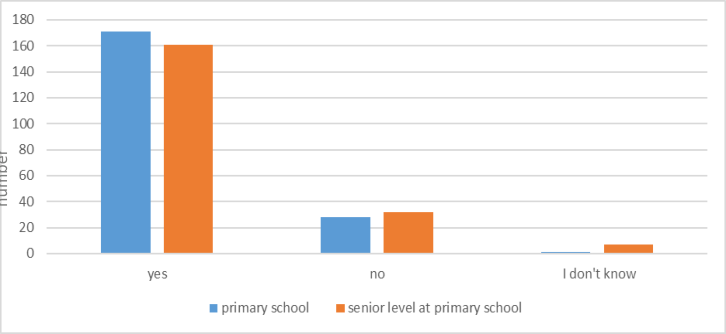
Figure 1. The responses to the question as to whether health and safety forms part of the lessons at primary school Is health and safety education part of the lessons in the junior level at primary school / the senior level at primary school?
Out of the total number of responses (200), 171 teachers stated that they taught health and safety in the junior school, while 28 teachers stated that they did not teach health and safety and 1 responded that they did not know. There was a similar question for senior school teachers, where 161 senior school teachers out of the total number of responses (200) stated that they taught health and safety in the senior school, while 32 teachers stated that they did not teach health and safety and 7 teachers responded that they did not know (see figure 1).
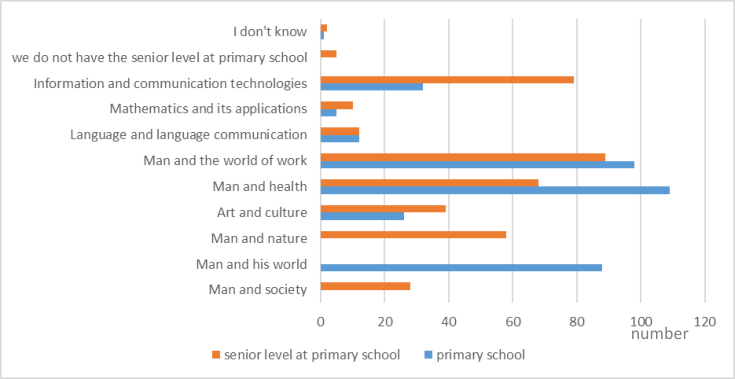
A supplementary question for both the junior and senior levels at primary school asked what educational areas this involved. The respondents from the junior level at primary school most frequently stated Man and Health, Man and his World and Man and the World of Work, while to a lesser extent this also involved Information and Communication Technology. The answers stating the areas Language and Linguistic Communication and Mathematics and its Applications, where the respondents would most probably not have been able to adequately incorporate the given topic, could be characterized as highly improbable and irrelevant. The respondents from the senior level at primary school likewise most frequently stated the areas of Information and Communication technology, Man and the World of Work, Man and Health and Man and Nature and to a lesser extent Man and Society. Once again, the answers stating the areas Language and Linguistic Communication and Mathematics and its Applications, where the respondents would most probably not have been able to adequately incorporate the given topic or where they merely associated it with a general statement on protecting health and safety, could be characterized as highly improbable and irrelevant. The areas of Man and Society and Man and Nature are not taught in the junior level at primary
Intelligent Human Systems Integration (IHSI 2022): Integrating People and Intelligent Systems https://openaccess.cms-conferences.org/#/publications/book/978-1-7923-8988-7 school, while the area of Man and his World is not taught in the senior level (see figure 2).
number
Figure 2. The realisation of health and safety by level and educational area at primary school Have any methodological guidelines been drawn up with regard to the issue of creating health and safety competencies in pupils?
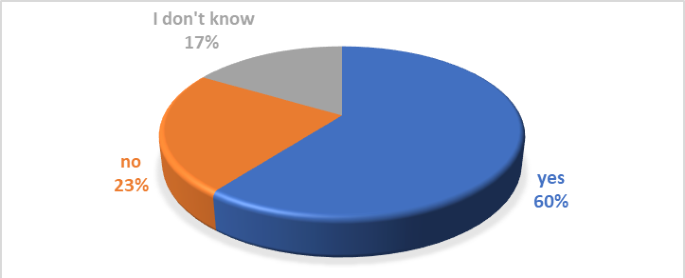
Out of the total number of responses (200), 121 teachers stated that they knew of methodological guidelines for health and safety, 46 teachers stated that they were not aware of having come across them and 33 teachers stated that they did not know (see figure 3).
Figure 3. Responses to the question as to whether any health and safety methodological guidelines have been prepared
Intelligent Human Systems Integration (IHSI 2022): Integrating People and Intelligent Systems https://openaccess.cms-conferences.org/#/publications/book/978-1-7923-8988-7
CONCLUSIONS
The health and safety preparation of pupils in primary school is a prerequisite for extending their competences in this area in secondary school, where they continue after leaving primary school. A good foundation will thus lead to appropriate practices and habits in the future, which will subsequently be reflected in the pupil's future professional life and, as such, in his or her acceptance of health and safety at work measures.
The logical solution to the whole process of preparing for occupational safety and health seems to be to include these issues in the curriculum for current and future teachers. It would be a good idea to involve other institutions specializing in these issues (e.g. the State Institute of Health, the Research Institute for Occupational Safety and Health, etc.) in the preparation of the curricula for current and future teachers, with a view to teaching pupils about health (occupational safety and health).
At the same time, the significant changes in the education system mean a new concept for the training of future teachers. Trainee teachers have always had to undergo a demanding preparation for the complex, dynamic and creative process of teaching, which needs to be fundamentally developed in terms of professional competences in theory, skills and personality. The same is true today, and one of these areas concerns health and safety education at work. This concept cannot, of course, do without the need to obtain information quickly and easily in large and targeted quantities. One of the fundamental problems in the field of occupational health and safety education is the discrepancy between the increasing volume of knowledge and (especially from a legal and legislative point of view) its practical application and the limited possibilities of school teaching. It is therefore necessary to look for ways to bridge this gap in the form of different approaches to the choice of curriculum, its integration into the didactic system and the choice of methods for presenting new knowledge in teaching.
REFERENCES
Černá, L., Brácha, J., Marek, V. & Kocián, J. (2002) Bezpečnost a ochrana zdraví při práci ve školách a školských zařízeních. Brno: MŠMT ČR ve spolupráci s IVBP v Brně. Dandová, E. (2008). Bezpečnost a ochrana zdraví dětí ve školách. Praha: ASPI, Řízení školy. Duke L. D. (2001) Creating Safe Schools for All Children. Pearson Feszterová, M. (2008). Bezpečnosť a ochrana zdravia při práci v laboratóriách. Nitra: UKF Nováková, Z. (2007). Bezpečnost a ochrana zdraví žáků na školách – školní a pracovní úrazy.
Olomouc: VUP Olomouc MPSV (2021). Český Focal Point pro bezpečnost a ochranu zdraví při práci., Website:: http://www.ceskyfocalpoint.cz/?page_id=6003
Intelligent Human Systems Integration (IHSI 2022): Integrating People and Intelligent Systems https://openaccess.cms-conferences.org/#/publications/book/978-1-7923-8988-7
MŠMT (2015). Rámcový vzdělávací program pro základní vzdělávání [Framework Educational Programme for Basic Education]. Available from: http://www.msmt.cz/vzdelavani/zakladni- vzdelavani/ucebni-dokumenty Paleček, M. (2002) Bezpečnost práce z pohledu evropské legislativy. VÚBP. Available from:
http://bozpinfo.cz/knihovna-bozp/citarna/clanky/bezpecnost_prace/p4020207.html Romaněnko, J. (2006). Bezpečnost a ochrana zdraví při práci ve školské praxi. Karviná: Paris. ŠPU (2015). Inovovaný štátny vzdelávací program pre 2. stupeň základných škôl. Website: https://www.statpedu.sk/sk/svp/inovovany-statny-vzdelavaci-program/inovovany-svp-2.stupen- zs/ Tomková, V., Feszterová, M., Bulla, R. & Depešová, J. (2019). BOZP pre školy a školské zariadenia:
príručka pre riaditeľov a zriaďovateľov ZŠ a SŠ. Bratislava: RAABE. Tomková, V. (2018). Kvalita vnútorného prostredia v školskej učebni a jej vplyv na výkon žiakov.
Technika a vzdelávanie, (7)2, pp. 2-4. Tomková, V. (2017). Detekcia možnosti vzniku pracovných úrazov pomocou analýzy rizík na pracovisku. Edukacja -Technika - Informatyka. (22)4, pp. 289-294. Tureková, I. & Depešová, J. (2019). Significance of Teacher Education in the Field of Occupational
Health and Safety. In. EDULEARN19, 11th International Conference on Education and New Learning Technologies July 1st-3rd, Palma, Mallorca, Spain, pp. 8576-8584 Tureková, I. & Bagalova, T. (2018). Knowledge and Experiences of Safety and Health Occupation Risks among Students. International Journal of Engineering Pedagogy, 8(5), pp. 108-120 Tureková, I., Lukáčová, D. & Bánesz, G. (2019). Lighting as an Important Factor of Students ́Work
Environment. International Journal of Engineering Pedagogy, (9)1, pp. 57-67.
Intelligent Human Systems Integration (IHSI 2022): Integrating People and Intelligent Systems https://openaccess.cms-conferences.org/#/publications/book/978-1-7923-8988-7
LISTED IN THE AHFE DIGITAL BOOKSTORE CATALOGUE
Explore the complete digital volume
Intelligent Human Systems Integration (IHSI 2022): Integrating People and Intelligent Systems
Read this individual research paper free through the original publisher, or explore the full digital proceedings book.
ISBN 978-1-7923-8988-7
Explore this ISBN in the AHFE Bookstore ↗Listed in the July 2026 bookstore catalogue; search by ISBN to confirm current availability · Digital book purchase optional