Yuan Jiang, Yan Zhang (2022). High performance micromixers by 3D printing based on split-and-recombine modules and twisted- architecture microchannel. In: Intelligent Human Systems Integration (IHSI 2022): Integrating People and Intelligent Systems. AHFE Open Access, vol. 22. https://doi.org/10.54941/ahfe1001085
Micromixers present essential roles in providing homogeneous mixtures in microfluidic systems. As the typical passive micromixers, the split-and-recombine (SAR) micromixer and twisted-architecture micromixer have the advantages of high mixing efficiency and low mixing consumption.To enhance the mixing performance , the twisted-architecture micromixer was optimized and improved by introducing 1 to 4 split-and-recombine modules. All micromixers in this work could be fabricated by LCD 3D printers, a rapid prototyping technology. Combined with mixing experiments and numerical simulation, it is proved that the mixing speed and mixing efficiency of these new micromixers are enhanced greatly. Among these new provided micromixers with a 10 mm mixing distance, the torsional micromixer with 4 split-and-recombine modules has the best mixing efficiency of more than 60% as well as a low mixing cost in the Reynolds number range of 0.1 to 100, which shows a quite good application prospects in the accurate and rapid microfluidic devices.
In recent years, microfluidic technology is more and more widely used in biochemical detection, chemical analysis, pharmaceutical research and other fields(Stone et al. 2004,
Dalili et al. 2019). Micromixer is one of the most important modules in LOC (Lab on a Chip) or micro total analysis system (μ-TAS), which is mainly used to produce homogeneous
mixture. Micromixers are usually divided into active mixers and passive mixers. Active micromixers usually need external energy sources, such as electric field, magnetic field and
sound field, while passive micromixers do not need external energy input, but they need to design complex channel geometry to enhance convection diffusion, enlarge convection area
or reduce diffusion distance(Nguyen et al. 2005, Bayareh et al. 2020). Compared with active micromixer, passive micromixer has the advantages of simple structure and easy control, so
more and more researchers pay attention to it.
Among all the passive micromixers, the split-and-recombine micromixer (SAR) and torsional micromixer have been extensively studied for their best mixing efficiency and
minimum mixing consumption. The SAR micromixer depends on multiple vertical separation and horizontal reorganization steps. If the initial fluid lamella has a thickness L0,
after n split-and-recombine units, the lamella will decrease to Ln = L0/2n, which will lead to the mixture time becomes Tn=T0/22n correspondingly(Chen et al. 2017, Husain et al.
2018). Torsional micromixer is a new type of micromixer. The wall of the flow channel is designed to be entangled with each other to guide the fluid flow along the spiral surface, so
that the fluid will rotates on the cross section, which not only strengthens the convection, but also expands the contact area between the fluids (Akar et al. 2021, Jafari et al. 2021).
Both of the above-mentioned micromixers have a wide range of applications, but both have a common disadvantage: the microchannel distance required to achieve sufficient mixing is
too long (larger than 20 mm). In this work, a novel mixcromixer with split-and-recombine units and twisted microchannel was designed where the layer thickness of different fluids
would be reduced before being stirred. The numerical simulations and mixing experiments have been conducted to evaluate the performance of newly designed micromixer based on
mixing efficiency and mixing distance. In addition, all micromixers in this work could be fabricated by LCD 3D printers. Differing from the traditional processing methods of
micromixer, including lithography, molding, laser ablation, micro-cutting and other methods, LCD 3D printing technology is an emerging and competitive method for rapid
manufacturing of micromixer devices, which supports micromixer design with more
Intelligent Human Systems Integration (IHSI 2022): Integrating People and Intelligent Systems https://openaccess.cms-conferences.org/#/publications/book/978-1-7923-8988-7 complex and diverse structures(Bhargava et al. 2017, Lavrentieva et al. 2020).
GEOMETRIC DESIGN OF MICROMIXERS AND
FABRICATION
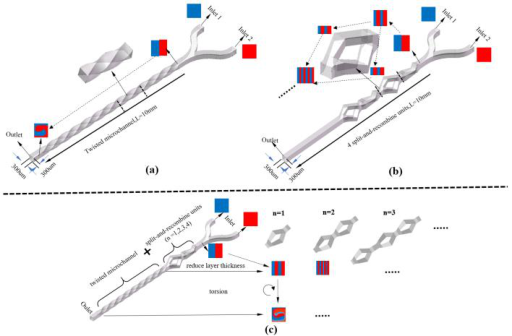
In Figure 1(a) and 1(b), the schematic diagram of geometry and action principles of torsional micromixer and SAR micromixer are presented respectively. Based on the Coanda Effect,
the fluid tends to flow along the surface of the microchannel , thus rotating continuously in a torsional microchannel in Figure 1(a). As shown in Figure 1(b), with repeated process of
separation and recombination, the two fluids will cross distribute with a reducing layer in a SAR micromixer. Figure 1(c) illustrates the micromixers provided in this work consisting of
split-and-recombine units and twisted microchannel with a total length 10 mm, which combines the advantages of the above two type micromixers. In the newly designed
micromixer, the length of each split-and-recombine units is 1.4mm, and the torsion angle of twisted microchannnel is 0.6 π.mm-1. According to the number of split-and-recombine units,
the designed micromixers are divided into 1SAR-T,2SAR-T,3SAR-T,4SAR-T.
Figure 1. The structures and mixing enhancement mechanism of variable micromixers. (a) micromixers with twisted-architecture; (b) micromixers with 4 split-and-recombine modules; (c) twisted micromixers with different numbers of split-and-recombine modules.
For experimental characterization of the mixing performance of passive micromixers provided in this work, torsional micromixers with split-and-recombine microstructures were
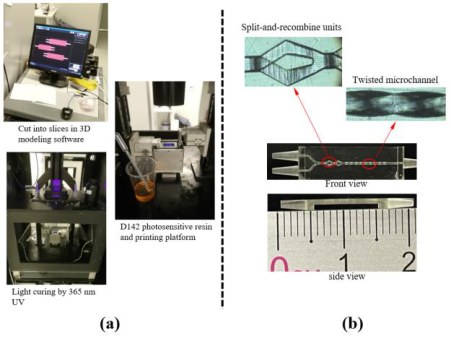
fabricated by LCD 3D printing. As shown in Figure 2, Micro-Np1 (produced by Prismlab Co., Ltd.) is a LCD light curing 3D printer with an optical wavelength of 365nm, a printing
Intelligent Human Systems Integration (IHSI 2022): Integrating People and Intelligent Systems https://openaccess.cms-conferences.org/#/publications/book/978-1-7923-8988-7 layer thickness of 5um, and a light source resolution of 5um. In addition, the photosensitive resin used in the printing process is D142 with a low viscosity and low light transmittance.
The 2SAR-T micromixer is also presented in Figure 2. Obviously, the designed micromixers have been successfully printed with a relatively smooth microchannel and complete
microstructures. The upper left side of the figure 2 is an enlarged view of a split-andrecombine unit, and the upper right side is an enlarged view of the twisted architecture
with some shadow structures caused by the boundaries between layers during printing. For microchannels printed by additive manufacturing , the dimensional error could be divided
into horizontal error (smaller, about ± 5um) and vertical error (larger, about ± 15um. In general, the micromixer fabricated by LCD 3D printing has not only clear and complete
microstructures, but also a small size error, which meets our design and experimental requirements.
Figure 2. The fabrication of micromixers by LCD 3D printing. (a) Micro-Np1 3D printer and D142 photosensitive resin; (b) physical images of 2SAR-T micromixer.
NUMBER SIMULATION AND EXPEIMENTS
The simulation software is COMSOL 5.6, and laminar flow and sparse material transfer module are applied. In laminar flow simulation, P2+P1 discrete mode is adopted for velocity
and pressure, while quadratic discrete mode is used for density of sparse material transfer module. The two modules are set as unidirectional coupling. The density ρ is 1000 kg.m-3,
the dynamic viscosity μ is 0.001 kg·m−1·s−1, and the diffusion coefficient D is 3e-10 m2·s-
1. The value of diffusion coefficient is basically the same as that of reagent in experiment.
To validate the numerical simulation, a mixing experiment was conducted, and the mixing
Intelligent Human Systems Integration (IHSI 2022): Integrating People and Intelligent Systems https://openaccess.cms-conferences.org/#/publications/book/978-1-7923-8988-7 index is usually calculated by measuring the color uniformity (light intensity) of the image at the outlet. The main devices for the experiment are syringe pumps (Kds Scientic LEGATO
100), CCD microscopic camera (Nikon ECLIPSE 80i), 0.5*1mm silicone tube, 10 ml syringe, and so on. The reagents used in the experiment include deionized water and edible
pigment,and the main components of edible pigment were sorbitol, glycerin, etc. In the experiment, 10 ~ 12 drops of pigment were dripped into 50 ml deionized water to prepare
different color solutions.
RESULTS AND ANALYSIS
The mixing of microfluidics is determined by diffusion time, diffusion distance, convection intensity and diffusion coefficient. Therefore, it is generally achieved to enhance mixing by
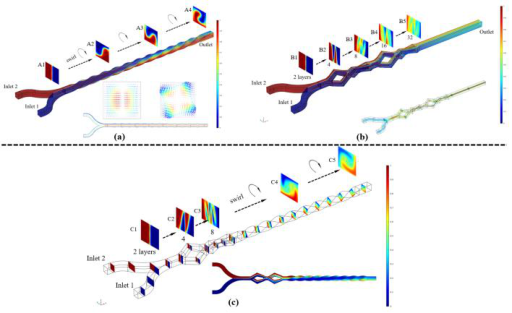
expanding contact area, reducing layer thickness and strengthening convection. Figure 3(a) depicts the action mechanism of the torsional micro mixer. At the inlet A, two fluids occupy
the left and right half of the rectangular section respectively while they begins to rotate around the axis after flowing into the twisted microchannel, resulting in that the fluids have
been twisted and wound together when reaching the outlet. It can be seen that on the one hand, the torsional architecture can expand the mixing contact area, on the other hand, it can
also strengthen convection by inducing stronger transverse secondary flow. Different from the twisting micromixer, it is obvious in Figure 3(b) that the two different fluids become four
layers in section B2 after passing through the first split-and-recombine unit, and become 8 layers in section B3 after passing through the the second split-and-recombine unit. By
analogy, the thickness of the two fluids is reduced by the exponential power of 2. Simply put, the SAR micromixer can continuously decompose the two fluids into 2n thinner
substreams. The above two type micromixers have their own advantages, but also have some disadvantages. The mixing enhancement of the torsional micro mixer is too weak, the SAR
micromixer requires a big quantity of split-and-recombine units, which will cause a larger pressure drop. Moreover, after multiple separation and recombination, it is still difficult for
the outermost fluids on both sides to participate in the mixing.
Intelligent Human Systems Integration (IHSI 2022): Integrating People and Intelligent Systems https://openaccess.cms-conferences.org/#/publications/book/978-1-7923-8988-7
Figure 3. Numerical simulation results of different micromixers at Re=1. (a) torsional micromixer; (b) 4SAR; (c) 2SAR-T.
Figure 3(c) illustrates the mixing process of 2SAR-T micromixer provided in this work. The number of fluid layers in section C3 rises from 2 to 8 after two split-and-recombine modules.
Then the fluids in different layers will rotate around each other as they flow into the torsional microchannel. From section C4 to section C5, the torsional degree of the fluid increases
rapidly, which indicates the fluid in the inner layer mixes continuously and effectively. At the same time, the fluids in the left and right edge layers attempt to transfer to the center with
rotation and begins to participate in the fluid mixing. Compared with SAR micromixer or torsional micromixer, this newly designed composite micromixer represents a significant
improvement, which is very useful for improving the performance of mixing.
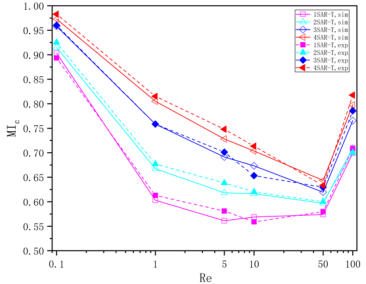
Figure 4. Mixing efficiency for the newly designed micromixers, solid lines correspond to simulation, dotted lines correspond to experiment.
Intelligent Human Systems Integration (IHSI 2022): Integrating People and Intelligent Systems https://openaccess.cms-conferences.org/#/publications/book/978-1-7923-8988-7
The numerical simulation and experimental results of twisted micromixers with different numbers of split-and-recombine units are plotted in Figure 4. Obviously, when the Reynolds
number rises from 0.1 to 100, the mixing index obtained by the simulation has a similar trend with that obtained in the experiment, and the error does not exceed 2%, which implies that
our mixing simulation can predict the true mixing process accurately.
Further analysis manifests the number of split-and-recombine operation has a significant impact on the mixing effect. Under the same Reynolds number, the mixing index will
increase with a larger number of split-and-recombine units especially when the Reynolds number is in the range of 0.1 to 50. Another important finding is that with the increase of
split-and-recombine modules, the improvement to mixture of the thickness of fluid layer becomes weaker and weaker. Therefore, it can be foreseen that when the number of split-
and-recombine modules increases to a certain value, the effect of reducing the layer thickness will be weakened to a negligible extent. This is because the layer thickness is no longer the
main factor affecting the mixing when the fluid layer thickness decreases to a certain value, and too many split-and-recombine elements will also shorten the torsional microchannel,
thus weakening the convection. In addition, the Reynolds number will also affect the mixing performance. The mixing index decreases when Reynolds number is between 0.1 and 50
while the mixing index increases when the Reynolds number is greater than 100. There are two underlying reasons: the larger the Reynolds number is, the faster the flow rate is and the
shorter the mixing time is. However, when the Reynolds number is greater than 50, Dean flow will greatly strengthens the convection of the fluid and plays a major role in mixing.
When the Reynolds number is equal to 100, the mixing index for the 4SAR-T micromixer increases to 85%.
CONCLUTIONS
A novel torsional micromixer with split-and-recombine modules is designed to enhance the mixing efficiency in a wide range of Re numbers. The 3D microstructure of the micromixers
was fabricated in photosensitive resin using LCD 3D printing technology. The effects of Reynolds number and the number of split-and-recombine units on mixing efficiency were
studied and analysed by numerical simulation and experiment. The major findings are summarized as follows:
• The provided micromixers with twisted architecture and split-and-recombine microstrucres can enhance the mixing efficiency dramatically. When flowing into
the twisted channel, different fluids in staggered distribution with thinner layer will swirl around the axis of the flow channel.The mixing of the inner fluids will be
Intelligent Human Systems Integration (IHSI 2022): Integrating People and Intelligent Systems https://openaccess.cms-conferences.org/#/publications/book/978-1-7923-8988-7
improved significantly due to a stronger convection, and the outer fluids will reach the center of the microchannel with rotation, participating in the mixing.
• The micromixers fabricated by LCD 3D printing not only has accurate and smooth microchannel, clear and transparent structure, rich and diverse microstructures, but also
has a fast manufacturing speed and simple process, which is of great significance for the research and popularization of microfluidic devices.
REFERENCE
Stone HA, Stroock AD, Ajdari A.(2004),“Engineering flows in small devices: Microfluidics toward a lab-on-a-chip.” Annual Review of Fluid Mechanics , 36, 381-
411.
Dalili A, Samiei E, Hoorfar M.(2019),“ A review of sorting, separation and isolation of cells and microbeads for biomedical applications.:microfluidic approaches. ”Analyst
,144(1) , 87-113.
Nguyen N.T, Wu ,Z.G.(2005), “Micromixers - a review.” Journal of Micromechanics and Microengineering,15,1-16 .
Lee C-Y, Chang C-L, Wang Y-N, Fu L-M.(2011),“Microfluidic Mixing: A Review.”
International Journal of Molecular Science, 12(5), 3263-87.
Bayareh M., Ashani M.N., Usefian ,A.(2020), “Active and passive micromixers: A comprehensive review.” Chemical Engineering and Processing-Process
Intensification ,147.
Chen X, Shen J.(2017), “Simulation and experimental analysis of a SAR micromixer with F-shape mixing units.” Analytical Methods, 9(12),1885-1890.
Chen X, Shen J.(2017),“ Numerical and experimental investigation on splitting-andrecombination micromixer with E-shape mixing units.” Microsystem Technology
Micro and Nano Systems Information Storage and Processing System, 23(10), 4671-
4677.
Gidde RR.(2021),“ On the computational analysis of short mixing length planar split and recombine micromixers for microfluidic applications.” International Journal of
Environmental Analytical Chemistry,101(1),79-94.
Hermann P, Timmermann J, Hoffmann M, Schlueter M, Hofmann C, Loeb P, et al.(2018),“ Optimization of a split and recombine micromixer by improved exploitation of
secondary flows.” Chemical Engineering Journal ,334,1996-2003.
Intelligent Human Systems Integration (IHSI 2022): Integrating People and Intelligent Systems https://openaccess.cms-conferences.org/#/publications/book/978-1-7923-8988-7
Husain A, Khan FA, Huda N, Ansari MA.(2018),“ Mixing performance of split-andrecombine micromixer with offset inlets.” Microsystem Technology Micro and Nano
Systems Information Storage and Processing System, 24(3),1511-23.
Akar S, Taheri A, Bazaz R, Warkiani E, Shaegh M.(2021), “Twisted architecture for enhancement of passive micromixing in a wide range of Reynolds numbers.”
Chemical Engineering and Processing-Process Intensification, 160.
Jafari O, Rahimi M, Kakavandi FH.(2016), “Liquid-liquid extraction in twisted micromixers.” Chemical Engineering and Processing-Process Intensification, 101,33-
40.
Bhargava KC, Ermagan R, Thompson B, Friedman A, Malmstadt N.(2017), “Modular, Discrete Micromixer Elements Fabricated by 3D Printing.” Micromachines, 8(5).
Bohr A, Boetker J, Wang Y, Jensen H, Rantanen J, Beck-Broichsitter M.(2017), “High- Throughput Fabrication of Nanocomplexes Using 3D-Printed Micromixers.” Journal
of Pharmaceutical Sciences 106(3),835-842.
Lavrentieva A, Fleischhammer T, Enders A, Pirmahboub H, Bahnemann J, Pepelanova I.(2020),“ Fabrication of Stiffness Gradients of GelMA Hydrogels Using a 3D Printed
Micromixer.” Macromolecule Bioscience ,20(7).
Intelligent Human Systems Integration (IHSI 2022): Integrating People and Intelligent Systems https://openaccess.cms-conferences.org/#/publications/book/978-1-7923-8988-7
LISTED IN THE AHFE DIGITAL BOOKSTORE CATALOGUE
Explore the complete digital volume
Intelligent Human Systems Integration (IHSI 2022): Integrating People and Intelligent Systems
Read this individual research paper free through the original publisher, or explore the full digital proceedings book.
ISBN 978-1-7923-8988-7
Explore this ISBN in the AHFE Bookstore ↗Listed in the July 2026 bookstore catalogue; search by ISBN to confirm current availability · Digital book purchase optional