Peng Lu, Hao Song, Bi Zhang, Jie Wang, Qingmei Zhu, Yan Zhang (2022). Simulation and Experiment of Hand-held Vacuum Cleaner Host Drop. In: Intelligent Human Systems Integration (IHSI 2022): Integrating People and Intelligent Systems. AHFE Open Access, vol. 22. https://doi.org/10.54941/ahfe1001091
Based on Hypermesh /LS-dyna, the drop simulation of the handheld vacuum cleaner host was carried out to simulate the phenomenon of part disengagement and structural deformation that may occur during the fall. A drop impact test bench containing three modules including posture control, data acquisition and motion analysis was built to test the impact resistance of the host prototype. The numerical simulation vividly shows the collision process of the handheld vacuum cleaner host, which is consistent with the phenomenon of part disengagement and structural deformation that occurred in the drop impact test. The impact force and acceleration peak values obtained by simulation and experiment are relatively close, which also verifies the reliability of the simulation. The impact resistance of the host was evaluated in this study, which helps reduce product development costs.
Intelligent Human Systems Integration (IHSI 2022): Integrating People and Intelligent Systems https://openaccess.cms-conferences.org/#/publications/book/978-1-7923-8988-7
INTRODUCTION
With the development of science and technology and the improvement of people's living standards, handheld vacuum cleaners, as professional indoor cleaning equipment, are rapidly spreading from abroad to domestic families, bringing users a lighter and faster experience (Sirimamilla et al. 2019, Yeh et al. 2014). However, hand-held vacuum cleaners will inevitably be subject to vibrations, impacts, collisions, etc., which may cause mechanical or functional damage to the product, such as shell cracks, loose parts, and collisions between parts. Vibration and shock will greatly affect the reliability of the product, and drop impact is the main cause of product damage (Pan et al. 2007).
At present, the research on product drop impact reliability at home and abroad is mainly divided into two types: drop impact experiment and finite element simulation. The traditional drop impact test not only consumes a lot of research and development time and cost, but also has many defects, such as: 1) The test experiment process is very short, and it is difficult to observe the phenomenon during the period.2) Test conditions (drop initial posture, etc.) are difficult to control and have poor repeatability. Generally, only simple surface, edge, and corner drops can be performed; 3) It is difficult to accurately measure the impact force, acceleration response and other parameters of the product during the fall process; 4) Traditional Generally, only the test results can be obtained from the drop experiment, and the root cause of the phenomenon cannot be observed (Zhou et al. 2008 , Mattila et al. 2014 and Ge et al. 2017) .Therefore, more and more researchers have begun to use finite element simulation software such as Radioss/ABAQUS/Autodyn/LS-dyna to simulate the process of product dropping. The combination of drop simulation and experiment has become a new trend in product reliability testing.
The hand-held vacuum cleaner has the advantage of being easy to disassemble, but it also comes with the risk of being easily damaged due to accidental fall. As the core component of a handheld vacuum cleaner, the structural impact resistance of the host is the focus of research. This paper combines the drop simulation and experiment to obtain the structural dynamic response of the host under the drop impact load, and evaluates its impact resistance, which provides a reference for subsequent structural improvements.
FINITE ELEMENT SIMULATION OF HOST DROP Geometry cleanup and model simplification
The initial geometric model has defects such as surface overlap, misalignment, and part interference, which requires geometric cleaning and model simplification. Geometric cleanup needs to remove small features such as fillets, chamfers, small holes, and text symbols in non-critical parts. In order to ensure the accuracy of the results, all stiffeners, buckles, and rounded corners near the collision location are retained. The simplification of the model mainly includes removing the circuit board and internal wiring; simplifying the
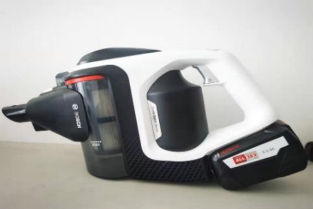
Intelligent Human Systems Integration (IHSI 2022): Integrating People and Intelligent Systems https://openaccess.cms-conferences.org/#/publications/book/978-1-7923-8988-7 internal parts of the battery; the internal fan is not easy to be damaged, so it is replaced with a simple rigid body of equal mass. At the same time, it is necessary to ensure that there is no big deviation between the center of mass of the host and the physical model, and the mass of the simplified finite element model and the host prototype is about 2 kilograms(Figure.1).
Figure 1. Host prototype (left) and finite element model (right).
Meshing and parameter setting Taking into account the complex structure of the model and the extremely uneven thickness distribution, tetrahedral meshing was carried out on most parts. After simplification of the model, a total of about 25 parts remained, and the total number of meshes is about 3.82 million.
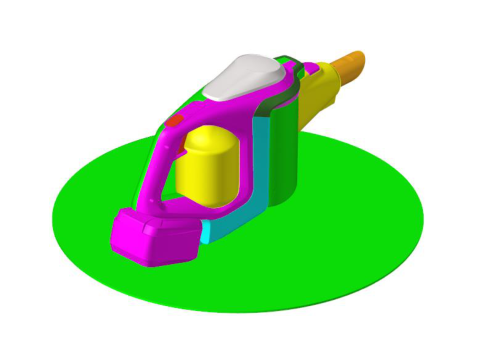
Considering that the host is freely falling from a height of 800 mm from the ground, in order to reduce the calculation time, the initial state of the simulation was set to 1 mm from the ground, and the speed of the host computer at this time was 3960 mm/s. The collision ground was semi-rigid PVC (Polyvinyl chloride) cushion. In the simulation, the impact force test bench was set as a fixed-supported disc with a diameter of 600 mm and a thickness of 3 mm, which was equally divided into 4 layers of units in the thickness direction(Figure.2).
Considering the calculation efficiency, the simulation duration was taken as 30 ms. In addition to the buckle connection of the model itself, the connection between host parts included screw connection and spring connection. Hyperbeam was used to define cross- sectional properties and combines beam elements and node rigid bodies to simulate the screw connection while springs were simulated by discrete elements. The contact setting adopted the most commonly used automatic contact in the collision process. Among them, the main machine parts adopted automatic single-sided contact, the static friction coefficient was 0.5, the dynamic friction coefficient was 0.4, and the automatic surface contact was adopted between the main machine and the ground, and the dynamic friction coefficient and the static friction coefficient were both Take 0.2.
Intelligent Human Systems Integration (IHSI 2022): Integrating People and Intelligent Systems https://openaccess.cms-conferences.org/#/publications/book/978-1-7923-8988-7
Figure 2. Drop simulation finite element model.
Material parameters The main materials of the host are ABS (Acrylonitrile butadiene styrene plastic),PC (Polycarbonate),PP (polypropylene) and other engineering plastics, as well as structural steel, semi-rigid PVC, etc. The parameters of plastic materials were obtained from the physical property table provided by the supplier, and some materials need to be subjected to material tensile tests. The main material properties are shown in Table 1 below.
Table 1: Main material properties Poisson's Material Elastic modulus ratio Density (g/cm3)
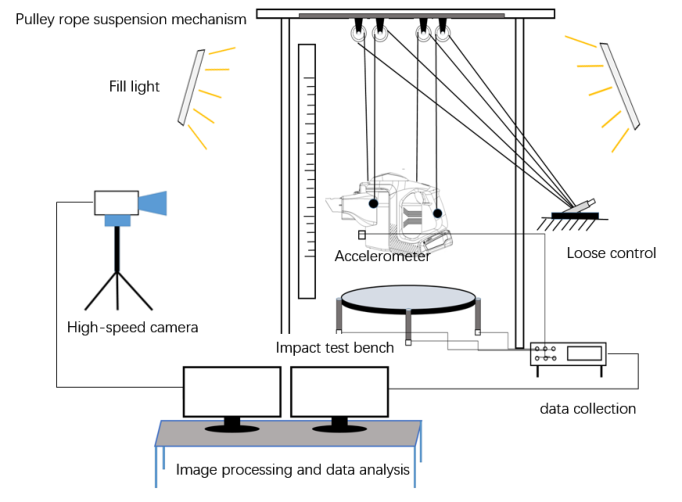
DROP IMPACT TEST The drop impact test mainly includes three modules: posture control, data acquisition, and motion analysis. Among them, pulley ropes were used with horizontal guide rails and fixed sticky hooks to control the host's drop posture. The data acquisition module including accelerometer, impact force test bench and M+P data acquisition system was used to detect the acceleration of the host computer and the impact force on the ground during the fall.
Intelligent Human Systems Integration (IHSI 2022): Integrating People and Intelligent Systems https://openaccess.cms-conferences.org/#/publications/book/978-1-7923-8988-7
High-speed cameras and image processing software were used to analyze the movement during the fall, observe and analyze the phenomenon of part disengagement and structural deformation that may occur in the experiment. Finally, the experimental results are compared with the simulation results to verify the reliability of the simulation, and the results are used for subsequent structural improvements. The schematic diagram of the test site is shown in Figure 3 below.
Figure 3. Schematic diagram of drop impact test.
RESULT ANALYSIS Analysis of the drop process of the host
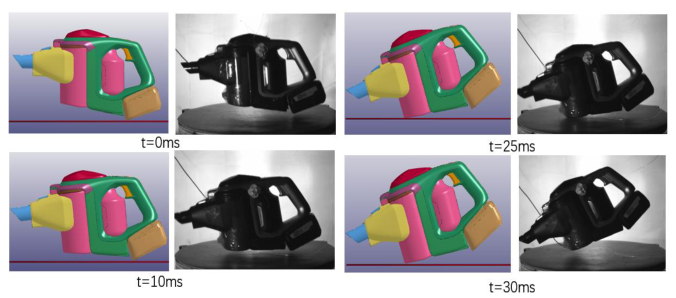
When the host falls, the battery first hits the ground and then rebounds. At this time, the bottom of the dust bucket of the left dust collector has not yet hit the ground, and the whole main unit rotates approximately counterclockwise. After the bottom of the dust bucket hits the ground, the whole host enters the rebound phase. It can be seen from the simulation animation(Figure.4) that the violent impact caused the overall dust collector to separate from the host, and the dust collector did fall off during the experiment.
Intelligent Human Systems Integration (IHSI 2022): Integrating People and Intelligent Systems https://openaccess.cms-conferences.org/#/publications/book/978-1-7923-8988-7
Figure 4. Analysis of the host's drop process.
Energy conversion diagram during drop The drop process is mainly divided into two processes: compression and rebound. The energy conversion diagram of the whole process can be obtained from the simulation post- processing, as shown in Figure 5 below. The compression process is mainly the conversion of potential energy into kinetic energy, and kinetic energy into internal energy (including elastic deformation energy and plastic deformation energy). In the rebound stage, the elastic deformation energy can be transformed into kinetic energy. Therefore, the kinetic energy and internal energy curves should be approximately symmetrically distributed. Due to the consideration of friction and damping, the model produces a larger slip interface energy, and finally the whole energy contains three parts: kinetic energy, internal energy and slip interface energy.
20000
17500
15000
Kinetic Energy Internal Energy Total Energy Hourglass Energy Sliding Energy
12500
10000
7500
Energy(N·mm)
5000
2500
0
0.000 0.005 0.010 0.015 0.020 0.025 0.030
Time(s)
Intelligent Human Systems Integration (IHSI 2022): Integrating People and Intelligent Systems https://openaccess.cms-conferences.org/#/publications/book/978-1-7923-8988-7
Figure 5. Energy conversion diagram during drop.
Figure available in the original PDF paper.
Stress and strain cloud diagram in the collision area The simulation adopts the ideal elastoplastic model, that is, it is considered that the part has the risk of plastic deformation when the equivalent stress of the material reaches the yield strength. It can be seen from the stress and strain cloud diagrams (Figure 6) of the two positions obtained by the simulation that when the host collides with the ground in this posture, in addition to the plastic deformation in the collision area (the lower end of the battery pack), the battery pack and the host shell. The connected buckle is also a dangerous area, and plastic deformation may also occur.
a) Host shell
b) Battery pack
Intelligent Human Systems Integration (IHSI 2022): Integrating People and Intelligent Systems https://openaccess.cms-conferences.org/#/publications/book/978-1-7923-8988-7
Figure 6. Equivalent stress of the host shell and the battery pack and diagram of damaged parts of drop impact test
Figure available in the original PDF paper.
Drop impact force and acceleration time history curve In the simulation, we can obtain the time history curve of the impact force of the collision between the host and the ground as shown in Figure 7. It can be seen that after the battery hits the ground, the impact force quickly reaches a peak value of about 5060 N. Until the 7.5 ms battery is separated from the ground, the curve has a trend of oscillation and attenuation. At 25 ms, the dust bucket collided with the ground again, but the impact force generated by this collision was much smaller than the result of the battery hitting the ground. It can be obtained from the simulation results that the maximum impact force during the drop process can reach 5060N, and the impact acceleration is about 260g.
Intelligent Human Systems Integration (IHSI 2022): Integrating People and Intelligent Systems https://openaccess.cms-conferences.org/#/publications/book/978-1-7923-8988-7
306.1
255.1
204.1
153.1
102.0
acceleration(g)
51.0
0.0
0.00 0.01 0.02 0.03
Time(s)
a) Time history curve of impact force and acceleration in simulation
Intelligent Human Systems Integration (IHSI 2022): Integrating People and Intelligent Systems https://openaccess.cms-conferences.org/#/publications/book/978-1-7923-8988-7
350
300
250
200
150
100
50
0
-50
Acceleration(g) -100 -150
-200 2.51 2.53 2.50 2.52 2.54 -250 Time(s)
b) Time history curve of impact force and acceleration in experiment
Figure 7. Comparison of simulation and experimental results From the drop impact experiment, the time history curve of the main engine hitting the ground can be obtained. The curve shows a half-sine wave decreasing as a whole, and the peak value is about 5567 N. The acceleration in the vertical direction during the main machine falling can be obtained from the acceleration sensor, Taking into account the influence of the sensor placement position, the time to reach the peak is slightly different, but the overall trend of sine wave attenuation is about 300g. Comparing the results of the experiment and the simulation, it can be found that the error of the impact force between the simulation and the experiment is about 9.1%, and the error of the acceleration is about 13.3%. Considering the complexity of the model, the error is acceptable.
Figure available in the original PDF paper.
CONCLUSIONS
The impact resistance performance of the host is quantitatively evaluated by a combination of drop simulation and experiment. The results show that the impact force of the main engine exceeds 5000 N and the impact acceleration is over 250g under this kind of falling posture. The simulation accurately simulates the falling process of the host, which is almost the same as the experimental process. At the same time, the part where the battery pack collides with the ground and the buckle at the connection position of the battery pack and the host will undergo plastic deformation. The subsequent structural improvement suggests that the outer packaging material of the battery pack should be optimized, and materials with better impact resistance, such as blending PC/ABS materials, etc., while appropriately increasing the thickness of the connection buckle or adding stiffeners.
Intelligent Human Systems Integration (IHSI 2022): Integrating People and Intelligent Systems https://openaccess.cms-conferences.org/#/publications/book/978-1-7923-8988-7
REFERENCES
Sirimamilla, A., Ye, H.,Wu, Y. (2019), “Phenomenological Modeling of Carpeted Surface for Drop Simulation of Portable Electronics.” Journal of Electronic Packaging. 141(2), 61—66. Yeh, M.K., Huang, T.H. (2014), “Drop Test and Finite Element Analysis of Test Board.”
Procedia Engineering. 79, 238—243. Pan, M.C., Chen, P.C. (2007), “Drop simulation/experimental verification and shock resistance improvement of TFT–LCD monitors.” Microelectronics Reliability. 47(12), 2249--2259. Zhou, C.Y. Yu, T.X. (2008), “Drop/impact tests and analysis of typical portable electronic
devices.” International Journal of Mechanical Sciences. 5(50), 905—917. Mattila, T.T., Vajavaara, L., Hokka, J. (2014), “Evaluation of the drop response of handheld electronic products.” Microelectronics Reliability. 54(3),601-609. Ge, Y., Zhang, L,X., Qian, Ying. (2017), “Dropping Simulation and Optimization of
Knapsack Saf flower Harvesting Machine.” Machine Design and Research. 33(2), 148—152.
Intelligent Human Systems Integration (IHSI 2022): Integrating People and Intelligent Systems https://openaccess.cms-conferences.org/#/publications/book/978-1-7923-8988-7
LISTED IN THE AHFE DIGITAL BOOKSTORE CATALOGUE
Explore the complete digital volume
Intelligent Human Systems Integration (IHSI 2022): Integrating People and Intelligent Systems
Read this individual research paper free through the original publisher, or explore the full digital proceedings book.
ISBN 978-1-7923-8988-7
Explore this ISBN in the AHFE Bookstore ↗Listed in the July 2026 bookstore catalogue; search by ISBN to confirm current availability · Digital book purchase optional