Maryam Alzaabi, Ahmed Shuhaiber (2022). The role of the AI availability and perceived risks on AI adoption and organizational values. In: Intelligent Human Systems Integration (IHSI 2022): Integrating People and Intelligent Systems. AHFE Open Access, vol. 22. https://doi.org/10.54941/ahfe1001043
Artificial intelligence (AI) is the simulation of human intelligence in various machines which are programmed to think like humans. AI could have many forms, such as Natural Language processing (NLP), expert systems, unsuper-vised learning, content extraction, question answering, image recognition, machine vision, speech to text and machine translation, and Robotics. De-spite the potential of AI technologies, little is known about its adoption by organizations worldwide, and especially in the Arab World and the Middle East. Thus, this research intends to investigate the relationships and the im-pact of the availability of AI technologies and the associated perceived risks on AI adoption in organizations and its perceived organizational values, and also considering two mediating variables: AI replacing humans and AI creat-ing jobs, in one Arab and Gulf country, the UAE. By reviewing the literature and describing the AI applications and services available in UAE, a research model was proposed and tested quantitatively on a sample of 150 employees who are familiar with organizational AI technologies. The results revealed that the availability of AI technologies significantly impacts organizations’ decisions to adopt those technologies in the UAE. In addition, the more the AI applications are available, the more the AI will be replacing humans in job positions and opportunities. On the other hand, perceived security, priva-cy, and technical risks can significantly influence organizations’ intentions to adopt AI technologies, and can, surprisingly, contribute to creating new job opportunities which serve the human side positively. The research concludes in some implications, limitation, and future directions.
Artificial intelligence (AI) is the simulation of human intelligence in various machines which are programmed to think like humans (Acemoglu and Restrepo, 2019). The main features of AI are problem-solving, acting reactively, prediction, and rule generation. The most advanced characteristic of AI is to take action for achieving a specific goal through an independent learning process (Dal Mas et al., 2019). AI involves advanced cognitive systems which are better than ordinary machine learning. It articulates explanations with answers through a network or in a robotic device. Artificial intelligence is different from human intelligence. The process of information is much faster than human intelligence. It uses only 2 watts of power and provides a more accurate result with highly objective (Acemoglu and Restrepo, 2019). There are three types of models concerned with AI, which are deep learning, machine learning, and neural networks. All the concerned types of AI have their specific features which can be identified as per their performance. Machine learning and deep learning are quite complex rather than neural networks (Lu et al.,2018). There are multifunctional capabilities associated with all three types by which the AI can dominate the traditional machine learning programs. AI can be of various forms, such as unsupervised learning, content extraction, question answering, image recognition, machine vision, speech to text, and machine translation.
AI could be also found in many forms and applications, such as Natural Language Processing (NLP), expert systems, planning system, and Robotics (Acemoglu and Restrepo, 2019). In detail, NLP for example, is a form of artificial intelligence that helps computers grasp, translate, and inspire human language. In its attempts to fill the void between human communication and computer comprehension, natural language processing is drawn from many fields, including computer science and computational linguistics(Lu et al.,2018). NLP enables computers to read, hear, interpret, quantify feelings, and recognize which sections are significant. One more example is the expert system, which mimics a person or organization's judgment and behavior, with expertise in a given area, by applying the know-how base to every situation that is defined to the program. Also, AI could be found in robotics which are used widely for basic routine tasks in many industries. Robot senses such as vision, touch, and sensing capacity can be like the human senses (Shuhaiber, 2020).
Intelligent Human Systems Integration (IHSI 2022): Integrating People and Intelligent Systems https://openaccess.cms-conferences.org/#/publications/book/978-1-7923-8988-7
Another major application of AI is the Internet of things which is based on open data (Shuhaiber et al., 2019). Due to the help of AI, the UAE implemented smart government, education, smart health, mobility, retail, agriculture, home, and intelligent energy. In the exclusive advancement of AI, the learning, reasoning, and self-correction method improved a lot (Alhashmi et al., 2019). The UAE is trying to develop more advanced machine learning which can be used in people's management (Almarzooqi, 2019; Al-Jundi et al., 2019). Therefore, the study aims to understand the adoption of AI and its application, associated risks, and perceived organizations’ values in the context of the UAE, and how they are correlated. This study will illustrate the impact of AI on UAE employment and job creation. There are significant recommendations that will be discussed in the study.
LITERATURE REVIEW
In the era of technological advancement, artificial intelligence is one of the effective intelligence technologies which can perform specific tasks (Akerkar, 2019). There is a wide range of applications associated with artificial intelligence in the context of the Arab world, specifically in the UAE. AI has been utilized in various activities related to healthcare, education, business, and autonomous vehicles (El Khatib, 2020). There is a wide range of events concerned with AI, which include medical diagnosis, robot control, remote sensing, image processing, and other electronic trading platforms (Alhashmi et al., 2019). Many business organizations are trying to implement useful AI applications for achieving business needs.
AI is one of the effective intelligence technologies which include learning, self- correction, and reasoning of the machines. According to Akerkar (2019), due to the advancement of artificial technology, the world is transformed in various aspects like socially, politically, and economically. The utilization of Artificial intelligence in the context of UAE can be categorized into four broad categories. The four main applications of AI are as healthcare, education, business, and transportation. However, the UAE is also implementing AI in different industries and applications, as described in the bullets below (Najdawi, 2020; Zaidan et al., 2020):
A robot to save lives on Dubai beaches: Dubai Municipality using this robot to save people’s lives from drowning. This robot has a safety system, and they designed it to resist the worst climatic situations. These robots can be used on the occasion of excessive waves or heavy ocean currents that are tough for human lifeguards to behavior rescue operations. One robot can save four to five human beings at the same time.
ADIB banking: AI makes the ADIB banking Application more useful, and we can use it to transfer money to anyone over the world by just using the Application without any effort.
Robot Lawyer: It is an electronic application that performs many of the tasks
Intelligent Human Systems Integration (IHSI 2022): Integrating People and Intelligent Systems https://openaccess.cms-conferences.org/#/publications/book/978-1-7923-8988-7
usually performed by lawyers such as reading documents and analyzing contracts, alerting them to defects and deficiencies, identifying risks, responsibilities, and obligations, giving legal defenses, and formulating arguments previously made for the judiciary to adopt and form Assumptions based on questions and input facts.
ADNOC: It is developing AI products for the energy sector. The story of this AI Application is the Agreement with Group 42, generating efficiency savings of up to $1 billion (Dh3.67bn) from 2017 levels and helping to reduce drilling time by 30 percent (Gnana, 2019).
Silicon Park: According to the AnNahar newspaper, in 2014, the UAE established the first integrated smart city project (Silicon Park). Dubai's first smart city, covering 150,000 square meters, costing 1.4 billion Dirhams for investment total. The project includes smart residential spaces of 46,000 square meters, corporate office spaces of 71,000 square meters, and other public services, as well as commercial spaces (Ajami, 2019).
SmartPass: An integrated platform for all services and information of government agencies in the United Arab Emirates. The SmartPass service allows you to access all government services in the United Arab Emirates, through one ID and one password through all federal and local portals in the country, without the need to use different usernames or passwords. This can be used to facilitate procedures for completing electronic transactions across all local and federal government agencies.
Given those successful AI applications taking place in UAE, one can ask: how could AI threaten humanism? Today all people enjoy the benefits of technological development. Medicine allowed curing many diseases and developing new effective medicine. Artificial Intelligence-powered smartphones, computers, and applications help people communicate, learn new information, purchase goods and services, and work (Burgess, 2017; Butcher and Beridze, 2019; Shuhaiber, 2020; Shrestha et al., 2019). However, many negative aspects of these technological improvements are missed by common users. Biotechnology and artificial intelligence offer many benefits, but these phenomena can also significantly harm humans, such as reducing job positions and increasing unemployment rates, providing security and privacy risks, the development of the new, improved, humans (DeCanio et al., 2016; Marr, 2018; Fleming et al., 2019; Li et al., 2020). For example, many talks about the opportunities to build super soldiers. Researchers can learn to manipulate human DNA to enhance the senses and physique (Marr, 2018). The new soldiers with the help of genetic and metabolic engineering would be able to cope better with extreme temperatures and environments and to process the information much faster. A variety of synthetic biological implants can help to change and improve the human body - allowing eyes to see in infra-red, or to hear in ultra-low and high frequencies (Fleming et al., 2019). The possibilities of such manipulations create great risks for safety. AI could be also unpredictable, uncontrolled, and lack human creativity in some
Intelligent Human Systems Integration (IHSI 2022): Integrating People and Intelligent Systems https://openaccess.cms-conferences.org/#/publications/book/978-1-7923-8988-7 situations (Li et al., 2020; Turchin, 2020).
Therefore, more details about the potential of AI and its impact on many real-life aspects in the UAE are required in order to understand its potential, growth, risks, and impacts from residents’ perspectives.
METHODOLOGY
This research followed a quantitative approach in order to understand the relationships between the adoption of AI technologies in organizations, perceived associated risks, technology availability, and organizational perceived values. The questionnaire included 20 items extracted from the relevant AI literature. The researchers considered the convenience sampling to approach respondents who are Emirate residents, older than 18 years, have sufficient knowledge about AI services and applications in organizations, and are willing to share their thoughts and opinions. The survey was available Online on Google forms, and the survey link was distributed among people of the UAE through social media, university learning portals, LinkedIn profiles, and other platforms. In total, 150 responses were found valid for analysis. In order to investigate the correlation among the research variables, the researchers considered the Structural Equation Modelling-Partial Least Squares approach (SEM- PLS), by using the SmartPLS3.0 software, which is an iterative process that provides consecutive estimates of loadings and structural parameters.
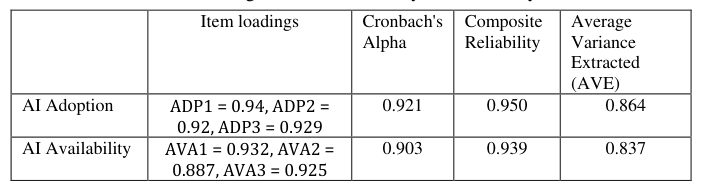
ANALYSIS AND RESULTS The structural results show that all item loadings exceed the cut-off point of .6 (Hair, 2021), demonstrating valid items. All item loadings could be found in Table 1. In addition, the reliability measures were examined. It is found that all constructs demonstrate reliability, since Cronbach’s Alpha scores were above the cut-off point of 0.7 (Hair, 2021). The constructs’ validity was also examined, and all scores of the AVE (Average Variance Estimated) were over the threshold point of 0.5, thus demonstrating convergent valid constructs. All constructs’ validity and reliability scores are shown in Table 1.
Table 1. Item Loadings, Constructs Validity and Reliability measures Item loadings Cronbach's Alpha Composite Reliability Average Variance Extracted (AVE) AI Adoption ADP1 = 0.94, ADP2 =
Intelligent Human Systems Integration (IHSI 2022): Integrating People and Intelligent Systems https://openaccess.cms-conferences.org/#/publications/book/978-1-7923-8988-7
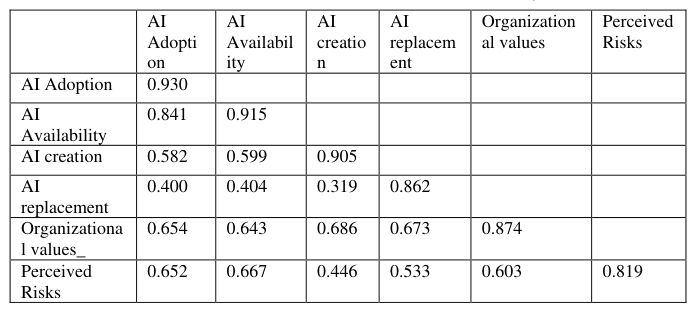
Furthermore, the intercorrelations among the variables and the discriminant validity were also assessed. As shown in Table 2, discriminant validity is demonstrated among all constructs are the diagonal scores SQRT(AVE) is greater than any correlation below it.
Table 2. Intercorrelations and discriminant validity Organization al values Perceived Risks AI Adopti on AI Availabil ity AI creatio n AI replacem ent
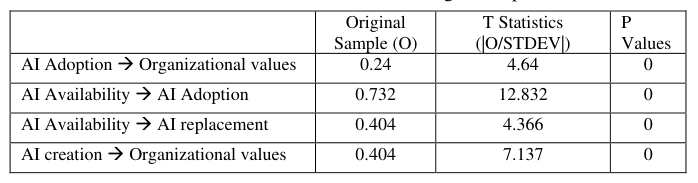
Finally, a bootstrapping algorithm was run to show the T-Statistics and path coefficients of the multiple regression equation. As a result, all paths were supported, as the p-values calculated were below the threshold score of 0.05 (Hair, 2021), as in Table 3.
Table 3. T-Statistics and P-Values of regression paths Original Sample (O) T Statistics (|O/STDEV|) P Values AI Adoption [Equation or mathematical symbol available in the original paper PDF] Organizational values 0.24 4.64 0
Intelligent Human Systems Integration (IHSI 2022): Integrating People and Intelligent Systems https://openaccess.cms-conferences.org/#/publications/book/978-1-7923-8988-7
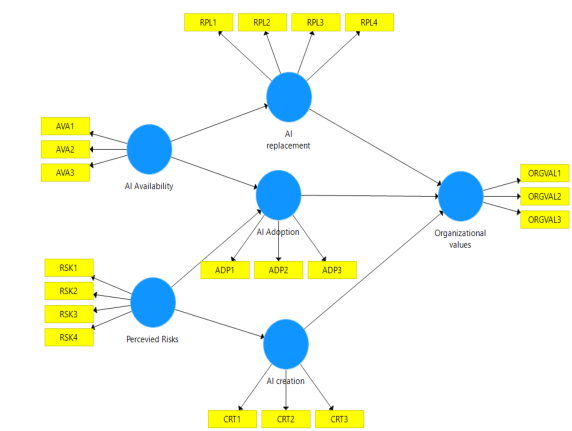
Figure 1 shows the tested and validated research model, as shown in SmartPLS3.0 statistical software.
Figure 1. Validated Research Model
DISCUSSION
The availability of AI technologies significantly impacts organizations’ decisions to adopt those technologies in the UAE. AI technologies should be available to many industries and aspects in order to provide a vast range of business solutions and intelligence. However, the more the AI applications are available, the more the AI will be replacing humans in job positions and opportunities. On the other hand, perceived security, privacy, and technical risks can significantly influence organizations’ intentions to adopt AI technologies and can also contribute to creating new job opportunities which serve the human side positively. This, in turn, can help in reducing the unemployment rate and provide new AI-relevant positions and working opportunities to the society.
In addition, adopting AI technologies would significantly impact some organizational values, such as reducing the number of employees for many organizations, increasing the efficiency of work for many organizations, and also creating a competitive
Intelligent Human Systems Integration (IHSI 2022): Integrating People and Intelligent Systems https://openaccess.cms-conferences.org/#/publications/book/978-1-7923-8988-7 advantage for the organization among its competitors in the UAE.
CONCLUSION
This study highlighted the impact of the availability of AI technologies and its associated risks to the adoption of those AI technologies in the UAE and consequently affecting organizational values. The availability of AI technologies can positively and significantly impact the number of job opportunities offered to the labor force. On the other hand, perceived risks such as security, privacy, and technical risks could the level of adoption of AI technologies by organizations but can also leverage the employment rate by offering more job offerings to the labor force.
The current research has some limitations. First, the results of that research are limited to the UAE context, where the level of AI technologies available in the market is considered high compared to other Arab and Middle Eastern countries. This opens the door for future research to test the proposed model in other contexts. Second, the researchers used the survey instrument which is vulnerable to sampling bias. However, the sampling bias was minimal due to the consistency of the research items with the relevant literature. Future research could be also interested in extending the current research model to include other AI-society aspects, such as the social norm and the culture to investigate their impact of adopting AI in organizations.
REFERENCES
Intelligent Human Systems Integration (IHSI 2022): Integrating People and Intelligent Systems https://openaccess.cms-conferences.org/#/publications/book/978-1-7923-8988-7 technologies. Insights from the Healthcare sector. In Proceedings of the first European Conference on the impact of Artificial Intelligence and Robotics (pp. 88- 95), 2019. DeCanio, S. J. Robots and humans–complements or substitutes?. Journal of
Intelligent Human Systems Integration (IHSI 2022): Integrating People and Intelligent Systems https://openaccess.cms-conferences.org/#/publications/book/978-1-7923-8988-7
LISTED IN THE AHFE DIGITAL BOOKSTORE CATALOGUE
Explore the complete digital volume
Intelligent Human Systems Integration (IHSI 2022): Integrating People and Intelligent Systems
Read this individual research paper free through the original publisher, or explore the full digital proceedings book.
ISBN 978-1-7923-8988-7
Explore this ISBN in the AHFE Bookstore ↗Listed in the July 2026 bookstore catalogue; search by ISBN to confirm current availability · Digital book purchase optional