Danah Al Ameri, Bashayer Almenhali, Sara Almarar, Ahmed Shuhaiber (2026). 'MoldVisor': AI-Based Mold Detection Technology for Proactive Building Maintenance. In: Sustainable Built Environment. AHFE Open Access, vol. 225, pp. 82–93. https://doi.org/10.54941/ahfe1007901
Mold growth in high-humidity environments presents persistent challenges to building integrity, maintenance costs, and occupant health, particularly in regions such as the United Arab Emirates where condensation and moisture accumulation are frequent. Existing mold detection approaches are largely reactive, relying on visual inspection or post-growth identification, which often leads to delayed intervention and increased structural and health risks. This paper presents MoldVisor, an AI-enabled mold recognition and monitoring system designed to identify early-stage mold risks before visible growth occurs. MoldVisor integrates thermal imaging, environmental sensing (humidity, temperature, volatile organic compounds), and edge AI algorithms to continuously analyze environmental patterns associated with mold development. By combining real-time data acquisition, predictive analytics, and intelligent risk assessment, the system enables proactive, condition-based building maintenance. The device architecture is informed by building maintenance requirements to ensure usability, operational efficiency, and scalability. Experimental evaluation demonstrates the potential of AI-driven sensing technologies to transform mold management from reactive detection to preventive intervention, improving building health, reducing maintenance efforts, and enhancing occupant well-being. The findings provide insights for the development of intelligent, technology-driven preventive maintenance solutions in smart buildings.
The presence of hidden mold growth is still an important issue in building management, especially in areas that are highly humid, poorly ventilated, and with high levels of condensation. This problem usually remains unnoticed until it develops further to posing risks to health and expensive property damage. Mold development is associated with many health complications, and this includes respiratory complications, allergies, and aggravated asthma that are becoming highly worrisome among occupants and property managers. Some of the most common ways to detect the presence of mold, such as visual assessment, moisture monitoring, and air testing are not good at detecting the initial signs of mold risk, particularly those in concealed
MoldVisor: AI-Based Mold Detection Technology for Proactive Building Maintenance 83 compartments, such as behind walls or within ceiling cavities (Martin- Sanchez et al., 2022).
To fill this gap, this project proposes a new, AI-based product, MoldVisor, which is an early mold detector based on thermal imaging, environmental sensing (humidity, temperature, volatile organic compounds), and machine learning algorithms. MoldVisor will provide a proactive solution to the problem of mold risks by using the latest technologies, so that building owners, facility managers, and residents can prevent the manifestation of the problem and health complications. Thus, this report outlines the reasons why the MoldVisor was developed, the underlying technologies, and the design thinking process applied to develop the device.
LITERATURE REVIEW
Mold Detection Technologies and Methods Visual inspection, moisture meter, and sampling have been common ways of identifying molds. These are reactive methods, although still in use, which are oftentimes discovered after the manifested symptoms or health have already been felt. As part of their study Dafico pointed out the fault of these traditional tools whereby, it is probable that they do not identify mold in hidden places that lead to late response and high costs (Dafico et al., 2023). The new technologies have introduced more active approaches due to the aid of the thermal-imaging equipment, environmental scanners, and AI algorithms which can detect the existence of the risks of mold before the appearance of the harm.
The use of thermal imaging as a method of identifying molds has received a lot of research due to the ability to identify moisture in dark spaces (Du et al., 2021). This process determines the variation of the temperatures because humidity collected behind walls or ceilings is often an indication of the presence of molds. This approach is, however, constrained. The accuracy of thermal imaging can depend on emissivity variations, ambient temperature, and moisture substance thickness (Himeur et al., 2020). To defeat them, it is suggested in recent research that thermal imaging be combined with other environmental sensors, such as humidity and VOC (volatile organic compounds) detectors, so that more accurate results can be obtained. One example is the multi-sensor technique that was developed (Salonvaara et al., 2023). The process involves the use of both thermal and humidity measurements to boost the degree of detection of molds. The practices can also be enhanced using AI integration, and the machine learning models can process sensor inputs to determine the risk of mold to prevent this risk and react to it in real-time.
Health and Building Maintenance Impacts of Indoor Mold House molds are not only a cosmetic problem but also a significant health hazard. The World Health Organization states that dampness and mold are some of the significant causes of respiratory diseases, including asthma
and allergic reactions (World Health Organization, 2009). The chronic respiratory complications may develop over a long term being exposed to molds, especially among vulnerable groups, e.g., young individuals, the aged, and individuals with respiratory-related complications. Humidity, which is usually found in buildings with mold, is also a contributor to health impacts. About building maintenance, the invisible mold can cause some severe damage to a building structure and material. Mold normally points to the existence of certain water problems such as dripping, condensation, or lack of sufficient air circulation. Failure to address the mold at the initial stages leads to costly repairs, decrease in property value, and potentially poor indoor air (Felipo et al., 2022). The economic cost of remediation of the molds can be high, especially in wet places where mold is a constant danger. Through this, early detection and prevention have a significant contribution towards minimizing health and maintenance costs.
Artificial Intelligence and Sensor Fusion in Building Health Monitoring The concept of artificial intelligence (AI) has gained significant relevance to the present building management systems, in particular, the identification of the presence of the risk of molds and moisture. The data obtained by various environmental sensors can be trained through machine learning algorithms where the trends and anomalies are identified, which can be used to indicate the presence of mold. In a study on previous inspection reports and the environmental characteristics researchers found that with the help of machine learning, it is already possible to predict the presence of dampness in buildings with an accuracy of more than 80 per cent (Aziz and Hardy, 2025). Similarly, Dafico applied AI to recreate moisture content of building material, and this would be useful in identifying the existence of mold, with the assistance of thermal data information (Dafico et al., 2023).
The other application that has been found to be helpful in the detection of the threat of the mold is the sensor fusion. It is possible to synthesize data of thermal cameras, humidity sensors, and VOC sensors, and investigate the nature of the environment in a building in real-time using AI models.The application of these sensors and indicated the importance of the use of a combination of data points to accomplish. the process of detecting a mold (Lyu, 2023). With the implementation of AI into such systems, risks of mold can be identified more precisely, and the risks in the future can be predicted using past trends and, therefore, preventive management and maintenance can be implemented.
Smart Indoor maintenance Quality (IEQ) Systems and Preventive Maintenance The utilization of smart building technologies has revolutionized the manner of controlling the mold and other problems in the building through integration of environmental monitoring systems. The management systems have also been equipped with sensors to check the Quality of Indoor Air
MoldVisor: AI-Based Mold Detection Technology for Proactive Building Maintenance 85 (IAQ) like temperature, humidity, carbon dioxide, and volatile organic compounds (VOC) that is then utilized to give real time information on a regular basis. Saini et al. (2020) also admit that they can also be employed to monitor environmental forces that might lead to the formation of molds and hence mold can be dealt with before it emerges.
Preventive maintenance is becoming popular through smart sensors that are applied in buildings that are prone to the development of molds. Using the example of Walker et al. (2024) demonstrated that an efficient combination of smart devices to monitor the humidity level and temperature in social homes could be implemented to reduce the risk of molds. Such systems are possible to relate to the building management systems which automatically control the HVAC systems or alert the facility managers about the condition when the environment is favorable to the development of the molds. These systems are also able to predict and preclude risks by combining AI, and it is a working and automated means of making indoors environments healthy.
Preventive Mold-Management Strategies Prevention of mold is very significant in reducing health risk and costs of maintaining molded buildings. The World Health Organization (2009) recommends that the level of humidity indoors should not be more than 60% to prevent growth of molds. It has been demonstrated by a study conducted that the regulation of the moisture level through improved ventilation, insulation, and sealing of building envelopes is a certain method of reducing the risk of mold development. Furthermore, it would be significant that the environmental conditions be regularly checked in ensuring that the risk of molds is managed. Such a proactive strategy helps facility managers to act in time before the problem of mold becomes a health or structural problem (Sousa et al., 2024).
Humid-Climate Building Contexts and Markets Opportunities Areas with a lot of humidity like the UAE and other GCC states pose special problems with detecting and preventing mold. According to Sousa et al. (2024), these areas have plenty of relative humidity, and this is where a mold thrives well. Also, the use of air conditioning systems which frequently result in condensation further increases the risk of mold.
There is a rising demand for smart mold detection solutions in such areas, owing to the increasing awareness of the health hazards of mold and the high cost of its eradication. The moisture-related problems with buildings in these areas are especially problematic, as pointed to by the author because of the structure and the way building materials are affected by the climate. MoldVisor device could be a viable solution since it is easily portable, user- friendly, and affordable early detection and monitoring device. Considering the current trend towards smart building technologies, there is an evident market potential of the proposed solution, such as MoldVisor, that can be easily integrated into the existing building management systems and provide actual-time mold risk detection (Lai, 2024).
METHODOLOGY
The development of MoldVisor followed a hybrid methodology combining the I-Team innovation framework and Design Thinking process. This integrated approach enabled structured system conceptualization, technology selection, iterative user-feedback refinement, and validation through prototype testing. The methodology emphasized multimodal sensing, AI-based interpretation, and usability.
I-Team Framework The I-Team framework assisted idea generation, technology evaluation, and challenge analysis. This framework included five core components: Challenge Topics, Creative Challenge, Human Needs, Combining Technology, and Pitch Canvas.
Industry and Core Problem Identification The selected industry most affected by mold is residential and facility- management services in humid regions like Abu Dhabi Island. To contain the problem, it was defined as Mold growth inside Schools. Thus, the target users were school administrators, Students, Teachers, Parents, and Staff. This phase established the technical objective of developing mold detection system.
Creative Challenge using Card Sorting A structured card sorting guided the brainstorming technologies process. The candidate technologies for solving mold detection challenge were: Applied Observability, Wireless Value Realization, Adaptive AI, Machine Vision, and Advanced Self-healing System. This phase identified the most feasible technological direction.
Human Needs Categorization Technologies were then sorted based on user need from Encouragement, Relationships, Entertainment, Convenience, Status, and Responsibility. This analysis ensured each technology was applied to these categorizes illustrating how these technologies will meet users’ needs by solving the problem of mold detection.
Combining Technology This stage envisioned how these technologies could work together with traditional methods of mold detection to create a next generation of mold detection.
Pitch Canvas The previous phases led to the creation of the first design prototype of MoldVisor using machine vision to automatically identify and treat mold through live feeds.
MoldVisor: AI-Based Mold Detection Technology for Proactive Building Maintenance 87 Design Thinking Framework
Following system conceptualization, the Design Thinking framework was applied refine and validate system functionality. The problem and users were updated before applying the framework to widen the system scope. Problem: Mold Growth in Buildings. Users: Residents and Professionals.
Empathy To understand the problem form user’s perspective an extensive review of the high impact of mold and it presence. The research resources translated the severity of Mold detection problems, mainly in humid areas like Abu Dhabi Island. This phase emphasized the emotional, financial, and health impacts mold can cause.
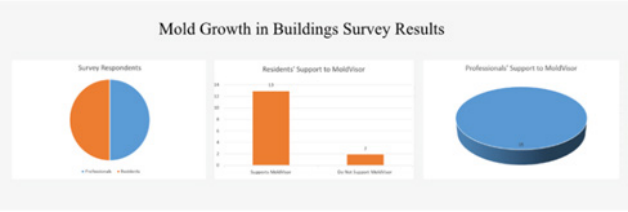
Problem Statements To identify of the problem a survey of 30 respondents of residents and safety staff, and professionals was conducted.
Figure 1: Infographic of mold growth in buildings survey results.
Figure 1 present the survey results. 68% experiences stress due to mold. 60% of residents experienced physical discomfort. 74% of respondents suffer allergies or respiratory issues. 58% of professionals feel pressured by constant complaints. 93% supported the idea of automated early detection system. Based on these findings, the refined problem statement was defined as: “The absence of an automated, proactive, and effective mold detection system.”
Ideate Three main solutions were proposed during the ideation stage: (1) a distributed IoT humidity-sensor network for ongoing monitoring; (2) indoor drones with environmental sensors for autonomous scanning; and (3) the MoldVisor Pencil, a portable AI device that combines micro-thermal imaging with environmental sensors. Every concept was assessed according to its technical feasibility, safety, user accessibility, portability, and scalability. IoT networks were limited by installation complexity, and while drones were posed because safety and operational challenges. The MoldVisor Pencil was selected due to its portability, affordability, ease of use, and ability to provide precise, real-time mold-risk assessment via AI-driven sensor integration.
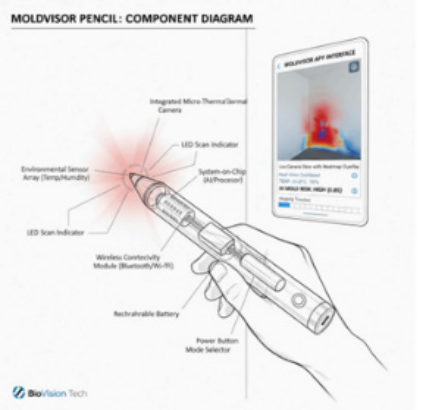
Prototype A conceptual prototype was developed, integrating the following Hardware and Software components (see Figure 2).
Figure 2: MoldVisor #1 Prototype. (Visualized using Google Gemini).
The MoldVisor hardware integrates multimodal sensing and embedded processing to support portable, non-destructive mold risk detection. A micro-thermal infrared camera captures surface temperature variations, enabling identification of thermal anomalies associated with concealed moisture within building materials, a condition strongly linked to mold development (Barreira, Almeida and Delgado, 2016). An environmental sensor array measures relative humidity, temperature, and volatile organic compounds (VOCs), providing contextual information required to assess environmental conditions favourable to mold growth and to reduce false interpretation of thermal data (Saini, Dutta and Marques, 2020), (Hayat et al., 2019). A system-on-chip (SoC) performs real-time data acquisition, sensor synchronization, and preprocessing at the edge, minimizing latency and energy consumption. System portability is supported by a rechargeable battery, while an LED scan indicator provides immediate visual feedback to guide consistent surface scanning. A wireless connectivity module enables real-time transmission of sensor data to a mobile device for visualization and storage. Collectively, these components enable reliable capture of thermal and environmental indicators associated with early-stage mold risk.
The MoldVisor software pipeline transforms sensor data into actionable information through real-time visualization and AI-based interpretation. A real-time thermal heatmap overlay displays spatial temperature variations to support rapid identification of anomalous regions during scanning. An AI generated Mold Risk Score fuses thermal and environmental features to provide a probabilistic assessment of mold favourable conditions rather
MoldVisor: AI-Based Mold Detection Technology for Proactive Building Maintenance 89 than relying on single-parameter thresholds. A humidity and temperature dashboard presents key environmental drivers of mold growth, while alerts and notifications inform users when predefined risk thresholds are exceeded. The system also includes data logging and historical records to support trend analysis and longitudinal monitoring, as well as cloud-based data sharing to enable access by property managers and facility professionals for documentation and maintenance decision-making.
Testing To test the prototype and gather user feedback residents and professionals were interviewed. Key results: 100% thought the tool was simple to use. 90% thought the app’s graphics were understandable. 85% thought the gadget would lessen mold issues. 70% asked for extra features like: vibration warnings, data exporting, scheduling reminders, extended battery life, and ergonomic grip.
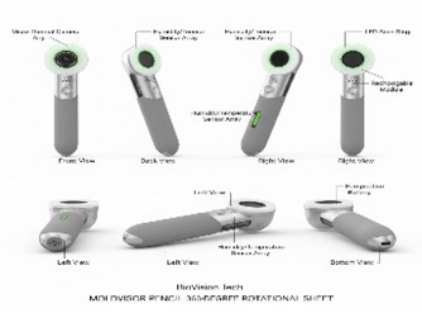
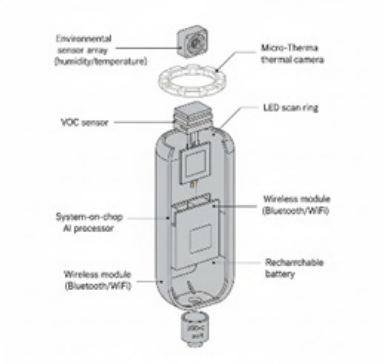
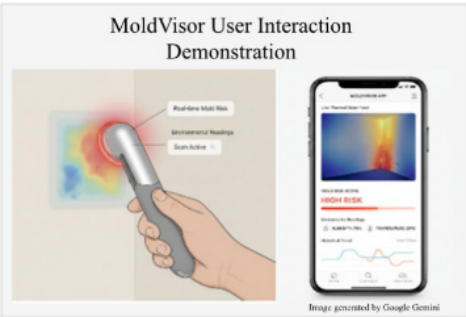
Figure 3: MoldVisor Rotational sheet. (Visualized using Google Gemini).Figure 4: MoldVisor Internal Structure. (Visualized using Google Gemini).Figure 5: Conceptual MoldVisor user interaction and mobile interface.
To incorporate users’ feedback, the new version of MoldVisor includes user refinements to ensure compatibility and portability. Figure 3 illustrates the external design and major components. Figure 4 shows the device’s internal structure and components alignment. Figure 5 depicts a user interaction along with the Mobile App Dashboard connected to the device.
DISCUSSION
Compared to traditional mold detection tools, such as visual inspection, moisture meters, and air sampling. MoldVisor is faster, accurate, and efficient. Studies note that these traditional tools often oversee hidden mold inside walls or ceilings (Dafico et al., 2023). MoldVisor overcomes this limitation by incorporating micro-thermal imaging with humidity, temperature, and VOC sensors for users to detect the temporal variation and environmental change observed in the mold during development prior to visible symptoms. This proactive capability sees MoldVisor as a practical improvement over reactive detection system.
Thermal imaging alone has been useful for mold and moisture identification; however, it is unable to provide specific properties of emissivity, ambient temperature, and moisture depth (Himeur et al., 2020). The literature indicates that using thermal imaging with environmental sensors significantly improves accuracy and reliability (Salonvaara et al., 2023). MoldVisor follows this approach by combining temperature, humidity, and VOC data into an AI-driven “Mold Risk Score,” which can provide more reliable measurements than single-sensor systems. In addition to its original thermal camera, MoldVisor’s integrated AI performs interpretive intelligence by translating raw data into actionable insights for residents and professionals without needing technical expertise.
Smart Indoor Environmental Quality systems and IoT sensor networks have strong potential to protect the indoor environment through monitoring moisture trends, predicting risks, and altering HVAC settings (Lyu, 2023), (Saini et al., 2020). But they are often very expensive, require high setup costs, or are integrated with building management systems, making them
MoldVisor: AI-Based Mold Detection Technology for Proactive Building Maintenance 91 inaccessible to most homes, schools, and small buildings. MoldVisor addresses this gap by providing real-time analytics that are only available in large-scale smart-building infrastructure. This makes it ideal for humid-climate markets regions such as the UAE and GCC, where mold risks are high, but budgets for complex systems may be limited (Sousa et al., 2024), (Lai, 2024).
CONCLUSION
In conclusion, this paper presented MoldVisor, an AI-driven mold detection system designed to address the persistent issue of hidden mold formation in buildings located in high-humidity environments such as the UAE. By integrating micro-thermal imaging, environmental sensing, and machine- learning analysis, the proposed system enables early identification of mold-prone conditions that are typically undetectable using conventional inspection methods. This proactive approach supports timely intervention, thereby reducing potential health risks and structural damage.
The proposed system demonstrates key advantages in terms of portability, affordability, and usability when compared to existing solutions such as professional thermal cameras and fixed IoT-based monitoring systems, which often involve high costs and complex installation requirements. MoldVisor provides real-time mold-risk assessment through a compact handheld device, improving accessibility to advanced detection technologies for routine building inspections. The system was developed using a Design Thinking methodology, incorporating user research, prototype testing, and iterative refinement to ensure both technical reliability and practical applicability.
LIMITATION AND FUTURE WORK Although MoldVisor demonstrates strong potential for early mold detection in high-humidity regions like the UAE, several limitations must be acknowledged. First, like other thermal-imaging and environmental- sensor systems, the device may face accuracy variability due to emissivity differences, ambient temperature shifts, and moisture depth limitations commonly reported in recent studies on mold detection technologies. Sensor fusion systems also require periodic calibration to maintain precision, as environmental readings can drift over time, especially in regions with extreme humidity. Additionally, MoldVisor currently relies on wireless connectivity for real-time data transfer, which may reduce performance in areas with unstable networks. Battery life is another constraint, as prolonged scanning of large buildings may exceed the device’s operational cycle. From a market perspective, MoldVisor competes with established solutions such as professional thermal cameras and fixed IoT systems, which, although expensive, are already used in large-scale facilities.
Future work will focus on reducing these limitations. Improved calibration procedures and the incorporation of UAE-specific thermal and humidity datasets will help enhance AI accuracy, consistent with research emphasizing localized environmental modelling. Offline, on-device AI processing will be introduced to reduce dependence on network connectivity, while upgraded
battery modules and power-saving mechanisms will extend field usability. Expanding hardware capabilities, such as wider scanning lenses, integrated VOC-sensitivity enhancements, and automated report-generation features will support professional building inspectors and facility managers.
Furthermore, the UAE provides a relevant real-world test environment due to its high humidity levels and diverse building infrastructures. Additional studies may assess the generalizability and robustness of the proposed approach across other humid regions, such as Southeast Asia and coastal regions of the United States, to evaluate model performance under varying climatic conditions. Such investigations would contribute to advancing AI-assisted preventive mold management in heterogeneous indoor environments.
REFERENCES
Abu Dhabi Chamber (n.d.) Home. Available at: https://www.abudhabichamber.ae/ Aziz, G. and Hardy, C. (2025) ‘A predictive model for damp risk in English housing using machine learning’, Scientific Reports, 15, p. 12345. https://doi.org/10.1038/ s41598-025-96396-7. Barreira, E., Almeida, R.M.S.F. and Delgado, J.M.P.Q. (2016) ‘Infrared thermography
for assessing moisture related phenomena in building components’, Construction and Building Materials, 110, pp. 251–269. https://doi.org/10.1016/j. conbuildmat.2016.02.026 . Dafico, L.C.M. et al. (2023) ‘Machine learning models applied to moisture assessment in building materials’, International Journal of Sustainable Built Environment, in press. Du, C. et al. (2021) ‘Indoor mould exposure: characteristics, influences and health
outcomes’, Environment International, 149, p. 106249. https://doi.org/10.1016/j. envint.2021.106249 . Felipo, R. et al. (2022) ‘Structural home defects are the leading cause of mould in residential buildings’, International Journal of Environmental Research and Public Health, 19, p. 1452. https://doi.org/10.3390/ijerph19041452 . FLIR Systems (2024) Infrared camera modules, lenses, & AI decision support.
Available at: https://oem.flir.com/ Hayat, H. et al. (2019) ‘The state-of-the-art of sensors and environmental monitoring technologies in buildings’, Sensors, 19(17), p. 3648. https://doi.org/10.3390/ s19173648 Himeur, Y., Ghanem, K., Alsalemi, A., Bensaali, F. and Amira, A. (2020) ‘Artificial
intelligence-based anomaly detection of energy consumption in buildings: A review, current trends and new perspectives’, arXiv. Available at: https://arxiv.org/ abs/2010.04560 Lai, Q. (2024) ‘Comparison of mould experiments on building materials’, Building and Environment, 229, p. 109917. https://doi.org/10.1016/j.buildenv.2024.109917 Lyu, J. (2023) ‘An assessment of the influencing factors promoting the development
of mould in buildings: A literature review’, Journal of Structural and Civil Engineering Analytics, 20, pp. 20–34. Martin-Sanchez, P.M., Núñez, M., Estensmo, E.L.F., Skrede, I. and Kauserud, H.
(2022) ‘Comparison of methods to identify and monitor mould damages in buildings’, Applied Sciences, 12(18), p. 9372. https://doi.org/10.3390/app1218937
MoldVisor: AI-Based Mold Detection Technology for Proactive Building Maintenance 93 Saini, J. et al. (2020) ‘A comprehensive review on indoor air quality monitoring’,
Sustainable Environment Research, 30, p. 29. https://doi.org/10.1186/s42834- 020-0047-y. Saini, J., Dutta, M. and Marques, G. (2020) ‘A comprehensive review on indoor air quality monitoring systems for enhanced public health’, Sustainable Environment Research, 30(1). https://doi.org/10.1186/s42834-020-0047-y Salonvaara, M. et al. (2023) ‘Application of machine-learning to assist a moisture-
durability tool’, Energies, 16(4), p. 2033. https://doi.org/10.3390/en16042033 Sousa, J. et al. (2024) ‘A systematic review about building characteristics as risk predictors for indoor mould growth’, Advances in Environment and Ecology Research, 5(1), p. 008. https://doi.org/10.3390/aeer-05-01-008 Walker, T. et al. (2024) ‘Indoor environment sensor systems for healthier homes:
feasibility in social housing’, Science of the Total Environment, 891, p. 164675. https://doi.org/10.1016/j.scitotenv.2024.164675. World Health Organization (2009) WHO guidelines for indoor air quality: dampness and mould. Geneva: WHO.
LISTED IN THE AHFE DIGITAL BOOKSTORE CATALOGUE
Explore the complete digital volume
Sustainable Built Environment
Read this individual research paper free through the original publisher, or explore the full digital proceedings book.
ISBN 979-8-950676-01-7
Explore this ISBN in the AHFE Bookstore ↗Listed in the July 2026 bookstore catalogue; search by ISBN to confirm current availability · Digital book purchase optional