Miguel Cobos, Carlos Borja (2021). Video game design to promote environmental conservation. In: Human Systems Engineering and Design (IHSED2021): Future Trends and Applications. AHFE Open Access, vol. 21. https://doi.org/10.54941/ahfe1001142
The objective of this research was to design a video game to promote environmental conservation in school children. This work was based on the SUM methodology as well as the considerations proposed by Schell and Rogers. Working meetings were held with the data obtained from the research instruments, aiming to place the project in a context close to the participants, so that the final product would be very familiar to them; then the characters that should also be within the context and the script as a key piece in the telling of the story were determined. To generate the video game design document, the recommendations made by Rogers were considered. In this project we have worked directly with the target audience, generating rapid prototypes that allowed the refinement of this, finally we obtained the design document, which will serve as the basis for its development. It is expected with this video game to get students interested in environmental conservation.
Human Systems Engineering and Design (IHSED 2021) https://openaccess.cms-conferences.org/#/publications/book/978-1-7923-8987-0
INTRODUCTION
Video games have revolutionized the world since their appearance, having a place in many fields. Education has made use of them to promote learning, get the interest of their students and make study a fun activity (García 2005).
(Rogers 2014) analyzes definitions proposed by various authors, contrasts them with his experience of what happens within a game, and defines it as an activity that requires at least one player, has rules and a victory condition. So, a video game is simply a game played on a video screen.
(Schell 2019) states that the game is not the experience, but it enables it; a magic happens when a video game is played and this gives the players a unique experience, which occurs in their minds.
At the present time, it is important to analyze player demand, what they want, (Schell 2019) proposes a series of questions in this regard, analyzing what players like and dislike, what they would like to find in a game. In any case, it is the target audience for whom a game is designed.
This work presents the design of a serious videogame oriented to school children focused on environmental conservation. For this purpose, recommendations proposed by important video game designers, their first steps, experiences and publications have been used.
The article is structured by presenting a second section with the methodology used, which describes how the proposal was arrived at. Section 3 shows in detail the proposal for the design of the video game. The results of the proposal are presented in section 4. Finally, section 5 presents the conclusions reached.
METHODOLOGY
This section describes the methods used in this study. Starting with conceptualization, pro- ject sketching, prototyping, building mechanics, fine-tuning and generating the game design document. Video game development process based on Scrum framework The Scrum framework is a methodology initially used in software development, which al- lows to reduce development time considerably. The proposed phases are Pre-game, Game, and Post-game phases (Saputra et al. 2021). Agile methodologies for video game development Based on the Scrum methodology, with the objective of formalizing the video game indus- try, (Acerenza et al. 2009) propose the SUM methodology. It includes five phases for de- velopment: concept, planning, elaboration, beta, and closure. This methodology describes
Human Systems Engineering and Design (IHSED 2021) https://openaccess.cms-conferences.org/#/publications/book/978-1-7923-8987-0 four roles for the functions of those involved, these are: developer, internal producer, client, beta tester, as well as sub-roles among which are described: developer, graphic artist, sound artist and game designer (Saputra et al. 2021). Video game concept For the concept of the video game, it is important to think about many aspects, to have the idea, the genre, the target audience, the platform on which it is intended to be played, the story, among others. (Rogers 2014) suggests some things you can do to get inspired, among them: read something you would not usually do, take a walk, take a shower, drive, attend a conference, play a video game, especially a bad one, get carried away by passion. He sug- gests brainstorming and breaking writer's block by finding ways to focus on having a clear idea. Video game design (Schell 2019) provides recommendations for the whole process of video game design, fun- damental bases that accompany the designer from the very beginning. On the other hand, (Rogers 2014) demonstrates a template for generating the game design document. (Adams and Dormans 2012) refer to the game design process in three stages: the conceptual stage, the elaboration stage, and the fine-tuning stage. These stages are very important, in the con- ceptual stage we work from the idea, sketch of the game, outline the story and other details. Then the elaboration stage, prototypes are elaborated, test of mechanics, adjustments. The fine-tuning stage consists of adjusting anything that is considered not fun, that the game does not need, mechanics are adjusted. In this step, the set of lenses proposed by (Schell 2019) can be applied to fine tune it. The rules The rules are those that define the game, determine what is allowed in it and lead to the objectives set. (Salen and Zimmerman 2003) define them as the formal structure of a game, as the set of abstract guidelines that describe how the game system works. Rules limit player action, rules are explicit and unambiguous, rules are shared by all players, rules are fixed, rules are binding, and rules are repeatable. Furthermore, they are classified into three types: Constitutive rules, Operational rules, Implicit rules. This classification allows us to under- stand how they work within a game. The mechanics (Adams and Dormans 2012) classify game mechanics into five different types: physical, internal economy, progression mechanisms, tactical maneuvering, and social interaction.
Human Systems Engineering and Design (IHSED 2021) https://openaccess.cms-conferences.org/#/publications/book/978-1-7923-8987-0
On the other hand, (Schell 2019) defines a taxonomy of game mechanics following the following categories: Space, Objects, Attributes, and States, actions, rules, skill and chance. Game flow The flow of the game consists of maintaining a balance between the player's abilities and challenges, according to the theory proposed by Csikszentmihalyi (Csikszentmihalyi 1991), so that the player does not feel that his skills allow him to easily meet the objectives of the game, on the other hand, he does not feel demotivated by not being able to meet certain challenges. (Caserman et al. 2020) place flow as a quality criterion for good playability. The characters Characters make video games able to tell great stories. (Schell 2019) states that magic hap- pens when the player controls a character, this is the avatar, the representation of the player within the game. He presents a series of ideas to follow to create compelling characters, these are: list character functions, define and use character traits, use the interpersonal cir- cumplex, make a character web, use status, use the power of the voice, use the power of the face, powerful stories transform characters, avoid the uncanny valley. In addition, (Rogers 2014) proposes recommendations for the physical appearance of the characters, to make them look friendly, enemies, strong, heroic, scary. It also guides on character customization such as name, appearance, weaponry, vehicles and so on. It also places recommendations for character proportions, height, weight, running speed, walking speed, jumping distance, types of jumps and many useful details to apply to the characters. Quality criteria for serious games (Caserman et al. 2020) identifies a set of quality criteria for serious games. There are two parts, the serious part, and the game part. Materials such as cardboard and plastic toys were used to develop prototypes of the scenario and characters, in this way it was possible to validate the focus on the goals, the achievements to be obtained in the proposed activities, and the flow of the player when involved in the game. A prototype was also made using the Unity videogame engine to contrast with the designs on paper, in this prototype it was pos- sible to incorporate sounds of free use (Bonilla Carranza et al. 2021). Game design document (GDD) Documenting the video game can be a stressful topic for many designers, but it must be considered that the design process concludes precisely in the presentation of the design document. (Rogers 2014) proposes a series of steps for documenting and generating the game design document. It establishes three steps to complete the design document, these are: Step 1 The One-Sheet, where basic initial data is placed at the beginning of the design.
Human Systems Engineering and Design (IHSED 2021) https://openaccess.cms-conferences.org/#/publications/book/978-1-7923-8987-0
This step contains: Game title, intended game systems, target age of players, intended En- tertainment Software Rating Board (ESRB) rating, a summary of the game’s story, focusing on gameplay, distinct modes of gameplay, unique selling points, competitive products. Step 2 The Ten-pager, is the backbone of the game, contains a quick overview of the important aspects of the design without going into detail. This step includes Page 1 - Title page, Page 2 – Game outline, Page 3 – Character, Page 4 – Gameplay, Page 5 – Game world, Page 6 – Game experience, Page 7 – Gameplay mechanics, Page 8 – Enemies, Page 9 – Cutscenes, Page 10 – Bonus materials. Step 3 The beat chart, this is a handy tool that provides a map of the game structure and allows you to quickly compare between levels. Finally, the game design document, based on steps 1 to 3 with additional technical infor- mation, such as: player metrics, Hud system, player skills, player inventory tools, health, rewards and economy, game progression outline. The following section presents the process of generating the video game design document.
PROPOSAL DEVELOPMENT This section describes the steps to reach the video game design document to promote envi- ronmental conservation. This work will comply with the principles of video game design, based on the methodologies and theories of video game design from its conception, devel- opment, refinement, until the game design document (GDD) is obtained. It is important to highlight that the target audience participated with their ideas for some decisions such as the type of character and elements of the environment. The design document developed complies with all the theoretical support previously men- tioned, in terms of extension, graphic elements, narrative, description of mechanics, con- trols, flow, progression and other elements, in accordance with the theme and proposal of this work (See Figure 1).
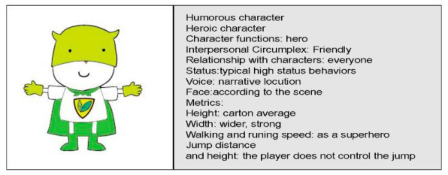
Figure 1. Steps of the Game Design Document based on Rogers’ model For the design of the main character, the humorous personality suggested by Rogers was used, in accordance with Schell's theme and theory for creating convincing characters. The character is a superhero who protects the environment (See Figure 2).
Figure available in the original PDF paper.
Human Systems Engineering and Design (IHSED 2021) https://openaccess.cms-conferences.org/#/publications/book/978-1-7923-8987-0
Figure 2. Character design and characteristics The mechanics are subjected to physical prototyping and software prototyping, then they are established according to the objectives of the game to place them in the Ten-pager and finally in the game design document (See Figure 3).
Figure available in the original PDF paper.
Figure 3. Mechanics used in the game The beat chart (See Figure 4) contains more detailed information on one page, allowing you to compare the flow of information within the game. This data helps to have an overview of the levels for future development.Figure 4. Beat chart of the videogame
Figure available in the original PDF paper.
Human Systems Engineering and Design (IHSED 2021) https://openaccess.cms-conferences.org/#/publications/book/978-1-7923-8987-0
RESULTS
The product falls into the category of serious games, therefore, metrics will be applied to determine if the video game has a balance between the serious part and the game part. (See Figure 5). The methodology developed by (Caserman et al. 2020) will be used. The proposal is presented to experts for analysis and evaluation, conclusions are drawn, and the report of this work is generated.
Figure 5. results of the expert review This data will allow to analyze the balance between the serious part and the game part with which decisions can be made towards the game design document.
Figure available in the original PDF paper.
Human Systems Engineering and Design (IHSED 2021) https://openaccess.cms-conferences.org/#/publications/book/978-1-7923-8987-0
CONCLUSIONS AND FUTURE WORK This video game design work, based on game design theories and existing methodologies, has allowed the involvement of designers, programmers, and target audience in the development of the game design document. Using video games as a resource to promote environmental conservation denotes how the use of research, methodologies, and existing material can contribute to generate serious video games that go beyond fun. The metrics used to determine the quality of the work do not guarantee its success, however, they are the basis for the development of the video game. In future work we want to develop the video game, validate its real functioning, apply it in schools and establish new lines of research related to the topic.
REFERENCES
Acerenza, N., Coppes, A., Mesa, G., Viera, A., Fernandez, E. and Laurenzo, T. (2009). Una Metodología para Desarrollo de Videojuegos., 2009, p.14. Adams, E. and Dormans, J. (2012). Game mechanics: advanced game design. Berkeley,
CA: New Riders. Bonilla Carranza, D., Peña Pérez Negrón, A. and Contreras, M. (2021). Videogame development training approach: A Virtual Reality and open-source perspective. JUCS - Jour- nal of Universal Computer Science, 27(2), pp.152–169. Caserman, P., Hoffmann, K., Müller, P., Schaub, M., Straßburg, K., Wiemeyer, J., Bruder,
R. and Göbel, S. (2020). Quality Criteria for Serious Games: Serious Part, Game Part, and Balance. JMIR Serious Games, 8(3), p.e19037. Csikszentmihalyi, M. (1991). Flow: the psychology of optimal experience. 1. HarperPerennial ed. New York: HarperPerennial. García, P. (2005). Fundamentos teóricos del juego. Sevilla: Wanceulen. Rogers, S. (2014). Level up! the guide to great video game design. 2nd ed. Chichester:
Wiley. Salen, K. and Zimmerman, E. (2003). Rules of play: game design fundamentals. Cambridge, Mass: MIT Press. Saputra, N., Tentua, M.N. and Sari, R.P. (2021). The Development of Web-Based Corre-
spondence Information Systems in University Using Scrum. Journal of Physics: Con- ference Series, 1823(1), p.012058. Schell, J. (2019). The art of game design: a book of lenses. Third edition. Boca Raton: Taylor & Francis, a CRC title, part of the Taylor & Francis imprint, a member of the Taylor & Francis Group, the academic division of T&F Informa, plc.
Human Systems Engineering and Design (IHSED 2021) https://openaccess.cms-conferences.org/#/publications/book/978-1-7923-8987-0
LISTED IN THE AHFE DIGITAL BOOKSTORE CATALOGUE
Explore the complete digital volume
Human Systems Engineering and Design (IHSED2021): Future Trends and Applications
Read this individual research paper free through the original publisher, or explore the full digital proceedings book.
ISBN 978-1-7923-8987-0
Explore this ISBN in the AHFE Bookstore ↗Listed in the July 2026 bookstore catalogue; search by ISBN to confirm current availability · Digital book purchase optional