Daniel Ripalda, Mario Piedra, Miguel Cobos (2021). Multimedia tool for the treatment of dyslexia and dyscalculia. In: Human Systems Engineering and Design (IHSED2021): Future Trends and Applications. AHFE Open Access, vol. 21. https://doi.org/10.54941/ahfe1001209
Specific learning disorders constitute a varied group of alterations or difficulties that can cause problems not only at school, but throughout life. These disorders can be evidenced, in the first years of schooling, when children present problems in reading, writing and numerical reasoning.Once the diagnosis is established, the experts develop treatments that generally require specialized teaching materials that, due to the technological gap, are often scarce, expensive and difficult to access, especially in developing countries. This study is based on the analysis of the skills that children with learning disorders have in front of the computer, with this information the tool GARABATO which in English means scribble. was conceptualized and developed. It is a multimedia tool developed in Unity that offers the possibility that children and therapists can develop exercises as part of the treatment of dyslexia and dyscalculia, using drawing as a developmental catalyst. This paper describes the tool design process, its development and implementation; In addition, it offers a comparison of results with other teaching materials, measuring the progress of children in specific areas and competencies that are part of the treatment.
There are a variety of Specific Learning Disabilities (DEA), among them dyslexia is defined as a disorder that involves oral and written comprehension of language; the associated problems can be identified in the schooling stage and involve the pairs of thinking, speaking, reading, writing and difficulty in recognizing symbols (Galaburda & Cestnick, 2003). In developing countries, this disorder is found among 8% of the
Human Systems Engineering and Design (IHSED 2021) https://openaccess.cms-conferences.org/#/publications/book/978-1-7923-8987-0 school population (Artigas-Pallarés, 2002) and constitutes a factor for dropping out of school. On the other hand, dyscalculia (Álvareza & Brotóns, 2018) manifests itself in the difficulty to understand and learn the mathematics and number concepts underlying basic arithmetic (Geary, 2017).
The most appropriate type of treatment is analyzed according to the case, the therapist may use traditional teaching materials or innovative techniques such as multimedia tools that integrate images, sounds, videos, texts. In general, the educational resources used in the treatment of specific learning disorders must be motivating, attract the attention of the student, and have professional, specialized support, they must be applied in a personalized way, according to the needs of each child, and evaluate their performance particularly. In Ecuador, the treatments for these conditions, especially in the most vulnerable population, are not completely resolved because the accompaniment processes to the therapies and the use of didactic material are deficient, expensive, and not very accessible. Faced with this reality, the Sinsoluka Foundation, which is aimed at children and youth living on the street, allows children who manifest these conditions to return to school, receiving specific diagnoses and treatment for learning disorders.
RELATED WORK
Different applications allow working on reinforcements for dyscalculia and dyslexia therapies, which can be found in different operating systems in force, which are very useful for specialists to work with children or adolescents with learning disorders, but to access some of these applications it is necessary to pay, so they are not accessible to all users or have limited activities that do not allow focusing on the various treatment areas. There is evidence of a great variety of investigations related to the subject that present solutions for the treatment of dyscalculia and dyslexia, through different proposals, using multimedia. Carolina Izquierdo developed a product containing a book and a video game (Izquierdo & Rodas, 2015), these two supports it is intended to reinforce the cognitive area, motor perception, writing, and reading. Another interesting work is the one developed by Karina Sánchez, which was aimed at establishing technological educational strategies to help children with dyscalculia in the first year of basic education (Sánchez, 2016), through development of didactic resources to perform basic mathematical operations.
In addition to these local investigations, there are technological applications such as Dytective, which is a multiplatform app developed by Change dyslexia (Rello & Ballesteros, 2016), which allows detecting if the user has risks of dyslexia through a series of games that vary in difficulty according to age, artificial intelligence allows to detect errors to strengthen in specific areas of the language. Another interesting application is Galexia (Serrano, Sánchez & Olmedo, 2016) which consists of twenty- four sections that are presented to the student as a story, the activities are divided into four phases, structured sequentially that increase the difficulty as the student
Human Systems Engineering and Design (IHSED 2021) https://openaccess.cms-conferences.org/#/publications/book/978-1-7923-8987-0 progresses. In addition to these applications, some methods can apply to tools, such as Binding (Albir-Mañanés) designed to improve comprehension and reading fluency, which allows easy recognition of letters, long words, morphology, and vocabulary.
METHODOLOGY
The research team proposed a quasi-experimental study (Hmelo-Silver, 2019), divided into two stages: The first made it possible to evaluate the technological skills of children diagnosed with dyslexia and dyscalculia (Meiselwitz & Trajkovski, 2006) to understand the particularities of the tool so that it would be effective in treatment, and a second stage that involved students from the Sinsoluka Foundation conducting tests on the tool that was produced. To carry out this work, we had a team of experts in preschool education, a psychologist, an expert in psycho-rehabilitation, a resource design team, and a group of programmers.
Analysis of technological competences This evaluation was carried out to measure the skills that children have when manipulating a computer or device, through some tasks that determined the use of the mouse, such as when dragging and dropping an object in a place specific. Under- standing of an animation, typing on the keyboard, and how long it takes to search the internet for a specific topic was also measured. The evaluations of each activity were carried out in two sessions, individually, under the supervision of a therapist and video recording. The data were analyzed by the specialists, who determined the activities that are most effective for children with specific learning disorders. Multimedia Activities for Dyslexia
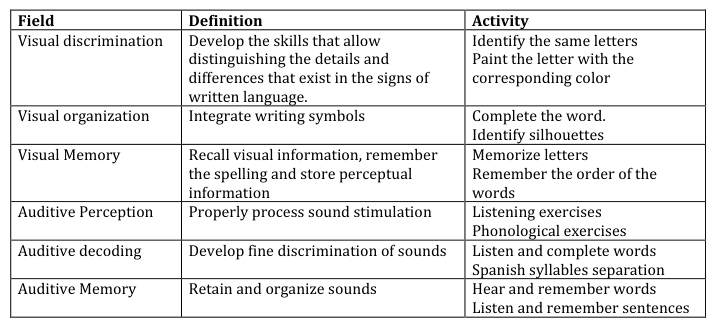
Table 1. Activities included in the application for the treatment of dyslexia
Human Systems Engineering and Design (IHSED 2021) https://openaccess.cms-conferences.org/#/publications/book/978-1-7923-8987-0
The activities of the tool were defined according to table 1. The technical team determined that for the treatment of Dyslexia, the multimedia tool would incorporate activities of a special kind to reinforce the disorders of the Lexia Route; while for the audio linguistic disorder, in which the student cannot carry out the phonological reading process, it is necessary to strengthen the connections between the visual analysis of the graphene and the phoneme level. Multimedia Activities for Dyscalculia In the case of Dyscalculia, the team decided to adopt the approach that the inability to handle arithmetic symbols and mathematical operations underlies the understanding of logic and mathematical reasoning, the activities were defined:
Table 2. Activities included in the application for the treatment of dyscalculia
RESULTS
For the development of the application, Unity technology [12] was used, using the SCRUM [13]agile development methodology with which the analysis, design, high and low fidelity prototypes, development, and user experience tests [14]. Children were defined as primary profiles and therapists as secondary. The application has mechanisms for validating the profiles, supporting and securing the data. The resulting application was called Gabarato, which is oriented mainly for touch and mobile devices; The application avoids the user having to resort to the use of peripherals, double-clicking, or dragging elements of the interface. From the previous study of skills, it was possible to understand that children who have these conditions have problems typing on the keyboard, so this device was eliminated, and all functions are solved from the interface. The scores of each exercise are registered in the applications and are recorded in the profile of each student. To measure progress, results can be accessed through passwords, all reports are accessible from the therapists' profile. The navigation diagram also defines those users who can select the level of difficulty in the activities; the design of the user experience is based on a linear structure, which allows each user to advance in the sequences once they have previously completed an activity. The hierarchy scheme defines first the options for dyslexia and then those for dyscalculia; later the categories of the activities are established and finally the levels of difficulty. In figure 1 you can see the main interface of the application with the different exercises by treatment area. You can also see the difficulty level selector for each of the programmed exercises
Human Systems Engineering and Design (IHSED 2021) https://openaccess.cms-conferences.org/#/publications/book/978-1-7923-8987-0
Fig. 1. Access interface and difficulty selector
Figure 2 shows a character identification exercise for which the pointing mechanism is used as part of the therapy for visual discrimination. For the different levels of difficulty, illustrations, interfaces, and specific interactions were used, the simplest being those in which it is indicated, even the most complex in which the characters are smaller, and the user has to establish the destination of an animated element.
Fig. 2. Letter identification activities
Figure 3 shows exercises that at the lowest level of difficulty allow exercising the ability to identify silhouettes, while at the highest levels of difficulty, children are asked to recognize and memorize letters, these activities. About dyscalculia, activities reinforce mathematical logic, number construction, and basic operations.
Human Systems Engineering and Design (IHSED 2021) https://openaccess.cms-conferences.org/#/publications/book/978-1-7923-8987-0
Fig. 3. Dyslexia and dyscalculia activity interfaces
Figure 4 shows the development team during user experience tests and evidence of application tests in a therapeutic environment, carried out on children who were diagnosed with dyslexia.
Fig. 4. User experience tests with experts and children from Sinsoluka
CONCLUSIONS
The Scribble tool, developed by the Indoamerica University research team, was built complying with all the protocols required by the methodology to produce more modern multimedia tools. The multidisciplinary team positively resolved several of the problems that this type of applications present, since in the activities proposed, they not only considered the therapeutic aspects, but also the conditions of the users, their tastes, limitations, and potential for progress. The use of this tool, as part of a therapy related to specific learning disorders, should be supervised by specialists, in short sessions and should include additional support material. This work fulfills an important social function since it is being implemented in specialized institutions at no cost.
FUTURE WORK
Gabarato is still in the evaluation process, the development team is now concentrating its efforts on comparatively measuring the effectiveness of the tool concerning other options available in the market. It is still necessary to determine the impact of the application at an educational and social level, as well as the groups in which it could be more effective considering the level of schooling, age, and potential for access to technology.
Human Systems Engineering and Design (IHSED 2021) https://openaccess.cms-conferences.org/#/publications/book/978-1-7923-8987-0
REFERENCES
Albir-Mañanés. (s.f.). Aplicación del método Binding en el proceso de aprendizaje de la lectura de un niño con Trastorno Específico del Lenguaje. Master's thesis. Álvareza & Brotóns. (2018). Dislexia y discalculia: una revisión sistemática actual
desde la neurogenética. U Psychologica. Artigas-Pallarés. (2002). Problemas asociados a la dislexia. Revista de neurología, 7-13. Galaburda & Cestnick. (2003). Dislexia del desarrollo. Revista de neurología, 3-9. Geary. (2017). La discalculia en edad temprana. Enciclopedia infantes. Hmelo-Silver. (2019). Systems learning with a conceptual representation.
Instructional Science, 53-72. Izquierdo & Rodas. (2015). Diseño gráfico de un producto editorial y multimedia que busque mejorar el aprendizaje de los niños con dislexia. Bachelor's thesis. Juliani, A., Berges, V. P., Teng, E., Cohen, A. (2018). Unity: A general platform for
intelligent agents. arXiv. Li, Y., & Liu, C. (2021). User Experience Research and Analysis Based on Usability Testing Methods. Advances in Graphic Communication, Printing and Packaging Technology and Materials, 263-267. Meiselwitz & Trajkovski. (2006). Effects of computer competency on usability and
learning experience in online learning environments. Seventh ACIS International Conference on Software Engineering, Artificial Intelligence, Networking, and Parallel/Distributed Computing(339-342). Rello & Ballesteros. (2016). Dytective: diagnosing the risk of dyslexia with a game.
PervasiveHealth, 89-96. Sánchez. (2016). La discalculia como trastorno de aprendizaje de las matemáticas en los niños de primer año de educación básica en la escuela Dra. Maura Castro de Marín. Schwaber, K., & Beedle, M. (2002). Agile software development with Scrum.
Upper Saddle River: Prentice-Hall. Serrano, Sánchez & Olmedo. (2016). Galexia: Evidence-based software for intervention in reading fluency and comprehension. INTED2016 Proceedings.
Human Systems Engineering and Design (IHSED 2021) https://openaccess.cms-conferences.org/#/publications/book/978-1-7923-8987-0
LISTED IN THE AHFE DIGITAL BOOKSTORE CATALOGUE
Explore the complete digital volume
Human Systems Engineering and Design (IHSED2021): Future Trends and Applications
Read this individual research paper free through the original publisher, or explore the full digital proceedings book.
ISBN 978-1-7923-8987-0
Explore this ISBN in the AHFE Bookstore ↗Listed in the July 2026 bookstore catalogue; search by ISBN to confirm current availability · Digital book purchase optional