Daniela Zumarraga, Frank Bernal, Cristian Darquea, Mauricio Unda (2021). Trends in Specialization for Health Infrastructures: Design of a Hospital for the Elderly in the Parish of Calderon, Quito for Preparation of Your Own. In: Human Systems Engineering and Design (IHSED2021): Future Trends and Applications. AHFE Open Access, vol. 21. https://doi.org/10.54941/ahfe1001131
In the city of Quito-Ecuador, the public health system does not have specialized infrastructure to treat certain conditions of the elderly, in addition to this, the COVID 19 pandemic has collapsed health systems around the world. In this context, this article presents an architectural design proposal for a specialization hospital for the elderly with the aim of responding from academia to this problem. A mixed research methodology is applied with socio-spatial analysis of the health care reality of the elderly and exploration in a hospital prototype design according to the needs detected in the socio-spatial analysis. As a result, it is found that the Calderon Parish in Quito is the area with the greatest deficit of hospitals for the elderly and digital design is an indispensable tool when viewing innovative architectural projects with a specialized function.
Currently, in Ecuador there are one million three hundred thousand older adults. Despite representing approximately 7.6% of the population, the public health system does not have specialized infrastructure to treat certain conditions in this minority group efficiently (INEC, 2016). On the other hand, the COVID-19 pandemic has collapsed health systems around the world. In Ecuador, there are approximately three hundred thousand infected. Of which more than half are located in the city of Quito. According to data from the Ministry of Public Health of Ecuador, in this city there is a mortality rate of approximately 3%. Where seven out of ten deaths are older adults. Despite the fact that health is free, it becomes a factor that puts patient’s lives at risk (MSP, 2021).
The Conception of Hospitals of the Future as a Tool to Improve Health Systems The World Health Organization (WHO) (OMS 2020), calls on all nations to rethink and transform public health systems. Given this, some countries in Latin America and the Caribbean such as Argentina (Law for the Creation of the Integrated Federal Health System) (Duré, M., Fernández, M., Gilligan, C. 2019), Chile (The Health Care Networks based on primary care) (Clouet-Huerta 2017) and Bolivia (The Municipal Intercultural Community Family Health Network and Service Network) (Choi 2020), propose several initiatives to transform collapsed and fragmented health systems.
This marks a new trend in the conception of the hospitals of the future (SEMI 2019). These initiatives are based on two dimensions: a) adjustment in health centers and b) rearticulation of the health system. The first dimension proposes a replacement of health services with the creation of hybrid facilities and the specialization of the health infrastructure (Jangwon Lee 2019). And the second dimension is based on giving control to primary care and letting the patient decide more (John 2020). This research takes the initiative to develop specialized infrastructure, as a strategy for the continuous improvement of health care, where it is proposed to concentrate services and personnel in a single health establishment (SEMI 2019).
There are several successful examples of specialized hospitals worldwide such as the Aravid Eye Hospital in India (Ravindran 2021), which shows how to use the economic conditions of patients as a strategy to provide equitable medical care. In
Human Systems Engineering and Design (IHSED 2021) https://openaccess.cms-conferences.org/#/publications/book/978-1-7923-8987-0 countries like Brazil (Martins 2008), university hospitals have become the key to carry out this initiative. Innovation in healthcare and research enables the design of smaller hospitals with specific functions concentrated in blocks. Here patients stay less time and have intensive treatment. The disease scales are managed through a database developed by the university system, which avoids the unnecessary mobilization of patients with mild symptoms to hospitals. In the case of Ecuador, the Solca Oncological Hospital (SOLCA 2015), which was created with the aim of providing private medical care for the fight against cancer and also establishing agreements with public entities that guarantee the diagnosis and treatment of people in conditions of economic vulnerability.
Undoubtedly, these cases show us innovative management tools that have improved public health systems in different countries. Therefore, this research asks: How can architectural design become an initiative that contributes to the improvement of health care and comfort conditions for the elderly in specialized hospital environments? In this sense, the present research aims to: a) visualize the reality of older adults and access to health infrastructure in the City of Quito, b) find the area with the greatest health care deficit for older adults in the city of Quito, c) implement spatial design strategies that respond to the comfort needs of the elderly and d) use digital programs that allow collecting information and visualizing the architectural proposal of the hospital in three dimensions.
METHODOLOGY In this context, this work proposes a mixed methodology (Echevarría 2019, Timans 2019) that is developed in two phases: a) the first with a correlational quantitative component (Hernández-Sampieri 2018), where statistical data that define the reality of adults are collected and interpreted greater and their limitations of access to the public health system in the City of Quito. The data collected is related to variables such as number of older adults by sector, pre-existing diseases, COVID-19 infections, access to health infrastructure and socioeconomic status; and b) the second with an exploratory sequential component (Hernández-Sampieri 2018), where the architectural design of a prototype of a hospital for the elderly is proposed, based on the needs found in the first phase of research related to the choice of the implantation site, the functional program of the building and the final representation of the proposal. For the development of the first phase, the QGIS software is used, with the aim of developing socio-spatial analysis maps (Ochoa-Ramírez 2020). For the second phase, simulations of the project are carried out under the climatic conditions of the sector using the Grasshopper software (Graham 2020). Finally, for the visualization of the prototype, 3D modeling and virtual tours are carried out with the Rhinoceros 6 and Twinmotion programs. This allows the hospital to be built in three dimensions, showing in detail the areas contemplated in the function of the building (Wortmann & Tuncer 2017).
Human Systems Engineering and Design (IHSED 2021) https://openaccess.cms-conferences.org/#/publications/book/978-1-7923-8987-0
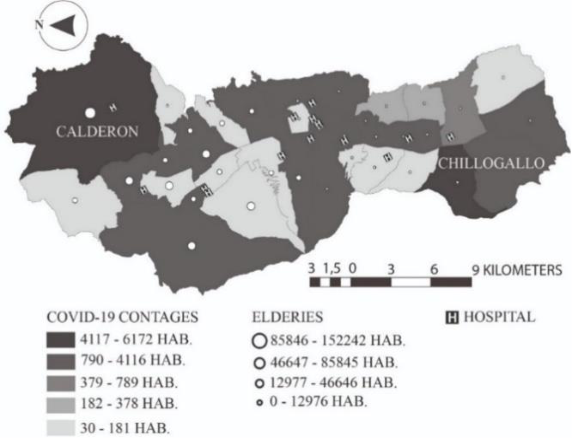
RESULTS Public Health System for Older Adults in the City of Quito In the city of Quito, there are approximately two million inhabitants in the urban area. Of these seven hundred thousand are older adults. The same ones that are located throughout the thirty-two urban parishes. As we can see in Figure 1, the highest concentration of older adults occurs in the northern area of Quito, specifically in the Calderon parish, with more than one hundred and fifty thousand older adults. Although it is true, this parish does not belong to the urban area, in this research it is considered due to the centrality it represents within the city.
On the other hand, the network of general hospitals extends longitudinally in the City of Quito. Where there is a greater concentration in the business center of the city. In this sense, the parishes of the north and south have a deficit of these facilities. This forces the inhabitants of these parishes to move to the downtown area to access health care, if they are not treated near their location. Finally, we can see that the parishes of Calderon and Chillogallo have more than six thousand people infected with COVID-19 until April 2021. Where according to the Ministry of Health of Ecuador, seven out of ten are older adults. In this context, this research finds the Calderon parish as the area with the most representative health care deficit for older adults.
Figure 1. Map of the elderly, general hospitals and COVID-19 infections in Quito.
Human Systems Engineering and Design (IHSED 2021) https://openaccess.cms-conferences.org/#/publications/book/978-1-7923-8987-0
Reality of the Elderly in the Parish of Calderon, Quito – Ecuador As shown in Figure 2A, in Calderon, sixty percent of older adults have public or private health insurance. This facilitates access to specialized hospitals such as those proposed in this research. On the other hand, it is found that one hundred and thirty- five thousand older adults are economically active and with educational instruction. Condition that strengthens the idea of specialized medical care in the area. Finally, Figure 2B shows the predominant diseases of older adults in Calderon. Osteoporosis is the most common condition in the area. Followed by heart and lung problems and lastly diabetes. It is necessary to mention that lung diseases continue to increase due to COVID -19. Therefore, this data varies according to the increase or decrease of infections in the area. In this sense, these findings determine the function of the hospital prototype.
Fig. 2. Maps of the living conditions and diseases of the elderly in Calderon.
Implantation, Climate Simulations and Hospital Spatial Comfort Once the diagnostic phase is completed, it is necessary to determine the project implementation site. For this process, several factors are considered, such as: a) accessibility, b) average density of inhabitants, c) regular topography and d) large- scale empty lots. In this sense, the El Arenal neighborhood complies with all the requirements proposed by the country's hospital regulations. The chosen site has an area of forty-six thousand square meters. And it is located in front of the North Panamerican Highway, which is considered one of the main arteries of the city. Its regular topography allows the implementation of an architectural project without
Human Systems Engineering and Design (IHSED 2021) https://openaccess.cms-conferences.org/#/publications/book/978-1-7923-8987-0 unevenness, which becomes an important element when designing for older adults.
As seen in Figure 3A, the wind speed coming from the west collides with the building at a speed of twenty-one kilometers per hour. In this sense, the building is rotated twenty degrees to control the wind speed and ensure the passive ventilation system throughout the building. On the other hand, as can be seen in figure 3B, the diagonal location of the architectural object allows capturing the greatest amount of light in the building at all times of the year. In the month of January, the sun's rays enter thirty degrees without the need for protection. However, for the month of June a solar protection system must be designed that is activated at fifteen degrees in the morning.
Fig. 3. Wind and sun simulations in the Calderon sector.
Architectural Specialized Program for Diseases in Older Adults As can be seen in Figure 4, the hospital is configured in six independent blocks such as: a) cardiology block, b) trauma block, c) pulmonology block, d) psychology block, e) endocrinology block and f) administrative block and teaching. This allows the elderly to directly access the area that corresponds to them, reducing waiting times in the diagnosis and treatment of diseases. On the other hand, in the case of general diagnoses and monthly monitoring, this project proposes the use of mobile units for health personnel to attend patients with mild symptoms at home.
Finally, it is necessary to mention that the project is directly related to the urban environment. Its location is designed to facilitate access from public and private transport routes in the area. In addition to providing green spaces to the city, which serve as rehabilitation points for the elderly and also as rest and recreation areas for health personnel.
Human Systems Engineering and Design (IHSED 2021) https://openaccess.cms-conferences.org/#/publications/book/978-1-7923-8987-0
Fig. 4. Functional section of the hospital prototype.
Digital Design of the Specialization Hospital for the Elderly Digital design, as the last stage of the project's conception, builds the hospital virtually. As shown in image 5A, double and triple-height interior spaces are designed with the aim of maintaining light and ventilated areas. Also, wide corridors are generated without barriers or unevenness, which allow the universal mobility of older adults and health personnel. Finally, Figure 5B shows that the hospital provides the city with green areas. These spaces help in the rehabilitation and rest of the users of the hospital. At the same time, it becomes an atmosphere that purifies the hospital environment.
Fig. 5. Renders of the hospital for the elderly.
CONCLUSIONS This research shows the need to strengthen the public health system of the City of Quito, especially in the Calderon parish. The architectural design of specialized hospitals is an alternative that guarantees equitable access to healthcare. In the specific case of older adults, design strategies focused on universal accessibility and thermal comfort, guarantee environments suitable for waiting, treatment and accommodation of patients. In addition to the innovative alternatives of mobile units, with the aim of avoiding the unnecessary mobility of patients with mild symptoms. On the other hand, understanding the living conditions and needs of the elderly, allows developing the operation of the hospital. On the other hand, the management of digital software is necessary to analyze information and model the project.
Human Systems Engineering and Design (IHSED 2021) https://openaccess.cms-conferences.org/#/publications/book/978-1-7923-8987-0
Undoubtedly, this research shows a clear process to conceive architectural design proposals based on the needs of older adults, however, when they are executed, they face a great limitation related to the lack of articulation between academia and state authorities. Therefore, it is recommended to apply a participatory design between authorities, health specialists, academia and mainly older adults with the aim of generating public policies that protect these processes and allow solving the health care deficit suffered by older adults in the City of Quito.
ACKNOWLEDGMENTS
We thank the Indoamerica University for motivating us to design participatory projects that make the general public aware of the needs of older adults in Ecuador. We also thank the joint work between academics, health personnel and older adults that allowed us to conceive a project consistent with the user's requirements. Finally, we congratulate the students Cristian Darquea and Daniel Proaño for their hard work in materializing this design project.
REFERENCES
Choi, W., Choi, J., Kim, K., Moon, J. y Oh, J. (2020). The analysis of healthcare service utilization among secondary and tertiary hospitals in Bolivia, 2017. Journal of Global Health Science, 2(1), pp. 1-10 Clouet-Huerta, D., González, B. y Katherine, C. (2017). Especialización médica en
Chile: tipos, mecanismos y requisitos de postulación. Una actualización de los procesos para los médicos generales. Rev Med Chile, 145, pp. 1454-1462 Duré, M., Fernández, M., Gilligan, C. (2019). Especialidades médicas: Estado de situación y antecedentes sobre el proceso de reconocimiento de nuevas especialidades y su relación con la formación, Ministerio de Salud y Desarrollo Social Presidencia de la Nación Argentina, pp.1-30 Echevarría, H. (2019). Métodos de investigación e inferencias en Ciencias Sociales:
Una propuesta para analizar su validez [online]. Argentina: UniRío Editora. Available from: UniRío eBook Collection [accessed 20 July 2021]. Graham, J., Umberto, B., Turnbull, G. y McKaye, R. (2020). Microclimate Analysis as a Design Driver of Architecture. Climate, 8 (72), pp. 1-13. Hernández-Sampieri, R. (2018). Metodología de la investigación. Las rutas
cuantitativa, cualitativa y mixta. 2nd ed. Ciudad de México: Editorial Mc Graw Hill Education. INEC. (2020). Ecuador en cifras [online]. Available from: https://www.ecuadorencifras.gob.ec/proyecciones-poblacionales/. [accessed 22 September 2021]. Jangwon Lee, Q. y He, P. (2019). Understanding the effect of specialization on hospital performance through knowledge-guided machine learning. Computers & Chemical Engineering, 125, pp. 490-498
Human Systems Engineering and Design (IHSED 2021) https://openaccess.cms-conferences.org/#/publications/book/978-1-7923-8987-0
John, S., Rowley, J. y Bartlett, K. (2020). Assessing patients decision- making capacity in the hospital setting: A literature review. Australian Journal of Rural Health, 28(2), pp. 141-148 Martins, E., Anselmi, M. y Dalmas, J. (2008). Evaluación de la calidad de los
procedimientos curativos en pacientes. Latino-am Enfermagem, 16, pp. 1-8 MSP. (2015). Boletines epidemiológicos coronavirus por semanas [online].
Available from: https://www.salud.gob.ec/boletines-epidemiologicos- coronavirus-por-semanas/. [accessed 22 September 2021]. Ochoa-Ramírez, J. y Guzmán-Ramírez, A. (2020). La Vulnerabilidad Urbana y su caracterización socio-espacial. Legado de Arquitectura y Diseño, 15 (27). OMS. (2020). Decade of Healthy Ageing 2020-2030 [online]. Available from:
https://www.who.int/docs/default-source/decade-of-healthy-ageing/final- decade-proposal/decade-proposal-final-apr2020-es.pdf?sfvrsn=73137ef_4. [accessed 08 September 2021]. Ravindran, R., Gupta, S., Haripriya, A., Ravilla, T., Subburaman, G. (2021). Sevenyear trends in cataract surgery indications and quality of outcomes at Aravind Eye Hospitals, India. EYE, 35, p. 1895–1903 Semi (2019). El hospital del futuro. España: SEMI SOLCA. (2015). Historia de Solca, Quito [online]. Available from: https://www.solcaquito.org.ec/inicio/historia [accessed 23 July 2021]. Timans, R., Wouters, P., Heilbron, J. (2019). Mixed methods research: what it is and
what it could be. Theor Soc, 48, p. 193–216 Wortmann, T. y Tuncer, B. (2017). Differentiating parametric design: Digital workflows in contemporary architecture and construction. Design Studies, 52, pp. 173-197.
Human Systems Engineering and Design (IHSED 2021) https://openaccess.cms-conferences.org/#/publications/book/978-1-7923-8987-0
LISTED IN THE AHFE DIGITAL BOOKSTORE CATALOGUE
Explore the complete digital volume
Human Systems Engineering and Design (IHSED2021): Future Trends and Applications
Read this individual research paper free through the original publisher, or explore the full digital proceedings book.
ISBN 978-1-7923-8987-0
Explore this ISBN in the AHFE Bookstore ↗Listed in the July 2026 bookstore catalogue; search by ISBN to confirm current availability · Digital book purchase optional