Michael Tondera, Matthias Fischer, Julia Kaiser, Thomas Maier (2021). Perceived Quality of Hand- Operated Mechanical Controls in Passenger Cars Using the Example of Air Vents. In: Human Systems Engineering and Design (IHSED2021): Future Trends and Applications. AHFE Open Access, vol. 21. https://doi.org/10.54941/ahfe1001126
Users perceiving mechanical controls as high quality is critical in au-tomotive engineering. This study examines how 30 participants rated three air vents taken from one vehicle segment. Results indicate that the haptic sense had the greatest influence on the judgement of quality. Participants were even able to detect differentiation of actuation path length and forces. Technical haptic parame-ters were identified that promise favorable impressions. Future research should use a test-rig to enable specific manipulation of technical parameters.
Motivation and Previous Research One focus of human-machine-interaction is the development and design of human-centered control devices. Hand-operated controls are considered precise and reliable due to various feedback functions. In addition to functional-ergonomic considerations, the perceived quality of operating elements is particularly important in passenger car interiors. Designing consumer products to account for a human’s affective needs is a growing research area within Human Factors (Burnett et all. 2009). The expected benefits for users are a tangible impression of the product's value and an increase in comfort. For manufacturers, a design based on customer-relevant quality perception can give a head start in an increasingly globalized competitive environment and contribute to differentiation. Perceived quality is the result of a comparison process between the costumers’ expectations and the actual technical product characteristics in a specific use case (Schmitt, and Neumann, 2013). Expectations in turn are dependent on the users’ previous experience, brand image and price. According to Stylidis et al. (2015) it remains unknown as to which perceived quality aspects (e.g. visual quality) and attributes (e.g. geometry, illumination, surface finish) engineers have to focus on in order to achieve the highest level of costumer appreciation. Besides vision, the haptic impression is in particular relevant for the aesthetic evaluation of consumer and design objects (Desmet and Hekkert, 2007). Upon investigating in-car control devices, Brunett & Irune (Burnett et all. 2009) claim that haptics has a greater influence on the judgment of quality than either vision or hearing. Many studies in the context of control devices investigated push buttons and their parameters operating force F [N], displacement distance S [mm] and force surge [%] (see Table 1).
Table 1: Favourable technical parameters of push buttons Author F [N] S [mm] Force surge [%]
Human Systems Engineering and Design (IHSED 2021) https://openaccess.cms-conferences.org/#/publications/book/978-1-7923-8987-0
The Present Study Researchers have widely focused on electromechanical controls (e.g. push buttons, rotary switches), whereas little research was conducted so far on manually operated, mechanical controls in passenger cars. These include for example air vents, door actuation, seat adjustment and openers for storage compartments. Air vents are used specifically as a design element, in addition to their functional relevance for thermal comfort and freedom from fogging. Consequently, an experiment was carried out in which three different air vents were presented to 30 participants for evaluation one after the other and their verdict recorded by questionnaire. The aim is to clarify if (i) the product exploration of mechanical controls serial parts yield to significant differences in regards to perceived quality. (ii) Which aspects (haptics, acoustics, surface, visual aesthetics, etc.) have an influence on the perception of quality and how should they be weighted. Third (iii), what are relevant technical parameters and their favorable ranges for general haptic feel considering the movement types slide and swivel?
METHOD
Experiment Design Thirty (n = 30) participants took part in the study (8 female and 22 male). Their age ranged between 22 and 59 years (M = 38.5; SD = 11.5). All participants have a driver's license (since M = 20.6 years; SD = 11.2) and reported driving at least "daily" or "several times a week". The three air vent concepts were presented shrouded on an order table. The air vents are from one vehicle segment. Information about manufacturer and model were undisclosed and the air vents were labeled as “A”, “B” and “C”. They differed in their design, type of movement (sliding, swiveling), actuation paths (length, angle), actuation force and the actuating element (geometry, surface).
In a repeated measure experimental design, participants were instructed to take the respective air vent in their given order (permuted), unpack it and explore it freely. In doing so, they were also to operate the product, i.e. adjust the air deflection. During the free exploration, a questionnaire had to be completed which contained a 5-point Likert scales with adjectives or rating pairs (e.g. atypical of the brand – brand typical). Further questions were towards ergonomic aspects and the general haptic feel. On a verbal 6-point scale, the judgment regarding perceived quality was recorded. Additionally participants were asked to rate the length of actuation path and force (too light/short – too long/heavy; 5-point scale). Finally, the respondents were asked for comments regarding liking and quality.
Statistical Analyses
Human Systems Engineering and Design (IHSED 2021) https://openaccess.cms-conferences.org/#/publications/book/978-1-7923-8987-0
In order to take into account the ordinal scale data, the correlations between perceived quality and other items were calculated using Spearman’s rank correlation coefficient. Before averaging over all air vents, Fishers z-transformation was applied. The arithmetic means were then transformed back to correlation coefficient (Bortz and Schuster, 2016). Because the three air vents were tested against each other with dependent samples, a Friedman test for significance was applied (Universität Zürich). For the multiple pairwise comparisons the alpha-level was adjusted by Bonferroni method to α = .017.
RESULTS
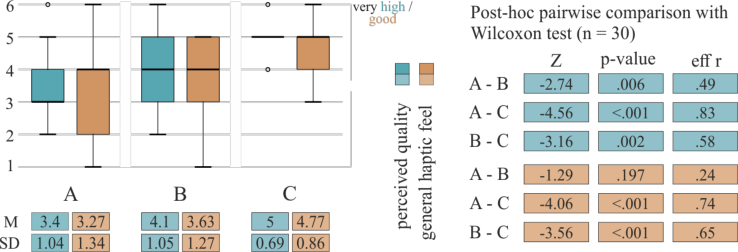
The result of the Friedman test indicates that there are significant differences between the air vents regarding the question “How high quality do you perceive the air vent overall?” (Chi-Square (2) = 32.61, p = .003). The null hypothesis, according to which there is no difference in terms of perceived quality, can be rejected. When looking at the arithmetic means (see Figure 1), one can see that air vent C was rated highest (M = 5; SD = .69). Post- hoc Wilcoxon test for paired samples yields significant difference for C and A (p < .001), as well as C and B (p = .002). Also, A and B differ significantly (p = .006), with B being the second best rated in perceived quality.
Figure 1. Boxplot for the principal dependent variable perceived quality, as well as for the assessment of general haptic feel. Added descriptive and inferential statistical analysis.
Similar results are obtained when comparing in terms of general haptic feel (“How does the air vent feel when adjusting the air direction?”). At least one air vent deviates from the other two (Chi-Square (2) = 23.29, p = .022). Again, C gained the highest rating (M = 4.77; SD = .86). Post-hoc pairwise comparison shows C differs to A (p < .001) and B (p < .001). The difference between A and B manifest no statistical significance (p = .197, adjusted α = .017). It is noticeable that a higher score of perceived quality conveys a favorable haptic impression and vice versa. Table 2 shows the ratings of other items from the questionnaire.
Human Systems Engineering and Design (IHSED 2021) https://openaccess.cms-conferences.org/#/publications/book/978-1-7923-8987-0
Table 2. Further participants’ rating results for various aspects (n = 30). (visually) pleasant air vent brand typicality aesthetic surface innovative pleasant acoustics
Table available in the original PDF paper.
A 3.57 (0.86) 2.90 (0.99) 3.43 (1.04) 1.40 (0.81) 2.50 (0.86) B 3.43 (1.10) 3.77 (0.97) 3.70 (0.92) 2.97 (1.25) 3.23 (1.22) C 3.37 (0.96) 3.87 (1.20) 4.4 (0.68) 3.17 (1.32) 4.13 (0.86) Arithmetic mean (standard deviation) The next aim was to estimate which item relates to the construct of perceived quality, causal or not. Spearman rho were calculated for six aspects and for each air vent, resulting in 18 correlation that were then averaged. Large strength of association (> 0.5) can be found for general haptic feel and brand typicality (see Table 3). The other aspects result in a medium effect of 0.3 < ρ ≤ 0.511. (Cohen, 1992). Surprisingly, visual cues like pleasant aesthetics and an innovative look yield relatively lower coherence than expected to the quality rating. A relationship between positive rated acoustic and a quality perception is noticeable, but has the smallest degree among the examined aspects. One can read that some seem to like actuation clicks and others explicitly reject them, when looking into the qualitative data of the participants’ comments. This could be a “zero defects” quality, where foremost interference noise has to be controlled, but large leaps to raise quality impression will probably not be feasible. The contrary seems to be the case for haptic feel by operating a product. The more intense engagement of interacting leads to an enhanced impression. Poorly outlaid haptic design, which does not account the human system, thus will be identified as inferior.
Table 3. Averaged rank correlation for perceived quality and different aspects.
Table available in the original PDF paper.
general haptic feel
brand typicality
(visually) aesthetic
pleasant surface
innovative
acoustic pleasant Perceived Quality .67 .51 .49 .46 .38 .33
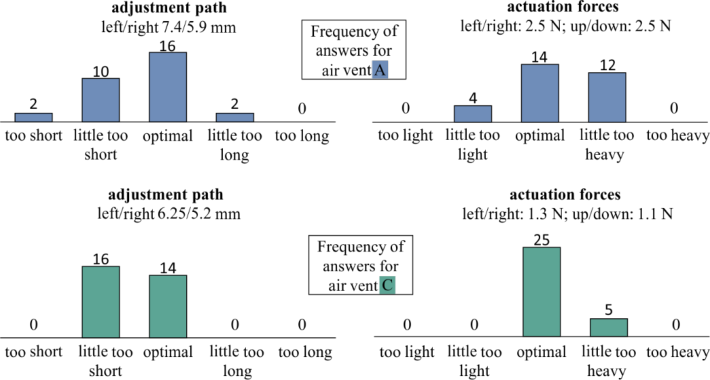
As a final step, the actual technical parameters of each air vent were linked to the participants’ answers. During the product exploration, participants answered the two questions: “For a precise adjustment of the air direction, I perceive the adjustment path as” and “For a precise adjustment of the air direction, I perceive the actuation force as”. The list of possible answers and their frequencies are displayed in Figure 2. Air vents A and C were compared here, as they have identical types of movement: sliding for adjusting air direction left and right, along with swivel for up and down. On the contrary air vent B is to swivel in both directions.
When comparing air vents A and C, one can determine that the participants were able to
Human Systems Engineering and Design (IHSED 2021) https://openaccess.cms-conferences.org/#/publications/book/978-1-7923-8987-0 recognize the differences of distance and force. Air vent C (total of 11.45 mm) has a shorter distance for adjustment of air direction and was rated more often as “a little too short” in comparison with air vent A (total of 13.3 mm). Air vent A was rated more often as “optimal” (16 times, n = 30) in that regard, with remaining 12 answers on “too short” or “little too short”. While A has 7.4 mm to the left, the distance to adjust air direction to the right is only 5.9 mm, as developers need to ensure co-drivers cannot be hit by the air stream. An increase in length to 7.5 mm (15 mm in total) could possibly lead to an even higher percentage of “optimal” replies. When looking at the actuation forces, smaller forces are favored. With 1.3 / 1.1 N, 25 out of 30 participant’s selected “optimal” on air vent C. More than double the times a “little too heavy” was voted on air vent A (2.5 / 2.5 N) compared to C (see Fig. 2).
When deriving favorable value ranges for technical specification of climate components, the user interaction elements should offer ≥ 7.5 mm for adjustment of air direction (movement type sliding), preferable to both sides. Actuation forces should be set between 1 N and 1.3 N, regardless of swiveling up/down or sliding left/right. Self-adjustment, despite the relatively lower forces, must not occur.
Figure 2. Histograms with the frequencies of respective answers to the length of adjustment path (left) and actuation force (right) for air vent A (top) and C (bottom). Actual technical parameters are above the bars. (n = 30)
CONCLUSIONS
Several studies have tried to propose a framework for the human perception of a products’
Human Systems Engineering and Design (IHSED 2021) https://openaccess.cms-conferences.org/#/publications/book/978-1-7923-8987-0 quality. The goal is to identify attributes that offer promising potential to elevate the perceived quality. When defining product requirements, developers in the automotive industry need to consider human affect, especially so when their component is displayed or interacted with in the car interior.
To approach this topic, an experimental product assessment was conducted with three different air vents. In conclusion, when presenting mechanical control serial parts, it is possible to trigger different quality impression and participants are not indifferent in this regard. Even though similar in the visual sense, air vent C was considered superior in perceived quality. Each air vent that was rated higher in quality perception also had higher scores for general haptic feel. The relationship with haptics was higher than with visual aesthetics or acoustics. The close physical interaction does seem to have a major influence on quality perception. These findings agree with conclusions of Brunett & Irune (2009), claiming that the touch sense contributes up to three times as much to quality ratings compared to either visual or hearing sense. When taking a closer look at technical parameters, participants were able to perceive and recognize variations of actuation distance and force. First value ranges or caps that reflect favorable product attributes were derived.
The study results must be assessed in the context of the boundary conditions. For one, only a small part of product aspects and technical parameters were examined. Further kinesthetic factors are for example damping and friction. In addition, the geometry of the actuation element will most likely affect the haptic sense, thus shall be investigated in the future. Most importantly though, because isolated serial parts were presented, confounding variable affected the results. To address this issue a test-rig must be developed which allows manipulating precisely one parameter, e.g. actuation force, while controlling all others, as they remain identical. Installing the test-rig in a driving simulator should enable a further improvement of context.
REFERENCES
Burnett, G., Irune, A.: Drivers’ quality ratings for switches in cars: Assessing the role of the vision, hearing and touch senses. In: AutomotiveUI, Essen (2009). Schmitt, R., Neumann, A.: Sensorische Qualitätswahrnehmung von Drehschaltern
objektivieren. In: ATZ, vol. 115, pp. 616-622, Springer, Wiesbaden (2013). Stylidis, K., Wickman, C., Södeberg, R.: Defining Perceived Quality in the Automotive Industry: an Engineering Approach. In: Procedia CIRP, vol. 36, pp. 165-170 (2015). Desmet, P., Hekkert, P.: Framework of Product Experience. In: International Journal of
Design, vol. 1, pp. 57–66, (2007). Anguelov, N.: Haptische und akustische Kenngrößen zur Objektivierung und Optimierung der Wertanmutung von Schaltern und Bedienfeldern. Dissertation, TU Dresden (2009). Baumann, K., Lanz, H.: Mensch-Maschine-Schnittstellen elektronischer Geräte. Springer,
Berlin Heidelberg (1989).
Human Systems Engineering and Design (IHSED 2021) https://openaccess.cms-conferences.org/#/publications/book/978-1-7923-8987-0
Glohr, T.: Untersuchungen zur markenspezifischen Betätigungshaptik und -akustik von Bedienelementen im Kraftfahrzeug. Dissertation, Universität Stuttgart (2018). Reisinger, J.: Parametrisierung der Haptik von handbetätigten Stellteilen. Dissertation, TU
München (2009). Bortz, J., Schuster, C.: Statistik für Human und Sozialwissenschaftler. Springer, (2016). Universität Zürich: https://www.methodenberatung.uzh.ch/de/datenanalyse_spss.html Cohen, J.: Statistical Power Analysis. In: Current Directions in Psychological Science, vol. 3, pp. 98-101 (1992).
Human Systems Engineering and Design (IHSED 2021) https://openaccess.cms-conferences.org/#/publications/book/978-1-7923-8987-0
LISTED IN THE AHFE DIGITAL BOOKSTORE CATALOGUE
Explore the complete digital volume
Human Systems Engineering and Design (IHSED2021): Future Trends and Applications
Read this individual research paper free through the original publisher, or explore the full digital proceedings book.
ISBN 978-1-7923-8987-0
Explore this ISBN in the AHFE Bookstore ↗Listed in the July 2026 bookstore catalogue; search by ISBN to confirm current availability · Digital book purchase optional