Masanobu Nishimura, Kazunari Morimoto (2021). Creative Design of Powered Wheelchair Based on Concept Analysis and Pleasurable Ideas Proposed by Designers and Educators. In: Advances in Affective and Pleasurable Design. AHFE Open Access, vol. 14. https://doi.org/10.54941/ahfe100580
Department of Design, b Department of Advanced Fibro Science, Graduate School of Science and Technology, Kyoto Institute of Technology, Hashigami-cho 1, Matsugasaki, Sakyo-ku, Kyoto 606-8585, Japan ↗
We conducted the pilot study about construction design concept using the development of design ideas in collaboration with educators and designers. The purpose of this study is to examine the effect of design results in which the new design method we devised brings. We set a design challenge a vehicle to assist the movement of difficulty walking person in this study. First, we share the knowledge about the physical and psychological characteristics of the user. Then, we share the knowledge about the traveling and function they understand each ideas. We figured that a point of view of driving characteristics required for the vehicle for the mobile support. Finally, designers make the basic vehicle design based on knowledge shared with educators and designers and propose design plan of educators and designers change recognition that wheelchairs are substitution of legs and understood that the consideration for difficulty walking persons makes a deeper design. Though there are a lot of design methods, we figured that we created designs full of innovative and interesting ideas with fusion of deep sensitivity and knowledge for target to design by using the design method in collaboration with educators and designers proposed in this research.
Modern wheel chairs make it possible for individuals with a walking impairment to get around and in that sense they are very successful. However, they almost always lack the factor that answers to our human sensual desires for pleasure and comfort in operating in the way that a car or motorcycle does. Also, our image of a wheelchair is that of a special tool for individuals with walking impairments. It has even become a sort of symbol for those with physical disabilities. However, when we think about glasses, they do not in any way symbolize people who are visually impaired. In fact, they have become a fashion statement throughout society. It is time for a design that will do away with the stale notion that wheelchairs only exist to provide a function. Therefore, there is a question of how can a statement imposed by a design do away with the concept of the wheelchair as a ‘substitute’ for the user and introduce a new style defined by the concepts of ‘driving is fun’ and ‘I’d rather be in my wheelchair’? In this research paper, we will propose a new design method to come up with a solution to this question and discuss the effects of the design results. In this research an experimental attempt is carried out at a design concept structure using a wealth of ideas produced through the collaboration of designers, educators, and specialists.
DEVELOPMENT OF A DESIGN METHOD An experimental attempt is carried out at a design concept structure using a wealth of ideas produced through the collaboration of designers, educators, and specialists. The purpose of this research is to discuss the effects to the design brought about by our new design method. The theme of this research is to create a more enjoyable vehicle to assist individuals with walking impairments with their mobility.
Sharing of knowledge of the physical and psychological characteristics of the user Normal design development aims to increase the functionality and comfort of the target (Jones, 1973, Cross, 2008). Measurements are taken and design values are decided as an index for development. It is desirable that development is carried out directly with maximum result, in minimum time (Ikebe, 1980). However, it has been shown that this method does not always produce a product that is perfectly fitted for the user. So, in order to overcome the limitations of this design method, it is important to set our eyes on a comprehensive value and consider ‘meaning’ and ‘effect’. Using a wheelchair as a design target, this paper outlines a new design method based on an overall perspective. To do this, designers, mechanical systems specialists, psychological technicians, welfare engineers, and computer scientists from educational institutions have gathered to debate and amass ideas from their respective fields, sharing knowledge about the physical and psychological characteristics of users, in order to create an image of the wheelchair of the future.
Organizing ideas according to the value curve After a long time of brainstorming, we came up with a value curve. Figure 1 represents the levels of value to consider when developing a wheelchair for individuals with walking impairments. As seen in figure 1, for able- bodied people, the conventional equipment: ‘crutches’, ‘wheelchair’, ‘motorized wheelchair’ correspond to the extent of a handicap and the comprehensive value of each item decreases in the order listed. Litters and stretchers are also mobility support equipment, however, since movement is not voluntary and these items more closely resemble devices to aid others in transporting the target rather than vehicles, comprehensive value is ranked even lower. By drawing this value curve, it became clear where new crutches and other vehicles stood in terms of comprehensive value and this had a great effect on organizing our thoughts for design development. There is a method where one organizes his/her design plan by mapping it out. By using this method and plotting the ‘value’ on the vertical axis, and then plotting the design target on the horizontal axis, and finally discussing the extent of the comprehensive value, it becomes clear that new vehicles can exist between design targets, and thus ideas for new designs are easily thought up. This rather simple operation of laying out design targets in an ordered manner has proven to be an important factor in coming up with new ideas. And with deep consideration, a value paradigm shift can be expected in the creation of new vehicles usable by disabled individuals.
Figure 1. Value Curve of Wheelchairs for Individuals with Walking Impairments
Figure available in the original PDF paper.
FOUR QUADRANTS OF DESIGN THINKING In order to further brush up design ideas that have come about as a result of knowledge sharing, we further considered how wheelchairs for individuals with walking impairments are used and have found that the following 2 perspectives are necessary.
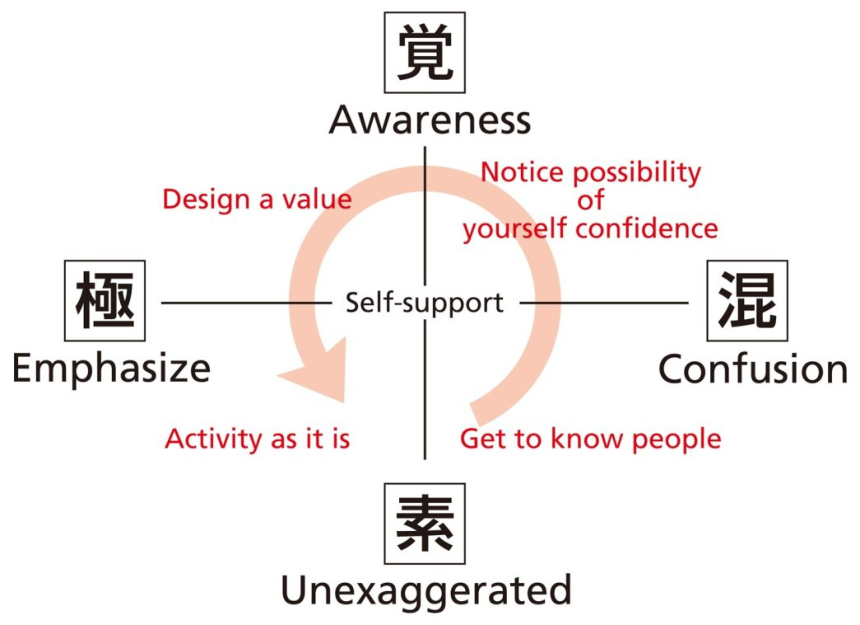
We came to the conclusion that a wheelchair is not simply a device for movement, but there is also the perspective that it plays a role in helping the user interact with society. Also, the perspective that there are differences in awareness of the users themselves is extremely important. Therefore, how individuals with walking impairments intermingle with their surroundings (society) is plotted on a horizontal axis, and how he/she is aware of this is plotted on a vertical axis. Figure 2 shows how these perspectives relate to each other. More concretely, the horizontal axis shows [intermingling with surroundings] – [standing out from surroundings]. The vertical axis shows [current state of awareness] – [changes in state of awareness]. Therefore, it can be said that the first quadrant represents the user’s awareness of their potential for confidence; the second quadrant represents the user detecting value; the third quadrant represents the user’s initial state, and the fourth quadrant represents how the user intermingles with his/her surroundings. By using this whole map for comprehensive thinking we may create a new value associated with wheelchairs and may even create more areas of activity for users.
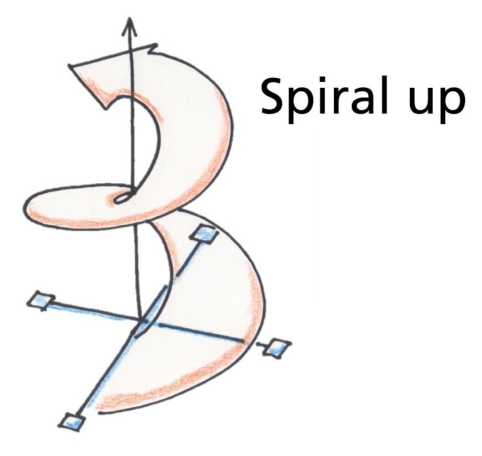
Figure 2. Quadrants of Design ThinkingFigure 3. Design Thinking in Spirals
Moreover, as seen in Figure 3, design thinking becomes deeper through consecutively running these four quadrants in order and examining them in a spiral pattern. In short, the specialty of this method lies in the thinking that there is a vector where the functions and special features of a new motorized wheelchair should straddle these four quadrants.
Sharing of Knowledge Concerning Movement Capacity We will share the movement specs and functions required by mobility assistance vehicles. In this paper, we discuss specifically the gluteal hold function, acceleration feel, and lean. We carried out design development based on office chairs with casters and research results of drive system and control system simulations along with body pressure and other measurements. The seat piece where the passenger sits attaches multiple cushions that can change between soft and hard to frame constructed in the shape of a polyhedron. And while moving, the passenger’s pelvis and spine are held in place allowing the passenger to move as one with the vehicle. There are computer controls and a damper at the base so that any shock created from inertia while moving is cancelled out. Also, by leaning back or forth, before, after, or during movement, the passenger increases the feeling of acceleration and can create a more dynamic moving experience by leaning in the natural direction of inertia. We undertake design based on these observations, coming up with and combining new design plans until both parties can appreciate the design together.
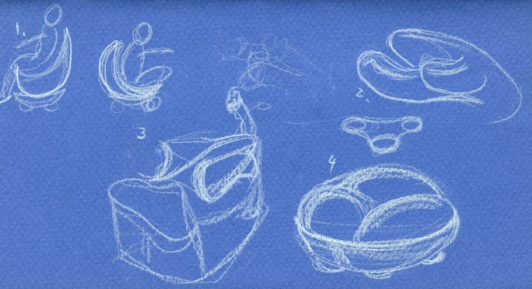
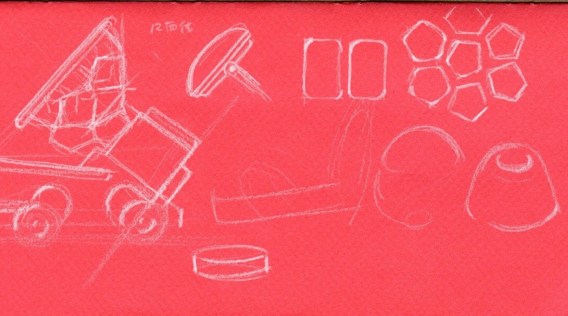
VEHICLE DESIGN FOR INDIVISUALS WITH WALKING IMPAIRMENTS USING SPIRAL THINKING In the first step we develop a seat that invites use of the vehicle (it makes one want to sit in it). I propose the following 4 ideas. There are represented in a rough sketch in Figure 4 and Figure 5. Figure 4 represents a seat that is made to fit perfectly with the user. Figure 5 shows a design plan for a seat that is inviting to sit in.
1) A seat with adjustable position using slide reclining 2) Different sitting options, and a forked seat offering dependable support 3) A bucket seat 4) A sofa-type seat made from low impact material
Figure 4. Design Plan for Proposed SeatFigure 5. Design Plan for an Inviting Seat
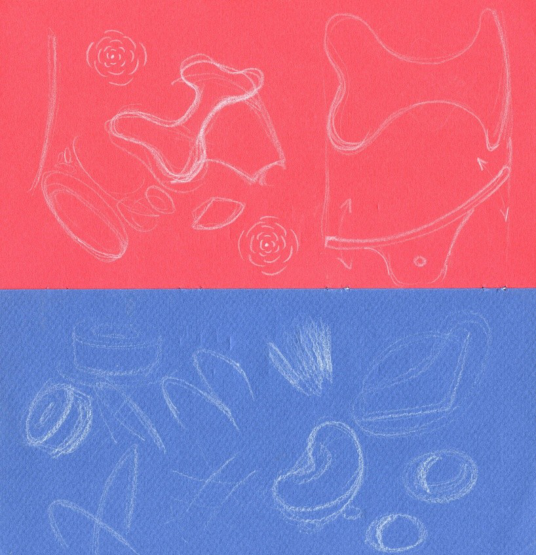
Changeable seat design Continuing, in order to provide comfortable mobility we present a small seat split into pieces that can be easily adjusted for softness and position. By making these pieces in the shape of polyhedrons, the seat is adaptable and uniform at the same time.
Figure 6. Design Plan for Flexible Seat
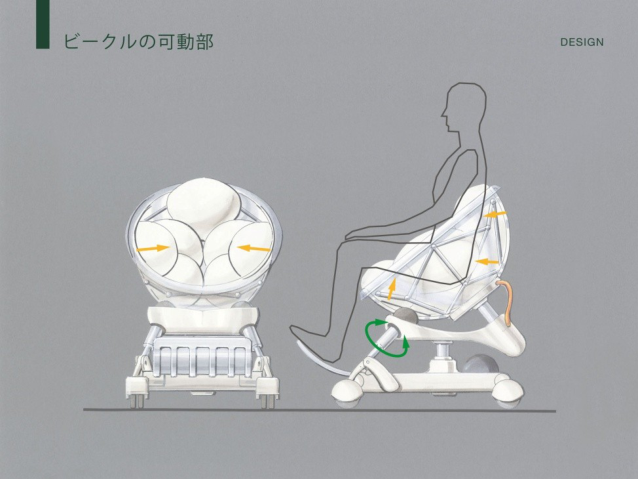
Seating position retention design Furthermore, we contrived a function to improve seating position retention based on this layout design.
Figure 7. Design for Seating Position Retention
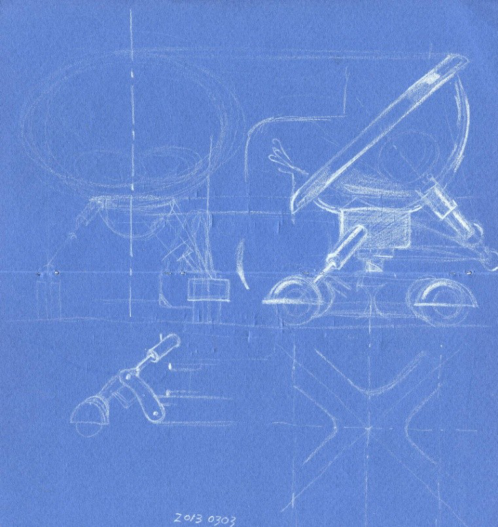
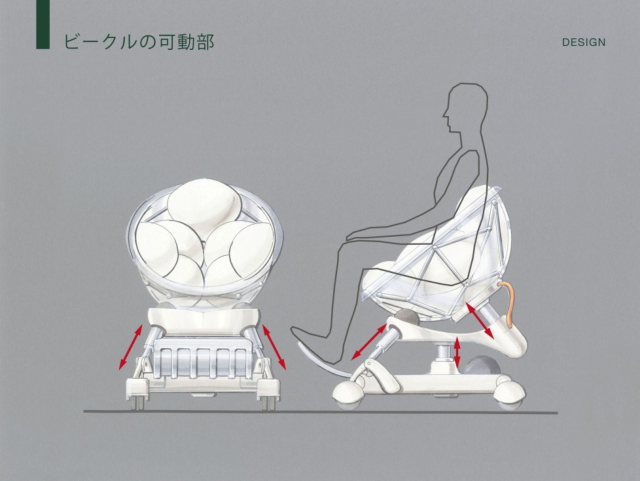
Electronically controlled suspension Upon review of the above plan, the idea of installing an electrically controlled suspension at each point to supplement the shock absorbers came about in consideration of gravity and direction of inertia other than that of the axle and the pivot. With this, it is possible for the user to feel external forces by counteracting and reversing the shifting inward of posture caused by centrifugal force created while rotating.
Figure 8. Vehicle with Electronically Controlled Suspension
Figure 9 shows a plan to stabilize the waist by developing a unique structure for seating position retention. This was seen to create ease and add function for the individuals, and possibly lead to an enjoyable and charming vehicle for able-bodied individuals as well. The elastic material in the small cushions allows the seat to contract and expand according to the user, and turned out to be a new seat for a vehicle capable of supporting the spine and hugging the gluteal muscles. Figure 10 shows a rendered sketch of the overall design.
Figure 9. Design of Seating Position Retention Structure
Figure 10 Final Design Using New Design Method
SAMMARY When designers and educators faced their perspectives against each other, the stale notion of a wheelchair being nothing more than a replacement for legs was completely done away with. Because of this, a more thoughtful design for individuals with walking impairments was achieved. Also, even though many design methods were proposed, by using the method that designers and educators collaborated on for this research, and through a combination of deep knowledge and deep sensibilities towards the design target, it was clear that an extremely revolutionary and fun design could be expected. Technological functions have been realized based on this design research. If the personal vehicle can change from being a ‘replacement for legs’ to something ‘fun to ride’ or something ‘I’d rather be riding’, then all people, those with a walking impairment or those able-bodied, may have a change of attitude towards it. Through making the joy of riding our motivation, we may attain ‘dynamism’ and ‘positivity’ from an ‘assistive device’ which is not usually associated with such terms.
REFERENCES
Cross, N.(2008), “Engineering design methods: strategies for product design”, Wiley. Ikebe K. Nakayama, M. (1980), “Everything About NM Methods”, in: Theory and Practical Method of Idea Creation (Revised ed.) , SANNO Institute of Management Publication dept. Jones, J.C. (1973). “Design Methods”, (Japanese translation), Maruzen Co., Ltd.
LISTED IN THE AHFE DIGITAL BOOKSTORE CATALOGUE
Explore the complete digital volume
Advances in Affective and Pleasurable Design
Read this individual research paper free through the original publisher, or explore the full digital proceedings book.
ISBN 978-1-4951-2109-8
Explore this ISBN in the AHFE Bookstore ↗Listed in the July 2026 bookstore catalogue; search by ISBN to confirm current availability · Digital book purchase optional