Jun Chen, Mengyao Guo (2024). NeuroDesign2.0: A Framework of Visual Perception in Visual Communication. In: Neuroergonomics and Cognitive Engineering. AHFE Open Access, vol. 126, pp. 211–219. https://doi.org/10.54941/ahfe1004754
This paper presents NeuroDesign 2.0, an advanced interdisciplinary framework that combines principles of visual design, cognitive process, and general working methods of NeuroDesign to understand the intricacies of visual perception. By utilizing functional near-infrared spectroscopy (fNIRS) and applying poster samples based on the International Typographic Style, our approach aims to clarify the selection mechanisms that explain the visual perception of audiences and influence the effectiveness of design in conveying messages. The study transforms from strategies that focus on the designers to the audiences to discuss the mass reception of visual information and further guide the designers’ practices, Where the audiences’ impression and intuition determine the selection of visual messages. Based on the existing research on design and neuroscience, the study presents a novel experimental method for analysing how the brain perceives visual information. It enhances our comprehension of the complex correlation between human engagement with visual stimuli and the corresponding selection reactions.
In the swiftly evolving design field, the intersection of cognitive psychology and aesthetic presentation has given rise to an innovative discipline known as NeuroDesign (Ritchie, 2020). This burgeoning domain merges principles of neuroscience with the creative processes of design to better understand the selections of human interaction with visual stimuli through visual percep- tion. Designers and creators strive to encode and decode their visual content to resonate deeply with audiences, and the importance of applying design principles to the results analysed by cognitive science is increasingly apparent.
and loyalty (Soler Mouline, 2019). These elements are specifically crafted to align with the consumers’ brains’ associative networks, leading to a solid psychological connection with the brand.
So, the utilization of design and NeuroDesign principles is worth applying in poster design to capture the brief attention of audiences in an environ- ment saturated with media to promote and advertise effectively. It aims to understand the selection after visual perception that helps designers create visually striking artworks with a subconscious impact by comprehending the interplay between visual elements and the neural processes of attention and perception. We are willing to discover that the geometric art form and visual hierarchy can direct the audiences’ attention and highlight important information through our upcoming experiment. At the same time, the other emotional triggers and storytelling elements in artworks can be strategically incorporated to evoke a desired response and enhance viewer involvement as our next step.
LITERATURE REVIEW
This study investigated previous research that has provided a significant ini- tial understanding of the neural mechanisms associated with creative design thinking. We build upon the existing research that elucidates the cognitive processes involved in design practices, delineates the role of flexible mental representations in fostering creativity, and proposes to utilize portable neu- rotechnology, fNIRS, for conducting experiments in real-world experiment settings for dynamic movement of viewing the design exhibition, to gain new insights into the comprehension of visual creativity. So, we review the relevant literature and propose a conceptual framework to provide a foundation for our goals for future work of understanding the audiences’ visual perception of art and design.
Background
Creativity encompasses various domains and is profoundly interdisciplinary, such as art and science, technology and humanities (Kaufman et al., 2017). At the same time, the central concern of NeuroDesign 2.0 in our study revolves around audiences’ perception of novel design ideas, particularly about the art forms employed by designers. The preliminary investigations of visual per- ception in art and design often focused on studying creativity independently through insight puzzles or tasks that assess divergent thinking (Sawyer, 2011). Nevertheless, creativity refers to solving practical problems rather than pro- ducing theoretical puzzles. Design issues necessitate the process of conceptual exploration, meticulous refinement, and continuous revision of representa- tions, so it is imperative to examine how audiences perceive and respond to these visual elements.
Existing scientific research also provides us with the realization approach. Recent developments in cognitive psychology and neuroscience have pro- vided a valuable understanding of the mental processes underlying the generation of creative works from the standpoint of designers. Additionally, brain imaging techniques have elucidated the specific functions of neural sys- tems, such as the lateral prefrontal cortex, which has played a crucial role in differentiating our project. The presence of individual differences, domain
NeuroDesign2.0: A Framework of Visual Perception in Visual Communication 213
expertise, and cultural and contextual influences all add complexity and challenge us.
Related Work
The NeuroDesign Special Interest Group: The NeuroDesign Special Interest Group (SIG) aims to foster collaboration in the fields of digital engineer- ing, neuroscience, and design research (Auernhammer et al., 2021). Their objective is to enhance comprehension of designers’ cognitive processes and collaboration in team-based problem-solving by utilizing neuroimaging tools, as design teamwork encompasses intricate social and cognitive dynamics. The researchers utilized hyper scanning techniques such as functional near- infrared spectroscopy (fNIRS) to measure the synchronized brain activity between individuals while performing team tasks. This method offers valu- able insights into the dynamics of cooperation and shared cognitive processes. Nevertheless, establishing a connection between brain activity and complex cognitive concepts like creativity in the field of design is difficult due to the potential complications and limitations arising from individual and contex- tual differences across various design domains, visual perception, cultures, and levels of expertise.
Creative Brains: The study on creative brains highlights the significance of representational flexibility, with the author observing how designers employ various symbol systems, ranging from ambiguous sketches to accu- rate drawings (Goel, 2014). It redirects attention from individual moments of understanding and sudden realizations to the inclusion of creativity as a fundamental component of solving practical problems in the real world. The authors suggested that the connection between the right and left prefrontal cortex (PFC) systems provides a possible neural foundation for cognitive explanation, where the right PFC facilitates the abstract and divergent think- ing necessary for conceptualization in art and design. This study serves as a source of inspiration for our research on audiences who are exposed to innovative design concepts, especially the detecting area identification of the brain for upcoming experiments.
Technology Improvement: Several techniques have been used to obtain brain signals, including EEG, MEG, fMRI, and fNIRS. EEG has high tem- poral resolution but limited spatial precision (Burle et al., 2015), whereas MEG provides better source localization than EEG (Liu et al., 2002). The fMRI technology advanced finer-grain spatial mapping but is limited to static environments, making it challenging to perform dynamic real-world tasks (Wilcox and Biondi, 2015). The fNIRS addresses these issues by being portable and tolerant of movement (Pinti et al., 2020). The improved technology enables multichannel recordings with signal quality that rivals fMRI.
Instead of fMRI, the fNIRS is a suitable alternative due to its porta- bility and ability to tolerate participants’ natural head movements during poster viewing. Due to its optical nature, fNIRS is immune to interference from background electrical noise or muscle movement artifacts, unlike EEG and MEG. These wireless, multichannel fNIRS systems allow for completely unconstrained experimental designs in non-laboratory settings like museums. Our framework aims to utilize fNIRS to identify brain stimulants present in
214 Chen and Guo
creative content, including visual designs, posters, and artwork. By compre- hending the mechanisms by which creative stimuli are triggered in audiences’ brains, we can acquire valuable knowledge to enhance the teaching and inspi- ration of design in domains such as creative art. Conducting fNIRS studies in real-world settings also allows us to closely observe the natural unfolding of creativity during everyday experiences involving visual art and media.
Theory Support Incorporating theoretical frameworks into our research is crucial for com- prehensively grasping the profound influence of design on human cognition and behaviour. As explained by Todorovic (Todorovic, 2008), the Gestalt Principles clarify how humans perceive visual elements as unified patterns or whole entities rather than individual parts. The design principle is crucial in our research as it helps us analyse the correlation between art form and the brain reactions of the audience in our experiment results. We need to under- stand how individuals perceive and interpret design elements. NeuroDesign employs this theory to examine how the emotional associations of various typographic styles can influence the degree of engagement, preference, and interaction with the content. Using these principles, the study explores the association or contradiction between different design styles and the intended design goal, thus examining the unique perceptual experiences that emerge.
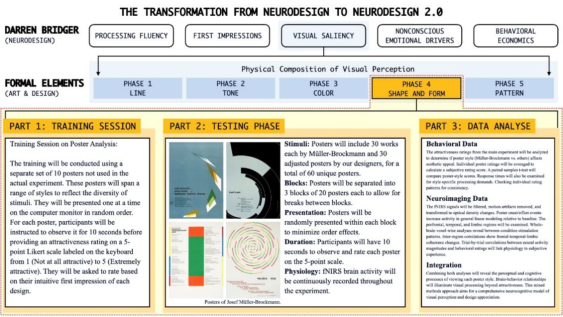
CONCEPTUAL FRAMEWORKS We have introduced a theoretical framework called NeuroDesign 2.0, which draws inspiration from Darren Bridger and is constructed by thoroughly examining existing literature and theoretical principles (Bridger, 2017). The primary objective of this framework is to significantly transform our under- standing of how we perceive art on a large scale (see Figure 1). Bridger’s research encompasses various psychological factors that significantly impact designers and marketers. These factors include processing fluency, first impressions, visual salience, unconscious emotional drives, and behavioural economics.
Figure 1: The framework of NeuroDesign 2.0 (credit by authors, 2023).
NeuroDesign2.0: A Framework of Visual Perception in Visual Communication 215
However, our NeuroDesign 2.0 emphasizes visual salience throughout the process, particularly in relation to the geometric art form. In our experimental approach, we employ the International Typographic Style (ITS) to examine the cognitive and visual perception elicited by visual stimuli. In the pictorial questionnaire, we will modify the proportions of various elements in a single poster to create distinct combinations. This will allow us to assess the audi- ence’s responses and identify the design elements that are most prominent and likely to attract attention and be memorable to the viewers’ minds.
The Concept of NeuroDesign 2.0 NeuroDesign 2.0 distinguishes itself from previous techniques by focusing on how audiences perceive geometric form in art, particularly how visual art can affect spectators. In the experiment, we used ITS (Carter et al., 2018) posters as visual stimuli. We consider using Müller Brockmann’s concert posters (Purcell, 2006), pioneering works that defined the ITS by combining visual rhythm with rigorous grids. His simplified forms and asymmetrical balances are also related to Gestalt psychology principles that humans per- ceive whole graphic patterns and images in simplified grouped forms, even when made up of separate and randomly placed elements.
Previous fNIRS studies have demonstrated the ability to detect dynamic inter-region synchronization about perceptual and imagery-based tasks (Kalafatovich et al., 2022). Our experiment will look for both local responses and long-range coherence changes triggered by poster elements in brain areas involved in functions such as visual attention, memory encoding, and emotional appraisal. The results of characterizing each role of elements in these processes may yield new measures of communication effectiveness. Integrating real-time brain mapping visualizations with subsequent quali- tative participant feedback may provide a comprehensive framework for understanding the ITS style’s psychological potency. Finally, understanding its impact on perceptual and cognitive mechanisms may aid in optimizing effective visual communication in various applications.
This approach provides neurological validation for long-held visual design theories by examining the perceptual effects of these elements. By inves- tigating how audiences interpret Müller Brockmann’s well-known posters (Fawcett-Tang, 2004), we can gain a better understanding of ITS long-term impact. Furthermore, the research findings may provide designers with new, fact-based guidance on creating visually appealing narratives. We also want to contribute to discussions about the formal aesthetic principles of the ITS style and their significance. Researchers in art history focus on the qualita- tive aspects of ITS, but we will fill in the gaps with quantitative research, so understanding how this movement rose to prominence may help explain why its design paradigm continues to pervade visual culture today.
Experiment Design The experimental task alternates between periods of active observation and control conditions (such as rest periods) to improve the detection of hemo- dynamic responses, and fNIRS data are continuously recorded during the
216 Chen and Guo
experiment. Each phase in the experiment is interconnected, impacting the subsequent statistical analysis and the study’s overall conclusions. Twenty participants (ten females and ten males) from the University of Macau and the local community, ages 19 to 55 years old, with normal or corrected-to-normal vision (over 1.0), will be invited. All participants will have informed consent before the experiment, and The University of Macau’s Ethics Committee will approve all research procedures.
Participants will be comfortably seated in a dimly lit room approximately 80 cm from the computer monitor. A training session on poster analysis will be conducted before the main experiment to familiarize participants with the task. They will learn to rate the attractiveness of the posters on the screen using labelled keyboard buttons. Following the training, participants will have a 30-second break before starting the main tasks, which will be divided into three blocks. Each block will include ten trials with posters by Josef Müller-Brockmann and ten with other posters, with the sequence of posters being randomized within each block with 1-minute rest between blocks.
Participants will utilize a fNIRS and EEG data acquisition cap provided by EasyCap GmbH. The data will be collected at a sampling rate of 500 Hz and subjected to bandpass filtering ranging from 0.03 to 70 Hz, referencing the left mastoid (TP9). We will move six EEG electrodes to nearby loca- tions to accommodate the fNIRS probes. The fNIRS data will be collected simultaneously with the EEG while participants observe the posters.
METHODOLOGIES The visual approach in NeuroDesign 2.0 entails a thorough selection process rooted in principles derived from our comprehension of visual perception (Morton, 2022). This requires selecting colours, shapes, lines, textures, and spatial arrangements that have a proven impact on the audiences’ attention, emotion, and memory retention. The selection indicates how various visual properties enhance engagement and elicit positive emotional responses. We consider the Gestalt laws of visual perception and describe how humans naturally organize visual elements into coherent groups.
In NeuroDesign 2.0, the technological approach frequently employs neu- roimaging and psychophysiological tools to pinpoint specific brain regions and responses activated when individuals interact with a design. Researchers utilize fNIRS technology to gain valuable insights into the neural components of aesthetic experience and user engagement. The detection encompasses the prefrontal cortex, temporal lobes, and Amygdala. The prefrontal cor- tex frequently participates in decision-making processes and the assessment of aesthetic attractiveness. Heightened neural activity in this region may indi- cate a participant’s subjective evaluation of the aesthetic quality of a design, and it influences their decision-making and evaluation processes. The tempo- ral lobes, particularly the hippocampus, are crucial in memory encoding and retrieval. Neural activity is observed when a design evokes previous visual memories or is sufficiently memorable to be stored in long-term memory. The Amygdala is primarily linked to the activation of emotions and the formation of emotional memories. Activation in this region signifies that a design has
NeuroDesign2.0: A Framework of Visual Perception in Visual Communication 217
captured the viewer’s emotional attention. We aim to identify patterns linked to practical design elements, which can offer valuable insights for creating visual communications with a significant impact.
Combining visual and technological methods involves an iterative test- ing process to evaluate the qualitative outcomes of the design. This hybrid methodology allows designers and researchers to assess how well the visual elements align with the neurophysiological data gathered. This symbiotic approach allows for the refinement of design elements based on subjective responses (such as self-reported emotional impact) and objective data (such as attention measured through eye tracking). Further qualitative analysis is crucial for interpreting the data in the context of real-world interactions and for understanding the nuanced emotional and cognitive impact of visual perception on the audience.
EXPECTED OUTCOMES Expected outcomes involve recognizing neural patterns linked to aesthetic attractiveness and emotional involvement, enabling the enhancement of design components to enhance the user experience. This research has the potential to validate the effectiveness of ITS design, generate marketing visual design strategies based on data, facilitate students’ understanding of design principles, and promote the creation of personalized and practical designs in three specific areas:
Neural Correlates of Aesthetics: We expect to identify the neural signa- tures associated with aesthetically pleasing designs, helping to uncover the universal elements of visual appeal from the audience’s perspective.
Optimization of Visual Elements: Use brain activity data to refine and opti- mize visual elements such as colour, layout, typography, and imagery to align more closely with the visual perception impact through data-driven design improvements, especially the geometric art forms.
Interdisciplinary Insights on User Centric Design: This framework may foster multidisciplinary collaboration between neuroscientists, psycholo- gists, designers, and marketers, leading to a richer understanding of human behaviour and visual perception. Empower designers to create more user- centric products and environments by incorporating neuroscientific insights into the design process.
LIMITATION AND FUTURE WORKS In NeuroDesign and visual communication, research possibilities may be limited by prevailing design trends and current technology constraints. For example, the global recognition of IST, which is admired for its clear, read- able, and objective design, may influence researchers to primarily choose elements from this style for their studies. This emphasis might unintentionally downplay the possible contributions and effects of traditional or emerging typographic styles. Consequently, this selection bias might unintentionally overlook creative design elements that could provide valuable and fresh per- spectives on the relationship between design and cognitive processes, so we
218 Chen and Guo
will consider introducing more different styles to acquire a more coverable paradigm.
CONCLUSION
This paper introduces an advanced NeuroDesign framework called Neu- roDesign 2.0, which seeks to enhance our comprehension of the brain’s perception and processing of visual designs. More precisely, the study aimed to investigate the neural connections associated with aesthetic attractiveness and emotional involvement by analysing posters inspired by the International Typographic Style.
The study commenced with a comprehensive examination of pertinent lit- erature on NeuroDesign, visual communication theories, and advancements in neuroimaging technology. This facilitated the establishment of the essen- tial theoretical underpinnings and provided a framework for our research objectives. Next, it delineates crucial elements of the intended experimental methodology, including utilizing Müller Brockmann’s posters as visual stim- uli and acquiring fNIRS brain scanning data while participants view them. The study outlined methodologies that integrated principles of visual design selection, neuroimaging techniques, and qualitative participant feedback. This mixed methods approach aims to acquire quantitative neural measure- ments and qualitative, subjective feedback to understand visual perception comprehensively. We deliberated on anticipated results for identifying neu- ral patterns associated with aesthetic appeal and emotional reactions and enhancing design elements by utilizing acquired insights.
The study acknowledged potential limitations regarding the range of styles considered and the selection of participants. Future work could incorporate a broader range of typographic styles and more prominent, diverse samples to enhance generalizability. Eye-tracking data can provide additional insights into behaviour, complementing other data streams. Advancements in tech- nology could potentially improve the level of immersion and interactivity in neurodesign experiences.
To summarize, this paper described the initial stages of creating a scientific and evidence-based approach to analyse and enhance visual designs using the principles of neuroaesthetics. The NeuroDesign 2.0 framework aims to facilitate interdisciplinary collaboration between the fields of visual art, cog- nitive psychology, and neuroscience. It has the potential to provide valuable insights that can improve creative practices and enhance human experiences with design.
REFERENCES
Auernhammer, J., Liu, W., Ohashi, T., Leifer, L., Byler, E., Pan, W. (2021). Neurode sign: Embracing neuroscience instruments to investigate human collaboration in design. Human interaction, emerging technologies and future applications iii: Pro- ceedings of the 3rd international conference on human interaction and emerg ing technologies: Future applications (IHIET 2020), August 27–29, 2020, Paris, France (pp. 284–289).
NeuroDesign2.0: A Framework of Visual Perception in Visual Communication 219
Bridger, D. (2017). Neuro design: Neuromarketing insights to boost engagement and profitability. Kogan Page Publishers. Burle, B., Spieser, L., Roger, C., Casini, L., Hasbroucq, T., Vidal, F. (2015). Spatial
and temporal resolutions of EEG: Is it really black and white? a scalp current density view. International Journal of Psychophysiology, 97 (3), 210–220. Carter, R., Maxa, S., Sanders, M., Meggs, P. B., Day, B. (2018). Typographic design: Form and communication. John Wiley & Sons. Fair, D. A., Schlaggar, B. L., Cohen, A. L., Miezin, F. M., Dosenbach, N. U., Wenger,
K. K.,... Petersen, S. E. (2007). A method for using blocked and eventrelated fmri data to study “resting state” functional connectivity. Neuroimage, 35 (1), 396–405. FawcettTang, R. (2004). New book design. Laurence King Publishing. Goel, V. (2014). Creative brains: Designing in the real world. Frontiers in human neuroscience, 8, 241. Kalafatovich, J., Lee, M., Lee, S. W. (2022). Learning spatiotemporal graph repre
sentations for visual perception using EEG signals. IEEE Transactions on Neural Systems and Rehabilitation Engineering, 31, 97–108. Liu, A. K., Dale, A. M., Belliveau, J. W. (2002). Monte carlo simulation studies of EEG and MEG localization accuracy. Human brain mapping, 16 (1), 47–62. Misra, L. (2023). Neuromarketing insights into consumer behavior. IUJ Journal of
Management, 11 (1), 143–163. Morton, F. (2022). Neuromarketing for design thinking: The use of neuroscientific tools in the innovation process. Organizational innovation in the digital age (pp. 39–61). Springer. Pinti, P., Tachtsidis, I., Hamilton, A., Hirsch, J., Aichelburg, C., Gilbert, S., Burgess. P. W. (2020). The present and future use of functional nearinfrared spectroscopy
(fNIRS) for cognitive neuroscience. Annals of the New York Academy of Sciences, 1464 (1), 5–29. Purcell, K. W. (2006). Josef mullerbrockmann. Phaidon Press. Rijo, C., & Marmelo, C. (2022). Neurodesign and the brand perception: Communication challenges. Design, Visual Communication and Branding, 35. Ritchie, I. (2020). Neuroarchitecture: Designing with the mind in mind. John Wiley
& Sons. Soler Mouline, A. (2019). Understanding consumers’ psychological behavior through neuroscience. Todorovic, D. (2008). Gestalt principles. Scholarpedia, 3 (12), 5345. Wilcox, T., & Biondi, M. (2015). fNIRS in the developmental sciences. Wiley
Interdisciplinary Reviews: Cognitive Science, 6 (3), 263–283. Kaufman, J. C., Gl˘aveanu, V. P., Baer, J. (2017). The cambridge handbook of creativity across domains. Cambridge University Press. Sawyer, K. (2011). The cognitive neuroscience of creativity: A critical review.
Creativity research journal, 23(2), 137–154.
LISTED IN THE AHFE DIGITAL BOOKSTORE CATALOGUE
Explore the complete digital volume
Neuroergonomics and Cognitive Engineering
Read this individual research paper free through the original publisher, or explore the full digital proceedings book.
ISBN 978-1-964867-02-1
Explore this ISBN in the AHFE Bookstore ↗Listed in the July 2026 bookstore catalogue; search by ISBN to confirm current availability · Digital book purchase optional