Teruko Doi, Noriaki Kuwahara, Kazunari Morimoto (2021). Effective Design of Recreation Activities in the Group Home for the Elderly with Dementia. In: Advances in Affective and Pleasurable Design. AHFE Open Access, vol. 14. https://doi.org/10.54941/ahfe100575
People with dementia spend their daily lives in solitude and anxiety. We aim to provide them with a sense of security and peace through a combination of nursing and medical care. This is the philosophy of the Kaide and Terado group homes, operated by TM medical services. The burden on family members stems more from the behavioral and psychological symptoms of dementia, (BPSD,) rather than from core symptoms like memory and cognitive impairment. Due to this heavy burden on family members, family carers are available as one of the services of long-term care insurance. Group homes are another service covered by long-term care insurance, and allow people with dementia to receiving care in small groups while living as part of a community. The homes we discuss rely on both drug therapy and psychotherapy for treating BPSD, which presents in such forms as delusions of victimization, excitement, violence, and wandering. By providing care that encourages close connections to residents with dementia, and by arranging their living environment properly, group homes become places where people with dementia are supported by care staff and can live each day as human beings. In order to realize the principles on which we base our care, it is necessary for care staff to deepen their understanding of dementia. Also, we have developed various gimmicks based on recognized psychotherapy techniques like reminiscence therapy, music therapy, horticultural therapy, and animal therapy. One of our gimmicks is utilizing Japanese traditional arts to provide quality care in our group homes. In this paper, we report on a workshop in traditional Japanese flower arrangement, or ikebana, which was carried out in the Terado group home. This report includes results verifying the effect of this lesson on the mental stability of participants, using the GBS Scale and interviews with care staff to reveal the secret of the success of this lesson.
“Give elderly dementia patients joyful daily lives through the cooperation of nursing and medical care.” This is the philosophy of our group homes, Kaide and Terado. People with dementia spend each day in solitude and anxiety be- cause the core symptoms (impaired cognitive function) and BPSD interfere with their social lives. As dementia pro- gresses, the burden of care placed on the family becomes larger. Eventually, many families finally choose to use one of the services provided by long-term care insurance.
A group home is one such service, which offers residents the care they truly need in small groups. Instead of relying on medication, we support our residents and cope with the symptoms of their dementia by creating a positive envi - ronment utilizing psychotherapy, reminiscence, music therapy, horticultural therapy, animal therapy, and other tech- niques (Gräsel et al 2003).
In this paper, we describe how lessons in Japanese flower arrangement were carried out as a collaboration between residents, their families, and care staff, as part of psychological occupational therapy in the Terado group home. We also evaluate the resulting effects on the care in our group home.
USE OF JAPANESE TRADITIONAL ARTS IN DEMENTIA CARE While short-term memory is gradually lost, long-term memory remains relatively stable in people with memory im- pairment due to dementia. It is well known that people with dementia remember episodes from their youth and childhood well, and that by regaining a sense of such periods, they become psychologically stable. For these rea- sons, it is desirable for them to partake in recreation that reminds them of parts of their earlier life, and to reflect on their life’s experiences.
Based on this perspective, the staff at our group home Terado are devising ways to restore their residents’ feelings of self-determination, respect their independent lives, and reduce their anxiety from both hardware and software as- pects. This consequently provides a better understanding of the residents’ role and place in the community.
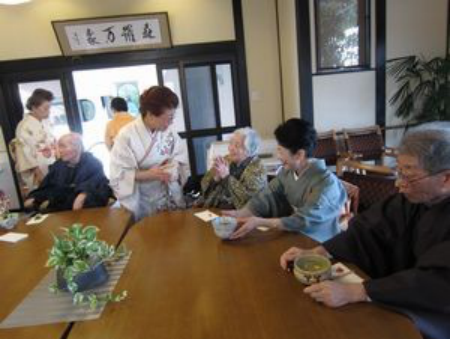
Providing activities that are rooted in traditional Japanese culture is one such practice for implementing Terado’s philosophy. We provide residents with dementia the opportunity to take part in special events like New Year's tea ceremony, a Bon Odori festival, and flower arrangement, where they wear seasonal kimono (Japanese traditional formal ware). Figure 1 shows a scene of New Year's first tea ceremony in Terado. Even long-term residents who need long-term care and don't seem to be able to wear kimono in normal circumstances have a dignified elegance and a reminiscent mood while wearing kimono during these events.
Figure 1. The New Year’s tea ceremony at Terado
The lessons in Japanese flower arrangement discussed in this paper were carried out in the Terado group home un- der the cooperation of the Ikenobo Society of Floral Art of Kyoto. Residents, care staff in our group home and healthy elderly people from the area learned Japanese flower arrangement together. Japanese flower arrangement is part of Japanese traditional culture, and is well-known by all Japanese. It is easy for Japanese people to imagine, even for people without experience. This sense of familiarity is both strong and widespread. Therefore, lessons in Japanese flower arrangement might be utilized for dementia care targeting a large group of Japanese residents.
METHOD
How to Plan Japanese Flower Arrangement Lessons
To conduct Japanese flower arrangement lessons targeted towards sufferers of dementia requires sensitivity to their needs, which are different from those of healthy people. We discussed these considerations with care staff and the instructor. Accordingly, the following steps were carried out to create an atmosphere where residents became willing to take part in the lesson.
1. We talked with residents about Japanese flower arrangement more than a week before in order to en- courage their interest in the lesson.
2. In addition to residents, we spoke to their family members to encourage the idea of the lesson as psy- chological occupational therapy.
3. Care staff started to tune up the physical condition of their residents, especially promoting regular di- urnal sleep cycles.
4. The instructor and care staff became familiar with each other in advance.
5. The instructor worked to understand the mentality of people with dementia, and learn more about the disorder. For example, an instructor should not consider people with dementia unable to perform Japa- nese flower arrangement, “because they cannot understand it.”
During the lesson, we decided to keep in mind the following.
6. When we introduced residents to the venue of the lesson, we did not force residents to take part in the lesson. We paid attention to their mental, emotional, and physical conditions.
7. All tools to be used in the lesson, including flower shears, vase, and pinholder, needed to be real equipment.
8. Care staff should call residents by name more frequently than usual, as keeping attention for long peri- ods is often difficult for people with dementia. Also, by sharing the schedule of the lesson between the instructor, care staff and support volunteers beforehand, we should be sure residents always have something to do during the lesson.
9. Small failures in the lesson should be allowed, and we should not damage the residents’ pride. For ex- ample, if a resident cuts off the head of the flower, the care staff might add a new flower to their ar - rangement without the resident’s noticing, and make the final arrangement look fine.
10. To make the lesson fun for every resident, the members of each table should be assigned with consid- eration to residents’ interpersonal relationships.
How to Perform Japanese Flower Arrangement Lessons The place, time and frequency of the lesson are as follows:
Place: Living room on the second floor of Terado Time: About two hours, starting at14:00 (including the snack time) Frequency: Monthly (lessons are ongoing, and have been conducted five times at the time of writing.)
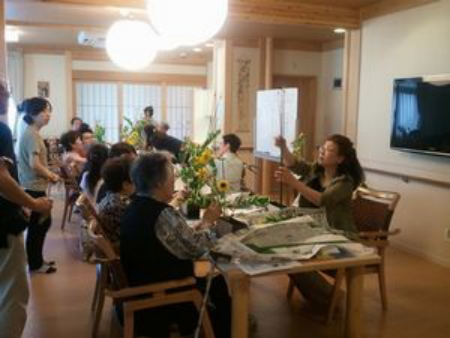
Figure 2 shows a scene of the lesson. The schedule on the day of the lesson was as follows.
1. In the morning of the day of the lesson, in order to warm up the atmosphere of the group home, care staff spoke to residents more actively than usual, and started the preparation of the lesson.
2. After lunch, care staff spread newspapers on the tables for the lesson, and brought out the tools used in cooperation with residents. After final confirmation of the participants, care staff determined the seating arrangement of the residents.
3. The instructor arrived at 2:00 pm. After greeting the instructor, the lesson began with an introduction to the materials of the flower arrangement.
4. The instructor explained what flower arrangement style residents were to follow in the lesson using a white board. Teaching materials were also used as needed.
5. Then, residents arranged flowers freely as the mood took them, regardless of experience. Support vol- unteers, the instructor, and care staff supported the residents as needed.
6. Residents took a break around 3:00 pm for a snack.
7. After finishing their flower arrangements, they shared their arrangements with each other.
Figure 2. A flower arrangement class at Terado Participants in Japanese Flower Arrangement Lessons
The number of participants in a lesson is shown below. In some cases, residents didn't take part in the lesson due to their physical condition at the time. Therefore, the number of participants differed for each lesson. Our group home Terado is characterized by its openness to the community, so we also recruited local support volunteers and elderly members of the community.
Residents of our group home: 5-8 Elderly living in this region: 2-4 Support volunteers: 2-5 Care staff: 3-5 Measuring the Effects of Japanese Flower Arrangement Lessons
To evaluate the effects of the lessons, we assessed the psychological state of the residents. For this purpose, we used the emotional assessment part of the GBS scale for assessing the severity of functional aspects of dementia (Got- tfries et al 1982). Assessments on the day of the lesson were timed as follows.
A: Before the lesson (e.g. before lunch) B: During the lesson C: After the lesson (e.g. before dinner)
In particular, seven point scales from 0 (normal) from 6 (very bad) were used to assess the following items: “Emo- tional blunting”, “Emotional liability”, “Reduced motivation”, “Anxiety”, “Reduced mood” and “Restlessness.” All assessments were done by trained care staff.
Also, after the lesson, we gathered additional details that showed the effect and changes in residents that would not have appeared in the GBS scale by conducting interviews with the care staff who participated in the lesson, the resi - dents, the instructor, and the assistants.
RESULTS
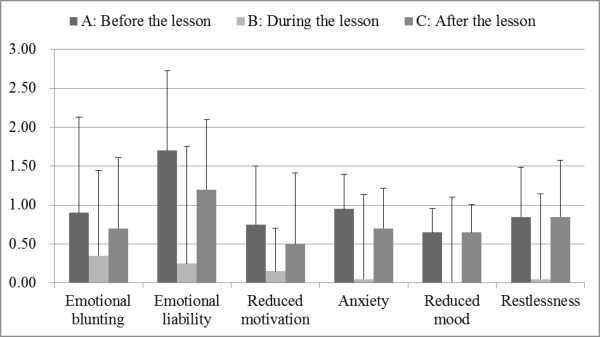
GBS Scale Results So far, ten residents have experienced flower arrangement lessons. However, during these five months, only four residents participated in all five lessons. We show the average assessment results of the GBS scale of these four resi- dents before, during, and after the lessons in Figure 3.
Figure 3. The results of the GBS scale assessment
From Figure 3, we can see a decrease in GBS scale during the flower arrangement lessons, i.e. an improvement in emotional state of the residents has been found. There are items that indicate the improvement of the state after the lesson compared to those before the flower arrangement. From the results of one-way analysis of variance, the aver- ages of the scores for “Emotional liability” (p <0.01), “Reduced mood” (p <0.05) and “Restlessness” (p <0.05) shows significant difference between groups: A, B and C.
Interview Result The following results became clear from interviews with the instructor and the care staff, residents, and assistants who participated in the lessons.
1. Lessons usually lasted for two hours. Although residents took a break, they could not maintain physical strength and concentration during the lesson, and started to doze off. For almost all residents, it was diffi- cult to concentrate on the lesson for more than one hour. Some improvements in the lesson plan are de- sired to help accommodate this issue.
2. Some residents had difficulty communicating during the lesson because they did not have a trusting rela- tionship with the elderly community members participating. Due to the residents’ personalities, the partic- ipation of the community members became an issue. While our group home philosophy requires us to be open to the local community, we should consider the needs of these residents more carefully.
CONCLUSION
We hope that our group home provides hope for people with dementia, who suffer from stress, a sense of loss, lone- liness, and despair, and the family members who take care of them. We want our residents to live in our group home and smile every day. However, the reality is that it is difficult for care staff to provide each resident with one-on-one care and a custom program due to a shortage of staff. Under these limitations, residents’ participation in the flower arrangement lessons has brought precious times to every resident. Care staff thought it was rewarding work. As shown in this paper, using a traditional Japanese craft like flower arrangement as an activity for people with demen- tia is acceptable regardless of gender. It touched their hearts and provided some measure of healing.
On the other hand, the effectiveness of flower arrangement is largely dependent on environmental considerations.
For example, Japanese flower arrangement requires such tools as flower shears, a vase, and a pinholder. It is a sim- ple thing to substitute craft scissors for flower shears, and the pinholder, a collection of sharp needles, is also a po- tential safety hazard. Although it is difficult for residents to handle, we should prepare the real tools for the begin- ning of the lesson to create an authentic atmosphere. After starting the lesson, we can replace these real tools with simpler, safer ones like craft scissors, an oasis, and so on. By exercising such ingenuity, we allow residents to truly enjoy the activity without safety risks.
The instructor must also be genuine. There is no meaning for care staff to play the instructor role, because residents do not understand the essence of Japanese flower arrangement by language. It is important for residents to take lessons from a certified instructor in the classical school. In fact, one resident with dementia stated that she learned “Shin,” “Soe,” and “Tai,” that are the basis of Japanese flower arrangement very long time ago. Her attitude toward flower arrangement was very mature. We hope that, by touching these aspects of our residents, young care staff will realize the interactive nature of dementia care, and add their experienced care while upholding the dignity of the res- idents.
The reason why Japanese flower arrangement is accepted by Japanese regardless of experience and gender is be- cause there was a period when it was considered an important aspect of domestic training, along with tea ceremony. Every Japanese citizen understands the cultural significance of this traditional art, as it is rooted in the cycle of sea- sons and the Japanese respect for nature. It resonates with our minds.
From the point of view of reminiscence therapy, it can be expected to bring a nostalgic feeling by recalling the al - cove in a traditional Japanese room where flowers are displayed, school flower beds, or the gardens and fields where residents played in their youth. In fact, one resident requested we use cosmos because she liked its flowers and they were familiar to her.
The instructor from Ikenobo School asks the students of the lesson to face the flowers sincerely. The instructor teaches the students by saying that you reproduce the means by which the plant extends its leaves toward the sun- light. Flower arrangement is a dialogue with flowers, which do not have a language; it is similar to our conversations with people who suffer from dementia, which cannot be shared with healthy people. What we need for both people with dementia who have difficulty with language and unspeaking flowers are imagination, creativity, and the power of compassion.
By seeing the growth of leaves of the flower, we know the way how it grows. By facing people with dementia, we give more than a passing thought to the stories of their lives. In near future, in the field of dementia care, we want to make use of other Japanese traditions, including tea ceremony and incense burning, to improve the quality of our care.
REFERENCES
Gräsel, E. et.al, (2003), “Non-drug therapies for dementia: an overview of the current situation with regard to proof of effectiveness”, Dementia and geriatric cognitive disorders Vol.15, No.3, pp.115-125 Gottfries, CG. et.al, (1982), “A new rating scale for dementia syndrome”, Archives of Gerontology and Geriatrics, Vol.1, No.4,
pp.311-330
LISTED IN THE AHFE DIGITAL BOOKSTORE CATALOGUE
Explore the complete digital volume
Advances in Affective and Pleasurable Design
Read this individual research paper free through the original publisher, or explore the full digital proceedings book.
ISBN 978-1-4951-2109-8
Explore this ISBN in the AHFE Bookstore ↗Listed in the July 2026 bookstore catalogue; search by ISBN to confirm current availability · Digital book purchase optional