Myungeun Lee, Gilsoo Cho (2021). Psychophysiologically Evaluated Visuo-Tactile Affection using Printed Fabrics. In: Advances in Affective and Pleasurable Design. AHFE Open Access, vol. 14. https://doi.org/10.54941/ahfe100574
The present study compared to the three perceptional conditions of tactile affection−tactile tactility, visual tactility, and visuo-tactile affections−using psychological evaluation and psychophysiological methods. A comparative study was performed to fine out the differences of psychological and psychophysiological tactile perception according to the conditions of tactile perception. Furthermore, it also aims to find out the important fabric factor for tactile affection. Through the previous study, we found the fabric factors which influenced in tactile affection of fabrics: weave construction and fabric pattern. Total of six printed fabrics were developed by DTP method on naturally colored organic cotton fabrics as stimuli. Thirty participants were placed by randomized incomplete block design for the experiment. For measuring psychological affection, questionnaire was developed using a 9 points semantic differential scale. Electroencephalogram(EEG) was measured as a CNS response and electrocardiogram(ECG), skin conductance level(SCL), and photoplethysmography(PPG) were quantified as ANS responses. According to the results, perceptional condition had little effect on psychological and psychophysiological tactile perception. Significant effects on perceptional condition showed only on “showy-plain” affection and SCL response. Mostly, weave construction was more important fabric factor to perceive tactile affection than fabric pattern. However, the importance of fabric pattern also observed through the interaction effects.
Fabric affection influences purchase decision as the first impression of the clothing products at the moment of decision making and continually affects clothing comfort and satisfaction (Bertaux et al., 2007; Ciesielska-Wrobel and Langenhove, 2012). In addition, it is an important factor for the evaluation of the fabric and quality of clothing products (Bishop, 2010). Fabric affection is perceived through the five senses of human body. Among them, tactile affection plays an important role for an affirmative perception of fabric affection because fabrics are directly and consistently contact with human skin.
Tactile affection of the fabric is perceived by visual and tactile senses together or separately (Baik, 2001). When both senses involved together for perceiving tactile affection, we called this visuo-tactile affection. We can easily assume that the visual tactility, tactile tactility, and visuo-tactile conditions elicit different affection responses from people. However, there have been few studies on this subject. According to Heller (1982), visual tactility and tactile tactility provided comparable levels of performance about the perception of smoothness, but bimodal input
(visuo-tactile) led to greater accuracy. However, Heller’s stimuli were aluminum oxide abrasive papers and no study was founded on fabric stimuli in our scope.
Meanwhile, when any emotional changes occur in our mind, our body reacts according to a certain pattern (Cho and Park, 2012). This supports that the psychophysiological evaluation which measure the physiological signals from a human body can be an objective method for evaluating human affection. Researchers are exploring more objective measures of human affection using physiological techniques such as electroencephalogram (EEG) as a CNS response and electrocardiogram (ECG), skin conductance level (SCL), and photoplethysmography (PPG) as ANS responses (Cho et al., 2001; Cho et al., 2005; Kim et al., 1998; Laparra-Hernandez et al., 2009; Sohn and Yi, 1998).
The present study compared to the three perceptional conditions of tactile affection−tactile tactility, visual tactility, and visuo-tactile affections−using psychological evaluation and psychophysiological methods. A comparative study was performed to fine out the differences of psychological and psychophysiological tactile perception according to the conditions of tactile perception. Furthermore, it also aims to find out the important fabric factor for tactile affection. There were two fabric factors manipulated in the study: weave construction (3 levels) and fabric pattern (2 levels).
EXPERIMENTAL Stimuli
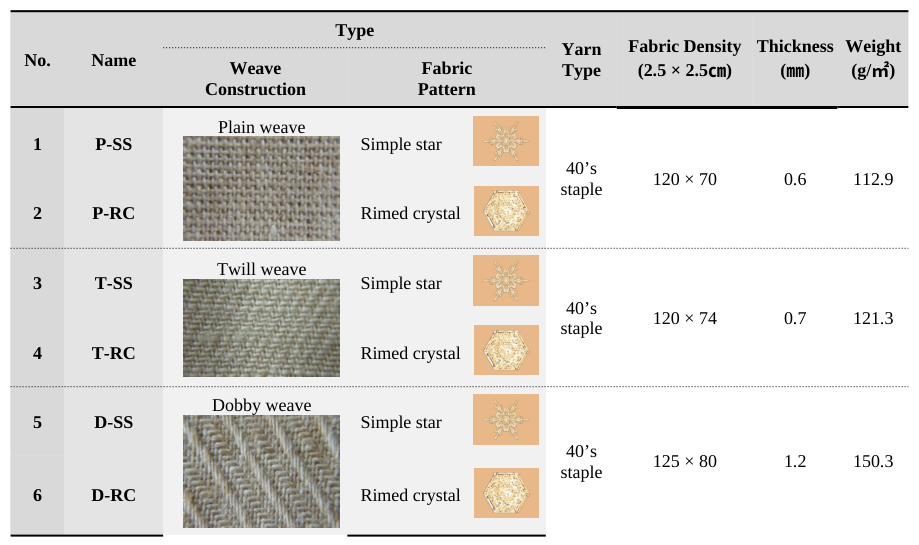
The six naturally colored organic cotton (NaCOC) fabrics were developed as stimuli (Table 1). Two snow crystal patterns were printed onto coyote-brown colored fabrics which have three kinds of weave constructions by digital textile printing (DTP) method (3 weave constructions × 2 fabric patterns). Each of the 6 fabrics was prepared in a 20 × 30 cm size.
Table 1: Specifications of the NaCOC fabric stimuli Type
Questionnaire for psychological evaluation The primary questionnaire for psychological affection evaluation consisted using bipolar adjective pairs which can be measured on tactile affection obtained from the literature (Bishop 1996; Cho. et al., 2000; Lee. et al., 2011; Sohn. et al., 1998). It was consisted of 25 bipolar adjective pairs. An initial psychological evaluation using 2 randomly chosen stimuli was conducted to select the appropriate adjective pairs which used in the main experiment. Participants of the initial test were 30 students (mean age 26.4 ± 4.3 years) majoring in Clothing and Textiles. After elimination processes by factor analysis, finally 14 adjective pairs were selected for the main experiment: “thin- thick,” “cushiony-hard,” “light-heavy,” “smooth-harsh,” “soft-rough,” “flexible-stiff,” “warm-cold,” “pleasant- unpleasant,” “luxurious-humble,” “beautiful-ugly,” “showy-plain,” “static-dynamic,” “feminine-masculine,” and “like-dislike.” Number 1-7 were the primary tactile sensation adjectives and number 8-14 were the secondary tactile affection adjectives. They consisted of a 9 point semantic differential scale (SDS).
Methods for psychophysiological evaluation Physiological signal data acquisition
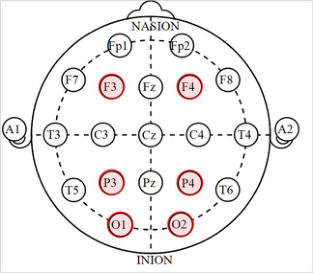
CNS and ANS signals were acquired using a Biopac amplifier MP150CE and AcqKnowledge 4.1 software (Biopac systems Inc., U.S.A.). As a CNS signal, EEG was measured from the frontal (F3, F4), parietal (P3, P4) and occipital (O1, O2) lobes of the brain based on an international 10/20 electrode system with a linked ears reference (Jasper, 1958) (Figure 1). EEG measuring sites were chosen by Amedi et al. (2011), Grill-Spector et al. (1998), and Sohn & Lee (1998). These sites are reacted by visual and tactile stimulations. The sampling frequency was 250 Hz and a bipolar lead was applied.
For the ANS responses, ECG, SCL, and PPG signals were acquired. ECG was recorded using a standard 3 leads montage (Lead I configuration). SCL electrodes were located on the index and middle fingers of the left hand. PPG was measured from the ring finger of the left hand. The sampling frequency of ANS signals was 250 Hz.
Figure 1. International 10/20 electrode system and the EEG measurement sites in the present study
(red circled sites)
Physiological signal processing EEG signals were firstly analyzed by FFT (fast fourier transform), and the relative power of each frequency band was analyzed. Analyzed EEG frequencies were 0.5-4 Hz (delta wave), 4-8 Hz (theta wave), 8-13 Hz (alpha wave), and 13-30 Hz (beta wave). The first second of all signals were discarded to avoid transitory effects and a total of 30 seconds of each signal was analyzed (Laparra-Hernandez, 2009).
Then, normalization processes was carried out by using Eqs. (1) and (2) (Laparra-Hernandez, 2009). In Eq. (1), X is the signal during the exposure time in each fabric stimulus and P is the signal before exposure of stimuli.
Normalization 2 (N2nj) was carried out for each participant with respect to the maximum value recorded for the participant in stimuli. This normalization (N2nj) was performed according to Eq. (2), where Nxnj is the normalized value (with the first normalization) of the signal, elicited by stimuli “j”, from subject “n”. Nx n is a vector with the normalized values (with the first normalization) of the signals, elicited by all stimuli, from participant “n”:
Equations and mathematical formulas are available in the original paper PDF.
HRV was analyzed from the ECG signals, and then RR intervals were calculated from each signal. Like EEG signals, the first second was discarded and a total 30 s of each signal was analyzed. Secondly, LF/HF was analyzed from the RR interval data by Kubios HRV (ver. 2.0., Biosignal Analysis and Medical Imaging Group, Univ. of Eastern Finland, Finland). Lastly, the normalization processes were carried out using Eqs. (1) and (2). From the SCL and PPG values, the mean value was calculated at each stimulus from 1 to 31 s. Then, the normalization processes were performed using Eqs. (1) and (2).
Participant and experimental design Thirty healthy right-handed female participants (mean age 24.3 ± 3.9 years) were recruited from Yonsei University and their participation was compensated. Before the main test, Ishihara’s color blindness test was performed for screening color blindness and two-point discrimination (TPD) was carried out for screening tactile paresthesia on hands. Participants were placed in the experiment by randomized incomplete block design. A total of 6 stimuli were evaluated by one participant.
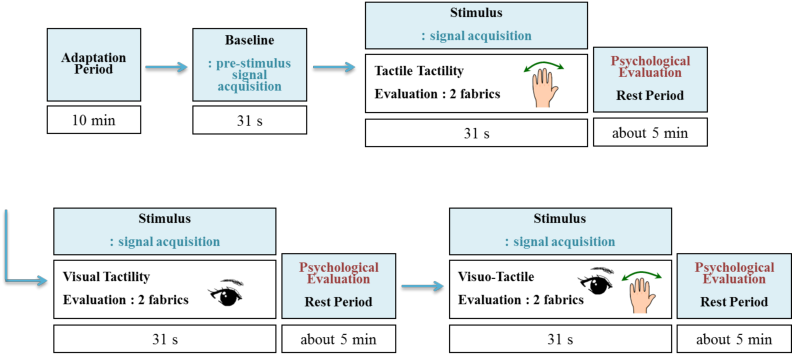
Experimental procedure The experiments were conducted in an anechoic chamber under 400 Lux of incandescence. Upon entering the chamber, the participant was instructed about the procedures of both the psychological and psychophysiological evaluations for 5 min, and then electrodes were attached to the participant to record EEG, ECG, SCL, and PPG signals. A 10 min adaptation period was given to stabilize physiological signals, and then pre-stimulus signals (baseline) were recorded for 31 s. Each stimulus was presented in a random order at a 30 cm distance from the participant’s eyes under the local lighting by daylight desk lamp over the participant’s head (SS-460, Samjung Co. Ltd., Korea). Physiological signals were recorded during 31 s of stimulus presentation. The participants were instructed to avoid speaking and to move as little as possible during the signal recording. Between each stimulus, there was a psychological affection evaluation using the questionnaire and then a rest period was given (Figure 2). The entire process took about 40 min per participant.
Figure 2. Experimental procedure
Statistical analysis A single factor ANOVA was used to analyze the differences of psychlogical and psychophysiological tactile affection depending on perceptional condition. Two-way ANOVA was performed to analyze the differences of psychlogical and psychophysiological tactile affection depending on weave construction and fabric pattern. Duncan’s test as a post-hoc ANOVA and simple main effect analysis for analyzing interaction effect was manipulated.
RESULTS AND DISCUSSION
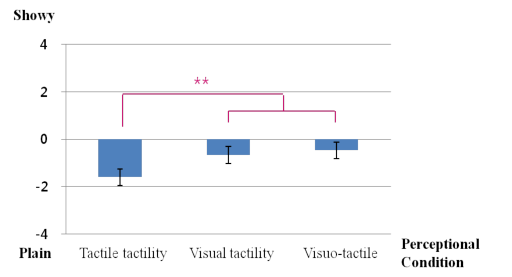
Psychological evaluation Psychological affection was evaluated by questionnaire. The cronbach’s alpha of the questionnaire was 0.749. Single factor ANOVAs were used to analyze the differences of psychlogical tactile affections depending on perceptional condition. Most tactile affections not showed significant differences except “showy-palin” (F(2, 177) = 5.594, p < .01). It means that perceptional conditions were almost no effect on psychological tactile affection. Therefore, the results were re-analyzed using ANOVAs with two fabric factors (3 weave constructions × 2 fabric patterns).
In case of “showy-palin”, Duncan’s test was performed as post-hoc ANOVA (Figure 3). It showed that visual tactility and visuo-tactile were classified as the same group and tactile tactility belong to another group. It means that showiness affection largely depends on the visual condition.
Figure 3. Duncan's test result of "showy-plain" on perceptional condition
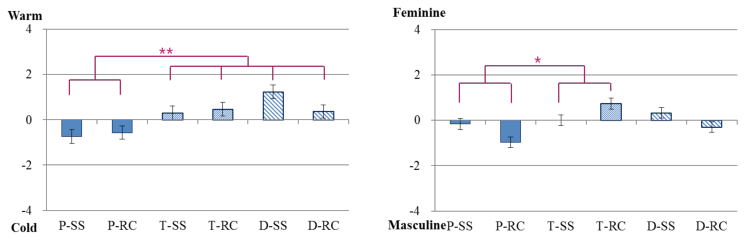
Two-way ANOVAs between weave construction and fabric pattern exhibited that significant main effects on weave construction showed in “thin-thick,” “cushiony-hard,” “smooth-harsh,” “soft-rough,” “warm-cold,” and “feminine-masculine” (Table 2). Figure 4 displayed Duncan’s test results. In the “thin-thick,” each of the three weaves belonging to the different group. In the “cushiony-hard,” “smooth-harsh,” “soft-rough,” and “warm-cold,” differences showed between plain weave and twill, dobby weaves. In the “feminine-masculine” affection, significant difference exhibited between plain and twill weaves. Meanwhile, no significant main effect showed on fabric pattern.
Table 2: A summary of significant main effects for weave construction in psychological evaluation
F(2, 174) F(2, 174)
F(2, 174) F(2, 174)
F(2, 174) F(2, 174)
Weave p < .001
p < .001 p < .01
p < .01 p < .001
p < .05
Figure 4. Duncan's test results on weave construction in psychological evaluation
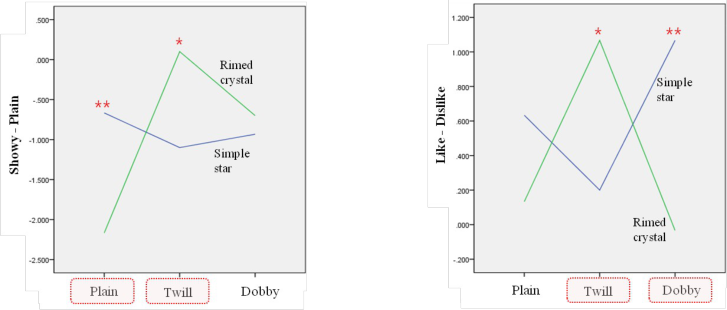
Significant interaction effects between weave construction and fabric pattern displayed in “flexible-stiff,” “pleasant-unpleasant,” “luxurious-humble,” “beautiful-ugly,” “showy-plain,” and “like-dislike” (Table 3). Simple main effect analysis for interaction effects showed that significant differences between simple star and rimed crystal patterns largely showed in twill weave (Figure 5). The twill weave rimed crystal (T-RC) fabric exhibited significantly flexible, pleasant, luxurious, beautiful, showy affection and preference compared to twill weave simple star patterned (T-SS) fabric. In dobby weave fabrics, simple star patterned (D-SS) fabric displayed significant pleasantness and likeness compared to dobby weave rimed (D-RC) fabric. In addition, plain weave simple star (P- SS) fabric evaluated less plain affection compared to plain weave rimed crystal (P-RC) fabric.
Table 3: A summary of significant interaction effects between weave construction and fabric pattern in psychological evaluation
F(1, 174) F(1, 174)
F(1, 174) F(1, 174)
F(1, 174) F(1, 174)
× Pattern p < .01
p < .01 p < .01
p < .01 p < .01
p < .01
Figure 5. Simple main effect analysis results for two-way interaction effect between weave construction and fabric pattern in psychological evaluation (*p<.05, **p<.01)
According to the results, mostly weave construction was more important factor to perceive tactile affection of fabric than perceptional condition and fabric pattern. Furthermore, weave construction was important factor to perceive the primary sensation such as thickness, smoothness, softness, flexibility, and warmness. In contrast, fabric pattern also affected with weave construction to perceive the secondary affection such as pleasantness, luxuriousness, beauty, and preference. This seems to be caused that participants try to objectively evaluate about the primary tactile sensation while imagine the whole image of stimuli about the secondary tactile affection.
Psychophysiological evaluation CNS response
CNS response was measured by using EEG signals. They were analyzed based on frequencies. Analyzing frequencies were 0.5 - 4 Hz (delta wave), 4 - 8 Hz (theta wave), 8 - 13 Hz (alpha wave), and 13 - 30 Hz (beta wave). Firstly, single factor ANOVAs were used to analyze the differences of CNS responses depending on perceptional condition. Any statistically significant difference did not observed among the perceptional condition. It means that the differences of perceptional conditions did not affect to EEG responses.
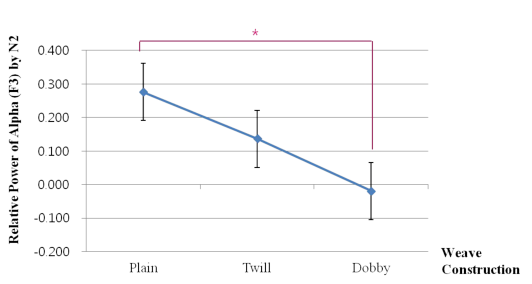
Therefore, the results were re-analyzed using ANOVAs with two fabric factors (3 weave constructions × 2 fabric patterns). Significant main effect displayed on weave construction in alpha (F3) (F(2, 174) = 3.396, p < .05). Post-hoc ANOVAs, Duncan’s test, revealed that clear differences exhibited between plain and dobby weaves (Figure 6). Plain weave fabrics elicited larger amounts of alpha waves on F3 than dobby weave fabrics. Twill weave fabrics were positioned in the middle of the other two weaves. It means that the differences of fabric touch by fabric construction elicited the changes of alpha waves on left frontal lobe. The larger surface changes presented, the less alpha waves appeared on left frontal lobe.
Figure 6. ANOVA and Duncan's test results on alpha (F3) (F(2, 174) = 3.396, p < .05)
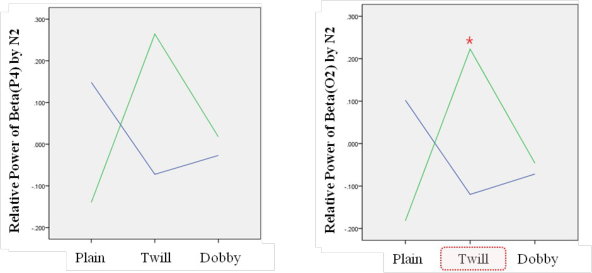
Significant interaction effects between weave construction and fabric pattern displayed on delta, theta, and beta waves in several sites of the brain (Table 4). Simple main effect analysis results are shown in Figure 7. Delta (F3, P3, P4, and O2) waves were significantly higher in the twill weave simple star (T-SS) fabric than in the twill weave rimed crystal (T-RC) fabric. Theta (F3, P3) and beta (O2) waves were significantly lower in the T-SS fabric than in the T-RC fabric. Beta (O1) waves were significantly higher in the plain weave simple star (P-SS) fabric than in the plain weave rimed crystal (P-RC) fabric. It is speculated that, these results related to the psychological evaluation results. In the psychological evaluation, twill rimed crystal pattered fabrics generally evaluated positively while plain and dobby rimed crystal pattered fabrics evaluated negatively.
Table 4: A summary of significant interaction effects between weave construction and fabric pattern in
EEG responses
F(1, 174) F(1, 174)
F(1, 174) F(1, 174)
× Pattern p < .01
p < .05 p < .05
p < .01 p < .01 Variable Theta Beta F3 P3 F3 O1 P4 O2
F(1, 174) F(1, 174)
F(1, 174) F(1, 174)
F(1, 174) F(1, 174)
× Pattern p < .05
p < .05 p < .05
p < .05 p < .05
p < .05
Figure 7. Simple main effect analysis results for two-way interaction between weave construction and fabric pattern in EEG responses (*p<.05, **p<.01)
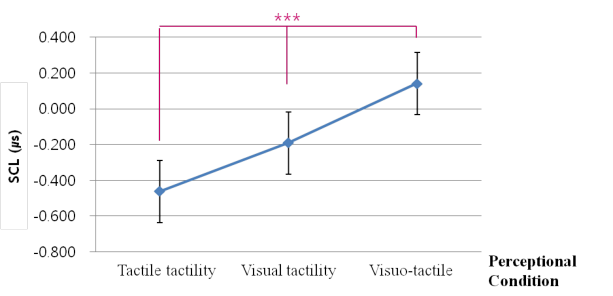
ANS responses ANS responses were measured by using ECG, SCL, and PPG signals. A single factor ANOVAs were used to analyze the differences of ANS responses depending on perceptional condition. Among the ANS signals, only SCL showed significant difference on perceptional condition (F(2, 177) = 15.297, p < .001). Values of LF/HF from ECG signals and PPG did not showed significant results. Post-hoc ANOVAs, Duncan’s test, revealed that three perceptional conditions were classified into separate group (Figure 8). SCL values were highly decreased in tactile tactility (-0.462 ㎲), slightly decreased in visual tactility (-0.191 ㎲), and increased in visuo-tactile (+0.142 ㎲) conditions. The result showed that the perceptional conditions can be distinguished using SCL signals.
Figure 8. ANOVA and Duncan's test results on SCL (F(2, 177) = 15.297, p < .001)
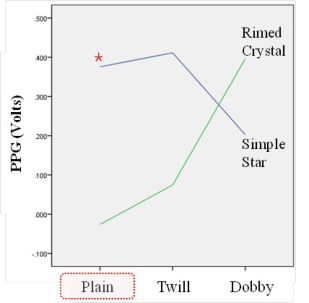
The results of LF/HF and PPG were re-analyzed using ANOVAs with two fabric factors (3 weave constructions × 2 fabric patterns). The analysis did not show any main effect. Two-way interaction effect between weave construction and fabric pattern was showed on PPG (F(2, 174) = 3.524, p < .05) (Figure 9). According to the simple main effect analysis, simple star patterned plain (P-SS) fabric had significantly higher PPG values than plain rimed crystal (P-RC) fabric.
Figure 9. Two-way Interaction effect on PPG response (F(2, 174) = 3.524, p < .05)
CONCLUSIONS
The present study compared to the three perceptional conditions of tactile affection−tactile tactility, visual tactility, and visuo-tactile affections−using psychological evaluation and psychophysiological methods. A comparative study was performed to fine out the differences of psychological and psychophysiological tactile perception according to the conditions of tactile perception. Furthermore, it also aims to find out the important fabric factor for tactile affection between weave construction and fabric pattern. According to the results, perceptional condition had little effect on psychological and psychophysiological tactile perception. Significant effects on perceptional condition showed only on “showy-plain” affection in psychological evaluation and SCL responses in psychophysiological method. It means that perceptional conditions of tactile affection had almost no effect on psychological and psychophysiological affection responses. Mostly, weave construction was more important fabric factor to perceive tactile affection than fabric pattern. However, the importance of fabric pattern also observed through the interaction effects. The study also revealed that weave construction was more important factor to perceive the primary sensation such as thickness, smoothness, softness, flexibility, and warmness while fabric pattern also affected to perceive the secondary affection such as pleasantness, luxuriousness, beauty, and preference. Furthermore, it is speculated that the left frontal alpha waves can be used to distinguish the differences of fabric weaves and SCL signals can be sorted the perceptional conditions of tactile affection. Further study needs to be performed to find out the relationship between psychological evaluation and psychophysiological responses.
REFERENCES
Amedi, A. Malach, R. Hendler, T. Peled, S., Zohary, E. (2001). “Visuo-haptic object-related activation in the ventral visual pathway”, NATURE NEUROSCIENCE, Volume 4 No. 3. pp. 324-330. Baik, S. (2001). “A Study on the Design of Visual-Auditory Haptic Interface – With Emphasis on Embodying Haptics Using
Visual and Auditory Perception”, JOURNAL OF KOREAN SOCIETY OF DESIGN SCIENCE, Volume 14 No. 2. Bertaux, E. Lewandowski, M., Derler, S. (2007). “Relationship between Friction and Tactile Properties for Woven and Knitted Fabrics”, TEXTILE RESEARCH JOURNAL, Volume 77 No. 6. pp. 387-396. Bishop, D. P. (1996). “Fabrics: Sensory and Mechanical Properties”, TEXTILE PRPGRESS, Volume 26 No. 3. pp. 1-62. Cho, G. Cho, J. Kim, C., Ha, J. (2005). “Physiological and S ubjective E valuation of the R ustling S ounds of P olyester W arp K nitted F abrics ”, TEXTILE RESEARCH JOURNAL, Volume 75 No. 4. pp. 312-318. Cho, G., Park, H. (2012), “Clothing sensibility science” (new Ed). Seoul: Dongsumunhwawon. Cho, G. Yi, E., Cho, J. (2000). “Effect of Fabric Sound and Touch on Human Subjective Sensation – Crosscultural Comparison
between Korea and U.S.A”, KOREAN JOURNAL OF THE SCIENCE OF EMOTION & SENSIBILITY, Volume 3 No. 1.
pp. 41-52. Cho, J. Yi, E. Sohn, J., Cho, G. (2001). “Psychophysiological Responses to the Sound of Fabric Friction”, KOREAN JOURNAL OF THE SCIENCE OF EMOTION & SENSIBILITY, Volume 4 No. 2. pp. 79-88. Ciesielska-Wrobel, I. L., Langenhov, L. V. (2012). “The Hand of Textiles – Definitions, Achievements, Perspectives – A Review”.
TEXTILE RESEARCH JOURNAL, Volume 82 No. 14. pp. 1457-1468. Grill-Spector, K. Kushnir, T. Edelman, S. Itzchak, Y., Malach. R. (1998). “Cue-invariant activation in object-related areas of the human occipital lobe”, NEURON, Volume 21. pp. 191-202. Heller, M. A. (1982). “Visual and Tactual Texture Perception: Intersensory Cooperation”, PERCEPTION AND
PSYCHOPHYSICS, Volume 31 No. 4. pp. 339-344. Kim, J. Park. Y. Oh, A. Choi, S., Sohn, J. (1998). “Emotions and EEG Features Evoked by Tactile Stimulation”, KOREAN JOURNAL OF THE SCIENCE OF EMOTION & SENSIBILITY, Volume 1 No. 1. pp. 153-160. Laparra-Hernandez, J. Belda-Lois, J. M. Medina, E. Campos, N., Poveda, R. (2009). “EMG and GSR Signals for Evaluating
User’s Perception of Different Types of Ceramic Flooring”, INTERNATIONAL JOURNAL OF INDUSTRIAL ERGONOMICS, Volume 39. pp. 326-332. Lee, M. et al. (2011). “A Study on the Visual Sensibility of Snowflakes for Designing a Pattern of Naturally Colored Organic Cotton Fabrics”, PROCEEDINGS OF KOREAN SOCIETY FOR EMOTION & SENSIBILITY, pp. 69-70. Sohn, J., Yi, I. (1998). “Psychological and Physiological Approach of Fabric Tactile Sensibility”, FIBER TECHNOLOGY AND
INDUSTRY, Volume 2 No. 4. pp. 439-450. Yamada, F. (1998). “Frontal Midline Theta Rhythm and Eyeblinking Activity During a VDT Task and a Video Game: Useful Tools for Psychophysiology in Ergonomics”, ERGONOMICS, Volume 41 No. 5. pp. 678-688.
LISTED IN THE AHFE DIGITAL BOOKSTORE CATALOGUE
Explore the complete digital volume
Advances in Affective and Pleasurable Design
Read this individual research paper free through the original publisher, or explore the full digital proceedings book.
ISBN 978-1-4951-2109-8
Explore this ISBN in the AHFE Bookstore ↗Listed in the July 2026 bookstore catalogue; search by ISBN to confirm current availability · Digital book purchase optional