Naseem Ahmadpoura, Jean-Marc Roberta, Gitte Lindgaardb (2021). A Study of Passengers’ Real-Time Emotional Responses and Comfort Experience During the Flight Using an Experience Sampling Method. In: Advances in Affective and Pleasurable Design. AHFE Open Access, vol. 14. https://doi.org/10.54941/ahfe100566
The majority of research on passengers’ subjective and holistic comfort relies on the retrospective recall of their experiences. Moreover, studies on the emotional responses of passengers to the aircraft interior are infrequent. This paper addresses the above issues by investigating the real-time comfort and emotional responses of passengers during the flight using an Experience Sampling Method (ESM). The results showed that the real time comfort remains constant during the flight, suggesting that passengers’ first impressions of the cabin could potentially determine their overall comfort. The results of emotional assessment highlighted two emotion groups as significant to passengers’ overall comfort in long haul flights. Those are wellbeing (e.g. joy/feeling good) and prospect-based (e.g. frustration/disappointment) emotions, evoked by passengers’ evaluation of several cabin features based on their concerns for a sense of security, peace and relaxation, and accomplishment. Enhancing passenger comfort should involve improving their experience with those features though fulfilling their concerns, offering higher degrees of joy and lowering frustration.
In recent years, a number of studies investigated passengers’ subjective experience of comfort in the aircraft interior environment using passengers’ trip reports (Vink et al., 2012; Ahmadpour et al., 2014a). Among those, passengers’ affective and emotional responses are rarely examined. Vink et al. (2005) emphasized on the role of emotion in defining one’s comfort experience and suggested that designing comfortable products should incorporate knowledge about emotional responses. The relationship between seat comfort and emotions was previously highlighted by De Looze et al. (2003) and Ahmadpour et al. (2014b). This is of interest particularly because the seat plays a central part in passenger’s experience during the flight. These studies provide enough evidence to motivate a study on the relationship between passenger comfort and emotions. This issue is addressed in this paper.
Most empirical studies on passenger comfort rely on reports of the flight experience after the trip. Vink et al. (2012) examined the trip reports of more than 10,000 travelers and prioritized the elements of the journey that influenced their overall comfort. Using passengers’ rating of overall comfort and descriptions of their experiences, legroom, hygiene, crew and seat were found to correlate significantly with their comfort and willingness to fly again with the same airline. Ahmadpour et al. (2014a) also used open descriptions of passengers’ experiences in the aircraft cabin after their summer vacation and suggested that their comfort experience could be described in relation to eight types of perceptions including peace of mind, physical wellbeing, and proxemics (e.g., perception of personal space). Each of those perceptions was linked to the specific concerns of passengers and the contextual features. For instance the perception of peace of mind was linked to passengers’ concerns for security, tranquility and relief and to cabin features such as the seat and temperature.
The above studies provided invaluable information about passengers’ recall of the trip impressions after the journey. However, less research is performed on passengers’ in-flight experiences whilst they take place in commercial flights. This paper reports an examination of passengers’ real-time comfort, emotional responses and their eliciting conditions in the aircraft cabin interior during the flight. Comfort, in this study, is defined as a person’s state of physical, physiological and psychological harmony (Slater, 1985). Some researchers have previously shown that comfort and discomfort could co-exist as independent concepts and that they are underlined by different sets of variables (Helander, 2003). An earlier study by Ahmadpour et al. (2014c), however, showed that passenger comfort and discomfort in the cabin interior are underpinned by the same types of variables and characterized by the same set of features. Consequently, comfort and discomfort are viewed as two extreme points of a bipolar phenomenon rather than being independent.
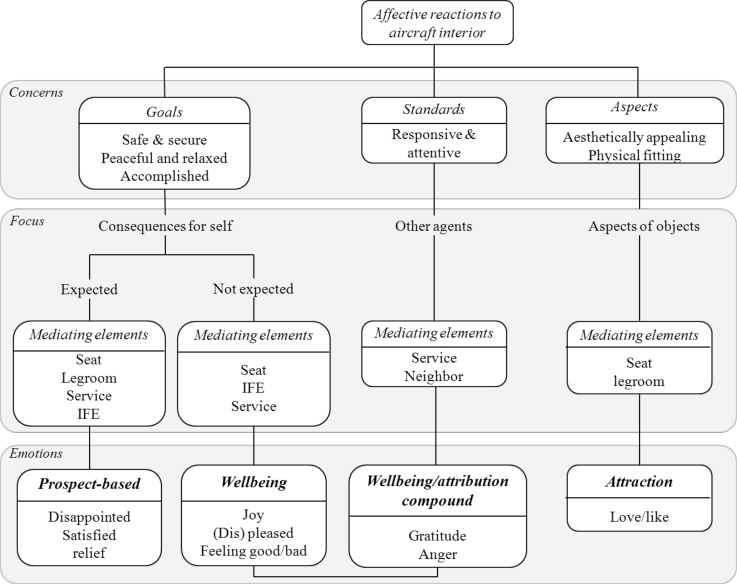
The Model of Aircraft Passengers’ Emotions A pilot study (Ahmadpour et al., 2014b) provided evidence on the salience of passengers’ emotional reactions for to their comfort experience. The emotion words were elicited from trip reports of 155 passengers and then sorted into groups using the OCC model (Ortony, Clore, Collins, 1988), proposing unique appraisal patterns for each group. The model is shown in Figure 1.
Figure 1. The cognitive structure of passengers’ emotions in relation to comfort in reaction to the aircraft cabin interior during the flight (Ahmadpour et al., 2014b)
The model suggests that the passenger comfort experience is linked to four groups of emotions. Those are prospect- based (e.g., disappointed, satisfaction, relief), wellbeing (e.g., joy, feeling good), wellbeing/attribution compound
(e.g., gratitude, anger), and attraction (e.g., love/like). The appraisal patterns leading to each of those emotion groups included passengers’ focus (on events, agents or objects) and concerns (goals, standards, and aspects) at the time. Certain mediating elements (i.e., context features) were identified in relation to each group as well. For instance attraction emotions, such as liking, were shown to result from passengers’ evaluation of the aesthetics appeal and the physical fit (i.e., their concerns) of the seat and legroom (i.e., mediating elements). The seat was the feature most frequently mentioned overall, suggesting that different qualities of this feature can elicit different emotions. The service, In-Flight Entertainment (IFE), and legroom were also influential on generating various emotions in the cabin environment.
This paper reports a follow-up study conducted to validate those emotions groups in the model, their appraisal patterns and relationship to passenger comfort. An Experience Sampling Method (ESM) was used for collecting real-time data about the above. A short description of the method follows next.
Experience Sampling Method (ESM) In psychology, a method called Experience Sampling Method (ESM) was developed to study real time subjective experiences (Csikszentmihalyi et al., 1977; Larson and Csikszentmihalyi, 1983). In this data collection method, the respondent is required to stop at certain times during the course of their experience to report “a high resolution description of their mental state right as they are happening” (Csikszentmihalyi and Csikszentmihalyi, 1988, p.253) in their natural environment. Usually, a beeping electronic device or cell-phone text message presents at random times during their experience indicates they should now stop and answer a series of questions (Anderson, 2002). If interruptions are impractical at that time, an event-contingent protocol is used in which participants report immediately after a particular, pre-determined event (Christensen et al., 2003).
Using EMS is advantageous for studying experiences as it eliminates memory biases in respondents’ answers and thus increases the validity of the results (Scollon et al., 2003). Depending on the signaling intervals, various changes in the experience dynamic become accessible. In this study, we employed ESM with an event-contingent protocol to access passengers’ real-time experiences and in particular their emotional reactions and comfort.
METHOD
Participants A convenience sample of 17 participants (14 male) of personal contacts was recruited. All participants had more than five flight experiences. Their age ranged from 20 to 70 (N=8 were 20-39 and N=8 were 40-59) years old. Their average height was 179.6 (160-190, SD=8.5) cm. Ten respondents reported long haul flights (>4hrs), mainly trans- Atlantic from north America to Europe or Asia, and 7 reported short haul flights (<4hrs) in Canada. Only two participants traveled on business class on long haul flights to Asia, and the rest traveled on economy class. None of the participants had any disability.
Questionnaire The first page of the questionnaire gave instructions about how it should be completed. The questionnaire began by seeking demographic information, flight information, seating location (window, middle, and aisle) and an assessment of their mood using a 5-point scales version of the Self-Assessment Manikin (SAM)(Lang, 1980). Next, three identical sections addressed the beginning, the half-way mark, and the end of the flight. Each section asked them to evaluate their overall comfort at the time on a 9-point rating scale (1=not very comfortable and 9=very comfortable) and to give an emotional assessment containing 22 emotion types of the OCC model, each accompanied by a 5-point scale (1= slightly feeling the emotions and 5=intensely feeling the emotion). The respondents were encouraged to provide justifications for their emotion ratings in a section provided for comments. Another question concerned the level of comfort with regard to certain interior cabin features. Those features were seat, legroom, temperature, noise, air quality, lighting, In-Flight Entertainment (IFE), service, hygiene, luggage room, and neighbors, all of which had been identified as generally influential on passengers’ comfort in a previous study (Ahmadpour et al., 2014). A 5-point scale (1=slightly comfortable, 5=very comfortable) followed by a comment section was provided for the rating of those features. Next, four open questions prompted the respondents to describe their experience at the time of reporting including their thoughts about the flight, their activity and reasons for taking it, as well as noting what made the flight memorable thus far.
Procedure The participants were contacted individually and were briefed on the structure of the questionnaire as well as on how it should be completed. They were instructed to enter the demographic information and mood assessment before boarding the aircraft. It was explained that passengers of long flights should complete all three sections at the beginning (when it was announced that they could unfasten their seat belts), halfway through the flight and at the end of the flight (10-15min before landing). Passengers on short flights were advised to complete the questionnaire only at the beginning and end of the flight. Each participant was also given a brief introduction to the emotion types used in the questionnaire. It was explained that each emotion represents a family of similar emotions, some examples of which, based on Ortony, Close and Collins (1988), were provided. Then the questionnaires and consent forms were emailed to respondents to print and take with them on their flight.
RESULTS
This section reports only a part of the data analysis. It includes the inter-relationship between participants’ overall comfort evaluation, emotional types, and cabin features as the impacting factors on the former. A full analysis and report is in preparation.
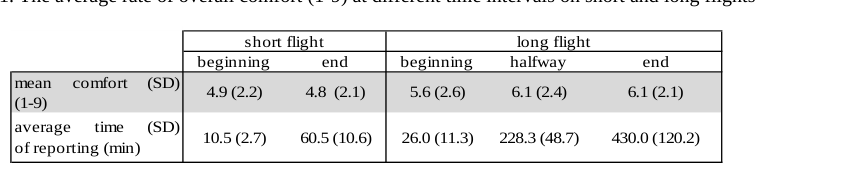
On average, the duration of short flights was 77.0 (60-95) min and long flights were 479.3 (300-665) min. The mean value (and standard deviation - SD) for overall comfort ratings and time of reporting for long and short flights are given in Table 1. The average of overall comfort appears to remain nearly constant throughout both short and long flights. The average comfort ratings on long flights were slightly higher than that of short flights.
Table 1. The average rate of overall comfort (1-9) at different time intervals on short and long flights short flight long flight beginning end beginning halfway end mean comfort (SD) (1-9) 4.9 (2.2) 4.8 (2.1) 5.6 (2.6) 6.1 (2.4) 6.1 (2.1) average time (SD) of reporting (min) 10.5 (2.7) 60.5 (10.6) 26.0 (11.3) 228.3 (48.7) 430.0 (120.2)
Next, a t-test was performed on the comfort ratings taken at the beginning and at the end of short flights; it was not significant. For long flights, a one-way ANOVA was performed on the comfort ratings at the beginning, halfway through and at the end of the flight. It was not significant either.
Next, a series of Pearson Product Moment correlation analyses were performed to uncover the relationship between overall comfort, emotional responses and ratings on cabin features. The correlation coefficients between ratings on overall comfort (long flights, short flights) and cabin features are shown in Table 2 and those that are significant for P<0.05 are marked. As the Table shows, overall comfort for short flights correlated strongly with legroom, followed by the seat, temperature, and noise. It must be noted that most of the reported short flights did not provide any entertainment unit in form of a personal screen (usually placed in front of the passenger). The results of the correlation analyses for long flights indicate a significant correlation (P<0.05) between overall comfort and temperature, seat, air quality and luggage room.
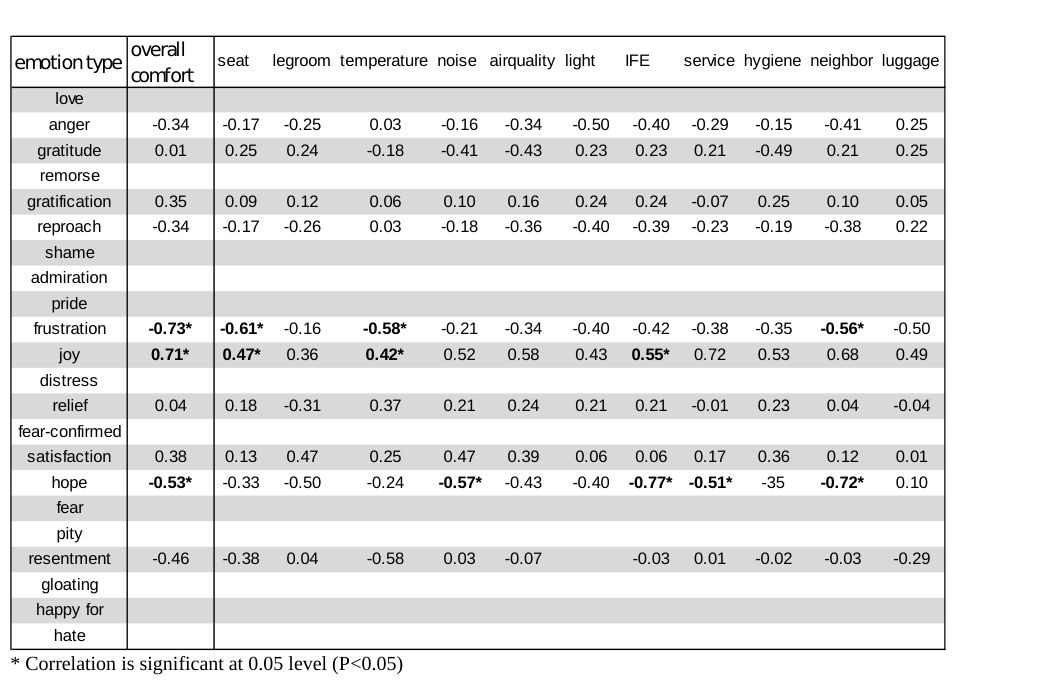
Table 2. The correlation coefficients between overall comfort and ratings on comfort of cabin features for short and long haul flights.Table 3. Correlation coefficients between emotions types and ratings on overall comfort and cabin features comfort for long haul flights.
The emotion frustration correlated negatively with the temperature, seat and neighbors respectively suggesting that undesirable temperatures could exacerbate. The seat frustrated participants when the physical fit was not perceived desirable and their fidgeting attempts at finding more comfortable positions frustrated them. Another common complaint was about a lack of personal space, having no space designated for personal belongings or a general feeling of confinement. Participants’ frustration with the temperature resulted from its instability (going from hot to cold or vise versa), mal-functioning of the overhead vents and the felt temperature extremes, e.g. feeling too hot or too cold. Finally the frustration with neighbors was commonly described in terms of unwanted interaction with the seat-mates, undesirable physical proximity to them, or in reaction to the reduced space when the passengers in front of them reclined their seats.
The emotion hope correlated most strongly with IFE, neighbor, noise, and service. The negative correlations demonstrated a low level of comfort experienced by those respondents and their wish for arriving at the destination and the flight to be over. The comments with regard to IFE were related to the constant interruption of the programs on the entertainment unit due to flight announcements and passengers’ hope that those type of communications would not continue. One passenger described his diminished hope to get any rest or sleep when his front neighbor reclined her seat to the maximum, shrinking his personal space. The correlation of hope and noise was related to instances where the noise level became uncomfortable and the respondents hoped to arrive at the destination, not having to endure the noise any longer. The service comments were related to respondents’ hope for a better service and the flight crew to circulate in their section, attending to their request.
DISCUSSION
The ESM method has been used before to study the interaction between people and systems. In product design, Demir et al. (2009) employed ESM combined with interview techniques to investigate the appraisal patterns of emotions in human-product interaction. The method proved successful and gave indications about the underling process and eliciting conditions of four emotions namely joy, satisfaction, anger and disappointment. This paper similarly benefited from repeated reports of passengers during the flight in order to gain an understanding of the dynamics of their comfort experiences and to verify the features that commonly elicit comfort and emotional responses.
The overall comfort did not significantly (P<0.05) vary when assessed at different times during the flight. This could imply that passengers’ early impressions of the flight context (design features and the service) might predict their impending experiences. That suggests that positive or negative aspects perceived in the first 8 to 14 minutes of a flight could overshadow the forthcoming experience and that the average comfort of the flight is close to that of the first impression. The mean value of comfort on long flights was slightly higher than on short flights. One reason for this could be that the service in long (trans-Atlantic) flights were reported to be better than short flights. There was also a significant correlation between the service and overall comfort of long flights (see Table 2). Another reason could be the offered In-Flight Entertainment (IFE) on long haul flights which also correlated significantly with overall comfort of those flights. Moreover, the aircrafts used on longer flights are usually larger in size, offering more personal space and lower noise level. Noise level was shown to have a significant correlation with overall comfort as well.
It was showed that four features namely seat, legroom, noise and temperature significantly influenced comfort regardless of the flight length. Thus identifying passengers’ preferences with regard to these features is of crucial importance as they are likely to predict the comfort of the whole flight if they provide favorable first impression. The temperature and the seat particularly had strong correlations with comfort in long flights.
The significance of features IFE, service, hygiene, luggage room and neighbor were specific to long flights. The impact of luggage room is likely to be related to that passengers on long flights carry more luggage and find it challenging to fit them in the shared luggage bins. Sometimes, they are forced to store some pieces under the seat in front of them, which impedes on their free personal space. The significance of the social aspects of passengers’ experiences (i.e., their interaction with their neighbors) for comfort of long flights necessitates particular attention to the design details. In their study, Ahmadpour et al. (2014a) suggested that the arm rest design is influential on these interactions. A removable arm rest improves the interaction of passengers who are travelling together while wider arm rests that are properly separated underneath would reduce the chances of conflicts between strangers.
The only significant relationship between emotional responses and passenger comfort was found for the long flights. It could be argued that short flights do not last enough to engage passengers’ emotions in a significant way. However, our study was limited in resources and it would be beneficial to repeat the study by recruiting a larger sample of participants.
Ortony and colleagues categorized the emotion type joy/feeling good in a group of emotions they called wellbeing. The appraisal process of these emotions involves evaluating the outcomes of an event for oneself without any prior expectations associated with them. In the flight context, if they are desirable, various degrees of joy and subsequently comfort are elicited; otherwise one experiences distress and discomfort. The results in this paper suggested seat, temperature, and IFE as the eliciting features of joy, meaning that once these features provide pleasant experiences or even surprises despite the passengers’ prospect, they generate a general good feeling. A common theme among comments related to the emotion joy was feeling peaceful and relaxed which is also confirmed by the model of passengers’ emotions (see Figure 1) as a concern for wellbeing emotions. Moreover, the appraisal patterns proposed by Ahmadpour et al. (2014b) for this group of emotions also confirm the seat and IFE as two mediating features of those emotions. However, the correlation of cabin temperature and passengers’ experience of joy was not calculated in that study.
The emotion types frustration/disappointment and hope belong to the prospect-based group. These emotions are elicited when the consequences of events are evaluated against one’s expectations and goals. If those consequences meet one’s expectations, they result in relief whereas violation of those expectations leads to disappointment and frustration. The results of the present study highlighted the temperature, seat, and neighbors as the mediating elements for the appraisal process of frustration. When passengers’ expectations for those features are not met, they feel frustrated and that negatively impacts their comfort. Among the features mentioned, the model of passengers’ emotions confirmed the importance of the seat but not that of the temperature and neighbors. However, once analysis method employed by Ahamdpour et al. (2014b) for developing the model is examined more closely, it became clear that the comments relating to feelings of confinement and proximity to neighbors had been classified as belonging to the ‘seat’ category. The reason for that classification, as they argued, was that this problem was caused by the seat design (e.g., seat dimensions, improper separation from neighbors) rather than by the actual neighbors. Interestingly, the feature neighbor was mentioned in prospect-based group in relation to emotion hope. This emotion type was not previously mentioned in the emotion model by Ahmadpour and colleagues but it was noticed that respondents’ ratings in relation to this emotion type was similar to that of frustration, i.e., they signified a level of disappointment in goals that were not met with respect to IFE program interruption, noise level, service quality or neighbors invading their personal space. Thus the ratings did not portray the respondents’ level of being hopeful as a positive state but rather they depicted respondents’ disappointment in the system and hope for either improvement during the rest of flight or wish for the flight to be over. Thus it is safe now to conclude that temperature is the only feature that was not mentioned in relation to prospect-based emotions in the model.
Passengers’ concern in relation to frustration is reflected in a common theme in their comments, namely the lack of personal space and a feeling of confinement. Those fall into the category of concern for security, i.e., not feeling any worry, on the model of passengers’ emotion. One concern relative to the hope emotion was feeling discomfort and agitation due to the noise level. This concern falls into the peaceful and relaxed category on the emotion model. Finally, passengers’ concern for entertaining themselves with no interruption or obstruction on the IFE unit is similar to the concern for accomplishment on the model of passengers’ emotion. It is therefore concluded that the results of this study verify the three concern categories for prospect-based emotions on the model proposed by Ahmadpour and colleagues.
The results of this study have some implications for the cabin interior design. It was shown that passengers’ comfort experience is highly influenced by their first impressions of the flight. These impressions should be addressed with more detail in future research. The cabin features that contributed strongly to passengers’ overall comfort and emotional reactions were prioritized (based on their correlation coefficient) for short and long haul flights separately and this could be used as a design reference. Such information is a valuable resource for the airlines and aircraft manufacturers’ decision making during product development and the cabin interior improvement process. The results point to specific features that could enhance comfort more effectively. In particular, the features that generate strong emotional reactions on long flights should receive more attention, given that emotions inform human behavior, i.e., they generate appropriate responses in people to cope with their environment (Frijda, 1986). Strong feelings of frustration, for instance, could alter a passenger’s interaction with other people during the flight and be potentially troublesome. They also impact comfort negatively and potentially passengers’ future choices of an airline. Brauer (2004) claimed that 35% of passengers base their selection of airline on comfort. The felt temperature, in particular, should be considered an important design criterion for passenger comfort of long haul flights. The reason is that we found it to have a correlation with comfort and also increase an emotion of frustration when not desirable. Finally, the seat was shown to impact those emotion groups in different ways; mediating joy through providing relaxing postures and facilitating sleep and preventing frustration by eliminating worries about personal space and privacy and fulfilling passengers’ concern for security.
Real time versus retrospective recall of comfort experience The ESM proved to be a good choice for this study of the real-time passenger experience during a flight. The above results confirmed two of the emotion groups (i.e., wellbeing and prospect-based) initially proposed by Ahmadpour et al.’s (2014b) passenger emotion model. More research is required to validate the remainder of the model and to replicate the above results. It is also essential to investigate the relationship between what passengers actually experience onboard commercial flights and their memory of the experience after the trip, i.e., what makes a trip memorable. These are examined in a follow up study by the authors of this paper in which regular travelers are recruited for reporting their in-flight experience both during and after the trip, using ESM questionnaire.
CONCLUSION
This paper studied the real time experience of passengers during the flight using ESM. It was shown that the real time comfort remains constant during the flight, suggesting that the first impressions of the passengers in the cabin could potentially determine their overall comfort. Furthermore, a number of cabin features (seat, legroom, temperature and noise) were identified as highly correlating with the comfort experience on both short and long haul flights. The results of emotional assessment highlighted the importance of fulfilling three important groups of passengers’ concerns in an effort to provide them with the feeling of joy, avoiding frustration and ultimately delivering comfort. Those are concern for peace and relaxation and concern for security (i.e. not having any worry or anxiety) and accomplishment. Some cabin features were attributed to each of those groups. The model of passengers’ motions in the aircraft cabin was partly validated in relation to prospect-based and wellbeing emotions.
ACKNOWLEDGEMENT
This research was funded by FQRNT-NSERC and Bombardier Aerospace through an Industrial Innovation Scholarship (IIS). The authors would like to thank Bernard Pownall for his support of the project and John Ferneley for his help and collaboration in data collection.
REFERENCES
Ahmadpour, N., Lindgaard, G., Robert, J-M., Pownall, B. (2014a). “The thematic structure of passenger comfort experience and its relationship to the context features in the aircraft cabin”. Ergonomics (In press). Ahmadpour, N. Lindgaard, G., Robert, J-M. (2014b). “Aircraft passenger comfort and emotion”. [To appear in: KEER’14:
International conference on Kansei Engineering and Emotion Research, Linköping, Sweden 11-13 June 2014]. Ahmadpour, N. Lindgaard, G., Robert, J-M. (2014c). “Impact of the seat on aircraft passenger comfort experience in the cabin interior”. [To appear in: T. Ahram, W. Karwowski and T. Marek (eds). Proceedings of the 5th International Conference on Applied Human Factors and Ergonomics AHFE 2014, Kraków, Poland 19-23 July 2014]. Anderson, L. (2002). “Use of experience sampling method to understand the wilderness experience”. In: Todd, Sharon, comp.,
(eds). Proceedings of the 2001 Northeastern Recreation Research Symposium. Gen. Tech. Rep. NE-289. Newtown Square, PA: U.S. Department of Agriculture, Forest Service, Northeastern Research Station. 92-97. Brauer, K. (2004). “Convenience, comfort and cost: the Boeing perspective on passenger satisfaction”. [PowerPoint slides] In: the Aircraft Interior EXPO’ 04, March 30- April 1, 2004, Hamburg. Christensen, T.C, Barrett, L. F., Bliss-Moreau, E., Lebo, K., Kaschub, C. (2003). “A practical guide to experience sampling
procedure”. Journal of Happiness Studies, 4, 53-78. Csikszentmihalyi, M., Larson, R. Prescott, S. (1977). ‘The ecology of adolescent activity and experience’, Journal of Youth and Adolescence 6, 281–294. Csikszentmihalyi, M., & Csikszentmihalyi, I. (1988). “Optimal experience: Psychological studies of flow in consciousness”. New
York: Cambridge University Press. De Looze, M.P., Kuijt-Evers, L.F.M., Van Dieen, J. (2003). “Sitting comfort and discomfort and the relationships with objective measures”. Ergonomics, 46 (10), 985-997. Demir, E., Desmet, P. M. A., & Hekkert, P. (2009). “Appraisal patterns of emotions in human-product interaction”. International
Journal of Design, 3(2), 41-51. Frijda, N. H. (1986). “The emotions: studies in emotion and social interaction”. Cambridge University press, Cambridge: UK. Helander, M.G. (2003). “Forget about ergonomics in chair design? Focus on aesthetics and chair design”. Journal of Ergonomics.
46(13/14), 1306 – 1319. Lang, P.J. (1980). “Behavioral treatment and bio-behavioral assessment: Computer applications”. In: Sidowski, J., Johnson, H., Williams, T. (eds.) Technology in Mental Health Care Delivery Systems, pp. 119–137. Ablex Publishing, Greenwich. Larson, R., Csikszentmihalyi, M. (1983). "The experience sampling method". New Directions for Methodology of Social and
Behavioral Science, 15, 41-56. Ortony, A., Clore, G., Collins, A. (1988). “The cognitive structure of emotions”. Cambridge Univ.ersity Press, Cambridge, UK. Overbeeke, C.J., De Looze, M.P., Vink, P., Cheung, F. K. (2005). “Comfort through an emotion aware office chair”. In: P. Vink (ed.), Comfort and design: principles and good practice (pp. 169-180) FL: CRC Press. Scollon, C. N., Kim-Prieto, C., Diener, E. (2003). “Experience sampling: promises and pitfalls, strengths and weaknesses”.
Journal of Happiness Studies, 4, 5-34. Slater, K. (1985). “Human comfort”. Springfield, IL: Charles Thomas. Vink, P., Overbeeke, C.J., Desmet, P.M.A. (2005). “Comfort Experience”. In: P. Vink (ed.), Comfort and design: principles and good practice (pp. 1-12) FL: CRC Press. Vink, P., Bazley, C., Kamp, I., Blok, M. (2012). “Possibilities to improve the aircraft interior comfort experience”. Applied
Ergonomics, 43 (2), 354-359.
LISTED IN THE AHFE DIGITAL BOOKSTORE CATALOGUE
Explore the complete digital volume
Advances in Affective and Pleasurable Design
Read this individual research paper free through the original publisher, or explore the full digital proceedings book.
ISBN 978-1-4951-2109-8
Explore this ISBN in the AHFE Bookstore ↗Listed in the July 2026 bookstore catalogue; search by ISBN to confirm current availability · Digital book purchase optional