Thomas Stüdeli (2022). Ergonomic Recommendations for the Design of Pacifiers. In: Advances in Ergonomics In Design, Usability & Special Populations: Part II. AHFE Open Access, vol. 19. https://doi.org/10.54941/ahfe1001283
Pacifiers are everyday companions for babies and toddlers. General safety requirements to reduce the risk of accidents with pacifiers are described in three European Standards (EN 1400-1/2/3 (2002)) and in the US Requirements for Pacifiers (1996). Next to these “general safety requirements” various recommendations on the use of pacifiers to reduce the risk of negative health effects have been formulated. In contrast to this, only few design recommendations for pacifiers have been published so far and most of them are focusing on or are limited to specific risks or user needs. This paper describes ergonomic design recommendations that have been derived from an analysis of the anatomical, physiological and psychological user needs. This work in the field of Ergonomics / Human Factors Engineering is based on literature search, screening of existing pacifier design solutions and interviews with parents and experts. Due to the fast development of infants and toddlers, the user needs on pacifiers are described age-dependent. The ergonomic design recommendations are written in the style of “general ergonomic requirements” focusing on the basic needs and well-being of the user and the usability of the product. These requirements should complement existing safety guidelines and use recommendations for pacifiers and aim to support the development of a new generation of pacifiers. To conclude, this paper describes some basic elements of a User Centered Design process for pacifiers for the redesign of an entire pacifier product family.
Pacifier Use and Health Effects Pacifiers, also called dummies, binkies or soothers, are artificial molded teats for babies and toddlers. Today, pacifiers are everyday companions for babies and toddlers in most of the developed countries. In a worldwide survey 1996-1997 the International Child Care Practices Study found pacifier usage rates of 12.5% (Japan) to 71% (Ukraine) for babies of 3 months of age (Nelson et al 2005).
Parents give pacifiers to their children to calm and soothe them when they cannot be comforted by other means. Pacifiers are also used to help infants to fall asleep or to overcome stressful or painful moments. Pacifier use is described as a “nonnutritive sucking behavior” the same as finger sucking. Sucking behaviors are considered normal in infants and young children (American Academy of Pediatric Dentistry 2006). Infants have a natural sucking instinct or urge which is considered as the first feeding reflex. “If this sucking urge is not completely satisfied by breast or bottle feeding, the infant will have a surplus sucking urge which may lead either to frustration or to satisfaction. If the child engages himself in a nonnutritive sucking habit, he or she may satisfy this sucking urge. Otherwise, he or she will be frustrated.” (Zardetto et al 2002) Ergonomics In Design, Usability & Special Populations II
Sucking habits is an important subcategory within all oral habits that include, among others, digit sucking, pacifier sucking, lip sucking and biting, nail-biting, bruxism, self-injurious habits, mouth breathing, and tongue thrust (American Academy of Pediatric Dentistry 2006). Sucking habits are divided into non-nutritive and nutritive sucking habits. Wolff compared the rhythmical properties of non-nutritive and nutritive sucking on newborns. He defined non-nutritive sucking as any repetitive mouthing activity on a blind nipple of a commercial pacifier. He concluded: “Normal newborn infants suck in two distinct rhythms: (1) a non-nutritive mode which is characteristically segmented into alternating bursts of sucking and rest periods, which has a basic frequency in the range of two sucks per second, and which can be elicited in all arousal states except sleep and great excitement; and (2) a nutritive mode which usually depends on a flow of milk from the nipple, is organized as a continuous sequence of sucks, and has a basic frequency of about one suck per second.” (Wolff 1968) The use of a pacifier and the sucking of fingers are the two most important and similar found non-nutritive sucking habits. Yonezu and colleagues (2013) e.g. report 13.9% pacifier use, 18.4% finger sucking, and 0.3% both habits for Japanese infants of 18 month.
Adverse and positive health effects of pacifier use are intensively discussed in various domains and disciplines, including myofunctional therapy (Zardetto et al 2002), pediatric nursing (Nelson 2012), clinical pediatrics (Schwartz and Guthrie 2009), general medicine (Sexton and Natale 2009), orthodontics, and dentofacial orthopedics (Warren and Bishara 2002, Poyak 2006). Most important positive health effects of pacifier use are:
Prevention of Sudden Infant Death Syndrome (SIDS),
Positive effect to the emotional and psychological development of the child (soothing, control gaining …), and
Effectiveness as an adjunctive pain relief.
Next to accidents with pacifiers or pacifier related injuries (choking, broken pacifier teat, separation of pacifier parts), reported negative health effects due to pacifier use are:
Negative effects on oral health and dentition (anterior open bite, posterior cross bite, and narrow intercuspid width), negative impact on breast-feeding and speech development,
Increased evidence of inflammation of the middle ear (otitis media),
Allergies (mostly latex allergies),
Skin irritations and infections (source of bacteria),
Alterations in the myofunctional development (lip incompetence, lip entrapment, decrease in muscular tonicity of tongue and lips, and a narrow hard palate (Zardetto et al 2002), and
Potential for compulsive use (pacifier addiction).
Most of the above mentioned health effects are still controversially discussed within different contexts (e.g. age, health status, and environment) and among the different disciplines and domains. However, in most discussions, there is – even among the different disciplines – consensus that frequency, type, intensity and duration of the use of pacifiers have an impact on health risks or health benefits (Nelson 2012, Warren and Bishara 2002).
Several studies showed evidence of long term health consequences related with pacifier use. Ovsenik and colleagues e.g. assessed functional and morphological malocclusion trait changes of the orofacial region from 3 to 12 years of age and to determine how early functional malocclusion traits correlate with malocclusion severity score at 12 years of age. And they found that the median morphological malocclusion severity score was almost the same at 3 and 12 years of age, while functional malocclusion decreased. They also found that sucking habits (finger- or pacifier- sucking, bottle feeding) until 5 years of age were statistically significantly correlated with an atypical swallowing pattern from 6 to 9 years. This atypical swallowing pattern from 6 to 9 years correlated statistically significantly with the morphological malocclusion severity score at 12 years of age (Ovsenik et al 2007).
Unfortunately, up to now, most studies focused either on sucking habits (e.g. Warren and Bishara 2002) or on Ergonomics In Design, Usability & Special Populations II pacifier design (teat design e.g. Arsenina 2006). Only few studies took both aspects - sucking habits as well as pacifier design - into account for their study design (e.g. Zardetto et al 2002). Consequently an ergonomic approach (Dul et al 2011) is generally missing in the discussions.
Design of Modern Pacifiers Pacifiers have been developed out of two kinds of forerunners: The hard teething rings and the soft sugar tits (also sugar-teats or sugar-rags), small fabric bags filled with sweet breads, honey or similar (Lewin 1971). It can be assumed that pacifiers have been industrially produced since the end of the 19th century. The first US patent for a “nipple-holder” has been granted in 1899 (Borcher 1899), and an “artificial nipple” aiming to protect sore nipples has been granted in 1845 (Pratt 1845).
Today’s pacifiers have artificial molded teats mostly out of silicon or latex and shields out of diverse plastic materials. They are consumer products with a high demand on product safety, as they are used by a high risk user group, namely potentially unattended babies and toddlers. European standards are specifying requirements for the product manual of pacifiers (EN 1400-1: 2002), mechanical and chemical requirements and their related tests (EN 1400-2: 2002, EN 1400-3: 2002). Specific design guidelines for the ventilation holes in the shield and the fixations between teat, ring or the knob and the shield are described in EN 1400-2 (2002). All three EN 1400 standards are referring to the European Directive on general product safety 2001/95/EC (Directive 2001/95/EC). In the US, the Code of Federal Regulations on Requirements for Pacifiers (1996) and the Standard Consumer Safety Specification for Toy Safety ASTM F 963 (American Society for Testing and Materials 2009) include guidelines and test methods “to prevent injuries from choking, sharp edges, toxins, pinching, and other potential hazards”. Whereas the European directive (Directive 2001/95/EC) refers to “safety and health of persons” the European standard CSN EN 1400-1 (European Standard CSN EN 1400-1: 2002) and the US Requirements for Pacifiers (1996) are only referring to “general safety” aiming to reduce accidents related to pacifiers. The US Requirements for Pacifiers names choking risk and suffocating risk as his main purpose.
It can be stated that actual standards related with pacifiers are mainly focusing on accident prevention and do not cover other health risks.
C
A B D
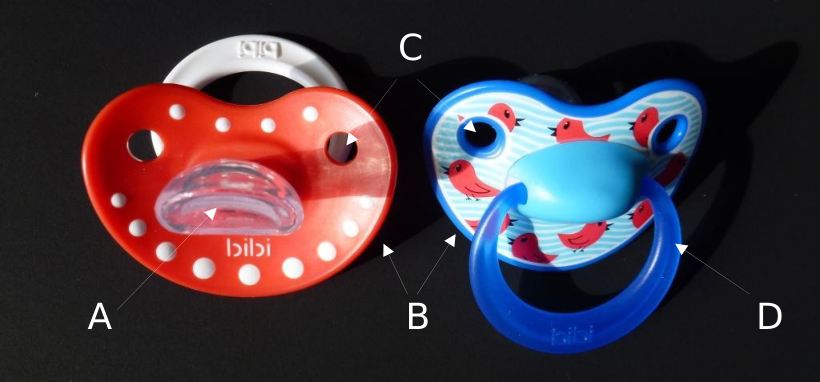
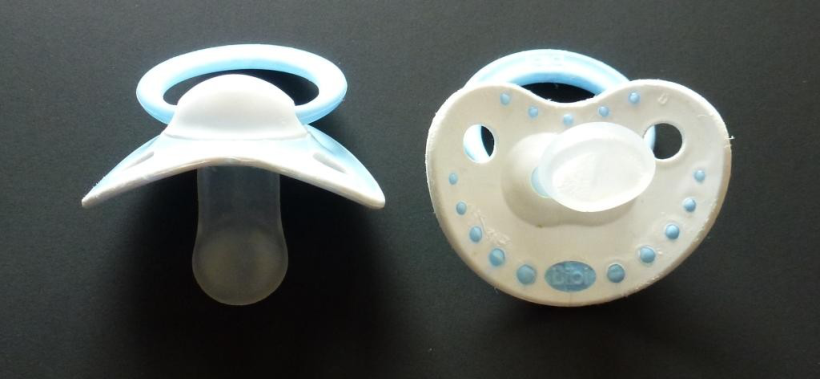
Figure 1. Basic design elements of a pacifier: Teat (A), shield (B), ventilation holes (C), and ring or knob (D). Model: bibi® EXCELLENCE, DENTAL PREMIUM / NATURAL COMFORT 6-16 months, Lamprecht Ltd,
Switzerland.
Figure 1 shows the most important and visible design elements of a modern pacifier. Teat and shield are obvious functional elements. The two ventilation holes are obligatory elements of the shield design (safety-by-design) demanded by safety standards European Standard EN 1400:2 (2002) and Requirements for pacifiers (1996) to allow a child to continue breathing even if the child sucks the pacifier shield into his or her mouth. Ring and knobs are design elements that cover the fixation of the teat with the shield.
Ergonomics In Design, Usability & Special Populations II
It can be concluded that - so far - an ergonomic approach has been missing in the discussions on pacifier use as well as in the discussion on pacifier design. An ergonomic approach is: 1) systematic (holistic), 2) design driven, and 3) incorporates performance goals as well as well-being goals (Dul et al 2011).
In an earlier publication the product environment has been described, as well as two basic functions of pacifiers, eight user requirements, and nine basic design criteria for pacifiers (Stüdeli 2013). This paper aims to further complement existing design guidelines for pacifiers (see above EN and US standards and guidelines) with age- dependent ergonomic design recommendations. Furthermore, it aims to describe the basic elements of a User Centered Design (UCD) process for pacifiers for the redesign of an entire pacifier product family.
METHODS
The ergonomic design criteria or design goals have been developed earlier (Stüdeli 2013) by following a classical approach for product ergonomic analysis in three steps, inspired by Ramsey (1985) and Bullinger and Solf (1979).
The first step was the analysis of product and product environment, the second step was the definition of user requirements, and the third step was the development of corresponding ergonomic design criteria. During these three steps literature search, analysis of existing design solutions and expert interviews have been conducted.
The literature search has been conducted between September 2012 and March 2014. In the first step, the literature focused on electronic publications using Web of Science and Google scholar. In the second step, the search has been extended to non-digitized literature within the Swiss library network NEBIS. Key words were among others: pacifier, dummy, binky, soother, nonnutritive sucking, and child development.
The analysis of existing design solutions focused on actually available pacifiers in the Swiss market for the age groups +/-2 month till 36 month. Overall 47 pacifiers from seven producers AVENT (Philips Electronics UK Ltd.), bibi® (Lamprecht Ltd.), Chicco (Artsana S.p.A.), Difrax (Difrax BV), MAM (Bamed AG), NûbyTM (Luv n’ care® Ltd.), and NUK® (MAPA GmbH) have been included in the analysis.
The expert interviews included four experts with a minimum of 12 years of expertise in the field. These experts covered the domains of pediatric dental surgery, pediatric dentistry, speech therapy, logopaedics, postpartum care, and breastfeeding counseling. The face-to-face interviews followed a protocol with personal introduction of 5-10 minutes, introduction to product ergonomics of 10 minutes (aims and benefits, ergonomic product analysis, ergonomic design principles, the role of the ergonomist in product design processes), and an open discussion of 50- 100 minutes. In the open discussion several topics have been addressed, including: general role of pacifiers for the domain, specific recommendations for pacifiers and pacifier use, effects of pacifier use on human development, need of the child and the parents, and specific feedback on design solutions (prototypes).
The description and recommendations on a User Centered Design process for pacifier design, have been based on experiences as an external Human Factors Engineering consultant within the re-design project of the bibi® Pacifier family for Lamprecht Ltd. and other similar projects for product developments for children.
RESULTS
Use Phases – Use Scenarios For pacifiers two different use phases, a learning phase and an application phase, have been assigned (Stüdeli 2013). This distinction, as simple as it looks like, does have a special relevance for pacifiers.
The learning phase starts with the first use of a pacifier, typically in the first weeks and months of life and in a very sensitive development phase of the myofacial system (oral cavity, tongue, lips, jaw, …) (Zardetto et al 2002, Furtenbach et al 2013). At this age, milk intake and sucking are of central importance for the child’s development. For a baby of 2 weeks, milk intake and breathing are also the main energy consumptions.
Ergonomics In Design, Usability & Special Populations II
The primary function of the pacifier at this stage is to support the child in learning and improving efficient motor patterns for the nutritive and nonnutritive sucking. Ideally, effective motor patterns of the sucking movements of the tongue, the jaw and the facial muscles are well coordinated with the nasal breathing and the swallowing. An intelligent design of pacifiers supports and encourages the child to learn and optimize an efficient motor pattern.
The satisfaction of the sucking urge is another important function of the pacifier at this stage. It has to be mentioned, that the child often has other possibilities to satisfy a possible sucking urge. Therefore this pacifier function related to the child’s sucking urge – from an ergonomic point of view – can be seen as a function of the user behavior (usage) rather than a design function. Behavioral aspects, like feeding habits (breastfeeding, bottle feeding) and other sucking habits (digit or thumb sucking) would then be the focus of an ergonomic intervention. We know that dependencies between nutritive and non-nutritive sucking habits are not only present in the first weeks and months of life, they can be present up to 2 or 3 years. Yonezu and colleagues (2013) e.g. investigated infant feeding patterns and analyzed their influence on non-nutritive sucking habits on 18 month old Japanese children. They found that breast-feeding was negatively correlated with pacifier use and sucking habits. In contrast, bottle-feeding was strongly associated with pacifier use and finger sucking.
Long-term non-nutritive sucking habits should be avoided. Pacifier habits should be discontinued before the age of 4 and it might be necessary to plan this behavioral change well in advance. Next to the long term health affects there is also a potential for compulsive use of pacifier (pacifier addiction) that should be addressed.
Figure 2 shows an example of a successful and positive way of a pacifier weaning. Every time children visit the Zoo of Zurich babies and toddlers see “the pacifier tree” that is located on a central place at the playground. They will learn, that when they are big enough it’s time to hang their last pacifiers also on a branch of this tree. Parents and children appreciate this ritual of the final use of a pacifier.
Figure 2. “The pacifier tree” at the playground of Zurich Zoo.
After 6 month, at the latest, the development of the myofacial system is no more dominated by sucking activities but is diversifying into many other activities such as tasting, eating, drinking, licking, and communication. The primary function of pacifier use at this stage is to satisfy the natural sucking need of the child. The actual benefit is the calming effect of the non-nutritive, undisturbed, and rhythmic sucking. At this stage the child might see the pacifier as an everyday companion. An intelligent design of pacifiers supports the child in his need for non-nutritive sucking, and – at the same time – respects the development of the myofacial system.
Behavioral aspects and their positive and negative health impact are widely discussed. Unfortunately little is known on pacifier use characteristics (e.g. intensity and duration) and their individual contribution to reported health effects. Too many variables would need to be taken into account. Most recommendations on pacifier use are therefore rather vaguely formulated and are rightly pointing out the need for individual prevention of health hazards, e.g.:
“Nonnutritive sucking behaviors (e.g. finger or pacifier sucking) are considered normal in infants and young children and are usually associated with their need to satisfy the urge for contact and security… The American Academy of Pediatric Dentistry supports an individualized approach for each child in evaluating oral habits.” (American Academy of Pediatric Dentistry 2006).
Ergonomics In Design, Usability & Special Populations II
“Because persistent nonnutritive sucking habits may result in long-term problems, professional evaluation has been recommended for children beyond the age of 3 years, with subsequent intervention to cease the habit initiated if indicated” (Nowak and Warren 2000).
“Babies have an intense instinct of sucking, which on one hand satisfies the need of feeding, on the other hand it replaces the connection with their mother. Because of this it offers them great pleasure. In order to satisfy this need the child uses its fingers or other objects. The pacifier is an important and very common means for satisfying the sucking need of the child. It can function preventively against the habit of finger sucking. Efforts to avoid the use of a pacifier lead to finger sucking which is a simple replacement of the pacifier habit and causes serious consequences on the development of the jaws. In general, the use of a soother is preferred over the use of fingers because it can be stopped easier, at a younger age and generally causes less damages.” (European Academy of Paediatric Dentistry 2014) Only few researchers published “numbers” or “measurable” recommendations. Proffit stated in 1985 that “oral habits that are maintained for at least 6 hours per day influence posture and alter resting tongue and lip pressures, which, in turn, are capable of affecting the pattern of development and causing malocclusion” (Zardetto et al 2002, Proffit 1985). Adair recommended (2003) “a few common sense steps can be taken to enhance the benefits and reduce the risks of pacifier use: 1. Educate parents and caregivers about the safe use of pacifiers. 2. Withhold the use of pacifiers until breast-feeding is established. After that point, limit their use for soothing breast-fed infants. 3. Advise parents and caregivers to exercise judgment and restraint regarding pacifier use. They should be taught to avoid ad lib use throughout the day. 4. Instruct parents and caregivers to clean pacifiers routinely and avoid sharing between siblings. Parents should not lick pacifiers to clean them. Parents should consider having several pacifiers to rotate through cycles of cleaning and use during the day. 5. Suggest to parents that pacifier use be curtailed beginning at 2 years of age and that pacifier habits be discontinued by or before age 4 to minimize the development of malocclusion.” Hauck and colleagues concluded (2005): “For breastfed infants, pacifiers should be introduced after breastfeeding has been well established… The pacifier should be offered to the infant when being placed for all sleep episodes, including daytime naps and nighttime sleeps.”
User Requirements A classical ergonomic analysis of a product covers anatomical, physiological and psychological aspects. Ramsey (1985) described 37 different aspects that should be considered. Of these 37 aspects eight can be rated as of particular relevance for pacifiers, main human aspects for the design of pacifiers (Stüdeli 2013):
1. Anthropometry or body mass, in particular the exterior mouth (upper and lower lips, nose and chin) and the inner mouth (upper jaw with arched palate, tongue).
2. Body motions and forces, in particular the movements and forces of the tongue during sucking.
3. Climate, in particular the thermal insulation of the shield.
4. Tactile perception, in particular the perception of shield and teat by the body surface of the child during sucking and at rest.
5. Motor development, in particular the coordination of sucking motion with swallowing and breathing (coordination of patterns).
6. Feedback, in particular the tactile response of the pacifier to the movement of the tongue during sucking.
7. Motivation, in particular the role and motivation of the parents, but also the motivation of the child.
8. User behavior, in particular the way the pacifier is used and in what situations the pacifier is used (e.g. individual desideratum of pacification).
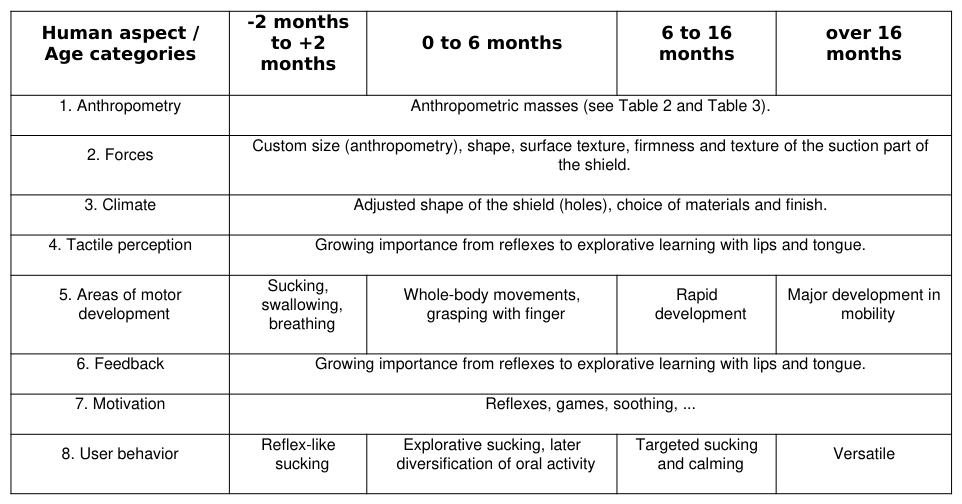
Table 1 shows a simplified overview of main human aspects to be considered for the design of pacifiers (Stüdeli 2013) and their relative importance for typical age categories of pacifiers. The overview displays the dynamics of the child development from premature babies (-2 month) to toddlers of 16 month and more (Ackermann 2004). However, the overview cannot display the individuality of the development.
Ergonomics In Design, Usability & Special Populations II
Ergonomics In Design, Usability & Special Populations II
Table 1: Main human aspects to be considered for the design of pacifiers (Stüdeli 2013) and their relative importance in different age categories.
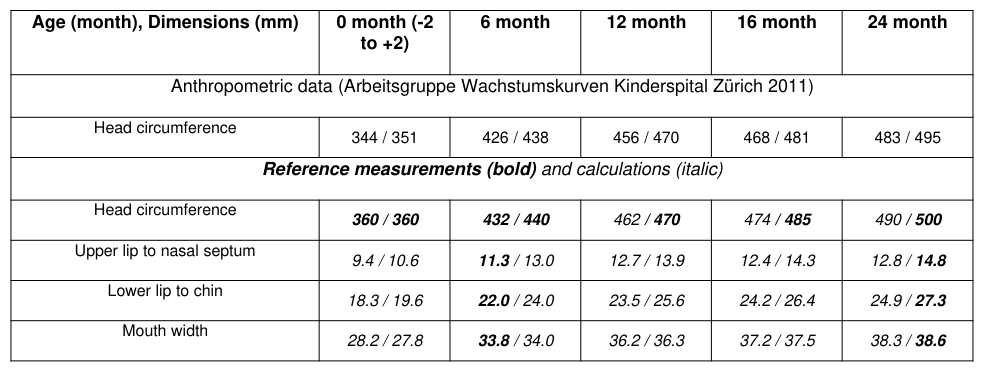
For the shield of the pacifier, the anthropometric masses of the outer mouth region are relevant, in particular upper lip to nasal septum, lower lip to chin and mouth width. Table 2 shows derived masses (italic) based on the growth curves of the head circumference (Arbeitsgruppe Wachstumskurven Kinderspital Zürich 2011) and two reference measurements, one with a 6 month old girl and one with a 24 month old boy (bold).
Table 2: Anthropometric masses of the outer mouth region (upper lip to nasal septum, lower lip to chin and mouth width). Mean values (girls / boys) in mm.
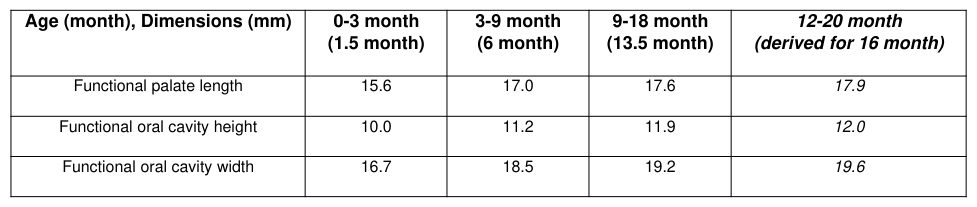
For the teat of the pacifier, the anthropometric masses of the inner mouth are relevant, in particular the upper jaw with arched palate, and tongue. Table 3 shows functional oral cavity masses for three age groups by Hummel and Herrmann (1989), supplemented with the derived values for 16 month (italic). No reference data for tongue sizes could be found for these age groups.
Ergonomics In Design, Usability & Special Populations II
Table 3: Functional oral cavity masses (Hummel and Herrmann 1989).
The dimension of the thumb can be used as an indicative reference value for the dimension of the pacifier teat. In the DINET anthropometric database the thumb breadth at birth (0 month) is indicated with 8.6mm, at 6 month with 9.9mm, at 12 month with 11mm and at 24 month with 13mm (DINET anthropometric database 2014). Comparing these data with the data of the data of the functional oral cavity (Table 3), it can be stated that during sucking of the thumb, in width the thumb covers approximately halve of the functional oral cavity (during sucking).
Ergonomic design recommendations Stüdeli (2013) described nine ergonomic design criteria in form of design goals for the pacifier shield and the pacifier teat. These design criteria have been based on literature and interviews with experts. At rest and during the natural sucking movements of the child, the shield of a pacifier should:
Absorb the suction forces during sucking and evenly spread the remaining forces over the outer mouth region (lips and facial muscles). The idea is that the possible suction forces should be kept limited. The mimicking of the physiology of the breast is limited with the shield. Reducing weight of the shield (and teat) might be beneficial.
Provide a support for the upper and lower lips and allow a vacuum during the closing of the mouth.
Not affect the child's nose or chin. Pressure points on the chin and nasal septum in rest position and normal range of motion during motion should be avoided. Consider anthropometry of the child (see anthropometric data in Table 2).
Not have exposed or protruding edges or engagement surfaces, so that the pacifier cannot be easily stripped off by simple movements such as grazing movements in the normal range of motion of the arms.
Avoid that the pacifier may accidentally access or be sucked in the trachea of the child and fulfill the other international safety requirements of EN 1400-1:2002-12 and in 16 C.F.R. Part 1511.
At rest and during the natural sucking movements of the child, the teat of a pacifier should:
Pick up the suction forces of and transmit them to a certain extent to the shield (counter-pressure on the lips). Also the teat design should help to ensure that possible suction forces are kept limited. The mimicking of the mother’s breast can generally be improved.
Give the tongue enough resistance (surface area and surface friction) to transmit the tongue movements to the pacifier. This will support the peristaltic movement of the tongue. Keep teat volume limited as higher volumes lead to increased suction forces (Hummel and Herrmann 1989) and unwanted pushing back of the tongue.
Allow the widest possible closure of the teeth at rest and during the natural sucking and sucking movements (small shank or shaft).
Absorb – to a certain extent – the suction and pulling forces of the tongue and the lower jaw. Consider anthropometry of the child (see anthropometric data in Table 3).
Ergonomics In Design, Usability & Special Populations II
User Centered Design Process for Pacifier Design The first major step of a User Centered Design process could be the definition of the user and the other stakeholders of the product. What looks – on the first view – like an easy task for pacifiers might turn out to be ratherchallanging.
The definition of the user includes e.g. a consensus on the different age categories within a pacifier product family. Questions like “Do we want a specific design variant for new born babies?” or “What is our oldest age group?” have to be addressed.
The definition of the stakeholders e.g. has – in a Co-design setting (Otto & Wood 2001) – an impact on the composition of the design team. All major stakeholders should be represented in the design team and actively be involved in the design decisions. “How do we include in the best way, the different expertise and the different personalities of the stakeholders?” might be one of the key questions related to the design process.
Figure 2. First pacifier prototypes for usability tests and expert reviews (variant for youngest users with smallest teat size (see also Figure 4).
The second major step in the design process could be the design of the first prototype. Figure 2 shows the first prototype in the re-design project of the bibi-pacifier product family. Figure 1 shows the final result of this project.
Prototyping for usability testing. The planning of a usability test is forcing the design team to re-address and re-think documented or undocumented design requirements (prioritization). Important to know that there is no “fail” in a first usability study. When the user is happy, the usability study will most probably strengthen your design decisions. When the user is not happy (maybe even better) the design team will be faced with new questions that not have been thought of, or that did not have been addressed adequately before.
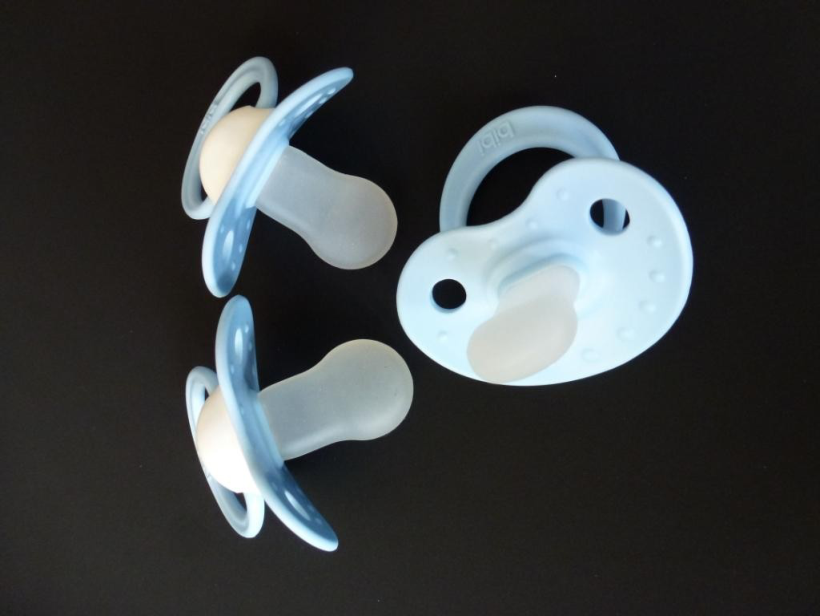
Prototyping for better design feedback and design decisions. Babies and toddlers cannot give verbal feedback to a pacifier prototype and parents tend to overestimate their ability to understand their child’s behavior. Having seen a baby using different design solutions of one pacifier (e.g. on video) will most certainly evoke tacit knowledge within the design team. Figure 3 shows the second prototype with a different teat size (design variant).
The third major step in the design process might be the discussion of the different experts from different fields in the multidisciplinary design team. Switching back and forth between general “product family thinking” and specific and detailed requirements (users, production, and marketing) is not an easy task but sometimes necessary.
General design decisions for a more ergonomic pacifier design (see above) could be: “No specific pacifier design for children of 2 or 3 years!” or “Keep the pacifier as light as possible!” or “Keep the center of gravity of the pacifier as close to the mouth as possible!”
Ergonomics In Design, Usability & Special Populations II
Specific design decisions for a more ergonomic pacifier design (see above) could be: “We need a specific pacifier design for new born (size and shape of teat, form and size of shield)!” or “We further optimize our pacifier teat with another prototyping step just for the teat!” (Table 4).
Figure 3. Second prototypes used for expert reviews and ad-hoc usability tests. The figure shows prototypes of three teat sizes with a new oval teat form (precursor of bibi® EXCELLENCE, NATURAL
COMFORT).
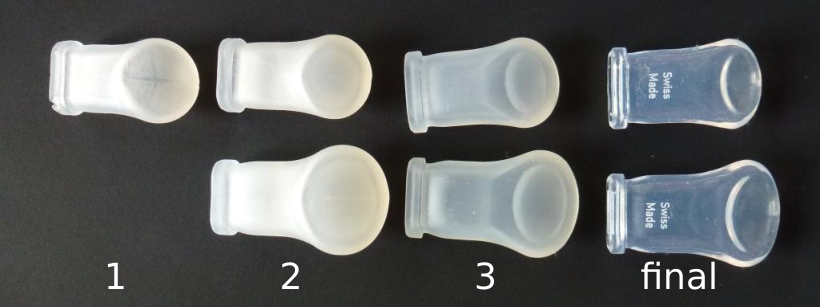
1 2 3 final
Figure 4. Three generations of prototypes of pacifier teats. From left to right three prototype stages (1, 2 and 3) and the final teat (final) used for the new bibi® EXCELLENCE, DENTAL PREMIUM pacifier. The upper row shows the smallest teat size, the lower row the biggest teat size.
Ergonomics In Design, Usability & Special Populations II
DISCUSSION AND CONCLUSION Pacifiers are everyday companions of children and – on the first view – seem to be simple products and easy to design. However, literature review and interviews with experts in the field of medicine and oral health care show a vast variety of specific demands and recommendations for pacifier use and pacifier design. This situation makes it difficult for producers and designers of pacifiers to get a grip on ergonomic aspects of the product.
This paper describes eight anatomical, physiological and psychological user requirements (needs) and nine specific ergonomic design recommendations for pacifier shields and teats. It also describes two basic age-dependent use phases or use scenarios and gives an overview on existing recommendations on pacifier use. The methodology used has been proven to be effective and is a combination of a classical product ergonomic analysis (Ramsey 1985, Bullinger and Solf 1979) with some newer elements, such as the participatory design approach (Vink et al 2008).
Actual standards related to pacifiers are mainly focusing on accident prevention and do not cover other health risks, therefore the aim was to complement the essential safety requirements of the international standards for pacifiers with ergonomic design recommendations.
The first implementation of these ergonomic design recommendations in a redesign of an entire “pacifier product family” could be effectuated and is briefly described in this paper. The description includes some basic elements of a User Centered Design process and specific recommendations for the pacifier design process: A) The design team should include all major stakeholders e.g. specialists in industrial design, engineering (R&D, production), marketing (a.o. product management), ergonomics / Human Factors Engineering and medical expert panel (user representatives). B) A Co-design setting that includes major stakeholder in the design process (Otto & Wood 2001) is advisable and will speed up the decision making processes within the design team. C) Prototyping of intermediate design solutions is seen as a key and a usability study with representative users (age, oral habits) is a must for successful implementation and validation of ergonomic design requirements.
Positive and negative health effects of pacifier use are widely discussed in different fields, such as myofunctional therapy, pediatric nursing, clinical pediatrics, general medicine, orthodontics, and dentofacial orthopedics. Unfortunately, up to now, most studies focused either on sucking habits or on pacifier design (e.g. teat design) and only few studies are taking in account both aspects - sucking habits as well as pacifier design. Consequently in the discussions an ergonomic approach (Dul et al 2011) is generally missing. For further research around pacifier use and pacifier design, an ergonomic approach that is taking in account behavioral aspects as well as design aspects is strongly advised. Carefully planned research activities in Ergonomics / Human Factors Engineering will be an asset to the actual discussions.
For the proper validation of the design goals of a new generation of pacifiers not only the usability but also the long term health effects might want to be monitored. The challenge will be to take into account - without undue effort - how well the design of a pacifier is fitting to the individual user e.g. by comparing anthropometric data with pacifier type and size. Another challenge will be how to collect reliable pacifier use characteristics during a study, for example a detailed description and/or quantification of the pacifier use and other sucking habits.
ACKNOWLEDGEMENT
The author acknowledges support from Lamprecht Ltd., CH - 8105 Regensdorf, Switzerland.
REFERENCES
Ackermann, E. (2004), ”The Whole Child Development Guide“, LEGO Learning Institute, Billund, Denmark, Available from Ergonomics In Design, Usability & Special Populations II http://learninginstitute.lego.com/ Accessed: 2013-02-23 Adair, S.M. (2003), “Pacifier use in children: a review of recent literature”. Pediatr Dent. 2003 Sep-Oct;25(5):449-58. American Academy of Pediatric Dentistry (AAPD) (2006), “Policy on Oral Habits”, ORAL HEALTH POLICIES p. 51-52, online available: http://www.aapd.org/media/Policies_Guidelines/P_OralHabits.pdf Accessed: 2014-03-31 American Society for Testing and Materials (ASTM) (2009), “Standard Consumer Safety Specification on Toy Safety (ASTM F
963)”, online available: http://www.astm.org. Arbeitsgruppe Wachstumskurven des Kinderspitals Zürich (2011), “Wachstumskurven„, Paedriatica 2011, Vol. 22, Nr. 1, online available: http://www.kispi.uzh.ch/Kinderspital/Medizin/Medizin/AWE/Wachstumskurven/Perzentilen_kispi_d.pdf / Accessed: 2014-03-31 Arsenina, O. (2006), “Studying of sucking behaviour at healthy babies at natural and artificial feeding with use of NUK teats.”
Russian Journal of Orthodontics 2006; 35: 14 – 16. Online available: http://www.nuk.de/fileadmin/static/NUK_Deutschland/media/studien/Ortodontia_engllische_Version_26112009_final_.pdf Accessed: 2014-03-31 Borcher, T. (1899), “Nipple-Holder”, Current U.S. Classification: 606/236, Filing date: Oct 4, 1898, Issue date: Oct 17, 1899 Bullinger, H.J., & Solf, J.J. (1979), „Ergonomische Arbeitsmittelgestaltung, I Systematik“, Forschungsbericht Nr. 196, Bundesamt für Arbeitsschutz und Unfallforschung, ISBN 3-88314-038-4, Dortmund, (1979) DINET anthropometric database (2014), TU Delft, Faculty of Industrial Design Engineering, TU Delft Ergonomics. Online
available: http://dined.io.tudelft.nl/dined/ Accessed: 2014-03-31 Directive 2001/95/EC of the European Parliament and of the Council on General Product Safety, 2001 O.J. L, Available from EUR-Lex http://eur-lex.europa.eu/ Accessed: 2013-02-23 Dul, J., Bruder, R., Buckle, P., Carayon, P., Falzon, P., Marras, W.S., Wilson, J.R., & van der Doelen, B. (2012),”A strategy for
human factors/ergonomics: developing the discipline and profession”, Ergonomics, 55 (2012) 4, 377-395, ISSN 1366-5847 European Academy of Paediatric Dentistry (EAPD) (2014) Online: http://www.eapd.gr/ Accessed: 2014-03-31 European Standard EN 1400-1:2002. Child use and care articles - Soothers for babies and young children - Part 1: General safety requirements and product information. European Standard EN 1400-2:2002. Child use and care articles - Soothers for babies and young children - Part 2 : Mechanical
requirements and tests. European Standard EN 1400-3:2002. Child use and care articles - Soothers for babies and young children - Part 3 : Chemical requirements and tests. Furtenbach, M., Adamer, I., & Specht-Moser, B. (2013), “Myofunktionale Therapie KOMPAKT I, Prävention, Ein Denk- und
Arbeitsbuch“, Praesens Verlag, Wien 2013. ISBN 978-3-7069-0518-3. Hauck, F.R., Omojokun O.O., & Siadaty M.S. (2005), “Do Pacifiers Reduce the Risk of Sudden Infant Death Syndrome? A Metaanalysis” Pediatrics 2005;116;e716-e723; originally published online Oct 10, 2005. Hummel, S., & Herrmann, B. (1989), „Untersuchungen über physiologische Saugleistung und Mundhöhlenform bei Sauglingen
und Kleinkindern im Hinblick auf die Gestaltung von Ernährungs- und Beruhigungssaugern.“ Fortschritte der Kieferorthopädie 50(5): 384-391. Levin, S. (1971), “Dummies”. S Afr Med J. 1971 Feb 27;45(9):237-40. Nelson, E.A., Yu, L.M., Williams, S. & International Child Care Practices Study Group Members (2005), “International Child Care Practices Study: breastfeeding and pacifier use”, Journal of Human Lactation, 21 (2005), 289 –295, ISSN 1552-5732 Nelson, A.M. (2012), “A Comprehensive Review of Evidence and Current Recommendations Related to Pacifier Usage”, Journal
of Pediatric Nursing, 27 (2012) 6, 690–699, ISSN 08825963 Nowak, A.J., & Warren, J.J. (2000), “Infant oral health and oral habits”, Pediatr Clin North Am 2000;47(5):1034-66. Otto, K.N., and Wood, K.L., (2001), “Product Design: Techniques in Reverse Engineering and New Product Development”, Upper Saddle River, N.J.: Prentice-Hall, 2001. Ovsenik, M., Farčnik, F.M., Korpar, M., Verdenik, I. (2007), “Follow-up study of functional and morphological malocclusion
trait changes from 3 to 12 years of age”, Eur J Orthod (2007) 29 (5): 523-529. Poyak, J. (2006), “Effects of pacifiers on early oral development”. Int J Orthod Milwaukee, 17 (2006), 13-16, ISSN 1539-1450 Pratt, E. (1845), “Artificial nipple”, US Patent number: 4131, Issue date: Jul 24, 1845, Patented Aug 4, 1845 Proffit , WR. (1986), “On the aetiology of malocclusion”. The Northcroft lecture, 1985 presented to the British Society for the Study of Orthodontics, Oxford, April 18, 1985. J. Orthod. January 1986 13:1-11. Ramsey, J.D. (1985), “Ergonomic factors in task analysis for consumer product safety”, Journal of Occupational Accidents, 7
(1985) 2, 113-123, ISSN 0376-6349 Requirements for pacifiers, 16 CFR Part 1511 (1996). 42 Federal Register. 33279, Jun 30, 1977, Online available: http://www.cpsc.gov. Schwartz, R.H., & Guthrie, K.L. (2008), “Infant Pacifiers: An Overview”, Clinical Pediatrics, 47 (2008) 4, 327-331, ISSN 0009-
9228 Sexton, S., & Natale, R. (2009), “Risks and benefits of pacifiers”, American Family Physician, 79 (2009) 8, 681-685, ISSN 0002- 838X Stüdeli, T. (2013), “Ergonomic criteria for the design of pacifiers”, Proceedings of the 5th International Ergonomics Conference,
Ergonomics 2013, June 12th-15th 2013, Zadar, Croatia, Eds: Budimir Mijović, Ivana Salopek Čubrić, Goran Čubrić, Alexandar Susić, ISSN 1848-9699, Croatian Ergonomics Society, Zagreb, Croatia. p. 75-80. Vink, P., Imada, A.S., & Zink K.J. (2008), “Defining stakeholder involvement in participatory design processes”, Applied Ergonomics. 39 (4): 2008. 519-526.
Ergonomics In Design, Usability & Special Populations II
Warren, J.J., & Bishara, S.E. (2002), “Duration of nutritive and nonnutritive sucking behaviors and their effects on dental arches in the primary dentition”, Am J Orthod Dentofacial Orthop, 121 (2002) 4, 347-356, ISSN 1097-6752 Wolff, P.H. (1968), “The Serial Organization of Sucking in the Young Infant”, Pediatrics 1968; 42:6 943-956. Yonezu, T., Arano-Kojima, T., Kumazawa, K., & Shintani, S. (2013), “Association between Feeding Methods and Sucking
Habits: A Cross-sectional Study of Infants in Their First 18 Months of Life”, Bull Tokyo Dent Coll (2013) 54(4): 215-221. Zardetto, C., Rodrigues, C., & Stefani, F. (2002), “Effects of different pacifiers on the primary dentition and oral myofunctional structures of preschool children”. Pediatr Dent 2002. 24 6:552–560.
Ergonomics In Design, Usability & Special Populations II
LISTED IN THE AHFE DIGITAL BOOKSTORE CATALOGUE
Explore the complete digital volume
Advances in Ergonomics In Design, Usability & Special Populations: Part II
Read this individual research paper free through the original publisher, or explore the full digital proceedings book.
ISBN 978-1-4951-2107-4
Explore this ISBN in the AHFE Bookstore ↗Listed in the July 2026 bookstore catalogue; search by ISBN to confirm current availability · Digital book purchase optional