Jingchen. Liu, Le. Zhang, Xiao. Chen, Jianwei. Niu (2018). Influence of Parameters on Landmark Automatic Identification from Three Dimensional (3D) Data. In: Advances in Physical Ergonomics and Human Factors: Part II. AHFE Open Access, vol. 2. https://doi.org/10.54941/ahfe100075
Local feature extraction is one of the fundamental aspects of the Three Dimensional (3D) data process and thus is quite promising. In our previous study, an algorithm combining Spin Image (SI) with Hidden Markov Model (HMM), was developed and applied on a 200 people database to automatically identify facial landmarks from 3D face data. The purpose of this work is to evaluate the reliability and accuracy of facial landmark identification with different parameter combinations, i.e. Bin Size (BS) and Support Angle (SA). Bin Size can improve or reduce Identification Accuracy Rate (IAR) by its value. The mean value of IAR increases with the Bin Size until the size reaches 10, when IAR acquires its maximum value 100% and remains constant before the Bin Size reaches 65. After that, IAR dropped with the increase of Bin Size, the velocity of the drop keeps increasing. Support Angle influences IAR positively. Support Angle starts to function at the value of 10 degrees, then, IAR increases with it until it reaches the degree of 90, when IAR acquired and maintained a constant maximum value of 100%. There are still several aspects need to be further studied such as efficiency and robustness. Moreover, using our method to identify landmarks on other human body segments is worth more investigation.
Three Dimensional (3D) data has been increasingly obtainable in recent years, which results the process of 3D data arousing more widespread attention. The application of the 3D anthropometric data can provide fundamental data to support ergonomic equipment and tool design, which improves work efficiency, comfort and safety. The international representative 3D anthropometric surveys projects include Civilian American and European Surface Anthropometry Resource (CAESAR) (Robinette and Blackwell et al, 2002), SizeUK, Japan Ergonomics Institute of 3D anthric surveys project, SizeGermany (Seidl, 2009) etc.
Promising progress of 3D data aroused the researchers’ interest and a number of researchers have devoted themselves to the 3D data processing research. For example, studies on automatic identification and localization of landmarks from 3D anthropometric data have drawn much attention from the academia and industry. To automatically identify landmarks, researchers need do some preliminary works. One of the works is to develop a local feature extraction.
Methodologies for facial feature extraction can be classified into three categories (Zhao and Chellappa et al, 2003): holistic, feature-based and hybrid methods. Holistic approaches (e.g. PCA and LDA) (Turk and Pentland, 1991) (Belhumeur and Kriegman, 1996) (Zhao and Chellappa et al, 2003) (Russ and Boehnen, 2006) use the whole face region as the raw input for face recognition. Whilst for feature-based methods (e.g. EBGM ) (Wiskott and Fellous et al, 1997), local facial landmarks such as eyes, nose and mouth corners are extracted. Their positions on 3D face data are used as for face verification/identification. The importance of facial landmarks in face recognition cannot be Physical Ergonomics II (2018) overstated. Many holistic feature extraction techniques, like eigenfaces (Turk and Pentland, 1991) and fisherfaces (Belhumeur and Kriegman et al, 1996), require accurate landmark detection such as eyes and nose tip for face registration (Johnson and Hebert, 1998) (Yang and Kriegman et al, 2002). Compared to holistic approaches, feature- based methods are less sensitive to illumination and viewpoint variations. Still, the recognition accuracy depends on the localization of facial landmarks directly. Hence, facial landmark detection is also essential for 3D face recognition.
Even though local feature extraction is one of the fundamental aspects of the process, it still need further study. Quite costly it is with traditional method since it requires considerable manual work such as paste of markers on landmarks of the subject, and as a result, it influences the efficiency of data analysis to large extent. To overcome the disadvantage of traditional method, numerous new ones are proposed. They are, however, found to be without expected results, such as high efficiency, good robustness and strong adaptability.
In our previous study, a novel landmark descriptor for 3D point clouds, called Spin Image (SI), was presented. In order to automatically identify facial landmarks from 3D face data, an algorithm combining SI with Hidden Markov Model (HMM), was developed and applied on a 200 people database. With this approach, which is confirmed to be highly efficient and robust by the preliminary results, it is possible to identify facial feature points.
Unfortunately, no studies have shown how the parameters in the algorithm influence the effect of landmark recognition. Even for comparing objects, which is much simpler, the appropriate parameters is not apparent (Johnson and Hebert, 1997; Johnson, 1998; Hebert, 1999). Therefore, the purpose of this work is to evaluate the reliability and accuracy of facial landmark identification with different parameter combinations.
The remainder of the paper is organized as follows: in Previous Work section, we review the theoretical background of our previous work. We describe the significance of Spin Image generation parameters in Methodology section. The experiment and the results of our research are introduced in Experiment and Results section. In Discussion section, we summarize our paper and give some discussions on this paper. Finally, we presented our conclusion and future work in Conclusion section.
PREVIOUS WORK In our previous study (Niu and Zhang et al, 2010) (Niu and Zheng et al, 2011) we formulated the landmark automatic identification problem as a probabilistic inference problem, where the inference is over a Hidden Markov Model (HMM). The landmark automatic identification process consists of three main steps. In the first step, we present a novel landmark descriptor for 3D point clouds, called Spin Image (SI), to extract local features of the facial landmarks. In the second step, we define and train parameters of Hidden Markov Model. In the last step, we perform probabilistic inference to realize the identification of facial landmarks from 3D face data.
Spin Image generation A Spin Image is a Two Dimensional (2D) histogram computed by an oriented point of a surface mesh, which characterizes the local surface geometry around a vertex (Johnson, 1997). In other word, it is a projection set of many points nearby the reference point in the spin field.
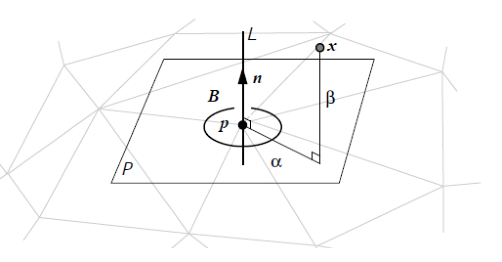
An oriented point at a vertex is defined by the 3D position and the surface normal at the vertex. As shown in Figure 1, p is the oriented point, and then its surface normal n, tangent plane P and point p compose its spin map.
Figure 1. Spin map used to computed the SI on an oriented point p (Johnson, 1997) In order to compute the Spin Image, two cylindrical coordinates (α, β) is defined to describe the 3D point x in the spin map, where α is the perpendicular distance to the surface normal n, and β is the perpendicular distance to the plane P. The coordinates can be computed as follows:
α=√∥x−p∥
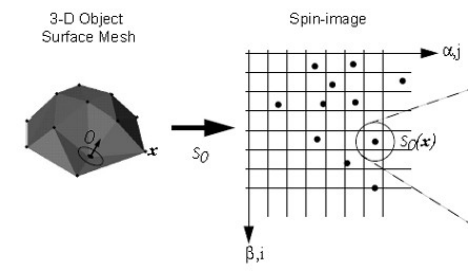
2+(n∙(x−p)) 2 (1) β=n∙(x−p) (2) The bins indexed by (α, β) in the spin map accumulate as an image where dark areas correspond to bins contain more projected points. As shown in Figure 2, the left image is the 3D model and the right image is the Spin Image of point O, the black point is the projection of the point O in the spin map.
Figure 2. A projection of 3D points to point O (Johnson, 1997)
Definition and training of Hidden Markov Model Hidden Markov Model is a double random process. One is the Markov chain, a basis random process, which describes the transition between hidden states. Another is a general random process, the probability distribution of the observation in every state, which describes the statistical relationship between hidden states and observable states.
Equation reproduced from the original PDF.
B=(B j(v k))N × M (5) π is the initial probability of HMM, N is the state number, A is a state transition probability matrix, B is an observation probability matrix, b j(vk) means the probability in state j observe the observation statevk.
In the training step we definite the HMMs and identify the parameters of the potentials attributed to the Spin Image. After the feature extraction from the 3D model was done, the landmarks were characterized by the Spin Image.
Then, we obtained an observation sequence O={b1,b2⋯bmn} about this landmark by vectorizing the Spin Image into a column vector. So all the observation sequences {O1,O2⋯Os} (s is the sample number) consist of the training data. Finally, the Baum-Welch algorithm was used to train the landmark Hidden Markov Model. The training process includes:
1. Initialization HMMλ0=(π0, A0,B0);
2. Calculate the parameters π1, A1,B1 of the new model λ1using model λ0
3. If log P(O∨λ1)−log P(O|λ0)<delta A,the model convergences and stops iteration.
4. If the criterion in step 3 does not meet, take λ1 as λ0 and go back to step 2, and keep iterate.
After the above process, the landmark HMM set {λ0, λ1⋯λl} is obtained, where ι was landmark’s number.
Probabilistic Inference The goal of probabilistic inference over HMMs is to find optimal matching between random landmarks and trained HMMs, which has the maximum matching probability. We use the Forward algorithm to calculate the matching probability, which includes:
1. Get the Spin Image set of the landmarks to be identified and then obtain observation sequence O.
2. Calculate the probability of observation sequence O generated by every landmark’s HMM model and take natural logarithms. The formulas are as shown below, M=( ´P1, ´P2 ´ ⋯Pl) (6) ´P=ln(P(O∨λ)) (7) 3. Find out the maximum probability in the set M, if which meets the predefined threshold, then this landmark can be identified.
Our previous study has demonstrated that Spin Image is a feature extraction method with good robustness and characteristic descriptiveness. Hidden Markov Model has the very strong ability of learning and reasoning. With the algorithm combining Spin Image with Hidden Markov Model, it’s confirmed to be highly efficient and robust to identify facial feature points by the preliminary results.
Unfortunately, no studies have shown how the parameters in our algorithm influence the effect of landmark recognition. Therefore, the purpose of this work is to evaluate the reliability and accuracy of facial landmark identification with different parameter combinations.
METHODOLOGY
This algorithm consists of two key parameters, i.e. Bin Size (BS) and Support Angle (SA), which may have some influence to the generation of Spin Images, leading to different characterization of the local landmark features.
Bin Size (BS) Bin Size determines the storage size of the Spin Image and the averaging of Spin Images reduces the influence of individual point position. It also has an effect on the descriptiveness of the Spin Image. The number of rows or columns in Spin Image is defined as Image Width, which multiplies the Bin Size is called Support Distance, determining the amount of space swept out by a Spin Image.
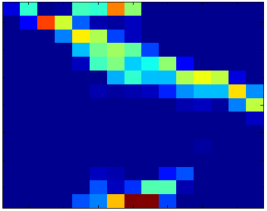
(a) Bin Size=5 (b) Bin Size=10 (c) Bin Size=30 Figure 3. Spin Images generated for the same facial landmark (gnathion) from the 3D head model
using different Bin Sizes.
Spin Images generated for the same facial landmark (gnathion) from the 3D head model using different Bin Sizes are shown in Figure 3. Even though they are generated from the same landmark, we can still notice the apparent differentiation between the Spin Images corresponding to the same landmarks for different Bin Sizes, given other parameters set to constant values. As we have mentioned above, the other points nearby the gnathion point in the 3D head model determine the colors of each bin in the Spin Image. The more projections the bin has, the darker the color will be. The Spin Images generated with a smaller Bin Size is not very descriptive of the global shape of the model. The Spin Image generated with a Bin Size of greater value does not have enough averaging to eliminate the effect of surface sampling. The Spin Image generated with a medium Bin Size has the proper balance between encoding global shape and averaging of point positions.
Support Angle (SA) Support Angle is the maximum angle between the direction of the oriented point basis of a Spin Image and the surface normal of the points that are allowed to contribute to the Spin Image, which is used to limit the effect of occlusion and clutter. Support Angle ranges from 0° to 180°. Johnson et al. (Johnson, 1997) proposed that Support Angle is set between 90° and 60°generally.
Suppose we have an oriented point A with position and normal (PA,nA) for which we are creating a Spin Image.
Furthermore, suppose there exists another oriented point B with position and normal(PB,nB). The Support Angle constraint can then be stated as: B will be accumulated in the Spin Image of A if
cos
−1(nA∙nB)<SA (8)
Equation reproduced from the original PDF.Figure 4. Spin Images generated for the same facial landmark (gnathion) from the 3D head model using different Support Angles.
As shown in Figure 4, Spin Images are generated for the same facial landmark (gnathion) from the 3D head model using different Support Angles. Decreasing Support Angle also has the effect of decreasing the number of points contributing to the Spin Images, which results the decrease of Spin Images descriptiveness.
EXPERIMENT AND RESULTS In order to testify how identification statistics vary as parameters are varied, we present a detailed experiment analysis of the effects of Spin Image parameters on the descriptiveness of Spin Images and the accuracy of the landmark identification using quantitative measures.
We define the Identification Accuracy Rate (IAR) as the identification statistic to measure the mean value of landmark recognition level. By plotting IAR varying a single parameter, while keeping the other parameters fixed, the effect of the parameter on the Spin Image generation and landmark identification can be determined.
In the experiment, 120 human heads of young male Chinese soldiers collected by a Chinese military institute are applied to our algorithm, among which 80 heads as the training samples for the HMMs learning, 20 heads as the preliminary testing samples, and the rest 20 heads as the identifying samples in order to evaluate the automatic landmark identification accuracy. We selected 7 anthropometric facial landmarks, as shown in Figure 5, which include left entocanthion (LE), right entocanthion (RE), alare (AL), apex nasi (AN), subnasale (SU), gnathion (GN), and cheilion (CH), for the sake of elimination the differentiation between different positions.
L 2 L 1
L 3
L
5
L 4
L 6 L 7
(a) front view (b) side view Figure 5. Seven facial landmarks for identification experiment.
Experiment and results related to Bin Size (BS) Bin Size is the geometric size of the bins in the Spin Images generated. The larger the Bin Size, the more averaging occurs in the Spin Images. Johnson et al. (Johnson, 1997) proposed that the rule-of-thumb is to set the Bin Size to roughly the resolution of the model surface mesh. We designed an experiment to test if this rule-of thumb is valid.
In the experiment of studying Bin Size, by using the 3D head models mentioned above, we calculated the identification statistics using Spin Images where the Bin Size varied from 1.0, at which a bin can only contain the landmark point itself, to 500.0, a bin with which size contains the whole points in the 3D head data. The Image Width was fixed at 15 and the Support Angle was set at 180 degrees, which means points at any angle to the landmark point can be contained in the Spin Image. We made a total of 32 experiment groups and experiment in each group will take one Bin Size value, keeping other parameters fixed. Each group of experiment repeated 10 times.
Figure 6. Effect of Spin Image Bin Size on facial landmark Identification Accuracy Rate statistic on average level, keeping Image Width and Support Angle fixed at 15 and 180 degrees, respectively.
Figure available in the original PDF paper.
The plots of mean value of Identification Accuracy Rate statistics on average level from the experiment with Bin Size are shown in Figure 6. Since the image width was fixed while the Bin Size varied, the support distance also varied as the Bin Size times the image width.
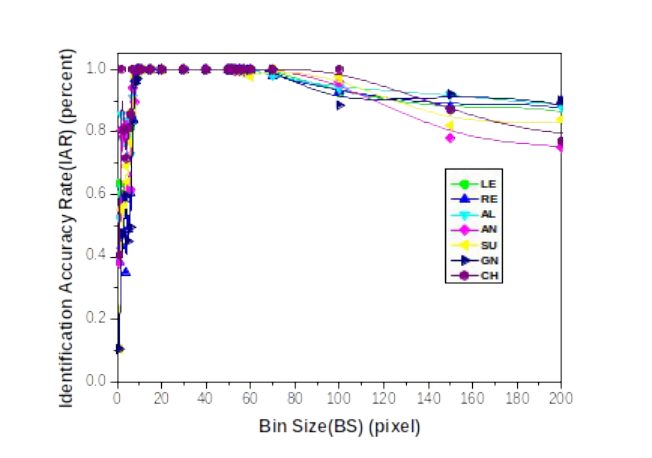
Figure 7. Effect of Spin Image Bin Size on facial landmark Identification Accuracy Rate statistic on seven landmarks, keeping Image Width and Support Angle fixed at 15 and 180 degrees, respectively.
The plots of mean value of Identification Accuracy Rate statistics on seven different facial landmarks from the experiment with Bin Size are shown in Figure 7.
Experiment and results related to Support Angle (SA) Support Angle is the angle between the direction of the oriented point basis of a spin-image and the surface normal of points contributing to the Spin Image. Support Angle is used to limit the effect of self occlusion and clutter during Spin Image generation and landmark identification. In general, Support Angle should be set as large as possible given the expected amount of clutter in the scene.
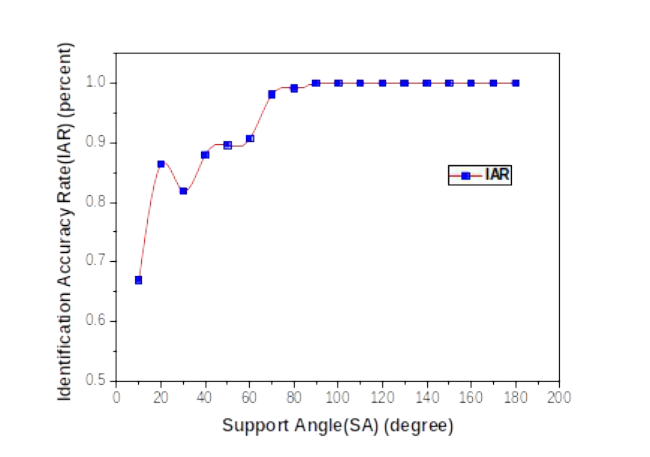
To test this hypothesis, we calculated the identification statistics using Spin Images where the Support Angle varied from 10 degree to 180 degree, which means points at any angle to the landmark point can be contained in the Spin Image, while Bin Size was fixed at 10 and Image Width was set to 15. We made a total of 18 experiment groups and experiment in each group will take one Support Angle value, keeping other parameters fixed. Each group of experiment repeated 10 times.
Figure 8. Effect of Spin Image Support Angle on facial landmark Identification Accuracy Rate statistic on average level, keeping Image Width and Bin Size fixed at 15 and 10, respectively.
The plots of mean value of Identification Accuracy Rate statistics on average level from the experiment with Support Angle are shown in Figure 8.
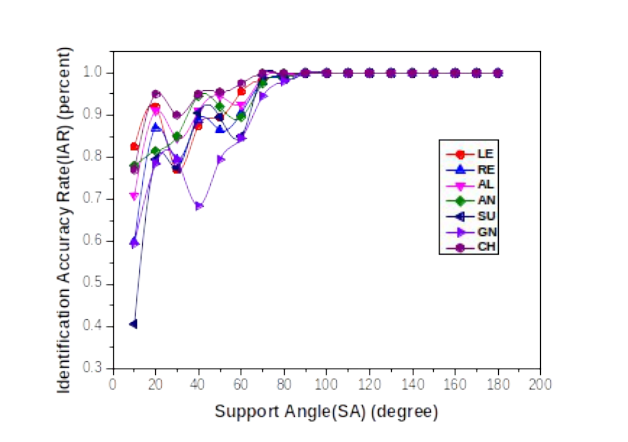
Figure 9. Effect of Spin Image Support Angle on facial landmark Identification Accuracy Rate statistic on seven landmarks, keeping Image Width and Bin Size fixed at 15 and 10, respectively.
The plots of mean value of Identification Accuracy Rate statistics on seven different facial landmarks from the experiment with Support Angle are shown in Figure 9.
DISCUSSION
Spin Images generation is affected by its parameters, which will further cause the influence on the descriptiveness of
Spin Images. As the local feature extraction, the Spin Images with different parameters combination have great effect on the reliability and accuracy of facial landmark identification. This paper specify the metrics used to measure Spin Image descriptiveness and facial landmark identification effect. Then give the analysis of each parameter.
Discussion on Bin Size (BS) As can be seen from Figure 6, Bin Size can multiply or diminish Identification Accuracy Rate by its value. The mean value of IAR increases with the Bin Size until the size reaches 10, when IAR acquires its maximum value 100% and remains constant before the Bin Size reaches 65. After that, IAR dropped with the increase of Bin Size, the velocity of the drop keeps increasing.
Bin Size determines whether neighboring points are binned together. With a small Bin Size, neighboring surface points will likely fall into separate (α ,β) bins; whereas with a large Bin Size, neighboring surface points will more likely fall into the same bin. When Spin Images are correlated, small differences between images are more apparent when the bin size is small; whereas with a large bin size, small differences in bin values do not contribute significantly to the correlation. Bin size, like support length, can be varied to change the Spin Image from a more to a less discriminating shape descriptor.
Consequently, the purpose of selecting a proper Bin Size is to compromise between precision of differentiation from landmarks and ambiguity of differentiation from 3D human heads. When Bin Size is small, the Spin Image of each facial landmark is too different to extract anything in common between faces. Hence, the mean value of IAR is low and the standard deviation is high. Whereas when Bin Size is large, all the feature point will be squeezed in one or only a few number of bins, so that the information contained in a human face is obscured and becomes least informative. Bin Size between 10 and 50 are proposed to choose when extracting the local feature and realizing the landmark identification problem.
Considering different landmarks, as can be seen in Figure 7, Bin Size influences each landmark differently. Bin Size influence all of the landmarks in the same way before 60, but after it exceeds 60, IAR of landmark GN is the first to drop but CH is the last. IARs of GN,AL,LE,RE dropped slightly and stopped to drop at a platform value 0.9, while IARs of SU, CH, AN dropped more than others’, with IAR of AN being the least.
The points after 200 are ignored because the tendencies to drop to 0 for IARs of each landmark is in the same way. Interestingly, we find the IARs of landmarks whose positions are rear drop slower than others’, these phenomenon are in association with some locative and concave-convex conditions and need further investigation.
Discussion on Support Angle (SA) It can be seen from Figure 8 that, Support Angle influences IAR positively. Support Angle starts to function at the value of 10 degrees, then, IAR increases with it until it reaches the degree of 90, when IAR acquired and maintained a constant maximum value of 100%.
Support Angle determines whether the points between the direction of the oriented point basis of a spin-image and the surface normal of points will contribute to the Spin Image. We can draw the conclusion that the Support Angle should be set as large as possible in order to maximize the match overlap and increase that variation between images. It’s better to select the Support Angle more than 90 degree, which can gain good effect.
Considering different landmarks, as can be seen in Figure 9, Support Angle influences each landmark in almost the same way. Figure 9 demonstrates relations between IARs and Support Angle, all of the curves vibrate with the increase of Support Angle when Support Angle is at a lower value, but reach and keep constant in the same tendency.
CONCLUSIONS
Three Dimensional (3D) data has been increasingly obtainable in recent years, which results the local feature extraction, one aspect of processes of 3D data, arousing more widespread attention. Our previous study puts forward a method of combining Spin Image and Hidden Markov Model to realize the 3D human landmark automatic identification problem.
In this paper, we evaluate the accuracy of facial landmark identification with different parameter combinations by a series of detailed experiments. Results show that different parameters of Spin Images affect the facial landmarks identification differently. With regard to Bin Size, the Identification Accuracy Rate (IAR) increases until the Bin Size reaches 10. IAR acquires its maximum value 100% and remains constant before the Bin Size reaches 65. After that, IAR dropped with the increase of Bin Size, the velocity of the drop keeps increasing. As for Support Angle, it influences IAR positively. Support Angle starts to function at the value of 10 degrees, then, IAR increases with it until it reaches the degree of 90, when IAR acquired and maintained a constant maximum value of 100%.Through intelligent choice of parameters, Spin Images can be tuned for specific surface feature extraction and automatic landmark identification applications.
The conclusion that the Spin Image parameters have a not totally same effect on the characterization of the entire model and characterization of local feature can also be given. Consequently, the selection criteria are different. In the case of Bin Size, between 10 and 50 is proposed to be chosen when extracting the local feature and realizing the landmark identification problem. In the case of Support Angle, the angle more than 90 degree is better to be selected, which can gain good effect.
There are still several aspects need to be further studied such as efficiency and robustness. Moreover, using our method to identify landmarks on other human body segments is worth more investigation.
ACKNOWLEDGMENT
The study is supported by the National Natural Science Foundation of China (No.51005016).
REFERENCES
Belhumeur, P.N. Jo, A.H, Kriegma, D. J. (1996). “Eigenfaces vs. fisherfaces. Recognition using class specific linear projection”.
In ECCV '96: Proceedings of the 4th European Conference on Computer Vision-Volume I, pp. 45-58. Johnson, A. Hebert, M. (1997). “Surface registration by matching oriented points”. Proc. of Int. Conf. Recent Advances in 3-D Digital Imaging Modeling, pp.12-15. Johnson, A. Hebert, M. (1998). “Efficient multiple model recognition in cluttered 3-d scenes”. Proc. of Conf. Computer Vision
and Pattern Recognition (CVPR), pp.671-677. Johnson, A. Hebert, M. (1999). “Using spin images for efficient object recognition in cluttered 3d scenes”. IEEE TPAMI, Volume 21 No.5 pp.433-449. Johnson, E. (1997). “Spin-images: A Representation for 3-D Surface Matching”, Ph.D. thesis, Robotic Institute, Carnegie Mellon
University, Pittsburgh, Pennsylvania, USA. Martinez, A. (2002). “Recognizing imprecisely localized, partially occluded, and expression variant faces from a single sample per class”. Pattern Analysis and Machine Intelligence, IEEE Transactions on, Volume 24 No.6 pp. 748-763. Niu, J.W. Zheng, X.H. Zhao, M. Fan, N. Ding, S. T. (2011). “Landmark Automatic Identification from Three Dimensional (3D)
Data by Using Hidden Markov Model (HMM)”. IEEE 18th International Conference on Industrial Engineering and Engineering Management, Changchun, China, 3-5 September, 2011. Quynh, H. Kropac, S (2006). “Multi-Resolution Spin Images”. Proceedings of the 2006 IEEE Computer Society Conference on Computer Vision and Pattern Recognition. New York, America, 17-22 June, 2006. Russ, T. Boehnen, C. Peters, T. (2006). “3d face recognition using 3d alignment for pca”. Proceedings of the 2006 IEEE
Computer Society Conference on Computer Vision and Pattern Recognition. New York, America, 17-22 June, 2006. Robinette, K. M. Blackwell, S. Daanen, H. (2002), “CAESAR, Final Report, Volume I: Summary”. AFRLHE WPTR 2002 0169, United States Air Force Research Lab., Human Effectiveness Directorate, Crew System Interface Division, Dayton, Ohio. Seidl, A. SizeGERMANY-the new German. (2009). “Anthropometric Survey Conceptual Design, Implementation and Results”.
Proceedings of 17th World Congress on Ergonomics, Beijing, China. Turk, M. Pentland, A. (1991). “Eigenfaces for recognition”. J. Cognitive Neuroscience, Volume 3 No.1 pp.71-86. Wiskott, L. Fellous, J.M. Kruger, N. alsburg, C. (1997). “Face recognition by elastic bunch graph matching”. IEEE Transactions on Pattern Analysis and Machine Intelligence, Volume 19 No.7 pp.775-779. Yang, M. H. Kriegman, D. J. Ahuja, N. (2002). “Detecting faces in images: A survey”. IEEE Transactions on Pattern Analysis
and Machine Intelligence, Volume 24 No.1 pp.34-58. Zhao, W. Chellappa, R. Phillips, P.J. Rosenfeld, A. (2003). “Face recognition: A literature survey”. ACM Comput. Surv., Volume 35 No.4 pp.399-458. Physical Ergonomics II (2018)
Zhang, X. Fan, N. Chen, X. Ran, L.H. Niu, J.W. (2010). “Feature Extraction of Three Dimensional (3D) Facial Landmarks Using Spin Image”, IEEE International Conference on Industrial Engineering and Engineering Management (IEEM2010), pp.537-541, Macau, China, 7-10 December, 2010.
LISTED IN THE AHFE DIGITAL BOOKSTORE CATALOGUE
Explore the complete digital volume
Advances in Physical Ergonomics and Human Factors: Part II
Read this individual research paper free through the original publisher, or explore the full digital proceedings book.
ISBN 978-1-4951-2105-0
Explore this ISBN in the AHFE Bookstore ↗Listed in the July 2026 bookstore catalogue; search by ISBN to confirm current availability · Digital book purchase optional