Shih-Yi Lu, Yi-Shyong Ing, Cheng-Lung Lee, Yi-Tsong Pan (2018). Development and Validation of a Posture Driven Tool to Estimate the Hazards of Manual Lifting. In: Advances in Physical Ergonomics and Human Factors: Part I. AHFE Open Access, vol. 1. https://doi.org/10.54941/10035
The primary biomechanical criteria used are based upon maximum compression on L5/S1 disc. According to NIOSH’s report, it indicates that the workers with predicted compression force more than 3400N have higher risk of back problem, and most workers maybe suffer from back injury while the force reaches 6400N. Therefore, most studies adopt these two values as criteria for LBP risk assessment. A compression prediction program based upon Taiwanese anthropometric data was developed during the study. Furthermore, a validation was carried out by investigating manual lifting on LBP outpatients. 38 patients were randomly chosen as subjects in this study. Using prediction program developed, an investigation on compression force on L5/S1 disc for Taiwanese LBP workers is presented. The study results indicated a mean value of 4785N with a standard deviation of 1916N, while the mean value of male and female are 5155N and 3878N, respectively. These results suggest that, if the data were normally distributed, approximately 21% of workers who suffer LBP due to lifting had ultimate compression strength of less than 3400N. The computer program may be adopted as a tool for work design to reduce physical pain and money loss. It should benefit both lifting workers and their employers.
Even a cursory review of the literature will reveal the seriousness of the problems associated with low back pain (LBP) in the workplace. The ubiquity of back pain has lead to extraordinarily high personal and financial costs both to the individuals involved and to society as a whole. LBP is the largest cause of workers’ compensation in the USA and Canada and a major reason for visits to health-care professionals (Andersson, 1999). Musculoskeletal disorders (MSDs) have consistently remained one of the most commonly reported type of work-related ill-health in Great Britain according to national surveys of work-related illness (HSE, 2008). Of the estimated number of individuals suffering from a work-related MSD, just over two-fifths suffer from a disorder mainly affecting their back. According to Taiwan’s National Institute for Occupational Safety and Health’s Working Environment Safety and Health Survey, 38.6% of respondents complained of musculoskeletal pain. Among these, wholly 49% had complaints of lower back pain in the sacro-lumbar regions (Taiwan, 2007).
Back pain can arise in many work situations but is more common in tasks that involve heavy manual labor. Manual lifting can result in high low back loading which is probably the reason that lifting is an important risk factor for low back pain (Lotters et al., 2003; Hoogendoorn et al., 1999). Due to awkward posture or lifting heavy objects, workers often sustain musculoskeletal injuries resulting in a lot of economic and social costs every year. Therefore, it is urgent to develop a simple method for rapid assessment of manual lifting work, which can be easily applied by on- site safety officers or staff in order to identify problems as soon as possible and to improve lifting tasks, in a result of reducing the risk of low back injury.
In discussing lower back pain caused by lifting activity, because of the L5/S1 disc position, there will be greater force here than elsewhere, so when developing biomechanical models of lifting limits, the maximum lifting limits for this region must especially be emphasized. Spinal compression is traditionally assumed the principal biomechanical mechanism associated with occupationally related low-back disorders (LBD), although shear loading has been identified (Kumar, 1990; Marras et al., 1997; Norman et al., 1998) as another important biomechanical factor to be considered. However, there has been little progress made towards establishing the magnitude of a shear exposure level linked to increased risk of injury (Cripton et al., 1995; McGill et al., 1998; Yingling et al., 1999). Cumulative loading of the spine has also been identified as a risk factor for low-back pain reporting (Kumar, 1990; Norman et al., 1998). Unlike identifying the peak loading, cumulative loading presents the difficulty of documenting the variation of the spinal loads with respect to time. However, there is limited study (Kevin et al. 1999; Waters et al., 1993; Herrin et al. 1986) conclusive evidence demonstrating that compression is related to occupational LBD. The limited feasibility has also hampered testing the hypothesis that compression forces are a cause of low back pain.
The main purpose of biomechanics is to determine the critical load in lifting activities for workers. To achieve this goal, many researchers have developed two-dimensional or three-dimensional static and dynamic models (e.g., Park and Chaffin, 1974; Schultz and Andersson, 1981; Garg et al., 1982; Smith et al., 1982; Freivalds et al., 1984; Granhed et al., 1987; Bean et al., 1988; Jager and Luttmann, 1989; Marras and Sommerich, 1994), and EMG models (e.g., Morris et al., 1961; Leskinen, 1985; McGill, 1992; Marras and Granata, 1992). Although the biomechanical model takes into account the three-dimensional acceleration and inertia effects, making it a much closer fit to the lifting action in a real situation, but their instrumentations, analysis and calculation processes are complex and are not directly suitable for job site use. With the assumed relationship between low back pain and injury due to compression, ergonomic studies on measures to reduce low-back loading during physically demanding tasks, such as manual materials handling, have often used spinal compression forces as outcome measures (de Looze et al., 1996; Davis et al., 1998; Nussbaum et al., 1999; Kuijer et al., 2003; Kingma and van Dieen, 2004). The calculation for cumulative loading of the spine provides a different approach, but it is still a labor intensive method. The videotaping, digitization and biomechanical modeling require a level of expertise and equipment that is not readily available to most ergonomists. Both ergonomic practice and epidemiological research into occupational spinal loading would benefit from a simple and easily applicable method to estimate compression forces on the spine. With the exception of the NIOSH lifting job specifications (Waters et al., 1993; Potvin, 1997), there are few other effective methods at present to assess and recommend appropriate weights for lifting, which can be simply applied in the worksite, for the effective and rapid assessment of the risk of injury from lifting actions. When the models become more complex through use of more input parameters, the applicability of the model to use as a tool for estimating lumbar spine forces at a worksite will be hesitated. It should provide valid estimates of at least the peak compression force during a task, since mechanical injury models suggest that the magnitude of the compression peaks and the frequency of their occurrence primarily determine the probability of injury (van Dieën and Toussaint, 1997; Parkinson and Callaghan, 2007).
The purpose of current study is to develop a software program, with fewer input parameters making it particularly better suited for worksite usage. Such a method would provide a useful tool for evaluating lifting tasks based upon the biomechanical criterion during infrequent lifting. The validation of this evaluation tool was performed by applying the developed software to calculate the peak compression forces on L5/S1 among work-related LBP outpatients. This investigation worked on the simulated reconstruction of lifting posture for thirty-eight outpatients.
METHODS
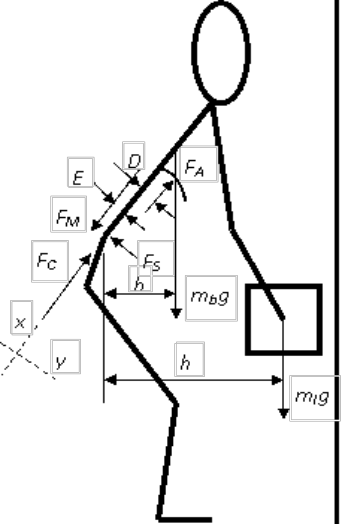
Biomechanical Model A simple cantilever low back model proposed by Chaffin and Andersson (1991), which is graphed in Figure 1, was adopted to predict compression force at the L5/S1. Large extensor moments about the joints of the lumbar vertebral column are produced during lifting by the paravertebral musculature to overcome the flexor moment caused by the weight of the upper body and load. A common model used for lifting incorporates five segments corresponding to the forearm, upper arm, truck, upper leg, and lower leg. Anthropometric parameters are also used and specify the segment lengths, weights, and center-of-mass locations. From these models the equations of motion based upon Newton’s second law and Euler’s equations can be derived to describe the force on L5/S1. A software program developed utilizes the Chaffin biomechanical model, computes the compression force acting on the lumbar L5/S1 region with the requirement of several input variables such as the height and weight of subjects, lifted weight, and the angle between the body segments.
Figure 1. Illustration of the kinematic input for biomechanical model
The three equilibrium equations, including one moment equation and two force equations, are ∑M L5/S1=0 mb gb+ml gh−F A D−FM E=0
where mb g is the weight of the body segments above the L5/S1 level, mlg is the weight of the load in the hands, FA is the force created by the abdominal pressure, FM is the effective erector spinae muscle force,
FC is the compression force at the L5/S1, FS is the shear force across the L5/S1, b, h, D, and E are the moment arms of relevant forces (as illustrated in Figure 1).
Equation reproduced from the original PDF.
o+β ,
and β=−17.5−0.12T +0.23K+0.0012TK+0.005T
2−0.00075 K 2 where T is the angle between torso axis and vertical line, and K is knee angle.
According to Morris et al. (1961) and Smith et al. (1982), the amount of force FA created by the abdominal pressure was estimated by assuming of an average diaphragm area of 465 cm2 upon which the abdominal pressure can act, and D is the moment arm of FA . The two empirical equations can be expressed as
Equation reproduced from the original PDF.
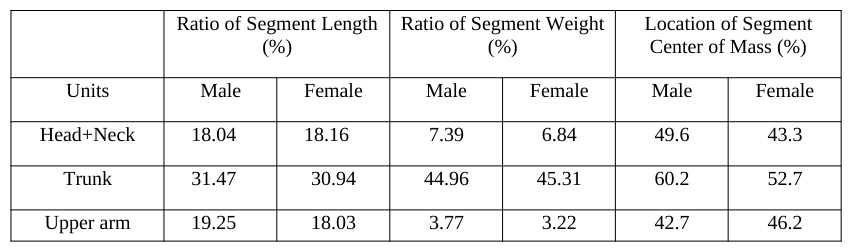
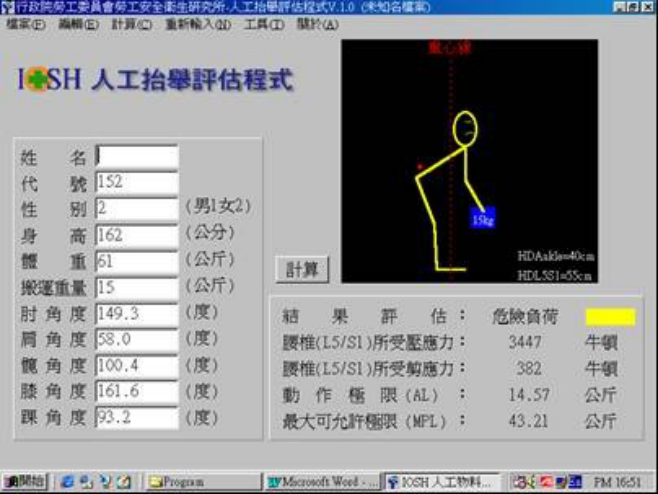
Anatomical parameters required for developing software program were based upon the mean measurements of Chinese. Cheng et al. (2000) and Lin et al. (2001) caught Magnetic Resonance Images from subjects, and the images were processed with edge detection for tissue identification to estimate the anthropometric data, including the mass distribution, the center of mass, and etc. The anthropometric data (Table 1) are applied to developed model. Adopting Chaffin’s two-dimensional biomechanical model, a software program (Figure 2) was developed to predict the forces on the disc of subjects with low back injuries due to work engaged in infrequent lifting, and examine the relationships between force loads on the discs.
Table 1: Anthropometric data applied to develop computer model Ratio of Segment Length Ratio of Segment Weight Location of Segment
1. The ratio of segment length specified as % relative to stature
2. The ratio of segment weight specified as % relative to whole body weight
3. The location of segment center of mass specified as % of segment length relative to proximal joint
Figure 2. Main program window (Chinese version)
Subjects Subjects were selected by referrals from Orthopedics doctor who evaluated outpatient visitors to a hospital clinic for low back pain treatment to determine whether their low back pain occurrence involved work-related lifting. Researchers recruited a sample of thirty-eight adults after doctor’s screening at hospital, and explained the objective of the study to each participant. This study was approved by the institute ethical committees and each subject read and signed an informed consent form. After completing questionnaires and interviews with the researchers, the necessary biomechanical model parameter information for software inputs was collected.
The criteria used for selecting subjects in this study were: (1) Tasks in which manual lifting are performed as a regular daily activity at least 20 lifts per day;
(2) Tasks with no major changes in content for the past 6 months;
(3) Tasks engaged in a lifting frequency of less than 2 times / minute; (4) Tasks that did not involve one-handed, seated lifting, and significant of non-lifting demands, such as pushing, pulling, or carrying.
Data collected Subjects were observed and interviewed to identify individual tasks within the job and to document the task times at hospital. As the basic demographic information, age, gender, height, weight, type of work, working hours, and etc. were obtained. The interview process for reconstruction of lifting tasks, simulation of work by the patients demonstrating their lifting postures, with the researchers recording all thirty-eight subjects by video camera during lifting motions, followed with laboratory processing through an image acquisition system, using freeze frame video playback to identify and select a number of awkward postures, for use of these postures in the software program to calculate the compression force on the L5/S1. Each subject performed each of the lifts three times. Some participants required multiple lifting activities, each with a unique set of task characteristics. Three repetitions of each task for each subject were examined and one cycle from each repetition for each subject was chosen for analysis. When examining the play back videos there is a consensus on the factors that lead to the most demanding instant, this is the greatest horizontal moment arm. The selection of awkward lifting posture was mainly determined from the horizontal distance between the lumbar spine and the lifted object.
Calculation of peak compression force To reduce measurement bias in the calculations, averages were taken across three trials for each lifting task to compute the peak force for each participant. In a few cases, there were significant differences between data samples, i.e. when the differences in measurements would result in more than a 10% difference in the peak force. In these cases, a professional ergonomist reviewed the video tape of the tasks, and judged what the appropriate measurements should be for the computations.
RESULTS
A total of 38 subjects who were orthopedic hospital clinical outpatients presenting with low back pain, of whom there were 27 males and 11 females, with a minimum experience of 6 months, participated in the study after signing an informed consent form approved by the local ethics committee. Their average age, height and body mass were 46.7 yr (SD 10.9 yr), 164.6 cm (SD 6.7 cm) and 66.4 kg (SD 10.3 kg), respectively. The average lifting weight at work was 30.9 kg, with a mean of 32.6 kg for the male, and 26.9 kg for the female (Table 2). Moreover, all 38 LBP subjects in this study worked with a lifting frequency in the range of 0.1 times / minute to once an hour at work.
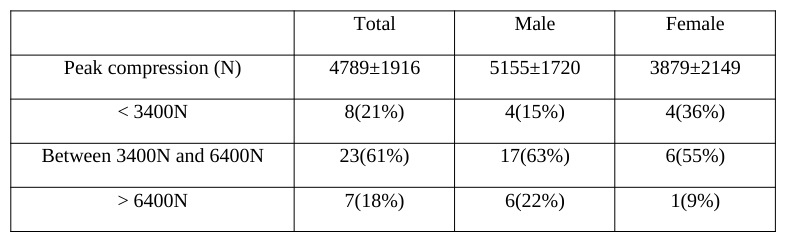
Of 38 participants, 20 were lifting objects with twisting angle less than 30 degrees, but 15 twisted wrist while lifting (Table 2). After determining the most adverse lifting postures for each of the 38 subjects by the abovementioned procedures, the parameters of segment angles including heel, kneel, hip, shoulder, and arm, were used as inputs to the developed software. The results shown in Figure 1 indicates that an average peak compression force of 4785 N (S.D 1916 N) exerts on the L5/S1 disc region, with an average 5155 N (SD 1720 N) in the male, and 3878 N (SD 2149 N) in the female. Taking a maximum force of less than 3,400 N, 3400N-6400 N, and 6400 N or above, to establish three regions, the size distributions for this three regions were 8 (21%), 23 (61%), and 7 (18%) participants respectively, as illustrated in Table 3. Comparing the statistical differences between male and female participants, it showed the male distributions by region to be 4 (15%), 17 (73%), and 6 (22%), while the female distributions for each region were 4 (36%), 6 (55%), and 1 (9%).
Table 2: Study population demographics with means (range).Table 3. Calculated compression force at L5/S1 and distributions Total Male Female
DISCUSSION
The primary aim of this study was to develop an evaluating tool with Chinese anthropometric data when applied to a lifting task analysis. In addition, a validating test on outpatients with low back pain was performed. The questionnaire, observations, and videotape data were obtained from 38 tasks. Workers’ anthropometric data (height and weight), load measurements, and video images were used to model worker postures. The NIOSH 3400N and 6400N criteria were considered as the gold standards in the validation study. The test results showed that an approximate 79% subjects experienced more than 3400N on L5/S1 disc region during daily work, while 18% subjects obtained higher than 6400N. The predictions of this model were shown to be highly correlated to NIOSH criteria. The consistency of the results obtained would suggest that the proposed tool can be used as a preliminary evaluation of biomechanical risk at the low back to warrant further ergonomic analysis of a lifting task. The proposed models, using minimal input variables, can provide valuable information about the hazard level of a task.
The present model is based upon a static equilibrium equation, whereas the realistic manual materials handling task, were dynamic in nature. This may well account for the difference in 21.1% subjects with compression under 3400N, as static modeling has been shown to cause an 11–38% underestimation of low back moments during lifting (Leskinen, 1985; McGill and Norman, 1985; Tsuang et al., 1992; de Looze et al., 1994; Lindbeck, 1995). Furthermore, the current model is based upon symmetry of load handling, whereas the tasks studied are not strictly symmetric. However, asymmetric lifting does not lead to significant higher compression forces than symmetric lifting (Kingma et al., 1998; van Dieën and Kingma, 1999, 2005). Therefore, ignoring asymmetry does not necessarily contribute to the underestimation of the L5/S1 moment and compression by the present study.
Observation error can affect the accuracy of model estimates and therefore care should be taken when obtaining the segment angles used in the prediction equation. Although the combination of video and 2D-biomechanical modeling appears to be the most convenient option, two major issues exist. First, digitizing video data is a time intensive process, and second, 2D-biomechanical models only analyze planar motion (i.e. sagittal) and therefore asymmetrical lifting motions cannot be accurately assessed, resulting in underestimation of joint compression (Kingma et al., 1998). The evaluation of peak spinal loading has been used as a convenient measure of risk as it is calculated at a single instant in time, which is considered to represent the point of greatest loading. In life, the magnitude of compressive forces experienced during a single lift is unlikely to cause endplate failure, and injury is more likely to be cumulative. Cumulative loading assessment, on the other hand, requires calculating demands on the spine over an extended period of time.
CONCLUSIONS
Occupational biomechanics focuses on determining the mechanical stresses on a worker’s body while performing his/her job tasks. Persons exposed to increased levels of compression are usually at a higher risk for developing musculoskeletal disorders of the low back than workers without these risk factors. The posture-based program software developed in this study suggest that lifting posture can be a feasible input method for workplace to assess lifting tasks when used as the kinematic inputs to a rigid link segment model. The key advantages of the developed tool are the ability to analyze lifting tasks on site and eliminating the expensive equipments by using a posture- observing technique for data input. Biomechanical models provide information to help reduce exposure to loads that are potentially injurious to a worker. This prediction model provides a quicker method for determining the force for a worker to reduce exposure to ergonomic risk factors associated with manual material handling by using both posture and person-specific variables.
ACKNOWLEDGEMENT
The authors would like to thanks Wen-Jer Chen, MD for his help with screening outpatients. This study was funded by the Institute of Occupational Safety and Health, Council of Labor Affairs, the Executive Yuan, Taiwan, R.O.C..
REFERENCES
Anderson, C.K., Chaffin, D.B., Herrin, G.D. (1986), “A study of lumbosacral orientation under varied static loads”, Spine, 11, 456-462. Andersson, G.B.J. (1999), “Epidemiologic features of chronic low-back pain”, Lancet, 354, 581–5. Bean, J.C., Chaffin, D.B., Schultz, A. (1988), “Biomechanical model calculation of muscle forces: a double linear programming
method”, Journal of Biomechanics, 21, 59-66. Chaffin, D.B., Andersson, G.B.J. (1991), “Occupational Biomechanics, 2nd Ed.”, John Wiley & Sons, Inc. Cheng, C.K., Chen, H.H., Chen, C.S, Lee, C.H., Chen, C.Y. (2000), “Segment inertial properties of Chinese adults determined from magnetic resonance imaging”, Clinical Biomechanics, 15, 559-566. Cripton, P.A., Berleman, U., et al. (1995), “Response of the lumbar spine due to shear loading”, Proceedings of the Centers for
Disease Control on Injury Prevention through Biomechanics, May (Detroit, MI: Wayne State University), 111-126. Davis, K.G., Marras, W.S., Waters, T.R. (1998), “Reduction of spinal loading through the use of handles”, Ergonomics, 41, 1155-1168. de Looze, M.P., et al. (1994), “The evaluation of a practical biomechanical model estimating lumbar moments in occupational
activities”, Ergonomics, 37, 1495–1502. de Looze, M.P., et al. (1996), “Weight and frequency effects on spinal loading in a bricklaying task”, Journal of Biomechanics, 29, 1425–1433. Health and Safety Executive, (2008), Health and Safety Statistics 2007/2008, Sudbury, UK: HSE Books. Freivalds, A., Chaffin, D.B., Grag, A., Lee, K.S. (1984), “A dynamic biomechanical evaluation of lifting maximum acceptable
loads”, Journal of Biomechanics, 17, 251-262. Garg, A., Chaffin, D.B., Freivalds, A. (1982), “Biomechanical stresses from manual load lifting: a static vs. dynamic evaluation”, AIIE Transactions, 14, 272-281. Granhed, H., Jonson, R., Hansson, T. (1987), “The loads on the lumbar spine during extreme weight lifting”, Spine, 12, 146-149. Herrin, G.A., Jaraiedi, M., et al. (1986), “Prediction of overexertion injuries using biomechanical and psychophysical models”,
American Industrial Hygiene Association Journal, 47, 322 -330. Hoogendoorn W.E., van Poppel, M.N.M., et al. (1999), “Physical load during work and leisure time as risk factors for back pain”, Scandinavian Journal of Work Environment & Health, 25(5), 387-403. Jager, M., Luttmann, A. (1989), “Biomechanical analysis and assessment of lumbar stress during load lifting using a dynamic 19-
segment human model”, Ergonomics, 32, 93-112. Kevin, P., Granata, K.P., et al. (1999), “Relation between spinal load factors and the high-risk probability of occupational lowback disorder”, Ergonomics, 42, 9, 1187 – 1199. Kingma, I., et al. (1998), “Asymmetric low back loading in asymmetric lifting movements is not prevented by pelvic twist”,
Journal of Biomechanics, 31, 527-534. Kingma, I., van Dieën, J.H. (2004), Lifting over an obstacle: effects of one-handed lifting and hand support on trunk kinematics and low back loading”, Journal of Biomechanics, 37, 249–255. Kuijer, P., et al. (2003), “Effect of a redesigned two-wheeled container for refuse collecting on mechanical loading of low back
and shoulders”, Ergonomics, 46, 543-560. Kumar, S. (1990), “Cumulative load as a risk factor for back pain”, Spine, 15, 1311-1316. Lindbeck, L. (1995), “Dynamic, semi-dynamic and static analyses of heavy lifting – three approaches applied to sack handling”, Clinical Biomechanics, 10, 407-412. Lin, Y.H., Chen C.S., Cheng C.K. (2001), “Geometric parameters of the in Vivo tissues at the lumbosacral joint of young Asian
adults”, Spine, 26, 2362-2367. Leskinen, T.P.J. (1985), “Comparison of static and dynamic biomechanical models”, Ergonomics, 28, 285-291. Lotters, F., Burdorf, A., et al. (2003), “Model for the work relatedness of low back pain”, Scandinavian Journal of Work Environment & Health, 29(6), 431-440. Marras, W. S., Granata, K. P. (1992), “Spine loading during trunk lateral bending motions”, Journal of Biomechanics, 30, 697-
703. Marras, W. S., Granata, K. P. (1997), “Changes in trunk dynamics and spine loading during repeated trunk exertions”, Spine, 22, 2564-2570. Marras, W. S., Sommerich, C. M. (1994), “A three-dimensional motion model of loads on the lumbar spine I. model structure”,
Human Factors, 33, 123-137. McGill, S.M., Norman, R.W. (1985), “Dynamically and statically determined low back moments during lifting”, Journal of Biomechanics, 18, 877-885. McGill, S.M., Norman, R.W., et al. (1998), “Shear happens! Suggested guidelines for ergonomists to reduce the risk of low back
injury from shear loading”, Proceedings of the 30th Annual Conference of the Human Factors Association of Canada, October (Mississauga, Ont: Human Factors Association of Canada), 157-162. McGill, S.M. (1992), “A myoelectrically based dynamic three-dimensional model to predict loads on lumbar spine tissues during lateral bending. Journal of Biomechanics, 25, 395-414. Morris, J.M., Lucas, D.B., Bresler, B. (1961), “Role of the trunk in stability of the spine”, Journal of Bone and Joint Surgery, 43-
A, 327-351. Norman, R.W., Wells, R.P., et.al. (1998), “A comparison of peak v.s. cumulative physical work exposure risk factors for the reporting of low back pain in the automotive industry”, Clinical Biomechanics, 13, 561-573. Nussbaum, M.A., Chaffin, D.B., Baker, G. (1999), “Biomechanical analysis of materials handling manipulators in short distance
transfers of moderate mass objects: joint strength, spine forces, and muscular antagonism”, Ergonomics, 41, 1597-1618. Park, K.S., Chaffin, D.B. (1974), “A biomechanical evaluation of two methods of manual lifting”, AIIE Transactions, 6, 105-113. Parkinson, R.J., Callaghan, J.P., 2007. Can periods of static loading be used to enhance the resistance of the spine to cumulative compression? Journal of Biomechanics, 40, 2944-2952. Potvin, J.R. (1997), “Use of NIOSH equation inputs to calculate lumbosacral compression forces”, Ergonomics, 40, 691-707. Schultz, A.B. and Andersson, G.B.J., 1981; “Analysis of load on the lumbar trunk muscles in isometric performance of
mechanically complex standing tasks”, Journal of Biomechanics, 6: 313-326. Smith, J.L., Smith, L.A., McLaughlin, T.M. (1982), “A biomechanical analysis of industrial manual materials handlers”, Ergonomics, 25, 299-308. Taiwan Institute of Occupational Safety and Health (2007), “A report of nationwide occupational safety and health survey in
Taiwan”, Annual Report of Occupational Safety and Health Research. Tsuang, Y.H., et al. (1992), “Influence of body segment dynamics on loads at the lumbar spine during lifting”, Ergonomics, 35, 437-444. van Dieën, J.H., Kingma, I. (1999), “Total trunk muscle force and spinal compression are lower in asymmetric moments as
compared to pure extension moments”, Journal of Biomechanics, 32, 655-662. van Dieën, J.H., Kingma, I. (2005), “Effects of antagonistic co-contraction on differences between electromyography based and optimization based estimates of spinal forces”, Ergonomics, 48, 411-426. van Dieën, J.H., Toussaint, H.M. (1997), “Evaluation of the probability of spinal damage caused by sustained cyclic compression
loading”, Human Factors, 39, 469-480. Waters, T.R., Putz-Anderson, V., et al. (1993), “Revised NIOSH equation for the design and evaluation of manual lifting tasks”, Ergonomics, 36, 749-776. Yingling, V.R., McGill, S.M., et al. (1999), “Anterior shear of spinal motion segments. kinematics, kinetics, and resultant injuries
observed in a porcine model”, Spine, 24, 1882-1889.
LISTED IN THE AHFE DIGITAL BOOKSTORE CATALOGUE
Explore the complete digital volume
Advances in Physical Ergonomics and Human Factors: Part I
Read this individual research paper free through the original publisher, or explore the full digital proceedings book.
ISBN 978-1-4951-2104-3
Explore this ISBN in the AHFE Bookstore ↗Listed in the July 2026 bookstore catalogue; search by ISBN to confirm current availability · Digital book purchase optional