T.D. Nguyen, Martin Kleinsorge, Jörg Krüger (2018). A System for Automated Live Ergonomics Assessment and Its Applications in Manufacturing. In: Advances in Physical Ergonomics and Human Factors: Part I. AHFE Open Access, vol. 1. https://doi.org/10.54941/10026
We present a system to assess ergonomics of a manual production process in real time. The system computes a score based on the current working pose of the subject using the “Ergonomics Assessment Worksheet (EAWS)” method. Furthermore, we propose an application scenario where this system is used to automatically adjust the height of a lifting table to enable an ergonomically optimal working pose for the worker. Our sensing system provides necessary information to assess the situational physical load. It consists of a “Microsoft Kinect”, a low cost 3D camera, and a software component. To demonstrate a practical application, we use the component to automatically adjust the height of a lifting table in order to enable comfortable working in straight pose with arms below shoulder level. In other words, it is able to adapt to different subjects with different anthropometrics.
Although there are tendencies to fully automatise manufacturing processes, manual work is still essential. Even in industrialised countries, human workers remain indispensable. Many companies, which prefer applying manual work to full automation in their production lines mention high costs and inflexibility as main reasons (Lay, 2001). Moreover, some production processes are too complex to be automatised by current technology. Customers worldwide demand more and more freedom of choice over a variety of product variants. Some even wish to have their products fully customised according to their needs. For manufacturers, this means that they have to design their production to be able to efficiently produce many product variants in small lot-sizes. Moreover, product life cycles, such as in electronics, have shortened (Bley, 2004). New generations of products have to be released annually and production lines have to be regularly updated. Since each process has to be planned from scratch and integrated into the existing manufacturing systems for each new variant, investment does not pay off if only small amounts are produced. Lien and Rasch (Lien, 2001) have calculated that in the case of robotic assembly, assuming current costs, full automation only pays off for yearly volumes starting at 75.000 – 120.000 units. Additional costs, such as maintenance of such systems and when breakdowns occur have to be considered, as well. Finally, there are processes which cannot be accomplished by current automation technology. Examples are tasks which require high sensomotoric skills e.g. when handling flexible and fragile parts or facing changing situations.
Human workforce is highly flexible and can deal with such demanding tasks. Workers are even able to optimise production processes on their own. Since humans have the tendency to accomplish their work with minimum energy consumption, they come up with process related improvements in the course of time. Thus human workers are still indispensable for many companies due to their flexibility, cost-efficiency, unique skills and ability to continuously improve. They especially outperform full automatised production system when many variants of products are produced in small lot-sizes.
Unfortunately, manual work processes often contain situations where high physical load strains the worker. According to a German health insurance “AOK” (Badura, 2010) more than one third of the total worker absence in 2009 was caused by musculo-skeletal complaints or injuries. Problems are often caused by working in awkward poses for a longer period of time. Due to the geometry of the parts, a worker may have to adapt unfavourable poses in order to perform a task. Designing the production environment geometry to reduce load for all workers seems to be impossible due to the variety of product geometries and varying human body sizes.
Physical load can become an even more severe problem when considering current demographic development in industrialised countries. Work related skills deplete when people age. The intensity of depletion is especially high when workers deal with high physical load or perform highly repetitive tasks (Ilmarinen, 1997). Elder workers may be unable to accomplish their tasks before they retire leading to unemployment or at least reduced well-being at work. Bley et al. (Bley, 2004) state that future challenges for manufacturing will involve creating production processes which are more feasible to human beings.
A solution to these problems can be found in methods of Human Centric Automation (Krüger, 2009) (Nguyen, 2013). The idea is to employ hybrid systems where the human worker is supported by the automation system instead of being replaced. Actuators, such as robots, can manipulate the environment in order to improve working conditions. Man and machine work together and combine their strengths. Krüger et al. (Krüger, 2009) give an overview over different concepts of cooperation and outline technological requirements for such systems.
With that said, we present a system which observes the worker during his process and automatically adjusts the working table height in order to preserve ergonomic guidelines. Our system consists of a Microsoft Kinect RGBD camera and a lifting table. Applied in process, the system can guarantee that the worker can work in the most ergonomic posture as possible. The innovation lies in integrating the fields of ergonomics assessment and optimisation in context of real time systems.
This paper is structured as follows: Section “Related work” gives an overview over the fields our work is inspired from. Section “System overview” describes in detail the components of our system and the methods applied. In section “Experimental Results” we present experiments and results showing strengths and weaknesses of our system. Finally, section “Conclusions” concludes our work and mentions tasks planned for the future.
RELATED WORK
Ergonomics Assessment Ergonomics assessment tools, such as AAWS (Winter, 2006), EAWS (Schaub, 2013), RULA (McAtamney, 1993), NIOSH (Waters, 1993) or OWAS (Scott, 1996) have been developed to analyse health risks in manual production processes. These tools provide a set of criteria relating to working pose, forces applied on the worker and repetitiveness of actions. When evaluating a process, a planner observes whether these criteria apply. Additionally, the assessment tools contain information about the influence of each criterion on the overall result, such that a final result can be derived from considering all criteria together. To give an example of the workflow, we consider AAWS and EAWS. Here, the evaluator assigns points for unfavourable physical load. The distribution of the points assigned provides a better understanding of where health risks in the process occur. In the end, points are accumulated into an overall ergonomics score. If the ergonomics score exceeds a pre-defined threshold, planners see that necessary measures have to be taken.
Digital factory tools, such as Siemens Jack or Delmia Quest enable to virtually simulate the process and perform ergonomics assessment on the simulations. The advantage is that risks can already be discovered and measures already be initiated in early planning phase before the workplace has been physically implemented. Ergonomics assessment is performed on digital human models. Unfortunately, ergonomic assessment on digital human models often leads to a high planning workload since these models are complex and offer many degrees of freedom. Thus, programming the behaviour of such digital workers can be tedious.
There are several approaches to reduce programming work e.g. by predicting the working pose to be adapted by a human given a working step (Enomoto, 2013) (Zhao, 2010). Integrating “intelligent behaviour” into digital humans is ongoing research. The biggest problem is to model the variation of behaviour among human workers.
Motion capture systems An approach to reduce programming work was to use motion capture technology (Härtel, 2011). These systems are able to record the movements of real people and transfer them to a digital human model. Typical areas of usage are animating characters in animation movies and video games or analysis of movement for sports or medical purposes. In general, motion capture systems can be divided into marker-based systems, marker-less systems and non-optical systems.
Marker-based motion capture systems, such as the ones offered by Vicon, rely on objects, so-called markers, worn by the subject to be captured. The markers are designed to be easily visible and detectable for the system. Each marker represents a part of the body, such as hand, elbow or head. While recording, only the positions of the markers are tracked. From the 2D positions of the markers in the images, the 3D coordinates of each part of the body can be reconstructed. The advantage of Marker-based motion capture techniques is high precision. Parts of the body can be located with an error of about 5mm. However, markers limit the subject's freedom of movement which can lead to unnatural motions. Another problem is that marker-based systems need to calibrate the markers to the human model before they can be used. User calibration involves fixing the markers at the correct place and telling the system which marker belongs to which part of the body. This routine can be time consuming which makes the system inflexible.
Marker-less motion capture systems, such as OpenStage® or Microsoft Kinect® do not require any markers to be worn. Therefore, user calibration is much easier and often only requires the subject to adapt a particular pose before tracking starts. Normally, accuracy is significantly lower than in marker-based systems. Moreover, in order to work properly, this technology demands special conditions on environment and subject, such as non-cluttered background, constant illumination or the subject to be completely visible. Finally, results are more susceptible to image noise. Nevertheless, this technology enables workers to work naturally without any obstruction.
Finally, there are non-optical motion capture systems. These systems do not work on camera images, but on alternative sensors, such as acceleration sensors (XSens systems) or ultra-wave sensors (Sarissa LPS). Non-optical systems can track parts of the body in cases where they would not be visible by a camera. The trade-off is that additional sensors have to be worn. These objects are often bigger than optical markers and battery powered, which limits the mobility of the worker even more than marker-based systems. For acceleration-sensor based systems, there is also the drift problem of accumulation of errors. Acceleration sensors can only measure the change of position of an object – not its absolute position. In each point of measurement, the sensor makes a small error. Since the current location relies on the current and previous measurements, the error is summed up over time. In other words, the system becomes less accurate the longer it operates. Data fusion with more sensor systems such as gyroscopes can improve the position estimation but the available solutions become more complex in size, prize and calibration.
Despite the technical problems, we believe that marker-less motion capture has the best conditions to be used in industrial environment due to its non-invasive character. If partial occlusions of the subject are frequent, non-optical methods can support tracking.
Ergonomics optimisation Having a better understanding of the risks in the process, the working environment can be modified in order to improve conditions for the worker. Past work has concentrated on choosing “optimal” workplace layout (Rabideau, 1975) or optimising the geometry of the product the worker interacts with. Normally, optimisation of ergonomics is done in planning phase.
Caputo et al. (Caputo, 2006) propose a methodology for studying and improving the ergonomics of a work cell in automotive manufacturing systems using digital humans. The task was to find the optimal combination of the work cell’s geometry features that support human postures during assembly. As test cases, sequences of digital humans welding in an automotive factory were used. Optimisation was done by creating different variants of processes and choosing the one with the best ergonomics score. To compute the score, several ergonomics assessment tools were used. Moreover, a reachability analysis and static strength analysis have been conducted.
A similar methodology has been employed by Marzano et al. (Marzano, 2012). The goal was to assess risks and find the critical postures in a process. What is interesting about this approach is that ergonomics as well as execution time were optimised. Therefore, not necessarily the solution with the best ergonomics is chosen, but the one which represents the best compromise between worker health risks and efficiency. A test case was chosen from a process in the railway industry.
Rasmussen et al. (Rasmussen, 2003 May) (Rasmussen, 2003 August) propose a system for ergonomic optimisation for tasks like product design. The core technology consists of the AnyBody Human Modelling System. This model considers the human as a bio-mechanical system. AnyBody can model the physical behaviour of up to 300 muscles. Assessment of ergonomics is done by computing internal forces and moments on muscular system given external forces and product geometry. Thus, complex models of the human body can be constructed and the environment's influence on it can be precisely determined. As application cases, the geometry of a hand saw, shapes of bicycle frames and seated postures were assessed and optimised.
Car seat shapes were also optimised by Zhao et al. (Zhao, 2009). Energy minimisation methods and genetic algorithms have been used to find the optimal surface of car seats. The goal of this task was to design a seat which is as smooth as possible but also as similar to the human spine’s shape as possible.
Finally, Rabideau and Luk (Rabideau, 1975) propose a method to compute ergonomically optimal workplace layouts using monte-carlo optimisation. As input, the system takes the 3D geometric layout and the usage frequencies of tools and parts. The cost function to be optimised considers visual and manual distance to the object, weight of the object, and probability of usage. The algorithm outputs a set of alternative layouts with the lowest costs.
To conclude, research has strongly concentrated on ergonomic assessment and optimisation in planning and design phase. Often, the problem of how to get information about working posture or usage of tools in a live process has not been considered. Many algorithms proposed cannot meet real time requirements since computation time is high. Finally, to our knowledge the idea to use degrees of freedom of flexible equipment, such as lifting tables or robots, has been rarely considered.
SYSTEM OVERVIEW
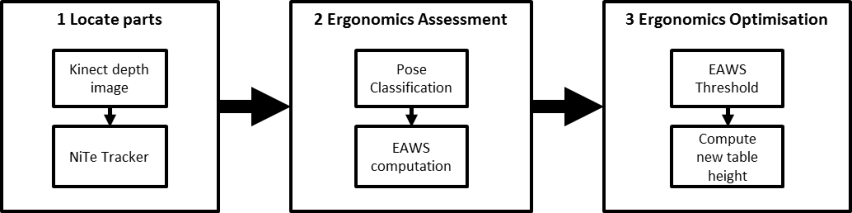
Figure 1. System workflow.
In this section we describe the components of our system and the workflow of the algorithms in detail. Information about a subject’s motion is acquired from a Microsoft Kinect sensor using the Primesense NiTE library. With the motion information, we classify the pose and compute an ergonomics score based on the “Basic Positions” section of the EAWS. Based on this score, our system decides whether measures for ergonomics optimisation of the working height become necessary by applying a threshold. In this case, the system computes the new height of the working table.
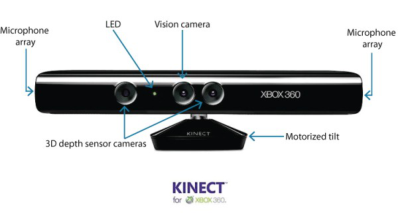
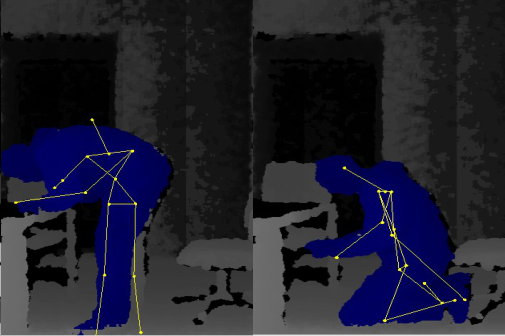
Marker-less motion capture using Microsoft Kinect sensor We use the Microsoft Kinect sensor to extract the 3D coordinates of the parts of the body. The Kinect is an integrated sensing system which unifies microphones, infrared (IR) camera, colour camera and depth camera (see Figure 2). Images from the depth camera contain 3D information where each pixel denotes the distance to the next visible point of the scene. Depth image generation is done by projecting an IR pattern onto the scene. The distortion of the projected pattern provides information about the 3D geometry of the scene. Since the IR pattern is invisible for the Kinect's colour cameras, there are no effects in the colour images. Thus, with the sensor, one can simultaneously acquire depth and colour images. There are several software libraries based on Kinect images which simplify application programming. One example is the Primesense NiTE middleware library from the OpenNI® framework, which we use in this project. The software is able to locate parts of the body in real time given a depth image from the Kinect. 3D positions of head, neck, shoulders, elbows, hands, torso centre, hips, knees and feet of multiple subjects can be tracked. A user calibration process is not necessary as the tracking of the parts of the body starts as soon as the subject moves. If every part of the body is clearly visible, the tracking works robustly even when motions are fast. However, if parts are occluded e.g. when the tracked person bents forward or kneels, the tracking can be distorted (see Figure 3 two right images). Joint positions jitter or coordinates computed are completely incorrect. Another problem is the low depth resolution of the Kinect-Sensor causing the tracking of hands to be lost if placed near the body. Objects in the subject's hands are interpreted as part of the subject, which can lead to incorrect estimations of hand positions. Generally, all moving objects are identified as subject to be tracked, even if they are not human.
Figure 2. The Microsoft Kinect Sensor.
Although Kinect tracking algorithms are normally designed to observe the subject from the front perspective, we choose to observe the subject from the side perspective. According to our experiments, tracking from this view appeared to be more robust when the subject bends forward. However, the tracking still fails if the subject adapts poses such as sitting or kneeling.
Figure 3. Body part tracking using NiTE. The two images left show a successful tracking of the body.
The two right images are examples where tracking fails.
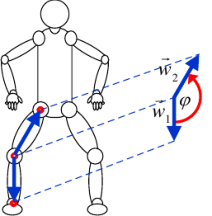
Pose classification The task of the pose classification component is to recognise the current working pose the subject adapts. The component gets as input 3D coordinates of the detected parts of the body in each frame. Using these coordinates, the component outputs the current pose. The classification routine first computes body angles between two neighbouring body segments from the coordinates (see Figure 4). This type of feature has the advantage that it is quickly computed and does not significantly vary among subjects with different anthropometrics. Also, observing the worker from a slightly different angle does not significantly change the feature. Furthermore, body angles are easily interpretable for humans. A drawback is that the accuracy of body angles heavily relies on accurate localisation of the parts of the body.
Since the angles are interpretable by humans, we choose a reference angle configuration for each pose which represents the pose. Classification is done by computing the euclidean distances between the computed angle configuration vector and the pose representatives. The pose whose representative has the smallest distance to the computed angle configuration is chosen as classification result. Since angles are not always accurate due to susceptible body tracking, we increase stability by summing up the distances over multiple frames and choose pose with minimum sum of distances. Manually evaluated EAWS only requires a time resolution of seconds. We choose to classify the pose every 0.5s which is about 15 frames.
Figure 4. Angles used for pose classification. Only the angles of the back and the right body half are shown.
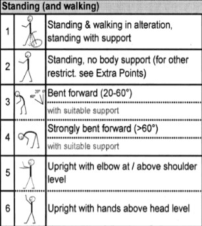
EAWS computation From the succession of poses acquired from our classification component, we compute an ergonomics score. Our score is based on the Ergonomics Assessment Worksheet (EAWS) by Schaub et al. (Schaub, 2012). EAWS consists of a worksheet to be filled out. A human expert observes a process and assigns load points when unfavourable loads occur. The higher the physical strain in the situation the more load points are given. Load points are assigned for: static working postures, action forces, load at material handling and upper limb load for repetitive tasks. The final score is computed by summing up all points. In the end, a traffic light scheme indicates whether measures are necessary given the computed ergonomics score. In this work, we concentrate on the “Basic Positions” section. The EAWS defines 15 working poses from which a user has to choose in every situation (see Figure 5). The load points depend on the fractions of the total process time the worker spends in each pose. The pose only counts into the load point computation when the subject remains in it for more than 4 seconds. Generally speaking, the higher the physical strain is when working in this pose and the higher the fraction of time spent in the pose, the higher the score. Since we intend to perform live ergonomics assessment, our system continuously updates the score. We have implemented two updating schemes: either assessment considers all poses from the beginning of recording or only the recent pose history contributes to the computation of the score.
Figure 5. Poses considered by EAWS (Schaub, 2013).
Ergonomics optimisation
Given the EAWS score, our system identifies situations when measures to improve ergonomics are necessary. In the particular context of our here presented approach we focus on ergonomics optimisation of the working table height. In these cases, the system computes the table height to improve ergonomics while working. Optimisation measures should be considered as rarely as possible in order to avoid frequent interruptions for the worker.
In our system, an optimisation move is initiated when the current EAWS score exceeds a pre-defined value. A drawback of this simple strategy is that it does not consider how long the worker is going to spend in the causing pose. Therefore, it can happen that the working table is adjusted even if the worker only remains a few moments in the pose. Frequent ineffective optimisation moves can be perceived as annoying.
If an optimisation move is initiated, the system has to compute the table height which enables the “ergonomically best” working condition. The algorithm first fetches the 3D positions of shoulder and hip on the body half facing the camera and the position of the highest hand. Additionally, we compute the back angle (alpha) and beta, the angle between the arm and chest (see Figure 6). The hand is considered as the point the user focuses on or will be working on. With adjusting the height of the table, this point is going to move either upwards or downwards. Our algorithm handles two cases: if the subject is bending forward when an optimisation move is initiated, the table height has to be raised in order to enable to work in an upright pose. In contrast, if at least one hand of the worker is located above heart level, this is an indicator that the focus point is too high. In that case, the table height has to be lowered. In both cases the computation of the optimal table height is based on different optimisation strategies.
In the case where the table is supposed to move up, the subject is assumed to be able to work in upright posture (alpha = 0°) after optimisation move. We first compute the distance between current shoulder position and hand position, which we call current “working distance”. We then compute the new position of the shoulder if the hip remains on the same place, but the back is upright. The optimal table height is the one where the new working distance is most similar to the old one, assuming upright working posture. We assume that the subject has consciously chosen the working height for a particular reason and the goal is only to minimise the back angle. Moreover, we add the side condition that the new hand position must still remain below shoulder level.
In the second case, we define an ideal beta as 45°. In an optimisation move, we search for the table height which minimises the absolute difference between new beta and ideal beta. The back angle alpha is supposed to remain the same since a subject who intends to reach higher points is probably standing upright to use the full body height.
Figure 6. Cases of optimisation. In the left image the table has to be moved up whereas in the right image the table is supposed to move down.
Figure available in the original PDF paper.
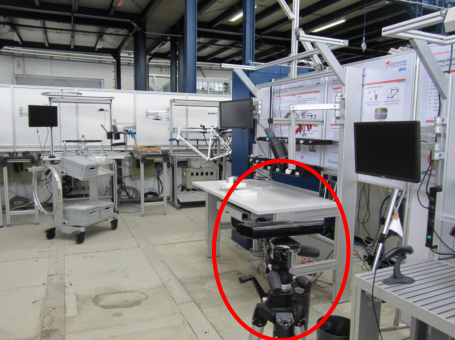
EXPERIMENTAL RESULTS We experimentally determined the performance of the system. The experiments were conducted at a research workplace in factory-hall like environment. The workplace includes a height-adjustable working table and boxes to store parts. At the workplace we position the Kinect sensor at about 3m distance to the table from side perspective. For the experiments, we choose 10 subjects with varying anthropometrics to perform working motions in different poses at the table.
Figure 7. Our experimental workplace. The Kinect sensor is marked by a red circle.
Ergonomics assessment In our first experiment, we intend to find out whether the system computes ergonomics scores comparable to human assessment. We recorded 11 subjects adapting standing poses from the EAWS in arbitrary order and for arbitrary durations between 6 and 10 seconds. These sequences were independently classified and assessed by 2 people. Manual classifications could only be done on the frames where the subject remains in a static pose. Frames between static poses where the subject moves from one pose to another were left out. We calculated EAWS score only on these frames. Comparisons with the automated ergonomics assessment system also only consider these frames.
The EAWS score in some datasets strongly deviates from manually calculated scores whereas the manually determined scores did not deviate significantly from each other. All scores computed were lower than the manually determined scores (see Figure 8 left). If we look at the pose classification results (see Figure 8 right) we can see that the algorithm confuses the poses 3 (bent forward), 4 (strongly bent forward), 5 (arms at shoulder level) and 6 (hands above head) with 2 (standing – arms below shoulder level), which has the lowest score among the poses we consider. The reason for these problems is that in these poses NiTE often fails to correctly locate the position of chest and hands. Moreover, the only difference between the poses 2 and 5 is the height of the arms. The nearer the arms are located at shoulder level the harder classification becomes – even for humans.
Right: Compare poses classified between manual (True pose) and automated classification (Classified pose). The color indicates the frequency of occurrence of the classified pair.
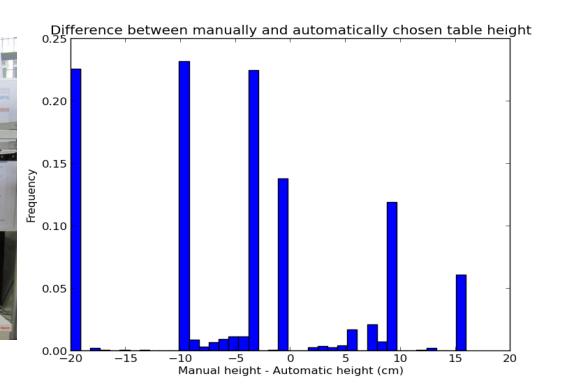
Ergonomics optimisation In the second experiment, we investigated the question whether the table height computed by our algorithm is similar to the one chosen by the subjects. We defined 3 focus points at the workplace (see Figure 9 left), where the subjects were asked to place their hands at. The subjects are told to imagine they would have to perform work at these points for several minutes without break. Based on this situation, they should adjust the table height, such that they can comfortably work. The maximum difference between old and new height was set to 20cm due to the physical the limits of the workplace. This height is compared to the one chosen by our algorithm (see Figure 9 right). In the results, we can see that in most cases, the difference between manually determined height and the height proposed by the system is about 5 – 10cm. There is a high peak at -20cm difference which means that the subjects intended to lower the table to the maximum value whereas our system proposed to keep the height. This problem occurs due to incorrect tracking of the hand. If the subject intends to lower the table, he or she probably works with hands at shoulder or even above head level. In these poses, the NiTE software often fails to track the hand estimating its location at hip level. Thus, the system does not consider readjustments of the table as necessary.
Figure 9. Left: The pre-defined focus points. Right: The distribution of manually determined height - optimal height proposed by our system.
CONCLUSIONS
We have proposed a system which assesses ergonomics at workplace in real-time. Based on the results of the ergonomics assessment, the system adjusts the height of a work table such that a worker is able to work in a comfortable pose. Our main contribution is to apply concepts known from factory planning in a real-time environment. Experiments have shown that the body part tracking routine is the most critical component in our system. Future work will include improving the pose estimation routine, and learning personal preferences considering table height from manual adjustments. Moreover, it can be interesting to investigate the optimal point of time when to perform an optimisation move in order to keep the number of interruption minimal.
ACKNOWLEDGEMENT
We gratefully acknowledge the funding of this work by the German Research Association (Deutsche Forschungs- gemeinschaft, DFG), Collaborative Research Center CRC1026 (Sonderforschungsbereich SFB1026).
REFERENCES
Badura, B., Schröder, H., Klose, J., & Macco, K. (2010). Fehlzeiten-Report 2009. Arbeit und Psyche: Belastungen reduzieren- Wohlbefinden fördern. Berlin, Heidelberg. Bley, H., Reinhart, G., Seliger, G., Bernardi, M., & Korne, T. (2004). Appropriate human involvement in assembly and
disassembly. CIRP Annals-Manufacturing Technology, 53(2), 487-509. Caputo, F., Giuseppe Di Gironimo, and Adelaide Marzano. Ergonomic optimization of a manufacturing system work cell in a virtual environment. Acta Polytechnica 46.5 (2006). Enomoto, A., Yamamoto, N., & Suzuki, T. (2013). Automatic estimation of the ergonomics parameters of assembly
operations. CIRP Annals-Manufacturing Technology, 62(1), 13-16. Härtel, T., Keil, A., Hoffmeyer, A., & Toledo Munoz, B. (2011, June). Capturing and Assessment of Human Motion during Manual Assembly Operation. In First International Symposium on Digital Human Modeling, Lyon, France. Ilmarinen, J., Tuomi, K., & Klockars, M. (1997). Changes in work ability of active employees over an 11-year
period. Scandinavian Journal of Work Environment and Health, 23(1), 49-57. Krüger, J., Lien, T. K., & Verl, A. (2009). Cooperation of human and machines in assembly lines. CIRP Annals-Manufacturing Technology, 58(2), 628-646. Lay, G., Schirrmeister, E., Wiendahl, H. P., & Röhrig, M. (2001). Zurück zu neuen Ufern, Rücknahme des
Automatisierungsniveaus in deutschen Unternehmen. Zeitschrift für wirtschaftlichen Fabrikbetrieb, 7, 8-2001. Lien, T. K., & Rasch, F. O. (2001). Hybrid automatic-manual assembly systems. CIRP Annals-Manufacturing Technology, 50(1), 21-24. Marzano, A., Agyapong-Kodua, K., & Ratchev, S. (2012). Virtual Ergonomics and Time Optimization of a Railway Coach
Assembly Line. Procedia CIRP, 3, 555-560. McAtamney, L., & Nigel Corlett, E. (1993). RULA: a survey method for the investigation of work-related upper limb disorders.
Applied ergonomics, 24(2), 91-99. Nguyen, T. D., Kleinsorge, M., Postawa, A., Wolf, K., Scheumann, R., Krüger, J. and Seliger, G. (2013). Human centric automation: Using marker-less motion capturing for ergonomics analysis and work assistance in manufacturing processes. Proceedings of the 11th Global Conference on Sustainable Manufacturing (GCSM) - Innovative Solutions, 586 - 592. Rabideau, G. F., & Luk, R. H. (1975, October). A Monte Carlo Algorithm for Workplace Optimization and Layout Planning-
WOLAP. In Proceedings of the Human Factors and Ergonomics Society Annual Meeting (Vol. 19, No. 2, pp. 187-192). SAGE Publications. Rasmussen, J., Damsgaard, M., Surma, E., Christensen, S. T., de Zee, M., & Vondrak, V. (2003, May). Anybody-a software system for ergonomic optimization. In Fifth World Congress on Structural and Multidisciplinary Optimization (Vol. 4). Rasmussen, J., Dahlquist, J., Damsgaard, M., de Zee, M., & Christensen, S. T. (2003, August). Musculoskeletal modeling as an
ergonomic design method. In International Ergonomics Association XVth Triennial Conference(pp. 24-29). Schaub, K., Caragnano, G., Britzke, B., & Bruder, R. (2013). The European assembly worksheet. Theoretical Issues in Ergonomics Science, 14(6), 616-639. Scott, G. B., & Lambe, N. R. (1996). Working practices in a perchery system, using the OVAKO Working posture Analysing
System (OWAS). Applied Ergonomics, 27(4), 281-284. Waters, T. R., Putz-Anderson, V., Garg, A., & Fine, L. J. (1993). Revised NIOSH equation for the design and evaluation of manual lifting tasks. Ergonomics, 36(7), 749-776. Winter, G., Schaub, K., & Landau, K. (2006). Stress screening procedure for the automotive industry: Development and
application of screening procedures in assembly and quality control. Occupational Ergonomics, 6(2), 107-120. Zhao, W., & Li, Q. (2009, December). Optimization of Surface Design Based on Energy Method and Ergonomics. In Information Engineering and Computer Science, 2009. ICIECS 2009. International Conference on (pp. 1-4). IEEE. Zhao, H., Zheng, G., & Wen, W. (2010, October). Human-machine posture prediction and working efficiency evaluation of virtual human using radial basis function neural network. In Intelligent Computing and Intelligent Systems (ICIS), 2010 IEEE International Conference on (Vol. 1, pp. 406-410). IEEE.
LISTED IN THE AHFE DIGITAL BOOKSTORE CATALOGUE
Explore the complete digital volume
Advances in Physical Ergonomics and Human Factors: Part I
Read this individual research paper free through the original publisher, or explore the full digital proceedings book.
ISBN 978-1-4951-2104-3
Explore this ISBN in the AHFE Bookstore ↗Listed in the July 2026 bookstore catalogue; search by ISBN to confirm current availability · Digital book purchase optional