Liu Yishuo, Liao Chen, Zhang Jingning (2018). Self-Adaptive Blur: A Persuasive Method for Healthy Posture. In: Advances in Physical Ergonomics and Human Factors: Part I. AHFE Open Access, vol. 1. https://doi.org/10.54941/10017
In this paper, we presented an interactive method named as Self-Adaptive Blur (SAB). By altering the sharpness of display according to the context, the SAB method was designed to prevent common discomforts of computer users by helping them maintain healthy posture. Based on previous pathophysiological studies, the causation of discomfort, mainly of neck and shoulder pain, was reviewed to select effective factors. A functioning prototype was developed using Microsoft Kinect and a desktop client program. The efficacy of our persuasive practice was examined by a series of experiments with the prototype. Objective records demonstrated the effectiveness of the SAB method, while subjective questionnaires and interviews revealed other instructive findings for further improvements.
Computer has become an irreplaceable tool for a population, such as office workers and college students. While the utilization kept keeps yielding benefits in efficiency and connectivity, the negative impact should not be ignored. Researchers in areas such as occupational health, physiology, and ergonomics have made advances in diagnosis, prevention and treatment of this issue.
Backgrounds – Survey, Pathophysiology and Persuasive Technology Discomforts caused indirectly by computer use threaten the health and performance of its user, though mild in most cases, the phenomena is common enough for attention. Some of the most common discomforts—back, neck and shoulder pain, have significant portion in the occupational health system. Despite the lack of universal data, several regional studies confirmed the causation. Among frequent computer users in Denmark , a questionnaire-based survey concluded that computer use is associated with a prevalence of neck and shoulder pain. A Finnish survey of Finns aged 30 and above reported that 9.5% of the men and 13.5% of the women have neck syndrome diagnosed via clinical examination. Other than the general-purpose study, some survey reported extremely negative impact among specific population. A 2003 study of office employee working with computer reported 34.4% as the annual incidence of neck pain, while a more recent study reported the number to be 45.5%. Similar to the latter one, a survey in Hong Kong found the prevalence of neck pain among university academic staff reached 46.7%, where the association with computer use was significant. Frequent computer use was also proved to be risky for adolescents.
Pathophysiological analysis was also included in most literature. Concerning specifically about neck and shoulder pain (NSP), the risk factors documented majorly come from three criteria: work related factors, personal characteristics, and environmental/psychological factors. As an example of the first criteria, kyphotic sitting posture, which means users put their head excessively forward, was a major cause of NSP for the extra and prolonged extension and stress to the musculoskeletal system. Gender plays an essential role in causing NSP, partly from the fact that most work environment was designed according to male, which resulted in inappropriate setting for female workers with generally smaller body. Mental stress level also affects the occurrence and degree of NSP by its impact on muscle tension.
Although massage and several therapeutic methods were tested to be effective in releasing the pain, completely curing NSP is not simple. Unfortunately, the efficacy of spine manipulation, as a major treatment of NSP, is not convincing enough. If the pain turns to be severe, for an example, nerve roots or cervical cord will be compressed, and further surgical process might be involved. In this case, prevention is the best solution to save people from the pain. Ergonomic improvements might be useful in solving the trouble by improving the working environment, especially for females. Physical exercise was also suggested by many professionals . Changing unhealthy habits can be beneficial for users, especially for those with sedentary jobs.
However, among the three factors in preventing discomforts, environmental settings may be restricted by external factors in practice, while physical exercise is largely dependent on people’s intention to activity. Thus, changing habits might be the primary and most practical choice for most users, since habit is totally controlled by users themselves, and additionally, has an impact on their physical exercise as well.
When it comes to alter people’s behavior, advances in persuasive technology offer an opportunity to discover solutions from a gentle and interactive view, rather than traditional therapeutic methods. Persuasive technology seeks to change people attitudes or behaviors via interactive persuasion, and includes neither coercion nor deception. Targeted behavior could be achieved by feedback at right time and appropriate place, where the continuity is guaranteed by ubiquitous computing. Ambient display is a preferable media to deliver necessary notifications, because of its unique strength in express information that people could be aware of but not focus on. Behavioral theory is necessary in supporting the design of persuasive practice. Factors associated with the performance of persuasion are suggested in several behavioral models, majorly include motivation, ability, and triggers. Individual expectation and evaluation and others’ judgments are also count in some practice. The persuasive technology theory has been examined and proved by some projects. And ambient display has enhanced the quality of care network for elderly in a healthcare prototype test, and showed its efficacy in the ambient sculpture project -- Breakaway, which was designed to remind computer users to stand up and have breaks. Chick Clique is a mobile app designed to promote teenage girls’ physical exercise by giving them more motivation with time reminders and peer pressure. Even life style transition was succeeded in a trial to form active gardening habits. The success of these pervasive technology projects confided the potential feasibility of deploying it in preventing discomforts related to computer use, which was an essence of our SAB project.
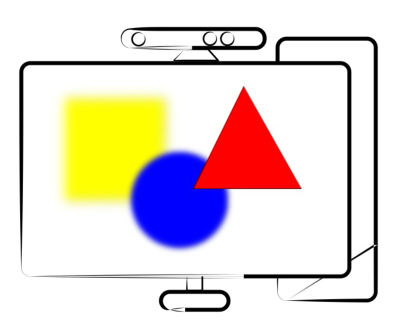
Self-Adaptive Blur (SAB): The Design The SAB method is a persuasive interaction designed to prevent neck and shoulder pains related to computer use. It follows a standard trilogy schema: input, process and output (feedback). The input module was designed to provide context awareness of the interaction, specifically, to capture posture data using gesture sensor. The processing module is simple: posture inference and alert level judgment, specifically, to calculate the relative distance of user head and shoulder in the depth axis and then generate the alert level signal if the distance exceeds a configured safe value. Then the output module changes the sharpness of the computer screen according to the alert level calculated. The entire interaction runs continuously and adaptively to the user sitting posture. Gaussian blur was selected as the feedback to construct a virtual three-dimensional recognition, which would inherently indicate the desired direction of user movement. This assumption was inspired by similar experiences while adjusting optical lens in photography – sharp images can be captured only if focused correctly.
Figure 1. Schema of a SAB system: 1) Depth sensor 2) Processor module 3) Monitor that would blur its display adaptively
It was proved and mentioned before that kyphotic posture is a main cause of NSP among computer users, and their tendency of putting head in an excessively forward position has led to musculoskeletal disorders. Therefore, if a therapy is able to keep their head in the normal zone, i.e. much backward than their current locations, the NSP might be successfully prevented. Current solutions following this idea generally fall into two categories: one is based on self-awareness and adjustment, and the other is to cure using physical tools. Self-control is not reliable, not to mention that many people are not aware of their unhealthy postures during work. However, the latter solution often appears in a rude yet inconvenient way, such as the desktop guardrail or the wearable elastic bandage system. From this point, SAB method would be a breakthrough to prevent the issue from happening due to its natural and gentle feedback. The interaction approach also gains it inherent portability – any computers will be able to feature the SAB method if they have the application installed and a depth-sensor. Though the current prototype captures the posture data using the Microsoft Kinect, the future version could be engaged with the pattern recognition method via a general video camera, which is now a standard feature for most devices. If the amendment succeeds, the portability would be even greater.
In this article, the background and related literatures are reviewed in the first chapter, followed by an illustration to the design of SAB method. The development of a prototype using this method is introduced in the third chapter, with a focus on an experiment design to test its effectiveness in maintaining healthy postures. Data analysis will conclude this article with insightful tips collected in interviews during the experiments.
RESEARCH METHOD In order to prove the method effectiveness in maintaining healthy postures, this research examined the relation between the method interference and the head position. If the causation were significant enough, then the SAB method would be effective in achieving its design purpose.
Independent Variables Risk factors for neck and shoulder pains related to computer use generally come from two categories: facility settings and task-related factors. Facility position is significant for its direct impact on user’s posture, which forms the spine and muscle during work. Position of the computer screen was documented in several articles as a significant role, the horizontal position, distance to user, height, tilt angle, and viewing angle were checked in related studies. Positions of keyboard and mouse also matter . Size of monitor and character on screen, as well as the dimensions of the table and chair have also been proven to have impacts. Task-related factors, whose nature affects user’s behavior pattern and mental status, basically include the task type. As to the meta type of tasks, reading, mousing (as an integration of visual searching and click), and typing were suggested to make a complete set for related studies.
Experiment Design A prototype has been developed for the experiments. The Microsoft Kinect for Windows was chosen as the depth sensor of the system. A Client program was developed using .Net framework. Participants could experience the SAB method within the Client window, which delivers the tasks, interaction and sharpness variation.
Task and feedback were the controlled independent variables. Feedback has two levels: with and without SAB method interference. As to the task, since mental stress was cited to play an important role during the process, and the experiment was time-limited, task was chosen to have users’ high concentration. Task includes three levels,
1) Reading: participants were asked to read a matrix of 100 (20 columns, 5 rows) repeated Chinese characters and to pick up the only one that is different from the rest. This special character would appear at a random position. For an example, a matrix composed by 99 “ 土”(Chinese character means “Earth”) and 1 “ 士”(Chinese character means “Scholar”) would be shown to one participant and he is asked to pick up “士” as quickly as possible.
2) Mousing Game: participants were asked to click colored squares that appear randomly (both location and duration) on the screen.
3) Typing: a news article was provided to participants who need to type it into the Client window.
Participants’ posture data and their subjective ratings were recorded separately to asset the performance. Kinect captured, inferred, and recorded the skeleton data automatically, and feedback questionnaire would be pushed to the Client window after each session was finished. On the staff’s side, the Client window with live video from the Kinect was recorded and saved as well. Some sessions were filmed by a cameraman in the lab as supplemental records, especially from the side view. Every participant was interviewed to generate some subjective comments on the SAB method and about their experience. Within-subject design was adopted for the experiment, thus each participant was required to finish six tasks in total.
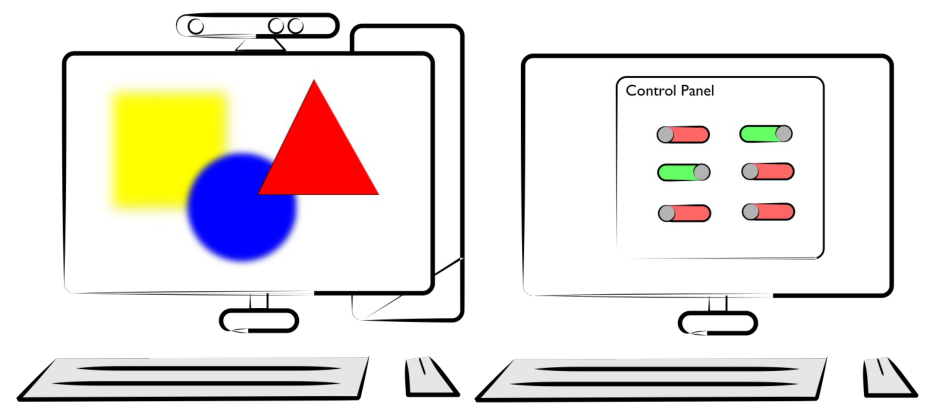
Apparatus The experiment was conducted in a HCI lab. Participants and two experimenters were seated on opposite sides of a table, face to face, but blocked by the computer screens. While both sides would operate on the same computer, each side was equipped with a 23-inch LCD widescreen monitor, paired with a set of wired keyboard and mouse. A Kinect sensor was mounted on the participant’s side to capture the skeleton data and video.
Figure 2. Apparatus of the lab experiment. Two monitors are connected to the same computer: the left one is for the participant: full-screen Client view, with the depth sensor mounted on top; the right one is for experimenter, with control panel setting the parameters. Each side is equipped with a pair of keyboard and mouse.
As mentioned, dimensions and positions are participant-specific and affect the tendency of experiencing neck and shoulder pain. To minimize this bias, participants were offered a 3-minutes allowance as warm-up. They were able to adjust all facilities to their best comfort, including the chair height and position, keyboard and mouse position, and the angle and position of the monitor.
RESULT & ANALYSIS In total, 30 participants were invited to our experiment. All of them were college students: both undergraduate and graduate were included, with a gender ratio of 19/11 (Male/Female). Considering the within-subject design—each participant needs to finish 6 different tasks and feedback questionnaires, the experiment was originally designed with replication level 5. However, the Kinect sensor occasionally failed during the experiments, and even under its well functioning, the skeleton detected would be interfered by exterior factors such as the participant’s dressing, which would result in some dirty data points. Some cases were unacceptable, thus we decided to filter the dataset according to its fidelity, and lower the replication to 4 (that is, to keep 24 records). Since the Kinect dataset contained the each data point’s status—“Detected”, “Inferred”, or “Untracked”, the filtration process was built entirely based on that record. After a weighted average calculation, the top 24 records with highest fidelity were kept for later analysis, while the rest (with uncertainty over 20%) were abandoned. The updated gender ratio for the new set was 15/9 (Male/Female).
The process of the experiment was recorded during multiple stages and ways. The first part is the raw skeleton dataset recorded by the Kinect sensor and an extended column for the alert level, which was a weighted average depth value of the original skeleton points—head, shoulder left, shoulder center, and shoulder right. After passing the normality test, a two-way ANOVA was conducted to examine alert level’s relation with “Task” and “Feedback”. Another one-way ANOVA test examined the gender’s impact on the alert level. Alert level was recorded continuously throughout the process, thus a time-average value was used to represent the level during each task.
As shown in the following summary, different tasks showed no significant influences under a confidence level of 0.95. However, the inclusion of the SAB method has shown a significant impact to the alert level. The interaction of these two factors was not significant, with p-value close to 1. Gender, as a risk factor documented in several previous studies, was not significant enough in our study.
Table 1: ANOVA Results Summary Two-way ANOVA: Alert Average versus Task, Feedback Source DF SS MS F P Task 2 646.9 323.44 2.21 0.114 Feedback 1 2199.9 2199.86 15.00 0.000 Interaction 2 0.4 0.19 0.00 0.999 Error 138 20241.8 146.68 Total 143 23088.9 One-way ANOVA: Alert Average versus Gender Source DF SS MS F P Gender 1 521 521 3.28 0.072 Error 142 22568 159 Total 143 23089 Individual 95% CIs For Mean Based on Pooled StDev Level N Mean StDev ---+---------+---------+---------+------ F 54 13.25 14.44 (-------------*-------------) M 90 9.32 11.38 (---------*----------)
The second part of the dataset came from the subjective questionnaires, which include 5 general-purpose questions and 3 SAB-specified questions. Each question was rated from 1 to 5 after every task session of 3 minutes. All questions and their basic statistics were listed as below in Table 2. Result showed relatively high perceived mental and physical concentration (Q1 & Q2) during the task. Combined with their mildly high perceived burden (Q4 & Q5), the task design fulfilled its requirement in this criterion. Participants’ self-awareness (Q3) was mildly low about their posture issue, especially when compared with their alert level records (with mean of 10.79, median 6.71, SD 12.71, ranging from 0 to 56.02; alert level value greater than 0 means unhealthy posture). When it came to participants’ experience of the SAB method, the results yielded both positive and negative results. Low annoying rate (Q8) proved its potential popularity with its gentle experience. But the mildly low scores of Q6 and Q7 indicated that the ambient display method also delivered ambiguous notifications to the user. Ambiguity undermines the intuitiveness.
Table 2: Subjective Questionnaire Content & Basic Statistics Q1 Concentration during this task? Q2 Visually focused on the monitor during this task? Q3 Aware of unhealthy posture during this task? Q4 Mentally exhausted after this task? Q5 Physically exhausted after this task? Q6 Realized my unhealthy posture with the appearance of the blur? Q7 Realized the suggested adjusting direction with the blur level? Q8 Annoyed by the blur during this task? Descriptive Statistics: Q1, Q2, Q3, Q4, Q5, Q6, Q7, Q8 Total Variable Count Mean SE Mean StDev Q1 Median Q3 Range Q1 144 4.632 0.047 0.564 4.000 5.000 5.000 3.000 Q2 144 4.333 0.090 1.084 4.000 5.000 5.000 4.000 Q3 144 2.972 0.088 1.057 2.000 3.000 4.000 4.000 Q4 144 3.181 0.095 1.145 2.000 3.000 4.000 4.000 Q5 144 3.174 0.095 1.136 2.000 3.000 4.000 4.000 Q6 144 2.069 0.182 2.186 0.000 0.500 4.000 5.000 Q7 144 2.021 0.179 2.147 0.000 0.500 4.000 5.000 Q8 144 1.396 0.139 1.669 0.000 0.500 3.000 5.000
Table available in the original PDF paper.
A series of two-way ANOVA was conducted to the five general-purpose questions (Q1 to Q5), and one-way ANOVA to the three SAB-specific questions (Q6 to Q8). Results showed that task was a significant factor for participants’ perceived visual concentration (Q2) and mental burden (Q4), while insignificant to the rest six questions. Feedback showed no significant associations with any of the general-purposed questions.
The third part of our dataset was the follow-up interview after all tasks were finished. The interview contained two standard questions and three open questions. According to the record, all 30 participants reported experience of neck and shoulder pain related to computer usage in their daily life, and all expressed their expectation of computers’ actively preventing that issue. Participants also gave their comments about their SAB experience in the open questions. Generally, SAB won their favor by its gentle expression—positive preference and perceived effectiveness. However, the detection accuracy of the depth sensor confused some subjects, while others commented the sensitivity.
CONCLUSIONS AND PROSPECT In this article, we have presented the philosophy and design of the SAB method. A series of experiments was conducted to examine whether it reaches its purposes. As supported by the quantitative and qualitative evidence, we could conclude that the SAB method has initially proven its efficacy of maintaining user’s healthy sitting posture, and the persuasive approach has won their favor. Almost all participants expressed their appreciation of the SAB design and its experience. About 1/3 of the participants also showed their interests in a color-variation notification, which was a designed yet not prepared for test feature other than the sharpness-variation.
Improvements to the current prototype, however, should not be ignored. As a practice following the persuasive approach, the SAB method also has three challenges: intelligence quality, long-term performance, and ethical issue. The intelligence quality caused several problems. While the sensitivity issue can be solved by a calibration before deploying the method, the detection accuracy relies greatly on the capability of the Kinect, both of its hardware and the pattern recognition algorithm. Long-term performance is essential in further studies to prove its efficacy, which might call for larger and longer experiments. As to the interaction design, intuitiveness remains to be improved by further understanding human behavior patterns and the persuasion process.
In our future work, we will refine the interaction and algorithms to enhance its effectiveness and deliver the state-of- art experience.
REFERENCES
Brandt, L. P., Andersen, J. H., Lassen, C. F., Kryger, A., Overgaard, E., Vilstrup, I., & Mikkelsen, S. (2004). Neck and shoulder symptoms and disorders among Danish computer workers. Scandinavian journal of work, environment & health, 30(5), 399-409. Cagnie, B., Danneels, L., Van Tiggelen, D., De Loose, V., & Cambier, D. (2007). Individual and work related risk
factors for neck pain among office workers: a cross sectional study. European Spine Journal, 16(5), 679- 686. Chiu, T., Ku, W., Lee, M., Sum, W., Wan, M., Wong, C., & Yuen, C. (2002). A study on the prevalence of and risk factors for neck pain among university academic staff in Hong Kong. Journal of occupational rehabilitation, 12(2), 77-91. Consolvo, S., McDonald, D. W., & Landay, J. A. (2009). Theory-driven design strategies for technologies that
support behavior change in everyday life. Paper presented at the Proceedings of the SIGCHI Conference on Human Factors in Computing Systems. Consolvo, S., Roessler, P., & Shelton, B. E. (2004). The CareNet display: lessons learned from an in home evaluation of an ambient display UbiComp 2004: Ubiquitous Computing (pp. 1-17): Springer. Fogg, B. (2009). A behavior model for persuasive design. Paper presented at the Proceedings of the 4th international
conference on persuasive technology. Fogg, B. J. (2002). Persuasive technology: using computers to change what we think and do. Ubiquity, 2002(December), 5. Froehlich, J., Findlater, L., & Landay, J. (2010). The design of eco-feedback technology. Paper presented at the
Proceedings of the SIGCHI Conference on Human Factors in Computing Systems. Hakala, P. T., Rimpelä, A. H., Saarni, L. A., & Salminen, J. J. (2006). Frequent computer-related activities increase the risk of neck–shoulder and low back pain in adolescents. The European Journal of Public Health, 16(5), 536-541. Harrison, D. E., Harrison, D. D., Janik, T. J., William Jones, E., Cailliet, R., & Normand, M. (2001). Comparison of
axial and flexural stresses in lordosis and three buckled configurations of the cervical spine. Clinical Biomechanics, 16(4), 276-284. Hawkins, R. J., Bilco, T., & Bonutti, P. (1990). Cervical spine and shoulder pain. Clinical orthopaedics and related research, 258, 142-146. IJsselsteijn, W., de Kort, Y., Midden, C., Eggen, B., & van den Hoven, E. (2006). Persuasive technology for human
well-being: setting the scene Persuasive technology (pp. 1-5): Springer. Intille, S. S. (2004). A new research challenge: persuasive technology to motivate healthy aging. Information Technology in Biomedicine, IEEE Transactions on, 8(3), 235-237.
Jafarinaimi, N., Forlizzi, J., Hurst, A., & Zimmerman, J. (2005). Breakaway: an ambient display designed to change human behavior. Paper presented at the CHI'05 extended abstracts on Human factors in computing systems. Koes, B., Assendelft, W., Van der Heijden, G., Bouter, L., & Knipschild, P. (1991). Spinal manipulation and
mobilisation for back and neck pain: a blinded review. BMJ: British Medical Journal, 303(6813), 1298. Korhonen, T., Ketola, R., Toivonen, R., Luukkonen, R., Häkkänen, M., & Viikari-Juntura, E. (2003). Work related and individual predictors for incident neck pain among office employees working with video display units. Occupational and environmental medicine, 60(7), 475-482. Mäkela, M., Heliövaara, M., Sievers, K., Impivaara, O., Knekt, P., & Aromaa, A. (1991). Prevalence, determinants,
and consequences of chronic neck pain in Finland. American journal of epidemiology, 134(11), 1356-1367. Ming, Z., Närhi, M., & Siivola, J. (2004). Neck and shoulder pain related to computer use. Pathophysiology, 11(1), 51-56. Picavet, H., & Schouten, J. (2003). Musculoskeletal pain in the Netherlands: prevalences, consequences and risk
groups, the DMC3-study. Pain, 102(1), 167-178. Pousman, Z., & Stasko, J. (2006). A taxonomy of ambient information systems: four patterns of design. Paper presented at the Proceedings of the working conference on Advanced visual interfaces. Rempel, D., Willms, K., Anshel, J., Jaschinski, W., & Sheedy, J. (2007). The effects of visual display distance on
eye accommodation, head posture, and vision and neck symptoms. Human Factors: The Journal of the Human Factors and Ergonomics Society, 49(5), 830-838. Shin, G., & Zhu, X. (2011). User discomfort, work posture and muscle activity while using a touchscreen in a desktop PC setting. Ergonomics, 54(8), 733-744. Sommerich, C. M., Joines, S. M., & Psihogios, J. P. (2001). Effects of computer monitor viewing angle and related
factors on strain, performance, and preference outcomes. Human Factors: The Journal of the Human Factors and Ergonomics Society, 43(1), 39-55. Szeto, G. P., & Sham, K. S. (2008). The effects of angled positions of computer display screen on muscle activities of the neck–shoulder stabilizers. International Journal of Industrial Ergonomics, 38(1), 9-17. Toscos, T., Faber, A., An, S., & Gandhi, M. P. (2006). Chick clique: persuasive technology to motivate teenage girls
to exercise. Paper presented at the CHI'06 extended abstracts on Human factors in computing systems. Ylinen, J., Takala, E.-P., Nykänen, M., Häkkinen, A., Mälkiä, E., Pohjolainen, T., . . . Airaksinen, O. (2003). Active neck muscle training in the treatment of chronic neck pain in women: a randomized controlled trial. Jama, 289(19), 2509-2516.
LISTED IN THE AHFE DIGITAL BOOKSTORE CATALOGUE
Explore the complete digital volume
Advances in Physical Ergonomics and Human Factors: Part I
Read this individual research paper free through the original publisher, or explore the full digital proceedings book.
ISBN 978-1-4951-2104-3
Explore this ISBN in the AHFE Bookstore ↗Listed in the July 2026 bookstore catalogue; search by ISBN to confirm current availability · Digital book purchase optional