Adam Górny (2020). Occupational Risk In Improving The Quality Of Working Conditions. In: Advances in Social and Organizational Factors. AHFE Open Access, vol. 9. https://doi.org/10.54941/ahfe100327
Adherence to the systemic approach to improving working conditions is increasingly becoming a central prerequisite for the successful operation of business organizations. By adopting systemic principles to improve the quality of working conditions, organizations gain access to effective tools for eliminating hazards and strenuousness and consequently acquire the ability to grow and improve themselves. Any measures adopted within that framework are undertaken in recognition of the roles and tasks of employees seen as the internal clients of specific processes.The article demonstrates that improvements can be achieved by assessing risks. In this context, risk assessment is viewed as a tool for gathering information on irregularities. By assessing risks, businesses can identify any hazardous, deleterious and strenuous factors which require improvement (through corrective and preventive measures) and whose scope and characteristics depend on the level of occupational risk. The use of occupational risk as a criterion for selecting improvement measures helps identify adequate technical means and organizational arrangements to be applied to bring the working environment to the required quality standard. In particular cases, such means and arrangements should be complemented by using personal protection items. An essential consideration in improving working conditions is to incorporate any selected elements of the systemic approach that are critical for shaping the working environment. Only then will the proper improvement measures be effective.
As the environment in which business organizations operate evolves, enterprises are constantly forced to improve their work processes. To that end, they increasingly rely on the systemic approach which entails searching for opportunities to improve quality in various areas of operation. One of their common focal areas is the quality of working conditions. The system developed for this purpose can be equated with one based on the principles of quality management. Its central focus is to fulfill criteria for the achievement of customer satisfaction (Górny, 2011).
In view of the way in which such a system operates and the nature of work processes pursued by business organizations, the system’s clients are the organization’s employees who may well considered internal. If such internal clients are to be recognized as critical for the efficient operation of an enterprise, they must be treated as verifiers of continuous improvement (Arsovski and Arsovski 2012; Thompson and Strickland, 2003). Such clients must evaluate their organization’s improvement efforts in terms of their impact on ongoing processes and various aspects of working conditions, some of the most common of which are occupational safety, hygiene, health and ergonomics.
To accomplish such goals, an organization needs to acquire tools to identify areas for improvement, select improvement measures and define the scope of such efforts and any related prerequisites. As it turns out, the necessary improvement measures may well be identified with the use of tools for assessing the occupational risks involved in performing work. Their application determines the methods adopted to conduct improvement measures.
THE ESSENCE OF IMPROVEMENTS IN QUALITY AND WORKING CONDITIONS In its essence, the systemic approach involves pursuing all required actions in an orderly fashion in keeping with the expectations of all concerned parties. In the particular case of the quality of working conditions, the systemic approach focuses essentially on ensuring worker safety and protecting their health. Occupational safety may be seen as affecting an enterprise’s working efficiency and its ability to grow by means of structured actions undertaken in all areas of its operation (Jasiulewicz-Kaczmarek, 2013; Mrugalska, 2013).
To gain the ability to satisfy client needs and expectations, an enterprise needs to create an environment which will allow and promote work efficiency. To that end, businesses need to recognize their internal clients who see quality, viewed as conditions which allow them to perform work, is a key criterion for assessing compliance with system requirements.
To undertake improvement efforts in the systemic approach, enterprises must revise their procedures and create conditions to support the achievement of the level of safety (worker protection) desired by the stakeholders and ensure that work proceeds appropriately. Systemic procedural documents (working procedures and manuals) affect the outcomes of such efforts and, as a consequence, determine the ultimate quality of working conditions. The effectiveness of such efforts bears on the ability to eliminate any hazards and strains and mitigate the associated risks. In the process, enterprises create conditions for the effective hazard-free performance of work which in turn allows them to build the working environment conditions desired by their internal clients.
The requirements which underlie systemic client-orientation apply to client needs and expectations pertaining to links between the client and the working environment. Some of the crucial factors which allow an organization to achieve the desired status include (Górny, 2011): – care and responsibility for worker health and safety displayed by the management and all other concerned parties,
– identifying any applicable legal requirements and standards, – identifying and assessing the potential impact of processes and actions on worker health and safety.
Organizations which shape their working conditions in the above manner may well be considered innovative. Although the method is based partly on well-tested guidelines for the systemic approach to working conditions, it goes well beyond the traditional systemic arrangements for managing sole areas of companies’ activity in line with integrated system guidelines (ILO-OSH 2001; Górny, 2011).
To ensure a modern approach to the quality of the working environment, organizations need to engage in efforts which drive such quality. Specifically, they should: – formulate a corporate strategy designed to achieve the desired quality of the working environment and, consequently, meet the expectations of the labor force and other stakeholders, as the organization’s top priority,
– secure any means necessary to achieve the desired state of the working environment, – translate their strategy for achieving the desired quality of working conditions into technical and organizational specifications with a view to satisfying the needs of all individuals involved in work processes,
– recognize that responsibility for ensuring the desired quality of working conditions rests with all workers regardless of their function and responsibilities, – assign responsibility for shaping the quality of the working environment to all individuals all across the board from decision-makers down to rank and file employees, rather than exclusively services and persons nominally responsible for ensuring proper working conditions,
– have all responsible individuals accept their assigned duties, – ensure that employees are motivated to make a continuous effort to improve the working environment and secure ever better working conditions,
– recognize that the responsibility for satisfying requirements rests with all member of the organization.
The effort to ensure working conditions may be associated with the concept of total quality management whereby success in an organization’s business depends mainly on the coordination of its human and physical resources (Górny and Grzybowski, 2007). To make this happen, businesses should build mechanisms for the development of structures and identify tools to effectively assess the current state. A primary role in all such efforts is played by factors in the working environment (Gołaś and Mazur, 2008). A secondary job is to secure instruments for improving the existing status by identifying areas for improvement and areas which can potentially be modified.
OCCUPATIONAL RISK IN IMPROVING THE QUALITY OF WORKING CONDITIONS Occupational risk as indicator of irregularities
Occupational risk may be described in various ways depending on the specific characteristics of the field in which it has been identified (Górny and Lech, 2003; Górny and Jasiak, 2006). However, such risk is always associated with the occurrence of hazards and strenuousness in the working environment and with prospective losses. Owing to its nature, occupational risk is linked inextricably with the human factor. When making improvements, due care needs to be taken to consider the workers (the human factor) and the possibility of hazards and/or strenuousness occurring as a result of the state of the working environment.
A study of factors behind occupational risks has identified two key considerations which are (Guidance…, 1996; 89/391/EEC, PN-N-18002): – losses, i.e. possible consequences defined as the severity of injuries caused by hazard-related factors and their extent expressed as the number of affected employees who may suffer health issues precipitated by the event,
– the probability of losses, which is a function of the probability of occurrence of a loss-triggering event, the frequency of exposures to hazards, the capacity to eliminate hazards, the ability to reduce losses by applying available loss-mitigation means, the way in which an organization becomes aware of the risks, the knowledge and experience of employees, etc.
Defined as above, risk may be described by means of the following formula (Guidance…, 1996; 89/391/EEC, PN- N-18002):
RISK = function (LOSS; PROBABILITY OF LOSS)
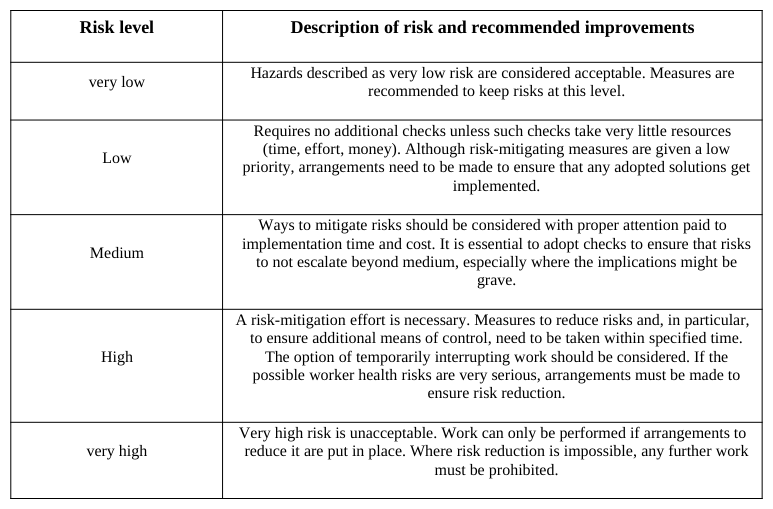
Occupational risk may be viewed as an indicator of irregularities which combines assessments of the degree of losses (disease, injuries or strenuousness) and the probability of occurrence of a given effect. Once identified in this manner, risk serves as an indicator of the impact of hazards as well as a consideration taken into account in decisions to undertake specific improvement measures. Descriptions of desired improvements to be made in response to specific risk levels have been provided in Table 1.
Table 1: Risk levels and recommended measures designed to improve the working environment (BS
An essential consideration in adopting improvement measures is to recognize that occupational risk assessments reveal irregularities and suggest the need to take action to eliminate them. Using occupational risk solely for insights into the existing status adds no value to the company and will not contribute to improving the quality of working conditions. This would reduce occupational risk assessment to a tool for merely describing the status quo rather than a driver of growth.
Occupational risk in hazard elimination
To take proper systemic action to improve the quality of working conditions, an organization needs to account for all significant legal and normative criteria which affect the decisions of its top management (Guidance…, 1996). This principle should be seen as equivalent to actions taken in any other area in which the systemic approach has been adopted. As part of the systemic approach, organizations need to employ any resources needed to achieve the desired improvement.
Based on the quality requirements which account for selected requirement areas, businesses may identify the need to have their top managements adhere to principles concerning the working environment, infrastructure, cooperation with suppliers and other business partners as well as care for natural resources (Górny, 2011).
An assessment of occupational risks arising in specific working environment provides information on the need to (Górny and Grzybowski, 2007): – satisfy workstation design requirements,
– ensure that principles governing technical and organizational changes adopted to minimize hazards are used effectively, – arrange employee recruitment processes with proper account taken of occupational risk assessment results,
– arrange occupational risk assessment processes by adopting related mandatory procedures or manuals to be followed within the organization,
– take advantage of worker dedication to assessing occupational risk and properly apply the findings of such assessments, – ensure that occupational risk assessments account for work methods and outcomes,
– ensure that occupational safety considerations are incorporated into the purchasing specifications stipulated in trade agreements, – ensure that any corrective and preventive measures rely on the results of occupational risk assessments and on analyses of their impact on risk levels.
Legislative acts and legislation-derived systemic criteria call for measures designed to mitigate risks and improve occupational safety. In the systemic approach, such duties entail an obligation to ensure continuous improvement. The pivotal measures in this field include (Mazur, 2009; Górny, 2011): – training in occupational health and safety and ergonomic requirements pertaining to specific workstations and the overall working environment,
– the acquisition, through proper training, of any required professional qualifications, competencies and knowledge on work organization at specific workstations with adequate account taken of technical and organizational requirements recognizing the needs of human operators, – ensuring efficient and effective flows of information on safety requirements in the working environment,
– ensuring the use of effective employee health checkup methods to assess fitness for work so as to screen out individuals whose health condition may pose risks and/or contribute to aggravating hazards, – ensuring safety in the performance of dangerous jobs, i.e. jobs where risks approach unacceptable levels,
– ensuring effective supervision over the working environment and the technical equipment in the place of employment, particularly equipment which may cause hazards, injuries and accidents leading to absences from work, – defining rules of procedure to be followed in circumstances which may lead to accidents, occupational diseases and near misses.
The specific activities and tasks performed by organizations correspond to actions designed to improve the working environment. The scope of actions and the relationships they cover result from occupational risk assessments. Among the key efforts to improve the quality of the working environment is risk avoidance by applying technical solutions, technical machinery and equipment, materials and organizational work arrangements which pose no threat to employees and other persons who might enter the work area and the impact range of technical equipment (Gołaś and Mazur, 2008; Górny, 2011; Guidance…, 1996, Mrugalska, 2013). The need for such actions follows from their significance for the level of occupational safety, for ensuring proper supervision over the operation of technical equipment and for the extent of damage caused by improper operation of technical machinery and equipment.
The results of occupational risk assessments provide the information necessary to take (plan and carry out) appropriate corrective and preventive measures. Based on evaluations of the effects of actions and the extent to which actions contribute to working environment improvements, organizations choose the most fitting workstation equipment and work organization arrangements. By employing state-of-the-art solutions in their work systems, businesses mitigate the adverse impacts of hazards on safety levels and, as a consequence, improve working conditions. Working environment improvements must be achieved in all areas considered to be priority for business operations and all areas which affect improvements in the quality of the working environment.
Impact of occupational risk on the improvement of working conditions
The level of occupational risk should be seen as a criterion for defining the requirements which best ensure effective performance of work. Any incompliance would then signal a need for improvement. The development of optimal working environments by adopting solutions on the basis of risk assessment findings covers both the human as well as physical factors which are associated with creative work methods and which allow organizations to utilize their full potential (Arsovski and Arsovski, 2012).
The goal behind eliminating hazards by means of occupational risk assessments is to rule out or reduce the impact of factors which are: – dangerous and lead to injuries,
– deleterious and constitute a cause of work-related health conditions, – strenuous and cause working discomfort.
Regardless of the specific nature of individual hazards, their elimination is fundamental for improving the working environment.
A company's growth vision may rest on the commitment of its management to adopt and deploy measures aimed at achieving the organization’s safety goals so as to ensure occupational safety and hygiene for workers and protect their health. Associated closely with guidelines derived from the assessment of risks, such measures should allow companies to (Guidance…, 1996, 89/391/EEC): – design their actions on the precept that the top management carries ultimate responsibility for the end result – the scope of such actions should be designed to help ensure improvement in worker safety,
– develop a strategy and internal-client orientation aimed at satisfying the needs of internal clients with respect of working conditions, – adopt a process management system combined with elements of the continuous improvement approach to ensure sustainable success in efforts aimed at improving working conditions and the quality of the working environment,
– employ advanced managerial improvement tools and techniques suited to the organization’s needs to identify and eliminate irregularities in occupational safety arrangements, – improve employee competencies,
– build a safety culture to boost occupational safety.
When introducing control measures and reflecting on the need to modify any existing protections, it is critical to consider the option of applying technical solutions. Only after such solutions are found to be ineffective (or rather inapplicable), is it justified to resort to other types of protections (89/391/EEC). These include procedural solutions and individual protection items.
Improvement measures pursued in the systemic approach are shown in Figure 1.
START Quality of working conditions described as
level of occupational risk Identify risk factors
Assess the need for improvements
Choose adequate improvement measures (aligned with systemic approach)
Are the selected NO
measures aligned with the
systemic approach?
YES Apply technical measures/solutions
Do the
Apply organizational arrangements to NO
measures taken ensure
complement technical measures
the achievement of adequate working environment YES standard? Do the
Apply personal protection items to complement technical NO measures & organizational
measures taken ensure
arrangements
the achievement of adequate working environment YES standard? Do the
YES measures taken ensure
NO the achievement of adequate
Assess the impact of the measures taken on the
working environment
quality of the working environment
standard?
STOP
Working environment quality described by occupational risk levels after the completion of improvement measures
Figure 1. Flowchart depicting measures designed to improve the quality of the working environment. (Author's work)
Figure available in the original PDF paper.
IMPROVEMENT IN THE QUALITY OF WORKING CONDITIONS BASED ON OCCUPATIONAL RISK In order to successfully improve the working environment in all of its quality aspects, it is crucial to rely on continuous improvement measures and arrangements. This applies in particular to systemic solutions designed for areas which are pivotal for ensuring the safe and effective performance of work. Such areas comprise, in particular, any criteria pertaining to the working environment which need to be incorporated into safety guidelines. The criteria include (ISO 9001, ISO 9004):
– the use of protective items to satisfy significant hazard protection criteria and allow workers to perform work, – compliance with ergonomic requirements at workstations – this includes facilitating comfort and safety for all worker groups,
– proper choice of workstation location with account taken of social implications, – recognition of conclusions from hygienic inspections concerning temperature, humidity, lighting, noise, vibration and air pollution in the working space.
Other requirements of equal significance for workers’ ability to perform work in a given organization include the necessary production infrastructure comprised of working space, tools, machinery and equipment, support services, ITC and moving equipment (ISO 9001, ISO 9004). Assessments of worker’s ability to work efficiently and of the quality of working conditions resulting from infrastructure improvements should be focused primarily on technical measures.
When assessing the technical solutions an organization has put in place, attention needs to be paid to their usefulness and availability and specifically to the scope of functionalities, specifications, cost of deployment, operation and disposal, environmental impact and conformity with safety requirements. To improve working conditions, an enterprise needs to undertake actions which will allow it to effectively carry out tasks and shape as well as oversee its working environment with proper account taken of safety requirements while mitigating hazard levels.
To respect working environment requirements which form part of their systemic enterprise management approach, organizations need to incorporate them into their existing enterprise management system. Such incorporation may serve as a starting point for developing an integrated management system. Occupational risk management would then become a part of the system and, as such, require that enterprises take action in various fields of their operation.
When seeking to improve the quality of the working environment in a systemic manner, it is vital to take preemptive actions to achieve absolute safety by adopting the required safety standards (Górny, 2011; Górny, 2012). Such actions require a prior detailed formulation of an action plan and identifying an adequate scope for such actions. The effort should allow enterprises to (89/391/EEC; Górny, 2011): – prevent on-the-job accidents and occupational diseases,
– seek to continuously improve their working conditions, – comply with legal requirements and worker expectations with respect of working conditions,
– ensure the resources and means needed to allow the organizations to achieve the required safety level, – improve the professional/vocational qualifications of the workers with respect to safety to allow for the safe performance of work,
– recognize the significance of worker contributions to efforts to raise safety levels, – reduce accident rates and, in effect, improve the organization’s financial standing.
Organizations need to realize that a proper recognition of such outcomes in evaluating the benefits of solutions adopted in keeping with occupational risk assessment findings is necessary for shaping working environment quality in a systemic manner.
CONCLUSIONS
Occupational risk assessments should be seen as an integral part of the working conditions improvement system. By incorporating occupational risk assessment findings into the working conditions improvement scheme, enterprises can identify key issues for the specific jobs performed in their organizations.
By adopting and effectively deploying adequate solutions suggested on the basis of an occupational risk assessment, businesses gain the ability to: – improve their occupational safety and, as a consequence, improve their accident standings (measured as the total number of accidents and cases of occupational disease relative to the total headcount or man-hours),
– gain an ability to make continuous improvements, particularly in occupational safety levels defined as continuous steady reductions of occupational risk, – satisfy legislative requirements and meet any unwritten rules formulated by workers as an expression of their desires,
– improve worker qualifications, in particular with respect to occupational safety and worker’s ability to perform work efficiently, – boost the dedication of the management to efforts aimed at improving occupational safety.
The above actions should be seen as a starting point for further improvement efforts made with an eye to increasing the social engagement of organizations in the community in which they operate. Such a role is associated with responsibility towards all stakeholders. By identifying and overseeing the actual impact of their efforts on man (the workers they employ), organizations can evaluate workers’ ability to perform work and accept the existing level of hazardousness as well as the risks associated therewith.
REFERENCES
Arsovski, S., Arsovski, Z. (2012), “Management’s challenge for Quality improvement”, in: Challenges of quality management, Sikora, T., Nowicki, P. (Eds.), Cracow: Cracow University of Economics, pp. 11-30). BS 8800:2004, Occupational health and safety management. Guide, BSi, London. Council Directive 89/391/EEC of 12 June 1989 on the introduction of measures to encourage improvements in the safety and
health of workers at work; OJ L 183, 29/06/1989, p. 1-8, with amended. EN ISO 9001:2008, Quality management systems. Requirements (ISO 9001:2008), CEN, Brussels. EN ISO 9004:2009, Managing for the sustained success of an organization. A quality management approach (ISO 9004:2009), CEN, Brussels. Gołaś, H., Mazur, A. (2008), “Macroergonomic aspects of a quality management system”, in: Macroergonomic paradigms of
Management, Jasiak, A. (Ed.), Poznan: Publishing House of Poznan University of Technology, pp. 161-170. Górny, A. (2011), “The Elements of Work Environment in the Improvement Process of Quality Management System Structure”, in: Advances in Human Factors, Ergonomics, and Safety in Manufacturing and Service Industries, Karwowski, W., Salvendy, G. (Eds.), Boca Raton: CRC Press, Taylor & Francis Group, pp. 599-606. Górny, A. (2012), “Ergonomics in the formation of work condition quality”, Work: A Jour nal of Prevention, Assessment and Rehabilitation, 1 (supp. 1), 1708-1711. Górny, A., Grzybowski, W. (2007), “The residual risk level as the indicator of quality working condition”, in: Ergonomics in
Contemporary Enterprise, Pacholski, L. M., Trzcieliński, S. (Eds.), Madison: International Ergonomics Association Press, pp. 101-104. Górny, A., Jasiak, A. (2006), “Application of residual risk for assuring quality working condition”, in: Pikaar, R.N., Koningsveld, E.A.P., Seattels, P.J.M. (Eds.), Proceedings of the 16th World Congress on Ergonomics (IEA 2006 Congress: „Meeting Diversity in Ergonomics”), Elsevier Ltd., part 0484 (CD-ROM).
Górny, A., Lech, S. (2003), “The occupational risk assessment as defines element of safety standards”, in: Proceedings of the 35th Annual Congress of the Nordic Ergonomics Society „Mind and Body in Technological World”, Reykjavík, pp. 149- 152. Guidance on risk assessment at work (1996), Luxembourg: Office for Official Publications of the European Communities. ILO-OSH 2001, Guidelines on occupational safety and health management systems, International Labor Organization, Geneva. Jasiulewicz-Kaczmarek, M. (2013), “The role of ergonomics in implementation of the social aspect of sustainability, illustrated
with the example of maintenance”, in: Occupational Safety and Hygiene, Arezes, P., et al (Eds.), London: CRC Press, Taylor and Francis, pp 47-52. Mazur, A. (2009), “Shaping quality of work conditions”, in: Health protection and ergonomics for human live quality formation, Dahlke, G., Górny, A. (Eds.), Poznan: Publishing House of Poznan University of Technology, pp. 31-44. Mrugalska, B. (2013), “Environmental Disturbances in Robust Machinery Design”, in: Occupational Safety and Hygiene,
Arezes, P., et al (Eds.), London: CRC Press, Taylor and Francis, pp 229-233. PN-N-18002:2011, Systemy zarządzania bezpieczeństwem i higieną pracy. Ogólne wytyczne do oceny ryzyka zawodowego, (Eng.: Occupational and safety management systems. Guidance on occupational risk assessment), PKN, Warsaw. Thompson, A., Strickland, A. (2003), “Strategic Management: Concepts and Cases”, Boston: McGrow Hill.
LISTED IN THE AHFE DIGITAL BOOKSTORE CATALOGUE
Explore the complete digital volume
Advances in Social and Organizational Factors
Read this individual research paper free through the original publisher, or explore the full digital proceedings book.
ISBN 978-1-4951-2102-9
Explore this ISBN in the AHFE Bookstore ↗Listed in the July 2026 bookstore catalogue; search by ISBN to confirm current availability · Digital book purchase optional