Jessica Lindblom, Peter Thorvald (2019). Towards a Framework for Reducing Cognitive Load in Manufacturing Personnel. In: Advances in Cognitive Engineering and Neuroergonomics. AHFE Open Access, vol. 7. https://doi.org/10.54941/ahfe100234
The interest in cognitive aspects of human performance has dramatically increased in recent years in manufacturing, complementing the area of physical ergonomics, and the expanded focus on cognitive aspects may offer significant insights and contributions to industrial domains. A considerably increased interest has been directed at the role and effects cognitive load has on human performance, and ultimately on production outcome. The main question addressed is: How can an understanding of cognitive load in manufacturing lead us to design better workplaces for the personnel at the shop floor? To answer this question, we have to consider how technology interacts with work environment and with human cognition from a systems perspective. Technology should be considered a resource in the design of a better working environment, aid those activities for which we are poorly suited cognitively, and enhance those cognitive skills for which we are ideally suited. This has resulted in a potential framework of factors that might have impact on high cognitive load, consisting of three levels; internal factors, external factors, and activity space. The initial framework focuses primarily on the former factors, identifying risks where a high cognitive load might lead to difficulty of work, negatively affecting production outcome.
The interest in cognitive aspects of human performance has dramatically increased in recent years in manufacturing, addressing the role of humans as active cognizers with different strengths and limitations in their cognitive performance, something that may have great impact on production outcome. The increased interest in improving the work environment by also addressing cognitive and mental work problems, complementing the more common physical aspects, are much longed-for, although these problems are of a more complex nature, harder to measure and find effective solutions to, and were rarely studied properly in computer systems (Sandblad et al., 2003). This shift in manufacturing complements the area of physical ergonomics, which has been successfully investigated for a long time, and the expanded focus to also include cognitive aspects may offer significant insights and contributions to industrial domains. In particular, a considerably increased interest has been directed at the role and effects that cognitive load has on human performance, and ultimately on production outcome (i.e. quality and productivity). Roughly speaking, cognitive load refers to the cognitive demand that performing a specific task imposes on the human’s cognitive system. Over the years, very much attention has been paid to the technology, and too little to the Cognitive Engineering and Neuroergonomics (2019)
‘human capital’ the humans using the technology (e.g., Norman, 1993; Sandblad et al., 2003). Three historical reasons for that situation, among others, are the following. Firstly, the view of the actual user in human-technology interaction, given the fact that users were generally considered as factors in the human-technology interaction loop, and the emerging shift from considering users as passive elements in information-processing to human actors with own agendas (Bannon, 1991, 2011) has reached an increased interest within manufacturing lately. Secondly, much emphasis has previously been focused on the technological side of the human-technology interaction coin, since technology was considered as the hard component and humans’ interpretation of the user interface was considered as the easy part (Norman, 1993; Rogers, 2012). Thirdly, more easily computerized activities are already automated, and the time has arrived when the more demanding cognitive tasks have to be dealt with (Sandblad et al., 2003). Taken together, there are huge costs associated with neglecting cognitive and user perspectives within manufacturing, but on the other hand, there is a vast potential to improve both the workers’ cognitive and physical health and an increased production outcome simultaneously. Human cognizers are constantly processing information, indicating that human beings always experience some level of cognitive load (e.g., Kahneman, 2012; Norman, 1993). Job-related stress and illness is a problem that occurs in many contemporary work environments. Karasek and Theorell (1990), for example, developed the demand/control model. The model is based on psychological demands of work, skill use, and task control. But despite the model’s focus on various cognitive demands on the user, criticism has been directed to the application of the demand-control model. Hultberg et al. (2006), for example, interpret cognitive demands as being similar to problem-solving. Consequently, such a limited view of the cognitive demands may overlook additional relevant risk factors of cognitive load. Despite the wide academic literature in fields as cognitive science and human-technology interaction concerning cognitive load and related issues, the synthesis and application of these theories in industrial domains like manufacturing environment, has yet to reach its full potential in order to provide significant contributions in decreasing high cognitive load. Generally speaking, in the past, physical ergonomics had to worry about fitting technology to human bodies, but today’s technology must also fit human minds (Norman, 1993). Taken together, technology should be considered as a resource in the creation of a better working environment, it should complement human abilities, aid those activities for which we are poorly suited cognitively, and enhance and help develop those cognitive skills for which we are ideally suited. The limited human capacity for attention and memory are some of the central pinnacles for cognitive load (Kahneman, 2012; Norman, 1993), and when acting beyond that limited capacity, too high cognitive load might occur.
The main question addressed in this paper is: How can an understanding of cognitive load in manufacturing lead us to design better workplaces for the personnel at the shop floor? In order to answer this question, we have to consider how technology interacts with human work environment and with human cognition. This has resulted in identification of three levels of factors that might affect cognitive load, then organized into a potential framework. By addressing and identifying the cognitive load problems proactively, and designing the work station and the assembly task properly, one reduces high cognitive load in the personnel. High cognitive load during pro-longed time-frames, may lead to inefficient work procedures, bad performance and low acceptance as well as ergonomic and mental health symptoms. The developed framework in its initial version focuses primarily on the task and work station factors identifying risks in task and work station design where a high cognitive load might lead to errors or difficulty of work, negatively affecting production outcome.
The remainder of this paper is structured as follows. The following section provides some conceptual background on the human cognitive system and cognitive load that will be useful in motivating and framing the work discussed in this paper. The subsequent section presents the potential cognitive workload framework, and the purpose of the framework is to guide work station developers in designing for reduced cognitive load and to educate them on factors that are argued to have effect on the cognitive workload in manufacturing personnel. The paper ends with a discussion of the work presented here, as well as addresses some future works, and then ends with some conclusions.
THE HUMAN COGNITIVE SYSTEM AND COGNITIVE LOAD Cognitive abilities enable the human being to experience the world and act in it. Perception, decision-making, problem solving, memory processes etcetera are all cognitive activities that human beings are engaged in every day. Cognition has traditionally been described as mental information processing that takes place inside the human brain,
Cognitive Engineering and Neuroergonomics (2019) following the computer metaphor of mind (e.g., Card, Moran and Newell, 1983; Norman, 1993; Rogers, 2012). Recently, it has been argued that one of the biggest misconceptions of human cognition is that humans function as computers, i.e. as machines. While in certain circumstances, there may be similarities between how humans and computers (machines) function, but recent research provides compelling evidence that human cognition is the result of the humans’ interactions with the environment. Hence, there are cognitive activities that are depending on the cooperation of the body (e.g. the musculoskeletal system and peripheral nervous system) and sensory inputs from the environment as well as the workings of the brain. This description and explanation of cognition is commonly referred to as distributed cognition, embodied cognition, embedded cognition, and situated cognition (e.g., Hutchins, 1995; Norman, 1993; Rogers, 2012; Suchman, 2007; Wilson and Golonka, 2013).
Although human cognition is comprehensive, there are limitations. When exposed to stimuli, the cognitive system experiences what is commonly referred to as cognitive or a mental load (Bannert; 2002; Norman, 1993). The most central form of psychological demands, according to , is mental workload. Mental workload refers to the amount of mental effort required to perform a task, and is increasing at such during time pressure. Thus, cognitive load refers to the mental load that performing a specific task imposes on the human’s cognitive system. Mental workload is often defined in a similar way (i.e. referring to the cognitive demand of a task) and the concepts are therefore henceforth used synonymously. Human beings always experience some level of cognitive load or cognitive strain; but the level can change depending on the situation, the tasks and the demands on the individual. For example: an assembly worker performing a manual assembly task is constantly exposed to situations with varying demands. Important aspects to consider concerning the level of cognitive load that the industrial worker can be experiencing is amount of information, time pressure, interruptions, rapid decisions, high variant flora of components and physical layout of work stations. These factors create a cognitive load primarily in combination with each other, where time pressure is assumed to be the triggering factor. Arguably, problems within most of the above factors can be coped with relative ease as long as there is no time pressure. Dealing with poor information design is for instance not huge problem at a first glance, unless the information has to be dealt with swiftly, as is the case in most industry applications. Thus, to be able to get a better understanding of the pros and cons of human cognition and the concept of cognitive load, it is appropriate to take a closer look at some of the components that are traditionally considered to make up the cognitive system.
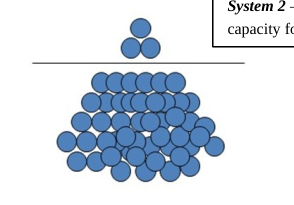
A Rough Model of Human Information Processing It should be emphasized that no model can be a complete description of the phenomenon of interest; therefore, the aim of the current model is to reflect relevant aspects of human cognition. The model does not have to be particularly complicated to be of practical use, functioning as a foundation to explain how to reduce cognitive load in manufacturing personnel. Several researchers for example, describe two different types of cognition that are particularly relevant for the purpose of this paper (Kahneman; 2011; Norman, 1993; Schneider and Shiffrin, 1977; Shiffrin and Schneider, 1977), namely the division between so-called automatic/experiential/system 1 and controlled/reflective/system 2 modes of cognition. We choose to follow Kahneman’s system labeling, avoiding unnecessary interpretations of the terms, and depicts their characteristics in the cognitive iceberg model (Figur 1). Broadly stated, Kahneman (2011, p. 20-21) describes the two systems as follows:
“System 1 operates automatically and quickly, with little or no effort and no sense of voluntary control.
System 2 allocates attention to the effortful mental activities that demand it, including complex computations. The operations of System 2 are often associated with the subjective experience of agency, choice and concentration”.
Cognitive Engineering and Neuroergonomics (2019)
System 2 – discrete, conscious level with limited capacity for effortful mental activities.
System 1– works in parallel, unconscious, good at pattern recognition with a virtually unlimited capacity.
Figure 1. The cognitive iceberg model - a simplified model that depicts two different modes of cognition.
Consequently, Kahneman (2011) denotes System 1 to the more automatic operations which he generally refers to as ‘fast thinking’, and System 2 to the controlled operations of which he generally refers to as ‘slow thinking’. The majority of the process of demanding and effortful mental work is related to system 2, in which the demands of memory, attention and other aspects of performing non-automatic cognitive tasks actually put some constraints on the cognitive processes, resulting in a slower thinking process because of the limited available cognitive capacity, then resulting in increased cognitive load.
Kahneman (2011), for example, points out that some of our mental activities become fast and automatic because of prolonged practice, although they from the very beginning needed conscious attention, e.g., reading skills which normally runs on our automatic pilot in the skilled reader. Furthermore, he argues the limited capacity for attention is the central pinnacle for cognitive load, along with limitations in short-term memory (Atkinson and Shiffrin,1968), and when acting beyond these limits, failure appears. The division of labour between the two systems is very efficient; minimizing effort and optimizing performance mostly of the time. However, System 1 has some biases, and sometimes provides the wrong reaction and it becomes obvious when there is a conflict between the two systems. One major task of System 2 is to provide a reflective and conscious “second opinion” of the automatic reactions of System 1. Following this line of argument, humans sometimes suffer from cognitive illusions, i.e., illusions of thought, which are quite hard to detect and overcome. The reason is that System 1 operates automatically and cannot be switched off by choice, and biases cannot be avoided since System 2 has not received any hint that there might be an error. A promising way to overcome this bias is learning to recognise particular situations in which mistakes are likely to appear. Continuously questioning humans’ thought processes via System 2 is not a viable approach, however, since it is impractical, too slow and has a too limited capacity (Kahneman, 2011).
Both modes of cognition are needed and neither is superior to the other, and despite they do not cover the whole cognitive spectrum, the cognitive iceberg model makes it possible to highlight and compare certain characteristics of human cognition. As pointed out by Norman (1993), the challenge when designing technology is to avoid forcing the use of technology towards one extreme or the other. Consequently, each mode requires different kinds of technical support to function properly. That is, there is a need to have a proper balance between the modes, so the operator is not forced to use her/his limited conscious capacity to interpret the machine’s user interface as such, instead the operator should use the cognitive capacity to solve the task at hand or make appropriate decisions. Thus, technology should be considered a resource in the creation of a better working environment, it should complement human abilities, aid those activities for which humans are poorly suited cognitively, and enhance and help develop those cognitive skills for which humans are biologically predisposed to process easily.
Cognitive Work Environment Problems The research underlying the traditional information processing model has mainly been based on experiments on individuals, with little or no attention paid to environmental factors/context, different kinds of tools, and how technology is used in situ and in practice (Norman; 1993; Rogers, 2012). Results from Swedish field studies of human-machine interaction (Sandblad, Lind and Nygren, 1991) showed clearly that humans often used automated processes to quickly scan large quantities of information and to identify the relevant parts of information which the user then would concentrate on more by using his/her conscious level/capacity. When using computerized machine systems, it is probably the automated processes that greatly contribute to efficient use and to minimize the perceptual and cognitive loads in operators. However, if the user interface prevents the user to develop and use the automated processes, it results in different kinds of cognitive work environment problems (Sandblad, Lind and Nygren, 1991). In a work situation, it is important that the person doing the work understands the course of events Cognitive Engineering and Neuroergonomics (2019) and that they can influence and control the detailed work processes so they can fulfill the business’s goals (Sandblad, Lind and Nygren, 1991). There are often various kinds of barriers in order to be able to accomplish this aim. An important class of problems is what Sandblad et al. denote cognitive work environment problems. The class of problems is defined as follows (Sandblad et al., 2003, p. 376): “With Cognitive work environment problems we mean when properties of the work environment hinders the workers to use their skills efficiently. These obstacles are often associated with the design of the information system but may also be the effect of an inappropriate work organization or inadequate managerial support”.
Their hypothesis is that cognitive work environment problems is a significant and a common source for different types of cognitive overload, in addition to the more well-known sources of stress, such as intense work speed and monotonous work. The problems may in turn result in psychological and physical reactions, musculoskeletal disorders, etc. As pointed out by Sandblad et al. (1991), an important aspect of the cognitive work environment problems that arise when using human-machine systems is related to the (graphical) user interface (GUI), i.e. the "surface" between the machine with which the operator and interacts with. Sandblad et al., (1991) emphasize that work on cognitive work environment problems requires a preliminary understanding of what the problems are and how they occur in the first place. It is of major importance to identify, describe and analyze the aspects of the properties on the system’s level that are significant to consider regarding cognitive work environment problems in a particular work situation. With the term system level properties they denote properties related to both the (1) working process and work organization, (2) as well as to the content and design of the user interface of the machine the operator is working with. Consequently, they point out that it is then reasonable to assume that even perceptual and cognitive loads can strongly be affected by the system's content and interface design. Many of these perceptual and cognitive loads occur in short duration in time and the operator that is exposed to them is often not even aware of the existence of the load. Examples of such perceptual and cognitive loads may be interruptions of thought in order to remember a control command, loads on short-term memory when one should remember information from one screen shot to another, or when one has to read extraneous text since it would not be easy to orient oneself within a screen display (Sandblad et al., 1991).
Types of Cognitive Work Environment Problems According to Sandblad et al. (1991), a variety of CWEPs exists that may occur when using machines and computer system at work. They do not offer a complete taxonomy of such problems, but do identify important problem classes. The identified CWEPs are based on analysis of their field work, as well as on their own and others’ experiments with different kinds of interfaces in professional work situations. They stress that cognitive work environment problems arise when the user is hindered from using his cognitive abilities effectively, and nine types of CWEPs are presented briefly as follows (Sandblad et al., 1991): Disruption of thought. The interaction does not allow the operator to fully concentrate on the task at hand, since the operator is often forced to use his/her limited higher level cognition to manage / control the machine/system. This is opposite to manual handling, when humans often manage to automate the "peripheral functions" that is needed to carry out the work task. At computer supported work, however, humans are often forced to perform these tasks with increased cognitive load.
Orientation and navigational problems. The operator winds up in doubt or ignorance about where he/she is in the system, ”being lost in the information space”, and it can also be difficult for the operator to formulate where he/she is heading. Most user interfaces do not allow the operator to constantly track where one is in the system, and how the current situation is related to the overall system as a whole. Another important aspect of the orientation problem is how quickly the operator gets back into the current work activity, as shown on the screen, when returning back to the activity after having done something else or was disturbed in any way. It is stressed that the operator quickly and effortlessly perceives where in the work process he/she is.
Cognitive "tunnel vision”. Humans have difficulty considering information that one has not simultaneous access to when making evaluations and decisions. Although the operator is aware of the existence of other important information sources, available at other places, it is difficult to integrate that information into the assessment and decision processes. Human tends to put much greater emphasis on the available information. If the operator can view information simultaneously, he/she has the ability to include even very large amounts of information in the decision-making process.
Cognitive Engineering and Neuroergonomics (2019)
Strains on short-term memory. Basic research on human memory within cognitive psychology has clearly demonstrated the limitations of short-term memory (STM). STM can store about 5-8 pieces/units of information simultaneously, has a short decay time and high disturbance sensitivity. What is meant by a piece/unit of information varies with the context, e.g., a digit, a number, a figure, a word, an image, or some fact of any kind. When the operator is unable to process the necessary pieces of information in STM, he/she starts to jump back and forth between the different information sources. This way of acting is time consuming as well as exhausting. If the operator then also must perform actions, such as giving commands, etc., which requires additional cognitive effort to cope with the situation, etc., the operator will "quench" the STM, or at least, disturb it greatly.
Unnecessary cognitive strain/load. The operator collects a lot of needed information in a particular work situation through recognition/decoding of the patterns the information forms, and not primarily through reading the actual information content. Humans make use of this ability to very quickly skim an instruction and see what is of interest in the current situation and to "zoom" in on the interesting pieces. If the user interface does not support such search- and interpretation processes, the operator must painstakingly read all the present information.
Spatial "dizziness". Humans often tend to relate information to its spatial properties. Humans usually remember in terms of color, shape, position, size, movement, etc. For example, "the instructions are far back in the red folder in the upper, right bookshelf, just behind a leaf with a yellow edge". Thus, we "know what we need to see" in a particular work situation without being able or at least having explicitly specified it. If these spatial relationships are non-existent, unclear or change somehow, the ability for spatial encoding of information carriers and information content is spoiled.
Inconsistent information coding. When the information to be communicated to the operator is coded in such a way that it is hard to obtain it, without unnecessary cognitive load, the operator suffers from inconsistent information coding. If the encoding is not equal over time and in different parts of the system, it may be very difficult to automate its use. If the coding is done in a thoughtful way, the operator can still encounter some problems, even if it is uniformly implemented. It is for instance important that the elements of the interface used have connections to the concepts used in the work situation.
Problems with time-coordination of values. It is often important in the work situation to be able to associate an information value to a certain time or a point of time, and to relate the timing of different amounts of information to each other. It may, for example, being to know when a specific test has occurred, in which chronological order, and with what time intervals a series of measurements should to be arranged. If the operator cannot swiftly and automatically grasp this situation, but instead has to consciously decode and analyze the time-coordination of values, he/she results in loss of time and unnecessary cognitive load.
Problems of identifying a process’s status. It is often important to quickly be able to put oneself into a process’s actual status. In an administrative application, for example, it can be to find out what errands are waiting, which are handled currently, how far they have been processed and which are closed. The ability to plan one’s work, to quickly being able to get into the right working context or to switch between tasks in an efficient and easy way, is otherwise impeded or impossible. If the operator is forced to be guided by what the system conveys and cannot find and execute the most prioritized errands, the result is increased cognitive load in the operator.
Although it is a promising step to recognize different types CWEPs, it is then of major importance to provide measures to reduce CWEPs (Sandblad et al., 1991). They emphasize how crucial it is to decide what problems are of most significant in each particular case, as well as to gain an understanding of how various problems interact with each other. They point out that many of these areas are not primarily related to interface design, but it turns out that poorly designed user interfaces strongly contribute to difficulties in these areas too, such as having knowledge about how well the goal of a work task are fulfilled or how far a process has reached. Hence, by considering the issue of CWEPs beyond the actual interface design, they are advocating a widened system view.
The focus on interactions between the cognitive agent’s and the the social and material environment is also strongly highlighted in theories of distributed/embedded/situated/embodied/cognition (e.g., Hutchins, 1995; Norman, 1993; Cognitive Engineering and Neuroergonomics (2019)
Rogers, 2012; Suchman, 2007; Wilson and Golonka, 2013). It has been suggested to integrate these distributed/embedded/situated/embodied theories of cognition, in order to broaden the focus and scope of the human cognitive system. The general assumption was that it would offer a broader unit of analysis stretching from the individual, across people, material and technical artifacts to culture, as much of everyday cognition is embedded in working life practices. The system perspective illustrated in the distributed cognition framework, for example, is related to the work on production complexity within manufacturing (Gullander et al., 2011). They point out the significant role of humans and technology in work systems as well as stressing the importance of taking a holistic view, i.e., a system perspective of production, including different user’s perspectives and their working environment into the unit of analysis.
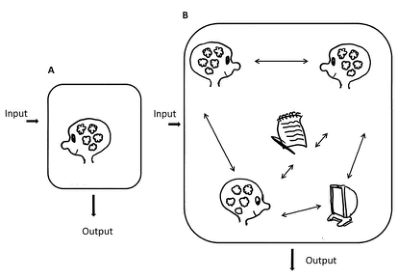
Distributed Cognition: Shifting the Boundaries of the Unit of Analysis The theoretical framework of distributed cognition (DC) was introduced by Hutchins (1995) in response to more individual models and theories of human cognition. From a DC perspective, human cognition is fundamentally distributed in the socio-technical environment that we inhabit. DC takes a system perspective, and discards the idea that human mind and environment can be separated and cognition should instead be considered as a process, rather than as something that is contained inside the mind of the individual. Hence, DC views cognition as distributed in a complex socio-technical environment, and cognition is seen as creation, transformation, and propagation of representational states within a socio-technical system (Hutchins 1995). According to Perry (2003), the DC, however, merely extends the traditional notion and theoretical framework of cognition as computationalism, since it still uses the notions of representations and representational transformations for describing human cognitive activity in larger units of study1. According to Perry (2003, p. 194) “researchers trained in cognitive science do not have to abandon their theoretical knowledge and conceptual apparatus to understand distributed cognition”. The main difference from computationalism “is in its theoretical stance that cognition is not just in the head, but in the world (Norman, 1993) and in the methods that it applies in order to examine cognition “in the wild”” (Perry, 2003, p. 194). The system level view makes DC a fruitful approach for studies of complex socio-technical domains, such as manufacturing. The framework differs from other cognitive approaches, by its commitment to two theoretical principles (Hollan et al. 2000). The first principle concerns the boundaries of the unit of analysis for cognition, which is defined by the functional relationship between the different entities of the cognitive system. The second principle concerns the range of processes that is considered to be cognitive in nature. In the DC view, cognitive processes are seen as coordination and interaction between internal processes, as well as manipulation of external objects and the propagation of representations across the system’s entities (Figure 2).
Figure 2. From a traditional cognitive science perspective (a) the unit of analysis is narrowed to the inside of the individual’s head, while from a distributed cognition perspective (b) the unit of analysis is expanded to be distributed across people and artifacts where cognitive processes are the result of the functional relationships of the entities of the cognitive system.
When these principles are applied to the observation of human activity in situ, three kinds of distributed cognitive processes becomes observable (Hollan et al. 2000): (1) across the members of a group, (2) between human internal 1 The issue whether DC should be considered as computationalism or not, are not the major focus in this paper. The interesting point here is the framework’s system level of analysis, and the implications for studying manufacturing and cognitive load from such a perspective.
Cognitive Engineering and Neuroergonomics (2019) mechanism (e.g., memory, attention) and external structures (e.g., material artifacts, technology and social environment), and (3) distributed over time.
Different kinds of representations are central to the unit of analysis in DC, as cognition is seen as coordination, transformation, and propagation of representational states within a system. Hollan et al. (2000) argue for the stance that representations should not only be seen as tokens that refer to something other than themselves but that they also are manipulated by humans as being physical properties. Humans shift from attending to the representation to attending to the thing represented, which produces cognitive outcomes that could not have been achieved if representations were always seen as representing something else. An example in Hutchins (1995) is the navigational chart. The chart is used for offloading cognitive effort (e.g., memory, attention) to the environment and to present information that has been accumulated over time. Furthermore, Hutchins (1995) describes the navigational chart as an analog computer where all the problems solved on charts can be represented as equations and solved by symbol- processing techniques. An important insight in this example is the relationship between the external structure (the chart as a representation) and the internal structure (the computation). The relationship between the external and the internal constructs cultural meaning, and are a part of the same cognitive ecology. Hence, to study external, material and social structures reveals properties about the internal, mental structures, which become observable. In other words, the study of external, material and social structures reveals properties about an individual's internal, mental structures. Hence, by studying cognition with this larger scope in mind, it is clear that the functional cognitive system has cognitive properties that cannot be limited to the cognitive abilities of the individuals.
As pointed out by Rogers (2012), DC’s utility in human-technology interaction has been criticized for the need to perform extensive fieldwork before being able to provide any final results, conclusions, and design solutions. Moreover, there are no explicit guidelines, checklists, or interlinked concepts that can be used to pull relevant aspects out from the data. It requires a skilled fieldwork researcher to move between the different levels of analysis, in order to being able to merge between the detail and the abstract. Hence, it is not a “quick and dirty” approach. Indeed, well-executed analysis of a work setting that results in detailed analysis can be useful for design, identifying why the problem occurs, and offering a design of how to the solve the situation. Such detailed and abstract analysis can provide several suggestions how to change the design to improve user performance and, in the long run, work practice (Rogers, 2012). Galliers, Wilson and Fone (2007), for example, have developed a more applied DC method that is more accessible and easier to use. Their method focuses on breakdowns in the information flow and provides checklist and guidelines as scaffolds for the user, and the end result could then be used to inform design (Lindblom and Sellberg, 2014). The DC framework has, for instance, found its way into the fields of ship navigation (Hutchins 1995), critical care environments (Patel et al. 2008), human-computer interaction (e.g. Hollan et al. 2000), information fusion (Nilsson et al. 2012), information visualization (Liu et al. 2008), and technostress in human- technology interaction (Sellberg and Susi, 2013). Thus, it is reasonable to assume that this theoretical framework is equally applicable to manufacturing.
TOWARDS A COGNITIVE WORKLOAD FRAMEWORK FOR MANUFACTURING PERSONNEL In this section, we propose an integrated framework towards studying and reducing cognitive load from a distributed socio-technical cognitive perspective. The purpose of the framework is to guide work station developers in designing for reduced cognitive load and to educate them on aspects that are argued to have effect on the cognitive workload of the operator. By addressing and identifying the cognitive load problems proactively, and designing the work station and the assembly task properly, one avoids too high cognitive load and cognitive work environments problems in the personnel. In other words, the focal point here is the interactions between the parts (tools, environment, and human agents) within the socio-technical system, and how proper design of both tasks and work stations may reduce cognitive load. The framework acts as a guide, for explaining or clarifying the issue, rather than being correct in detail. Hence, the intended contribution of the framework is based on the integration of perspectives in a form not previously proposed, which means that while the ideas themselves need not necessarily be original their combination is novel. In the following, the potential framework is presented in more detail.
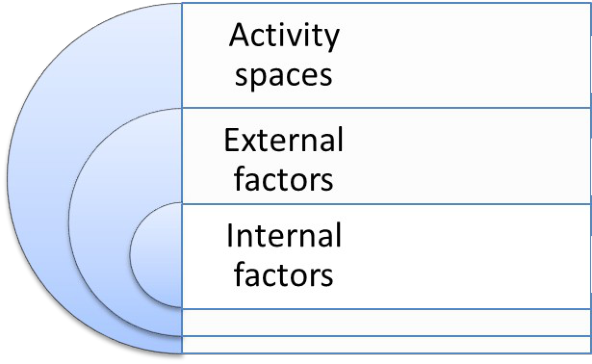
Description of the Potential Cognitive Load Framework An integrated socio-technical approach, based in the distributed cognition framework, involves investigation and Cognitive Engineering and Neuroergonomics (2019) analysis of cognitive load from an interactive perspective, rather than separating the task (assembly) from the environment (work station design and work environment). The motivation for the framework has its theoretical foundation in theories such as situated and distributed cognition approaches (Hollan et al., 2000; Hutchins, 1995; Kirsh, 2000; Norman, 1993; Suchman, 2007). Prior research regarding cognitive load and related concepts from a holistic perspective has mostly been conducted in office environments (Dix, 2002; Kirsh, 1999, 2000, 2001). Kirsh (1999), for example, emphasizes the need to design better work environments trough interactive and distributed cognition principles of changing structural coupling of agent-environment constraints and resources. Kirsh points out when humans engage in an activity or task, the environment is a changing coalition of external and internal resources and constraints (cultural, social, physical, and computational). The fundamental issue at hand is to coordinate these different resources and constraints appropriately at different temporal resolutions. Assembly lines within manufacturing can be considered as a distributed coordinating activity where several persons are assigned different roles, performing certain tasks in a specified order and timing through the use of certain tools and artifacts at the shop floor. Hence, we argue that an integrated approach represents an extension of existing research and design approaches to the study of cognitive load from a more holistic perspective. Such an advance would recognize the integrated nature of the aspects that impact cognitive load in shop floor personnel that is embedded in the tools and information technology used in manufacturing, to increase productivity and production quality. In order to be able to identify and recognize the causes of cognitive load resulting in different CWEPs, there is a need for an understanding of how the task at hand as well as the work station design influence operators’ cognitive load, via the coordination of internal (memory, attention), and external factors (tools and layout) present in the overall activity space (see Figure 3).
Level
Level
Level
Figure 3. The potential framework focuses on the coordination of internal (human memory, attention), and external factors (tools and work station layout) present in the overall activity space that might affect cognitive load in manufacturing personnel.
Figure 3 illustrates our potential framework that considers coordination activity between different aspects and factors at multiple levels. It should be pointed out that the levels are only used as abstractions; they are no levels that can be investigated and analyzed in isolation. On the contrary, as Dix (2002) phrases it, “we do not just act on the world, but act with the world”. The fact that operators in manufacturing are situated in what Kirsh (2000) denotes as activity spaces, i.e. the recognition that a single ‘work environment’ is a delusion since we slip between different environments at work, do not allow us to separate the object of study. Instead we have to consider the complexity of the coordination of activities and levels. Taken together, these aspects show how complex the task of reducing cognitive load in manufacturing is.
At level 1 in the figure above is the internal factors, i.e. focus is on the rough model of human information processing depicted in the cognitive iceberg model, namely the division between so-called automatic/experiential/system 1 and controlled/reflective/system 2 modes of cognition (see Figure 1 in the section “A Rough Model of Human Information Processing”). The majority of the process of demanding and effortful Cognitive Engineering and Neuroergonomics (2019) mental work is related to system 2, in which the demands of memory, attention and other aspects of performing non- automatic cognitive tasks actually put some constraints on the cognitive processes, resulting in a slower thinking process because of the limited available cognitive capacity, then resulting in increased cognitive load. There is a need to have a proper balance between the two modes, so the operator is not forced to use her/his limited conscious capacity to unnecessary issues, instead the operator should use the cognitive capacity to solve the task at hand or make appropriate decisions, in order to accomplish a good workflow. Possibly identified CWEPs at this level are; disruption of thought, strains on the short-term memory, unnecessary cognitive strain, and inconsistent information coding. Examples of these CWEPs can be found in the operators regarding the level of attention required in the assembly task dependent on the presence of variant flora (batch sizes), product variants, batching of variants, and parts identification. It is a well-documented fact, for example, that the variant flora does have significant effect on production efficiency and it can easily be argued that this effect relates to the cognitive load of the worker . However, the concept of variant is only relevant in, more or less, one-piece production where there can also be said to be a volume product. In many manufacturing companies, one does not consider variant and volume products but different types of products are instead batched together. From the perspective of cognitive workload of the operators, batching can become a quality risk when batches are small and workers are expected to adjust to new batches relatively often. Moreover, batching of variants is a common strategy in mixed mode assembly is to batch variants in sets of two or more variant products to reduce psychological ramp up time between product types. As stated earlier, Sandblad et al., (1991) emphasize that work on CWEPs requires a preliminary understanding of what the problems are and how they occur in the first place, which often is related to these internal factors. This level provides a good starting point and provides necessary but not sufficient body of knowledge about reducing cognitive load in manufacturing.
At the second level (Level 2) depicted in the figure we begin to address how external factors should be considered as a resource in the creation of a better working environment, it should complement human abilities, aid those activities for which humans are poorly suited cognitively, and enhance and help develop those cognitive skills for which humans are biologically predisposed to process easily. At this level, the coordination of activities between internal and external factors is the major scope of interest, with an added focus on the external structures. As highlighted by Kirsh (2000), this is also a kind of coordination given that humans coordinate their internal processes (Level 1) with external ones (Level 2) is tightly coupled, and the timing of these structural scaffolds is appropriately related to the performance. As pointed out by Kirsh (1999), humans are very good at adding structure to the environment in forms of different kinds of scaffolds; i.e., cues, prompts, artefacts, manuals and instructions etc., to make the task at and hand more effective and efficient. Kirsh (1999) mentions that there are different sources of coordination for these activities, in which artifacts and tools serve as mechanisms for adding constraints to a distributed system. On the one hand, they can be considered as the resource they are intended to be used as, e.g., a certain tools is developed for an assembly task or as manuals and instructions for offloading memory and enhancing information processing. On the other hand, they function as coordinative structures, and it is important to consider how well the mapping of the work station spatial design complies with the assembly sequence. For instance, tools and parts that are used together should be placed together and in the correct order. In so doing, the work station designer may consider the spatial layout of the workplace in relation to the basic workflow. Tools and artefacts have prominent functions in these coordination activities.
As pointed out by Susi (2006), their roles as coordination devices include their functions as triggers (Dix et al., 1998, 2004), placeholders (Dix et al., 2004) and entry points (Kirsh, 2001). Roughly speaking, Susi (2006) highlights that triggers indicate that something needs doing (prompting an activity and include five categories). Placeholders indicate the status of a process (what needs to be done and how they are stored in three different ways). Tools can also function as entry points that invite the human to take some action, that vary along six different dimensions (having different characteristics) that affect how humans react to them (Susi, 2006). As pointed out by Susi (2006), the combination of these concepts provides an integrated process view of tools and provides significant characteristics that we due to space limitations, are not able to develop in more detail. However, applying these concepts to manufacturing, in order to make operators paying attention to significant aspects in assembly task, is a viable approach. Further analysis of these concepts and their combinations may provide significant explanations and adequate design solutions to how operators /designers might adapt the work environment by making use of different tools to reduce cognitive load, creating external structures that facilitate the internal processes (Level 1) via the use of external structures in certain ways, and spatial layout of items (Level 2). Taken together, what unite these environmental resources is the fact that humans make them function as scaffolds in order to reduce cognitive load. Cognitive Engineering and Neuroergonomics (2019)
Special forms of physical constraints currently used to reduce cognitive load in manufacturing are poke-a-yoke and forcing functions. Poke-a-yoke is a Japanese term that means "mistake-proofing", and is any mechanism in a lean manufacturing process that helps an equipment operator to avoid mistakes (Shingo, 1989). Its purpose is to eliminate product defects by preventing, correcting, or drawing attention to human errors as they occur. In a similar vein, a forcing function is an aspect of a design that prevents the operator from taking an action without consciously considering information relevant to that action. It forces conscious attention upon something and thus deliberately disrupts the efficient or automatized performance of a task. It is useful in safety-critical work processes and in situations of skilled user performance, since the execution of this type of tasks is often automatized, requiring low or no conscious attention, and it can thus be necessary to "wake the operator up" by purposely disrupting the performance of the task. It should be pointed out that improper coordination between internal and external factors may results in CWEPs such as orientation and navigation problems, cognitive “tunnel vision”, spatial dizziness, problems with time-coordination of values, and problems of identifying a process status. Hence, as pointed out by Kirsh (2000), the mechanisms of coordination between agent and environment become the focal point of explanation, since humans utilize aspects of their environment, or create structures in their environment that link with internal states in creative ways, Thus, when the timing of these various kinds of scaffolds (Level 2) is appropriately related to internal factors (Level 1) reduced cognitive load is achieved.
At level 3, the activity spaces of the workflow is considered from a holistic perspective, mainly inspired by Kirsh’s (2000) work on activity spaces and Dix’s (2002) work on ecology of work environments. This level also addresses socially and culturally situated aspects of work, such as norms, work practices and the historical development of work processes and of the tools and artefacts used over time (Hutchins, 1995; Suchman, 2007). Due to space limitations we are not able to develop these issues further, but want to highlight the fact that we as humans never are separated from social and cultural aspects, although we currently are performing individual tasks. The accomplishments of these tasks are structured through social and cultural scaffolds that we sometimes are unconsciously unaware of, and these aspects come into conscious light when the social norms and scaffolds to some degree are altered, or at times, totally changed (Suchman, 2007).
DISCUSSION AND CONCLUSIONS This paper has presented different views on human cognition and how these aspects affect cognitive load and subsequently may give rise to cognitive work environment problems; resulting in a potential framework of factors that may result in cognitive load in manufacturing personnel from a systems perspective. This paper contributes to extending the understanding of human cognition and cognitive load and guide work station developers in designing for reducing cognitive load and to educate them on factors that are argued to have effect on the cognitive workload of the operator. However, the proposed framework is still work in progress, and needs further elaboration. Firstly, the identified factors need to be developed further, since there is a need to incorporate more relevant work from research areas as situated/embodied/distributed approaches of cognition, interaction design and human-computer interaction. Secondly, the theoretical foundation should then be complemented with empirical studies in manufacturing, e.g. ethnographic workplace studies, which will subsequently be incorporated in the final framework. Thirdly, additional validations of the framework, i form of experiments and adequate user research on certain identified issues in the workplace study, may provide further support for the above issues. Finally, a tool and subsequently a method for evaluating and assessing cognitive load in manufacturing are under construction (Thorvald and Lindblom, 2014). To conclude, the intended outcome of the proposed framework is to address and describe cognitive load problems proactively, designing the work station and the assembly task properly, so that one avoids too high cognitive load and work environments problems in the personnel. There are huge costs associated with neglecting cognitive and user perspectives within manufacturing, but on the other hand, there is a vast potential to improve both the workers’ cognitive and physical health and an increased production outcome simultaneously.
Cognitive Engineering and Neuroergonomics (2019)
ACKNOWLEDGEMENTS
This work was financially supported by Sense and React - the context-aware and user-centric information distribution system for manufacturing project. Sense and React is an Integrated Project funded by the European Commission under the 7th Framework Programme.
REFERENCES
Atkinson, R., Shiffrin, R., (1968), “Human memory: A proposed system and its control processes”. In: The psychology of learning and motivation (Volume 2), Spence, K.W., Spence, J.T, (Eds.). pp. 89–195. Bannert, M. (2002), “Managing cognitive load – recent trends in cognitive load theory”, Learning and Instruction, 12. Bannon, L. J. (1991), “From human factors to human actors: The role of psychology and human–computer interaction studies in
system design”. In: Design at Work: Cooperative Design of Computer Systems, Greenbaum J., Kyng, M. (Eds.). pp. 25-44. Bannon, L. J. (2011), “”20 years a-growing”: Revisiting From Human Factors to Human Actors”. In: Reframing Humans in Information Systems Development, Isomäki, H, Pekkola, S, (Eds.). pp. 181-188. Card, S. K., Moran, T., P., Newell, A. (1983), “The psychology of human-computer interaction”. Hillsdale, NJ: L Erlbaum. Dix, A., Ramduny, D.,Wilkinson, J. (1998), “Interaction in the large”. Interacting with Computers Volume 11 Number 1. Dix, A. (2002), “Managing the ecology of interaction.” Paper presented at the Proceedings of Tamodia 2002 - First International Workshop on Task Models and User Interface Design, Bucharest, Romania. Dix, A., Finlay, J., Abowd, G.D. (2004), “Human-computer interaction”. Harlow, England: Prentice Hall. Galliers J, Wilson S, Fone J (2007), “A method for determining information flow breakdown in clinical
systems”. International Journal of Medical Informatics Volume 76 Number 1. Gullander, P, Davidsson, A, Dencker, K, Fasth, Å, Fässberg, T., Harlin, U., Starhe, J. (2011), “Towards a production complexity model that supports operation, re-balancing and man-hour planning”. In Proceedings of the 4th Swedish Production Symposium (SPS): Lund, Sweden. Hollan, J., Hutchins, E., Kirsh, D. (2000), “Distributed Cognition: Toward a New Foundation for Human-Computer Interaction
Research”, ACM Transactions on Computer-Human Interaction Volume 7 Number 2. Hutchins, E. (1995), “Cognition in the Wild”. Cambridge, MA: MIT Press. Hultberg, A., Dellve, L., Ahlborg, G. (2006), ”Vägledning för att skapa goda psykosociala arbetsförhållanden i arbeten med klienter och patienter”. Institutet för stressmedicin, ISM-rapport 3. Kahneman, D. (2011), “Thinking, fast and slow”. New York: Farrar, Straus and Giroux. Karasek, R., Theorell, T. (1990), “Healthy work – stress, productivity and the reconstruction of working life”. New York: Basic
Books. Kirsh, D. (1999),”Distributed cognition, coordination and environment design”. Paper presented at the Proceedings of the European conference on Cognitive Science. Kirsh, D. (2000) “A Few Thoughts of Cognitive Overload”, Intellectica Volume 1 Number 30. Kirsh, D. (2001), “The context of work”, Human-Computer Interaction, Volume 16. Liu, Z., Nersessian, N. J., Stasko, J. T. (2008), “Distributed Cognition as a Theoretical Framework for Information
Visualization”. IEEE Transactions on Visualization and Computer Graphics Volume 14 Number 6. Nilsson, M., van Laere, J., Susi, T., Ziemke, T. (2012), “Information fusion in practice: A distributed cognition perspective on the active role of users”. Information fusion Volume 13. Norman, D. A. (1993), “Things that make us smart – defending the human attributes in the age of the machine”. Reading:
Addison-Wesley. Patel, V. L., Zhang, J., Yoskowitz, N. A., Green, R., Sayan, O. R. (2008), “Translational Cognition for Decision Support in Critical Care Environments: A review”. Journal of Biomedical Informatics Volume 41 Number 3. Perry, M. (2003), “Distributed Cognition”. In: HCI Models, Theories, and Frameworks: Toward a Multidisciplinary Science,
Carroll, John M. (Ed.). pp. 193-223. Rogers, Y. (2012), “HCI Theory: Classical, modern, and contemporary”. San Rafael; Morgan & Claypool Publishers. Sandblad, B., Lind, M., Nygren, E. (1991), ”Kognitiva arbetsmiljöproblem och gränsnittsdesign” [in Swedish]. CMD-rapport Number 20/91. Sandblad, B., Gulliksen, J., Åborg, C., Biovie, I., Persson, J., Göransson, B., Kavathazopoulos, I., Blomkvist, S., Cajander, Å.
(2003),”Work environment and computer systems development”, Behaviour & Information Technology, Volume 22 Number 6. Schneider, W., Shiffrin, R.M. (1977), “Controlled and automatic human information processing: II. Perceptual learning, automatic attending and a general theory”, Psychological Review, Volume 84 Number 2. Sellberg, C., Susi, T. (2013), “Technostress in the office: a distributed cognition perspective on human–technology interaction”,
Cognition, Technology & Work, March
Cognitive Engineering and Neuroergonomics (2019)
Sellberg, C., Lindblom, J. (2014), “Comparing methods for workplace studies: a theoretical and empirical analysis”, Cognition, Technology & Work, February: http://link.springer.com/article/10.1007/s10111-014-0273-3 Shiffrin, R. M., Schneider, W. (1977), “Controlled and automatic human information processing: I. Detection, search and
attention”, Psychological Review, Volume 84 Number 2. Shingo, S. (1989), “A study of the toyota production system: From an industrial engineering viewpoint”. Productivity Press. Suchman, L. (2007), “Human–Machine Reconfigurations: Plans and Situated Actions”. Cambridge, MA: Cambridge University Press. Susi, T. (2006) “The Puzzle of Social Activity: the significance of tools in cognition and cooperation”, Thesis. Linköping
University, Linköping, Sweden. Linköping Studies in Science and Technology. Thorvald, P. (2011), “Presenting Information in Manual Assembly”. Thesis. Loughborough University. Loughborough, UK.
Wolfson School of Mechanical and Manufacturing Engineering. Thorvald, P., Lindblom, J (2014), “Initial Development of a Cognitive Load Assessment Tool”. Paper to be presented at the 5th International AHFE 2014, Krakow Poland. Wilson, A., D., Golonka, S. (2013), “Embodied cognition is not what you think it is”, Frontiers in Psychology Volume 4 Article
58.
Cognitive Engineering and Neuroergonomics (2019)
LISTED IN THE AHFE DIGITAL BOOKSTORE CATALOGUE
Explore the complete digital volume
Advances in Cognitive Engineering and Neuroergonomics
Read this individual research paper free through the original publisher, or explore the full digital proceedings book.
ISBN 978-1-4951-2101-2
Explore this ISBN in the AHFE Bookstore ↗Listed in the July 2026 bookstore catalogue; search by ISBN to confirm current availability · Digital book purchase optional