Andreas Bergqvist, Jonathan Källbäcker, Rebecca Cort, Åsa Cajander, Jessica Lindblom (2024). Towards a framework for digital work engagement of enabling technologies. In: Artificial Intelligence and Social Computing. AHFE Open Access, vol. 122, pp. 257–265. https://doi.org/10.54941/ahfe1004663
Increased use of robotization, automation, and artificial intelligence (AI) highlights the need for theory development of the digital work environment since such technologies are likely to significantly alter or even totally change human work practices. This paper focuses on how these technologies influence people’s digital work engagement. In an ongoing project, we study how support from these technologies changes the socio-technical work dynamics and how work engagement can be facilitated in such digital workplaces. The project aims to develop a digital work engagement framework based on input across multiple work domains. The present paper reports on an initial characterization of digital work engagement and presents a synthesis of findings from the first iteration of the envisioned framework. Finally, a discussion on the opportunities and challenges of enabling technologies for the future of work practices is provided
The current technology push related to enabling technologies such as robo- tisation, automation, and artificial intelligence (AI) raises new questions for the theory development of the digital work environment since these technologies may significantly alter and even totally change human work practices. The yearly Gallup reports include various measures of work expe- riences, including stress, well-being, and engagement. Earlier Gallup reports pointed to tremendous problems globally with employee work engagement and negative work-related emotions peaking in 2020 (Gallup, 2021). Conse- quently, the global economy lost trillions to low work engagement in 2021 (Gallup, 2022). However, the latest report shows that work engagement has increased after the pandemic (Gallup, 2023). A key finding in this report is that employees’ feelings about their work are more related to their relation- ships with their teammates and managers than working remotely (Gallup, 2023). Although this significant trend-breaking is very positive, stressing the importance of social relations for work engagement, there are still under- studied areas of work engagement. A recent literature review on enabling technologies used in work environments from human-computer interaction (HCI), user experience (UX), and digital work environment identified sev- eral research gaps (Cajander et al., 2022). One of these research gaps points
to understudied aspects of how enabling technologies relate to their influ- ence on work engagement (cf. Bainbridge, 1982; Palanque et al., 2019; Roto et al., 2018; 2019). Therefore, this paper focuses on how enabling tech- nologies influence people’s work engagement, which we here denote as digital work engagement.
Work Engagement Work engagement is often described as the positive, non-constant inner state where employees are fully present and engaged. The state is connected with motivation and productivity (Bakker & Demerouti, 2008; Bakker & Albrecht 2018).
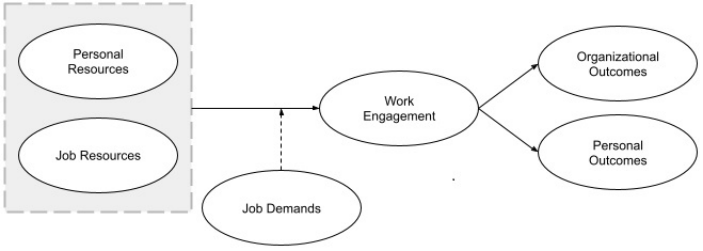
Moreover, an initial characterization of work engagement is presented below, based on the initial findings from an ongoing literature review (Figure 1). The renowned Job Demands-Resources of work engagement model (Bakker & Demerouti, 2008) was used as a starting point.
Figure 1: The adapted job demands-resources model (adapted from Bakker & Demer- outi, 2008).
The model was adapted to also account for personal outcomes in addi- tion to the organizational ones as more recent research has shown that work engagement affects the individual workers in addition to the values it brings to the organizations (cf. Keyko et al., 2016; Rodríguez-Muñoz et al., 2014). We then included examples of general and technologically enabled demands, resources, and outcomes from the ongoing literature review to explain further and exemplify the model.
AIM AND OBJECTIVES The ongoing project called Automation, Robotisation, and AI (AROA) stud- ies how technology support changes of socio-technical work dynamics and how work engagement can be facilitated in such digital workplaces. The project aims to develop a practical general framework of digital work engage- ment based on input from three selected work domains: rail transportation, IT, and agriculture, which, to various extents, have implemented enabling technologies in their work practices. The three selected domains are comple- mentary to ensure a broad context for research and provide a basis for the
Towards a Framework for Digital Work Engagement of Enabling Technologies 259
foreseen credible and solid theoretical framework. The following objectives were formulated:
What opportunities and challenges do you identify with enabling tech- nologies in your domains?
What challenges do you identify with digital work engagement?
The envisioned frAmeWork of AI@work and woRk Engagement, called AWARE, will provide knowledge and insights into potential problems and benefits related to enabling technologies and work engagement, such as how they arise, can be identified and prevented. The outcome of the synthesis of the above actions offers guidance for the next steps of the framework development.
METHOD
The method used in the AROA project is multi-grounded theory building (Goldkuhl & Cronholm, 2018), combining theoretical and empirical work in four iterations. The working description of work engagement described in Figure 1 serves as the foundation for addressing what digital work engage- ment entails in the selected domains, emphasizing existing challenges and opportunities related to the foreseen digital work engagement in both a short- and long-term perspective.
The data was collected during a one-day workshop with a reference group of HCI researchers and stakeholders from the selected domains. Moreover, one union representative with competence in digitalisation participated. The workshop centered around two primary activities related to the objectives described above.
First, the participants were divided into three groups, one for each domain, with HCI researchers spread across the groups. The objective of this activ- ity was for stakeholders to discuss the opportunities and challenges of AI, automation, and robotization within their specific domains. In the discus- sions, the researchers were passive, letting the participants be responsible for providing insights from their areas of expertise. All participants were encouraged to take notes during all discussions.
Second, the first author presented the working description of work engage- ment (Figure 1), which opened up a discussion with the participants about various aspects and components of the modified model.
Third, two groups were formed with representatives from all the domains to discuss digital work engagement further. For this activity, the starting point for discussion was the second objective, including the questions: “What is your understanding of digital work engagement?” and “What challenges do you see with digital work engagement?”.
Finally, the two groups were encouraged to formulate three aspects of dig- ital work engagement, both in the long- and short-term perspective, that the project group should consider in future work.
Thereafter, the AROA project group jointly analyzed the collected post-it notes. The differences, similarities, and overall implications of the discussed topics were synthesized, and future research areas were identified.
FINDINGS Our findings are presented as follows. We report the main opportunities and challenges with enabling technologies for each domain and end with a summary of the commonalities and differences across the domains. Next, we present the participants’ characterizations of digital work engagement and the challenges they foresee with digital work engagement. Lastly, we present the participants’ key concerns about digital work engagement that they urged the project group to consider in future work.
Opportunities and Challenges With Enabling Technologies for Each Domain The main opportunities and challenges identified from each domain are sum- marized and presented in Table 1. Regarding opportunities with enabling technologies, it appears that the most outstanding prospect is increased effec- tiveness, which could have organisational benefits in the long run. Examples are effective traffic control and correct information to the right stakehold- ers, both trains and passengers, in the railway domain. The possibility of reducing repetitive and tedious tasks and enabling an increased focus on core business and innovation were examples of opportunities in the IT domain. Managing resources like manure, pesticides, and fuel was the focus in the agriculture domain, which strongly emphasised sustainability, biodiversity, cow comfort, and animal welfare issues.
Table 1. Summary of opportunities and challenges with enabling technologies in the three domains.
Table available in the original PDF paper.
Topics Railway domain IT domain Agricultural domain
Lessen repetitive tasks
Opportunities
A common language for all stakeholders
Increased utilization of both human and environmental resources
More focus on the essential activities of the core business
Enabling correct information to stakeholders
Organisational development
More effective traffic control
Digital literacy risks becoming a class issue
Increased social, economic, and environmental sustainability Challenges
Accessing information creates a power struggle between stakeholders
Multiple parallel systems, often incompatible, create redundant and tedious work tasks
Incompatible systems create sub-optimizations
Varying opportunities for IT investment
Lack of transparency and risk of bias in training data
Risk of “de-skilling” and less emphasis on the craftsmanship of agriculture
Risk of “de-skilling” as tasks become more dispersed with numerous systems to handle
Negatively affected work-life balance due to technology-induced stress
Technological difficulties create stress and decreased resources for handling unforeseen events
Towards a Framework for Digital Work Engagement of Enabling Technologies 261
Regarding challenges, it appears that the major drawbacks identified were the risk of overreliance on technology and de-skilling. In the railway domain, this could take the form of unforeseen events that might be more difficult to handle if the automation fails. In the agriculture domain, this could devalue the use of the stock person’s eye (i.e., the tacit ability to interpret cow behavior correctly) and the difficulties in using various IT tools for farm management because of infrequent usage. It was also revealed that the IT domain is con- cerned with the risk of technology optimism, leading to potentially harmful investments implemented to stay ahead in the development.
Additional recurring challenging topics were managing and getting the most out of the data, where different IT systems that are incompatible with each other but still necessary to use when accomplishing certain work activities were potential issues mentioned within the agriculture and IT domains. The issue with multiple and incompatible IT systems often results in workarounds and unnecessarily cumbersome work processes, such as log- ging the same kind of data in several systems but in different formats. It was revealed that the railway domain struggles with the issue of sharing data between stakeholders, which the separate stakeholders might be reluctant to do, fearing the power dynamics between their own company and the other stakeholders, which may be disadvantageous for their business. Similar con- cerns were raised by the IT domain, stressing that the managing of data might be an increased challenge due to constant changes in legislation on how to store and manage data, which ultimately corresponds with aspects of data control, such as where the sources of the data are and the potential biases that are associated with the input data. Another common challenge raised by the IT and agriculture domains was the risk of the frequently disrupted work-life balance, where a concrete example in the agricultural context was receiving alarms and notifications 24/7 from automated milking systems.
In summary, it was revealed that increased effectiveness is the foremost commonly identified opportunity across the domains. The main commonly identified challenge is tedious and unsupported workflows from a human- centered perspective, where work activities often need to be carried out in several but often incompatible IT systems, which leads to frequently occurring workarounds.
What Challenges Do You Identify With Digital Work Engagement?
It was revealed that participants’ understanding of digital work engagement mainly focused on the multifaceted roles of the enabling technologies in work engagement. A commonly addressed topic was what kind of work roles and tasks do we want these technologies to perform, reflecting upon the preferred mode of working alongside technology rather than viewing it as a threat to your acquired professional competence. This topic was further broken down into how these enabling technologies can be considered as a resource when they reduce and ultimately remove repetitive or boring manual tasks, provide support in prioritization of work tasks and workflows, and strengthen the individual workers’ personal needs and goals, e.g., feelings of competence and autonomy while accomplishing their work activities.
On the other hand, several tentative drawbacks were also revealed, such as added demands on the individuals at the workplace who may need further resources like education and training to learn how to use these technologies effectively. Individuals need to identify work tasks and situations when these enabling technologies may not be working functionally as a way of feeling in control. It was also pointed out that it is crucial to have an open mind as innovation and change are currently developing, being a moving target. That work engagement can increase the use of digital tools and processes in work activities.
Based on the participants’ understanding of digital work engagement, they identified several challenges. It was revealed that there are some fears that dig- italisation and automation might negatively affect the workers’ competence and self-image. For example, multiple voices focused on the overreliance on data that could result in the risk of losing specific skills and competencies and a fear of lacking a solid connection to the real world, i.e., being situ- ated, if these technologies will mediate and carry many central work tasks that earlier were carried out or monitored by themselves. Other revealed challenges were qualms that the envisioned support resources may either be insufficient or not yet fully implemented when these new work activities should be implemented. Another raised concern was that the functionality provided by enabling technologies might not correctly fit the organisation’s goal. For example, advanced automation might lead to a lack of understand- ing and transparency about how the technology carries out work tasks, which could result in problems for the leadership and management in their efforts to support the digital work engagement.
Consequently, digital work engagement might diminish due to workers’ expectations of the increased demands on them while still lacking support- ive resources to handle them properly, which may subsequently decrease the quality of work.
Critical Concerns About Digital Work Engagement in Future Work We asked the participants to bring up critical concerns to consider in future research, both in the short and long term. In total, five concerns were revealed that are presented below:
Individual workers’ expectations, perceptions and attitudes toward automation, digitalisation, and AI will likely change over time.
Stressing the importance that technology should always serve humankind, meaning that users and human values should be prioritised over technol- ogy.
The introduction of new technology brings the risk of alienation as it might cause job displacement and highlight inequalities in education, competencies, and available resources.
During the development of the framework, do not forget to consider the importance of social aspects, such as norms, professional identity, structures, and human encounters.
The required human skills and competencies will change along with tech- nology changes. It is, therefore, essential to stay up to date with the current needs of human skills and provide support for people to develop them.
Towards a Framework for Digital Work Engagement of Enabling Technologies 263
DISCUSSION AND CONCLUSION In this paper, we investigate and analyze the changing dynamics of digi- tal work engagement within the context of enabling technologies, notably automation, robotization, and artificial intelligence (AI). Our work builds upon the Job Demands-Resources model (Bakker & Demerouti, 2008), serv- ing as the foundation for our exploration of digital work engagement. We are conducting the ongoing AROA project that delves into how enabling tech- nologies influence work engagement across different domains, specifically rail transportation, IT, and agriculture. Our research aims to formulate a comprehensive framework for digital work engagement. This paper presents the initial findings from this framework’s development, highlighting the potential opportunities and challenges across these domains.
Integrating enabling technologies, including automation and AI, funda- mentally reshapes the workplace. This transformation necessitates a corre- sponding adaptation in the skill sets and abilities of the workers. In this context, society must prioritize skills that complement technology, such as critical thinking, creativity, and adaptability.
One key takeaway from our findings is the potential for increased pro- ductivity and efficiency by adopting enabling technologies. This holds the promise of a positive economic impact but also raises concerns about sus- tainability, inequalities, fear of lack of competence, and potential job dis- placement. As we embrace automation, robotization, and AI, society must proactively explore strategies to prevent that technology enforces discrim- ination. Instead, we emphasize that technology should foster professional development, sustainability, and the transition of displaced workers into new roles and industries. Ensuring that individuals are not left behind, provid- ing access to required resources, support, and competencies, and offering a smooth and equitable transition are crucial to mitigate potential negative repercussions.
Additionally, our findings underscore the need for ongoing research into the societal implications of enabling technologies. The impact of these tech- nologies extends beyond the workplace and into various aspects of society and humanity.
We encourage interdisciplinary collaboration among domain experts and researchers from diverse fields, such as HCI, sociology, psychology, and tech- nology studies, to better understand the intricate relationships between these technologies and society. We also encourage developers to be aware of how their technologies might implicate the role of humans and infringe on human and animal values in sustainable ways. New technologies can be designed and developed to support sustainability, humanity, and human values instead of overturning them.
To conclude, this paper has reported on the first step out of four toward the envisioned framework of digital work engagement by applying the multi- grounded theory-building approach (Goldkuhl & Cronholm, 2018) in three domains. However, the proposed framework is still a work in progress and needs further elaboration. Future work includes finalizing the ongoing literature review of digitalization and work engagement that will provide
additional insights into the theoretical foundation for the AWARE frame- work. We will also interview approximately 15 workers within each domain to complement the theoretical foundation.
One of the main strengths of this research project is the inclusion of stake- holders from the three domains who provide valuable input and take-home messages that should be incorporated in future work. They especially high- lighted the fears of de-skilling and lack of support in learning how to use the enabling technologies. They also addressed the hopes that new technol- ogy will lead to more advanced and reliable technological support of work activities, still emphasizing human contributions and values in fostering the workplace of the future.
We hope that the final AWARE framework will benefit the workers in these domains by, in the long run, answering how the identified and potential challenges of digital work engagement arise and especially revealing how they can be mitigated.
ACKNOWLEDGMENT
The authors thank the researchers and stakeholders participating in the ref- erence group meeting. The AROA project was financially supported by Afa Försäkringar [220244] Sweden.
REFERENCES
Bainbridge, L. (1982). Ironies of automation. IFAC Proceedings Volumes, Volume 15 No. 6 pp. 129–135. Bakker, A. B. Demerouti, E. (2008). Towards a model of work engagement. Career
development international, Volume 13 No. 3 pp. 209–223. Bakker, A. B, Albrecht S. (2018). Work engagement: current trends. Career Dev Int.
Volume 23 No. 1 pp. 4–11. Cajander, Å. Sandblad, B. Stadin, M. Raviola, E. (2022). Artificial intelligence, robotisation and work environment, [cited 2024 Jan 24], Swedish Agency for Work Environment Expertise Available at: https://sawee.se/publications/artificial-intelli gence-robotisation-and-the-work-environment/. Gallup (2021). State of the Global Workplace 2021 Report [cited 2024 Jan 24]. Avail-
able at: https://www.gallup.com/workplace/349484/state-of-the-global-workplac e.aspx. Gallup (2022) State of the Global Workplace 2022 Report [cited 2024 Jan 24]. Available at: https://www.gallup.com/workplace/349484/state-of-the-global- workplace-2022-report.aspx. Gallup (2023). State of the Global Workplace 2023 Report [cited 2024 Jan
24] Available at: https://www.gallup.com/workplace/349484/state-of-the-global- workplace.aspx. Goldkuhl G, Cronholm S. (2010) Adding theoretical grounding to grounded theory: Toward multi-grounded theory. Int J Qual Methods, Volume 9 No. 2 pp. 187–205. Keyko, K. Cummings, G. G. Yonge, O. Wong, C. A. (2016) Work engagement in pro-
fessional nursing practice: A systematic review. International journal of nursing studies, Volume 61 pp. 142–164. Palanque, P. Campos, P. F. Nocera, J. A. Clemmensen, T. Roto, V. (2019) User Experience in an Automated World. IFIP Conference on Human-Computer Interaction, pp. 706–710.
Towards a Framework for Digital Work Engagement of Enabling Technologies 265
Rodríguez-Muñoz, A. Sanz-Vergel, A. I. Demerouti, E. Bakker, A. B. (2014). Engaged at work and happy at home: A spillover–crossover model. Journal of Happiness Studies, Volume 15 pp. 271–283. Roto, V. Clemmensen, T. Väätäjä, H. Law, E. L.-C. (2018) Designing interac-
tive systems for work engagement. Human Technology, Volume 14 No. 2, pp. 135–139. Roto, V. Palanque, P. Karvonen, H. (2019) “Engaging automation at work–a literature review. In Human Work Interaction Design”. In: Designing Engaging Automation: 5th IFIP WG 13.6 Working Conference, HWID 2018, Espoo, Finland, August 20-21, 2018, Revised Selected Papers 5. pp. 158–172.
LISTED IN THE AHFE DIGITAL BOOKSTORE CATALOGUE
Explore the complete digital volume
Artificial Intelligence and Social Computing
Read this individual research paper free through the original publisher, or explore the full digital proceedings book.
ISBN 978-1-958651-98-8
Explore this ISBN in the AHFE Bookstore ↗Listed in the July 2026 bookstore catalogue; search by ISBN to confirm current availability · Digital book purchase optional